
Backtesting Backtesting Introduction A CCP shall assess its
Backtesting
Backtesting Introduction A CCP shall assess its margin coverage by performing an ex-post comparison of observed outcomes with expected outcomes derived from the use of margin models. Such back testing analysis shall be performed each day in order to evaluate whethere any testing exceptions to margin coverage. Coverage shall be evaluated on current positions for financial instruments, clearing members and take into account possible effects from portfolio margining and, where appropriate, interoperable CCPs. ” ESMA Article 49 paragraph 1 • LME Clear executes a number of back tests using different parameters and assumptions. • Where applicable this is performed via factor backtesting and on Clearing Member accounts using portfolio back testing. LME Clear will also use the methodology on back testing the performance of collateral haircuts. • LME Clear uses the BASEL traffic light approach (BASEL II coverage test) and Kupiec-POF test to analyse the results of backtesting. 2
Backtesting Governance overview • Backtesting is performed on a daily basis. • Any breaches are analysed and reported to the Clearing Risk Committee on a monthly basis. • At the point at which the number of breaches in a historical look-back period exceeds pre-determined thresholds then this will be immediately escalated to the Clearing Risk Committee with a full explanation and where appropriate the proposed actions. • A quarterly report is provided to the Board Risk Committee. • The results of backtesting will be made available to Clearing Members on a regular basis. 3
Backtesting BASEL Traffic Light and Kupiec – POF tests - Generic • The coverage test has been derived from BASEL II practices to estimate the maximum number of breaches allowed per time window. • LME Clear chose a traffic light approach that is derived from the Basel II regulation Annex 10 a (page 315) which defines three zones; Green, Yellow and Red. • The Basel Traffic Light approach uses a yellow zone beginning at the confidence interval at 95% of not achieving the stated margin methodology. The red zone begins at the point such that the probability exceeds 99. 99%. • Instead of calculating the start of the red zone as defined by the Basel approach, LME Clear utilises the more conservative Kupiec-POF test at a 99% confidence interval to provide a more statistically robust measure. • LME Clear calculates the maximum number of breaches allowed per time window derived from the rules above. 4
Backtesting Factor Margin Backtesting • LME Clear performs the backtesting of all SPAN margin parameters using one and two day nonoverlapping returns over a period covering all available price history. • • • Both 1 -day and 2 -day returns are calculated per risk factor. • • The breaches on the 2 -day returns are separated into two non-overlapping Sets. • • These are compared to the margin parameter on that date and margin “breaches” are calculated. Margin parameters are compared to the absolute size of forward calculated returns, mirroring what would happen in the event of a Member default where LME Clear Initial Margin would need to cover the price moves on the subsequent days. Breaches are then counted and grouped as follows: • 1 -day upside breaches • 2 -day upside breaches in Set 1 • 2 -day upside breaches in Set 2 • 1 -day downside breaches • 2 -day downside breaches in Set 1 • 2 -day downside breaches in Set 2 The maximum of all 1 -day groups and 2 -day groups are taken separately per risk factor and compared against the Traffic Light Thresholds (given the number of observations). Traffic Light thresholds are expected to change over time due to the increase in sample size over time. 5

Backtesting Factor Margin Backtesting – November 2019 results • The table below summarises the results. • All parameters are in the green threshold 6
Backtesting Portfolio Margin Backtesting • The LME Clear risk appetite states that LME Clear’s margining model seeks to ensure that at each position account level a minimum 99. 5% of observed losses will be less than the initial margin held. • LME Clear performs daily portfolio backtesting on all Members, for each position account. • LME Clear will look to pass portfolio backtesting at a confidence interval of 99. 5% on both one day and two day clean P&L. • All portfolio backtesting will use the available history on each account to analyse backtesting results. • For any new Member accounts, LME Clear will analyse and report on any breaches. However a minimum number of data points are required for the account level portfolio backtesting to be statistically relevant. LME Clear deems 250 data points to be sufficient. 7
Backtesting Portfolio Margin Backtesting assumptions • While analysing the backtesting results, the known SPAN margin algorithm limitations will be taken into account. Where breaches at an account level are caused by a known limitation, which are managed outside of the Initial Margin calculation, these will be documented. This may require no action to be taken or new model proposed, even if the number of breaches falls into the Red threshold. • While the backtesting data will use a significant and realistic spread of real portfolios covering a substantial range of instruments and strategies, LME Clear will identify specific hypothetical strategies to prove the effectiveness of the algorithm and backtest these in conjunction with real portfolios. • For the purpose of further validating the model LME Clear has included fixed representative portfolios within the analysis. This allows LME Clear to perform some relevant statistical analysis. Portfolio Backtesting – November 2019 results • The maximum number of breaches on a single member portfolio is two and there are currently no breaches on any hypothetical or representative portfolios. Therefore all results are in the green threshold. 8
Backtesting Collateral Backtesting • Member collateral back testing follows the same reporting and governance process as cleared positions. • Back testing performed in 2 areas; – Risk Factor; Securities – zero coupon curves with volatility converted to prices, Gold – spot prices, FX – spot rates, LME Warrants – cash price – Member Portfolio – Position account level, clean portfolio • Results measured on same Basel II combined with Kupiec-POF basis as margin collateral against a 99. 5% confidence level • Backtesting results can be captured for each Risk Factor once sufficient historical data is available so that haircuts can be modelled based on the current methodology 9
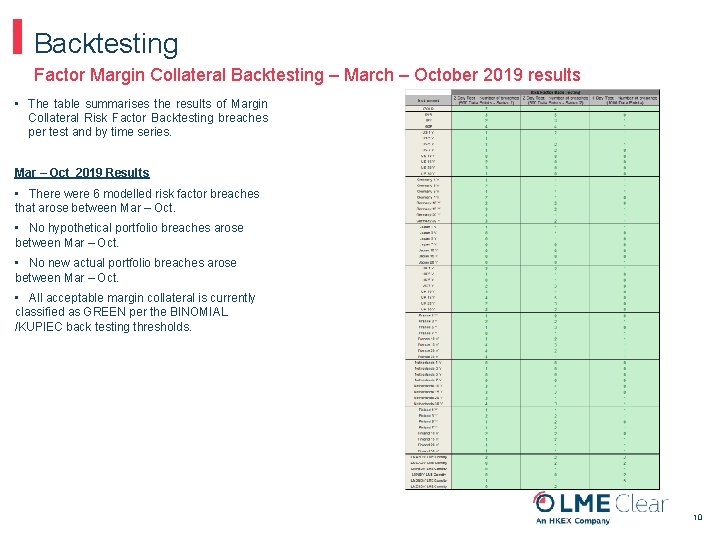
Backtesting Factor Margin Collateral Backtesting – March – October 2019 results • The table summarises the results of Margin Collateral Risk Factor Backtesting breaches per test and by time series. Mar – Oct 2019 Results • There were 6 modelled risk factor breaches that arose between Mar – Oct. • No hypothetical portfolio breaches arose between Mar – Oct. • No new actual portfolio breaches arose between Mar – Oct. • All acceptable margin collateral is currently classified as GREEN per the BINOMIAL /KUPIEC back testing thresholds. 10
- Slides: 10