
BackgroundEndogenous DNA Damage Considerations for Dose Response Risk
Background/Endogenous DNA Damage: Considerations for Dose. Response & Risk Assessment L. H. Pottenger & J. S. Bus, with support from J. A. Swenberg & R. Budinsky LHP 5/2011 ARA Workshop III 1
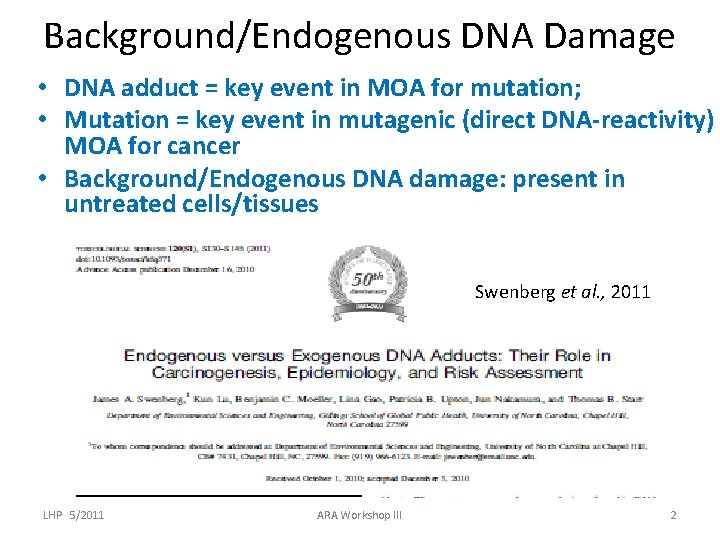
Background/Endogenous DNA Damage • DNA adduct = key event in MOA for mutation; • Mutation = key event in mutagenic (direct DNA-reactivity) MOA for cancer • Background/Endogenous DNA damage: present in untreated cells/tissues Swenberg et al. , 2011 LHP 5/2011 ARA Workshop III 2
Considerations 1. DNA is not pristine; ubiquitous burden of background & endogenous damage. 2. Background/endogenous damage can match DNA adducts from exogenous exposure to reactive chemicals: expect to be biologically equivalent. 3. Distinguish exogenous from background/endogenous with stable isotope-labelled or radiolabelled test material under controlled exposure experiments. 4. Background/endogenous DNA adduct levels vs exogenous levels: adduct-specific and varied. 5. Use of DNA adduct data can help better understand the shape of the dose-response curve (linear vs. non-linear) at low doses for critical steps, in particular doses for which exogenous adducts are either not observed or fall within the range of background/endogenous DNA damage. 1. Recognized limitations & conservatism--DNA adduct is only ARA Workshop III beginning of first step LHP 5/2011 3
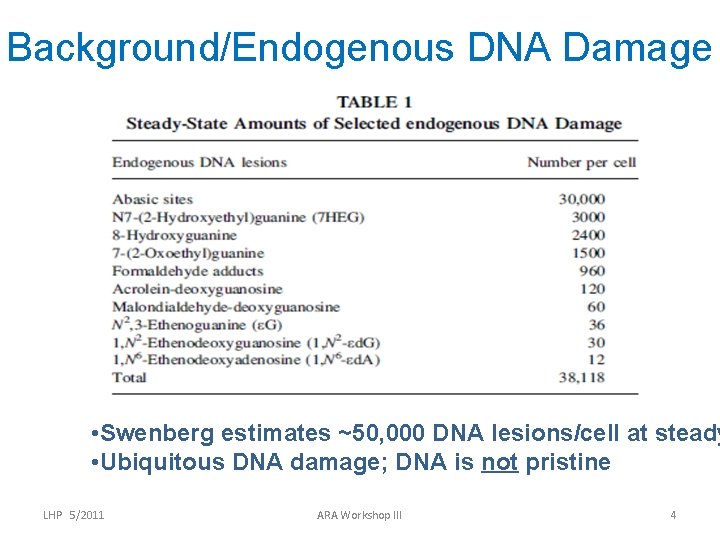
Background/Endogenous DNA Damage • Swenberg estimates ~50, 000 DNA lesions/cell at steady • Ubiquitous DNA damage; DNA is not pristine LHP 5/2011 ARA Workshop III 4
In some cases, same adducts! • For certain cases, same adduct can be from background/endogenous or from exogenous source: formaldehyde (FA), vinyl chloride (VC), ethylene oxide (EO) – Biologically equivalent • Only able to differentiate source with stable isotope label (13 C) or radiolabel (14 C) – Labelled test material; controlled exposures LHP 5/2011 ARA Workshop III 5
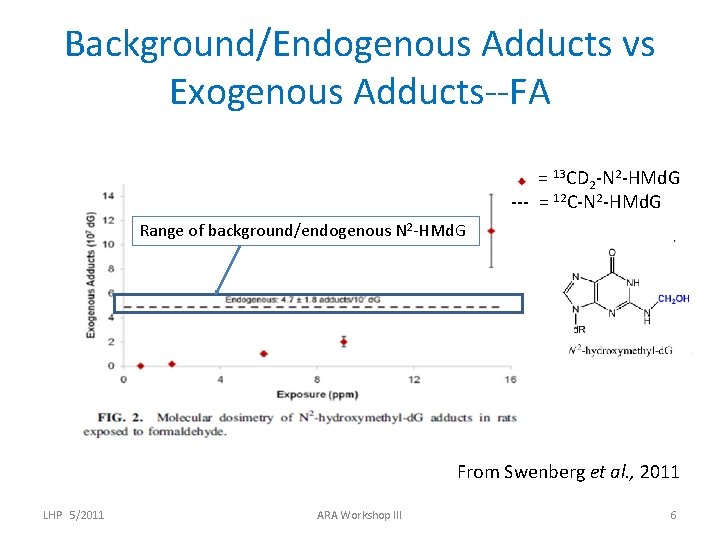
Background/Endogenous Adducts vs Exogenous Adducts--FA = 13 CD 2 -N 2 -HMd. G --- = 12 C-N 2 -HMd. G Range of background/endogenous N 2 -HMd. G From Swenberg et al. , 2011 LHP 5/2011 ARA Workshop III 6
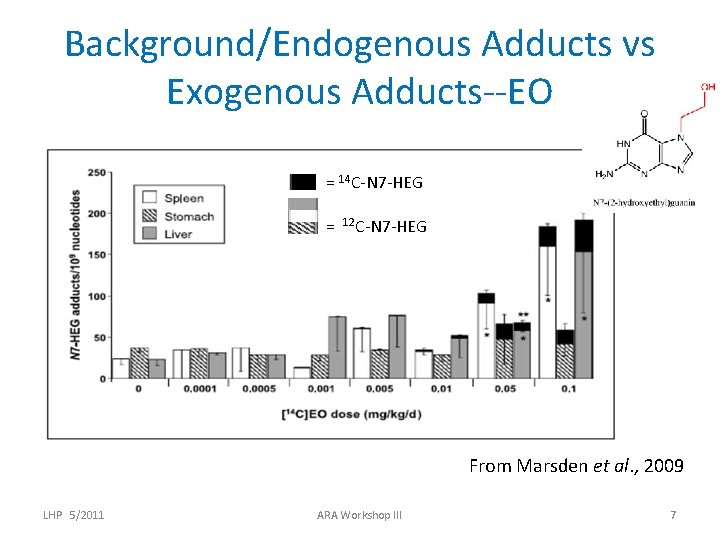
Background/Endogenous Adducts vs Exogenous Adducts--EO = 14 C-N 7 -HEG = 12 C-N 7 -HEG From Marsden et al. , 2009 LHP 5/2011 ARA Workshop III 7
Adducts & Risk Assessment • Recommendations: approach needs caution & significant data (Jarabek et al. , 2009): – Structural identification – Pro-mutagenic & persistent adduct – Presence in target tissue • Formation of DNA adduct = initial step – Multistep process of MOA • Mutation • Mutagenic MOA for cancer • Recognizing these caveats, where adequate data available, develop potential risk values: – Dose-response models for specific adduct as dose-metric – Delineate upper bound of potential risk (very conservative) – Possibly serve as point-of-departure (added safety factors) LHP 5/2011 ARA Workshop III 8
Formaldehyde • Potential risk values calculated based on N 2 -HMd. G adducts: – Nasal cancer: ~similar to EPA/IRIS risk value (~1. 5 -28 x lower risk than EPA) – Systemic cancers: 45 x ~ 19, 000 x difference • Serve to test the plausibility of risk values developed using other approaches • Swenberg et al. , 2011 LHP 5/2011 ARA Workshop III 9
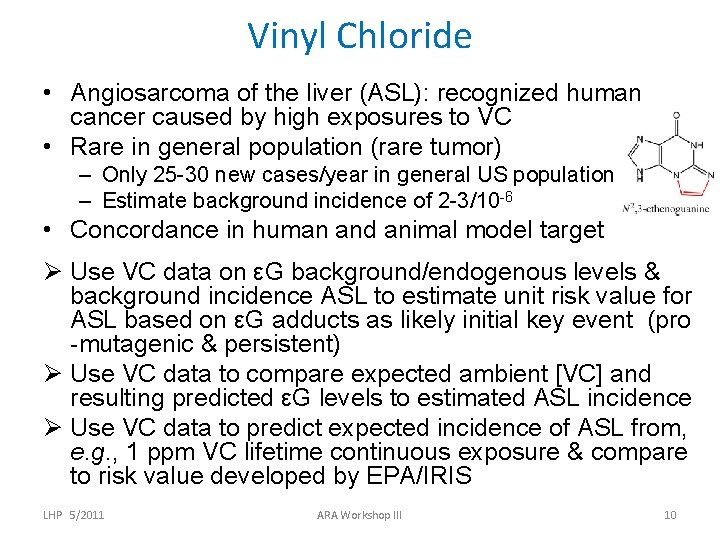
Vinyl Chloride • Angiosarcoma of the liver (ASL): recognized human cancer caused by high exposures to VC • Rare in general population (rare tumor) – Only 25 -30 new cases/year in general US population – Estimate background incidence of 2 -3/10 -6 • Concordance in human and animal model target Ø Use VC data on εG background/endogenous levels & background incidence ASL to estimate unit risk value for ASL based on εG adducts as likely initial key event (pro -mutagenic & persistent) Ø Use VC data to compare expected ambient [VC] and resulting predicted εG levels to estimated ASL incidence Ø Use VC data to predict expected incidence of ASL from, e. g. , 1 ppm VC lifetime continuous exposure & compare to risk value developed by EPA/IRIS LHP 5/2011 ARA Workshop III 10
Conclusions • Consider background/endogenous adducts and/or DNA lesions in risk assessment. • Develop examples to establish conservative nature of risk values based on DNA adducts. • Use rich databases of existing chemicals to understand what can be learned vis-à-vis linear & non -linear/threshold dose-response models and upper bounds on potential risk. • Ability to quantify & differentiate endogenous adducts (for at least some DNA-reactive materials) – opportunity to better inform the shape of low-doseresponse for these chemicals, – to better inform the degree of conservatism currently associated with LNT risk assessment models. LHP 5/2011 ARA Workshop III 11
- Slides: 11