
Background The Oral Approach SLT Method Approach Index

Background The Oral Approach & SLT Method - Approach Index Method - Design Method - Procedure Demo-teaching Conclusion
Background ▷ 1920 s~1930 s ▷ Harold Palmer and A. S. Hornby ▷ They attempted to develop a more scientific foundation for an oral approach to teach English that was evidenced in Direct Method. ▷ Result : A systematic study of the principles and procedures.
Vocabulary control ▷ An essential component of reading proficiency. ▷ One of the most important aspect of foreign language learning. ▷ Increased emphasis on reading skills. 'The Interim Report on Vocabulary Selection'(1936) 'A General Service List of English Words'(1953)
Grammar control. Grammar as underlying sentence patterns of the spoken English. . Internalizing the rules of English sentence structure. . Substitution table (Palmer, Hornby, Other British linguists)
The Oral Approach and Situational Language Teaching ① Selection ② Gradation ③ Presentation ④ The main Characteristics of the Approach
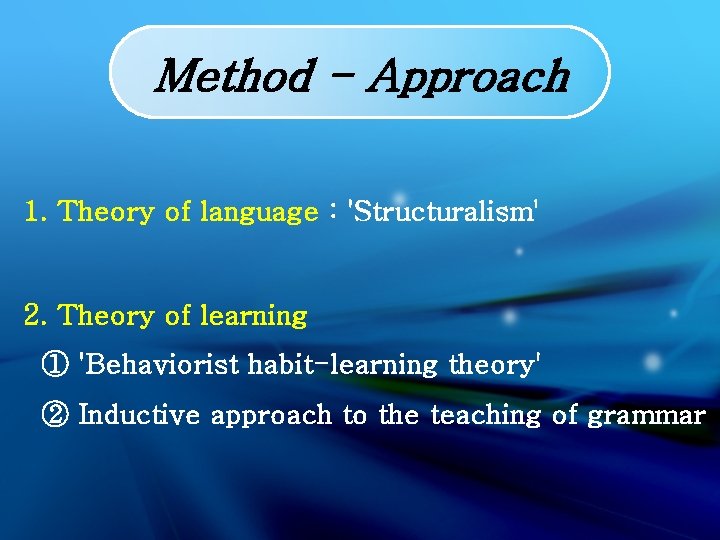
Method - Approach 1. Theory of language : 'Structuralism' 2. Theory of learning ① 'Behaviorist habit-learning theory' ② Inductive approach to the teaching of grammar
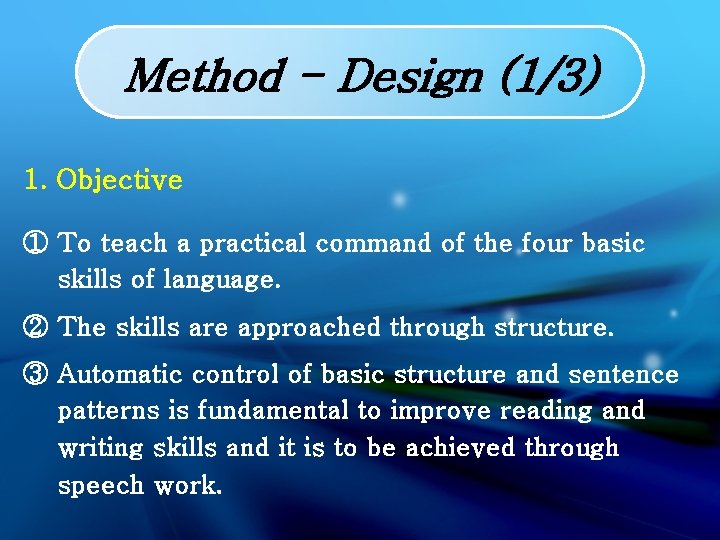
Method - Design (1/3) 1. Objective ① To teach a practical command of the four basic skills of language. ② The skills are approached through structure. ③ Automatic control of basic structure and sentence patterns is fundamental to improve reading and writing skills and it is to be achieved through speech work.
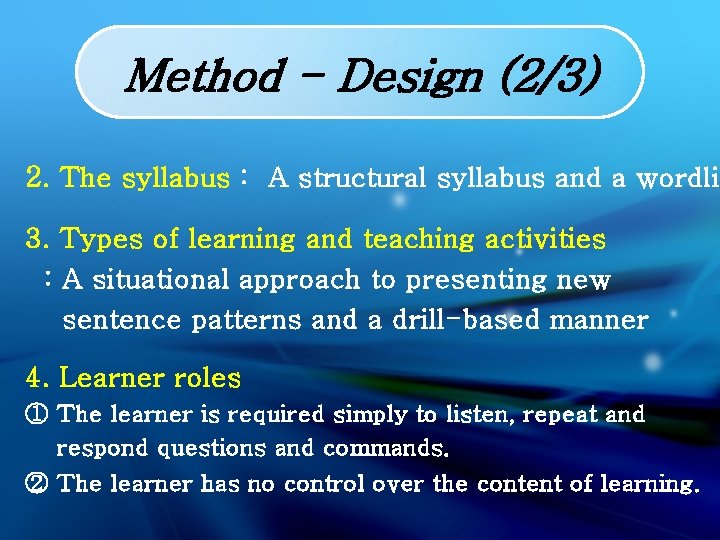
Method - Design (2/3) 2. The syllabus : A structural syllabus and a wordlis 3. Types of learning and teaching activities : A situational approach to presenting new sentence patterns and a drill-based manner 4. Learner roles ① The learner is required simply to listen, repeat and respond questions and commands. ② The learner has no control over the content of learning.
Method - Design (3/3) 5. Teacher roles ① ② ③ ④ ⑤ ⑥ Timing Oral practice, to support the textbook structures Revision (review) Adjustment to special needs of individuals Testing Developing language activities other than those arising from the textbook 6. The role of instructional materials : A textbook and visual aids. (wall charts, flashcards, pictures, stick figures, and so on)
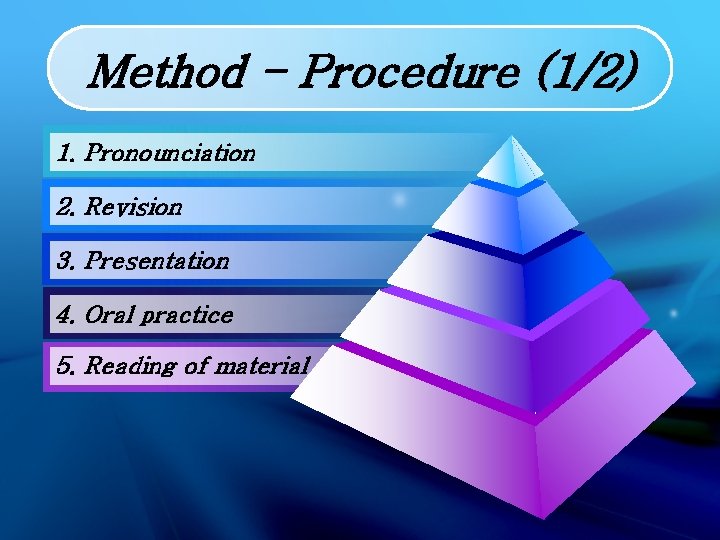
Method - Procedure (1/2) 1. Pronounciation 2. Revision 3. Presentation 4. Oral practice 5. Reading of material
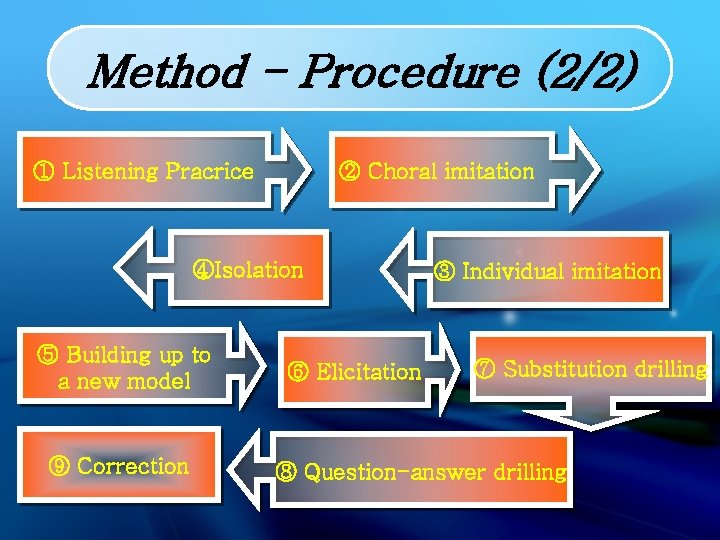
Method - Procedure (2/2) ① Listening Pracrice ② Choral imitation ④Isolation ⑤ Building up to a new model ⑨ Correction ⑥ Elicitation ③ Individual imitation ⑦ Substitution drilling ⑧ Question-answer drilling
Demo-teaching
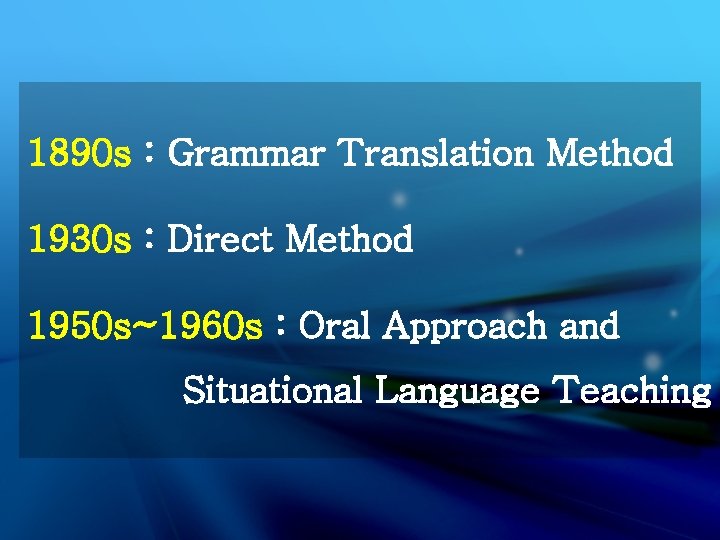
1890 s : Grammar Translation Method 1930 s : Direct Method 1950 s~1960 s : Oral Approach and Situational Language Teaching
Conclusion (1/3) Strength ① It improves listening ability. ② It helps to learn immediate teaching through realia, action and performance. ③ It gives brain development by listening, speaking, reading, writing and emphasizes inductive teaching in grammar instruction.
Conclusion (2/3) Weakness ① Unlike the Direct method, it allows students to use the mother tongue in class. If students cannot understand what the teacher is saying, it is time consuming to try to explain English in target Language ② Inhibits students initiation to speak ③ Teacher-centered ④ It takes a lot of energy from teachers
Conclusion (3/3) Situational Language Teaching continues to be widely used in many parts of the world. Appropriate level of students : Elementary school students & early middle school students Questions ① The difference between Direct Method and Oral Approach ② The meaning of theory of language 'Oral Approach'
- Slides: 17