
BACKGROUND The FEL Performance Program started in the
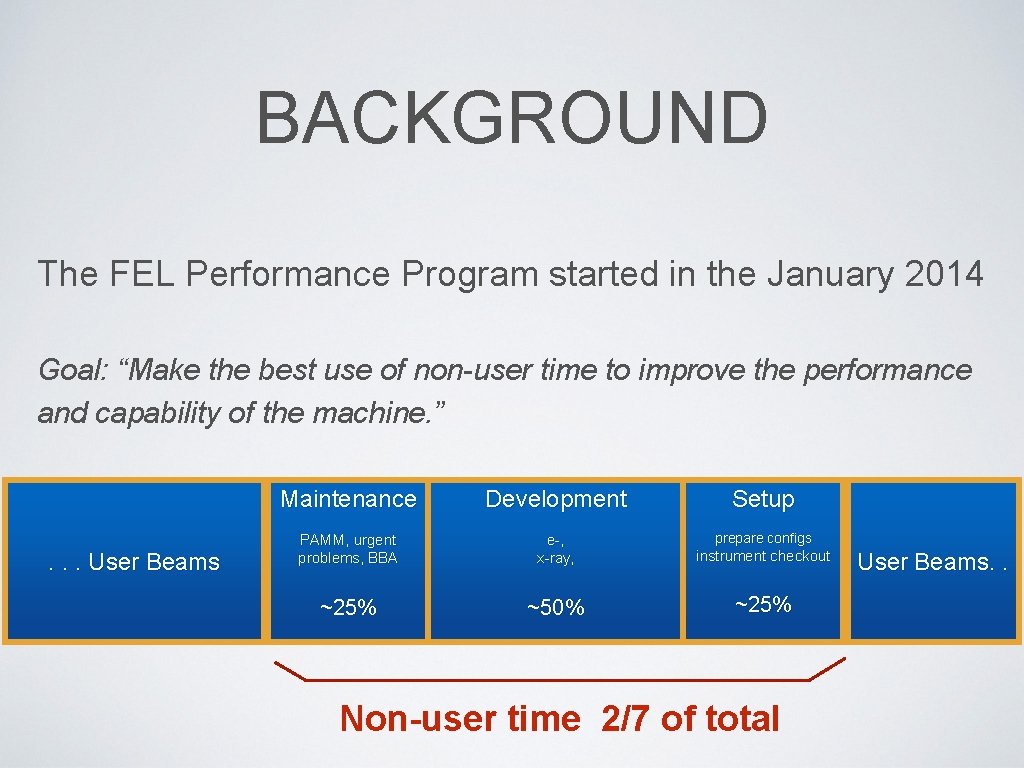
BACKGROUND The FEL Performance Program started in the January 2014 Goal: “Make the best use of non-user time to improve the performance and capability of the machine. ” . . . User Beams Maintenance Development Setup PAMM, urgent problems, BBA e-, x-ray, prepare configs instrument checkout ~25% ~50% ~25% Non-user time 2/7 of total User Beams. .
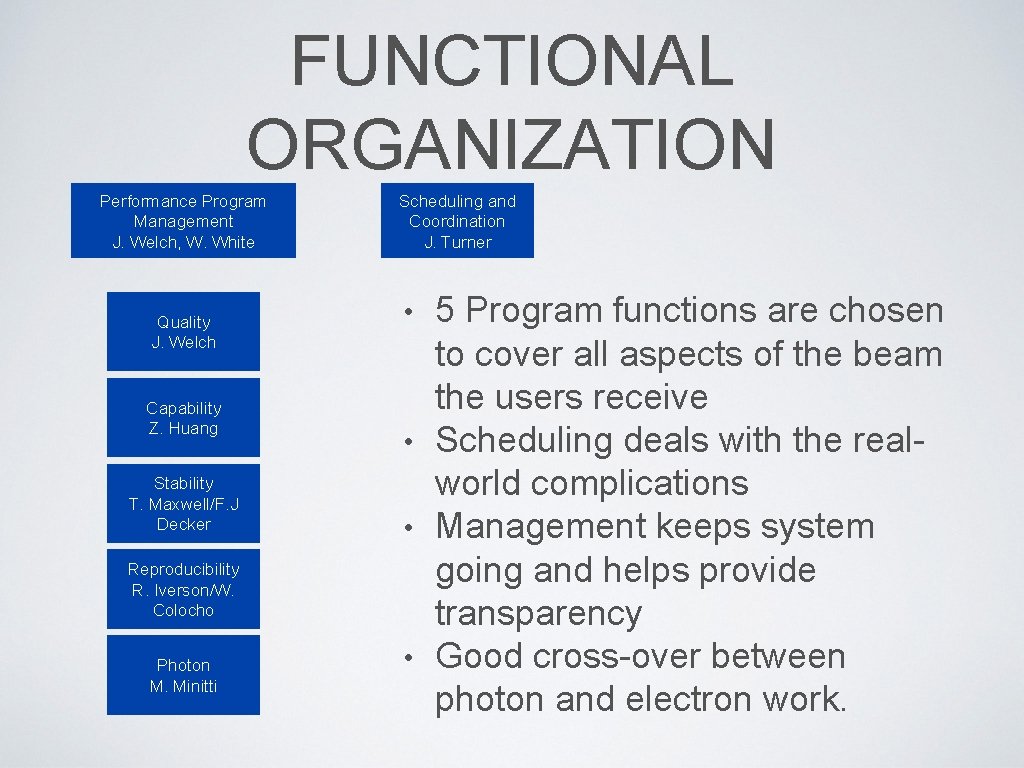
FUNCTIONAL ORGANIZATION Performance Program Management J. Welch, W. White Quality J. Welch Capability Z. Huang Stability T. Maxwell/F. J Decker Reproducibility R. Iverson/W. Colocho Photon M. Minitti Scheduling and Coordination J. Turner • 5 Program functions are chosen to cover all aspects of the beam the users receive • Scheduling deals with the realworld complications • Management keeps system going and helps provide transparency • Good cross-over between photon and electron work.
• HOW IT WORKS Each Program has a clear Objective and Scope defined in a synopsis. • User Run Schedule is made by LCLS and sets the user and non-user time. • Overall % allocation of development time for each program is assigned by Performance Program Managers at beginning of user run. • Program Leads decide priorities within their program, plan and organize studies, and make sure analysis is done and reported. • Individual studies are scheduled each week using the %
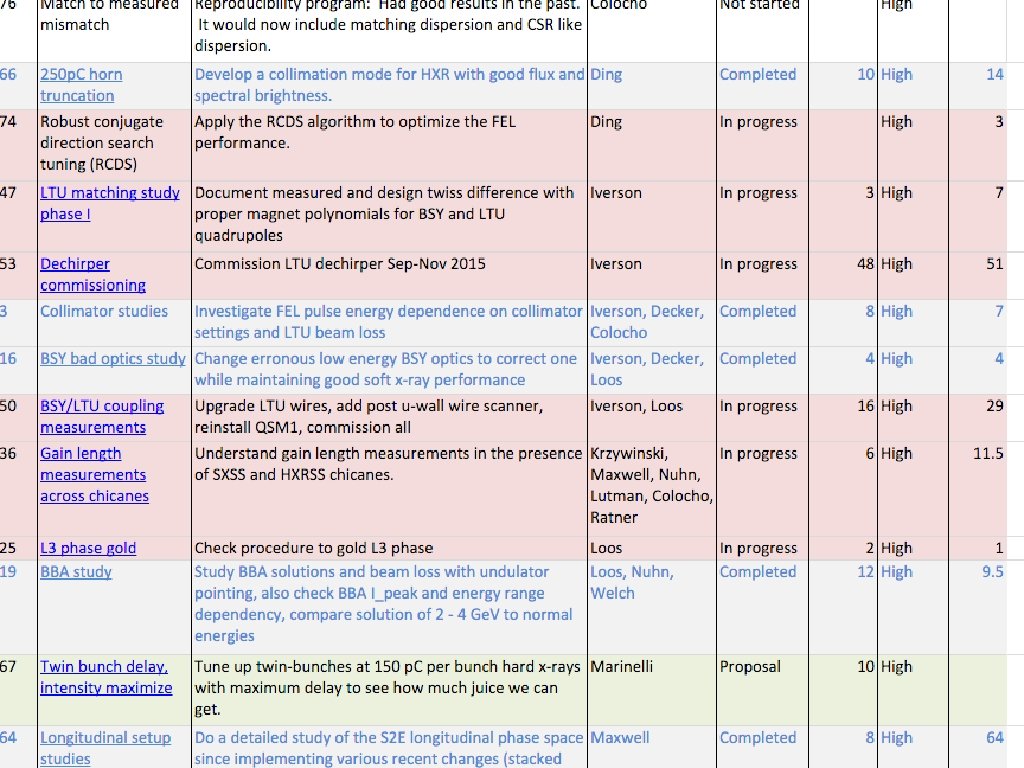
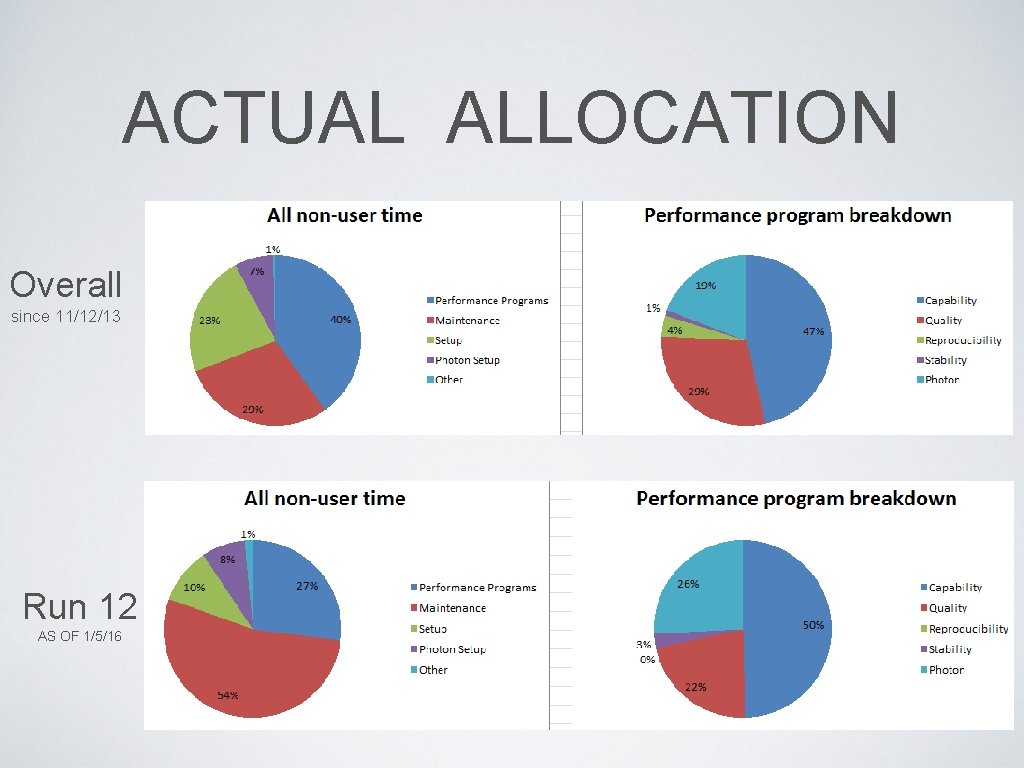
ACTUAL ALLOCATION Overall since 11/12/13 Run 12 AS OF 1/5/16
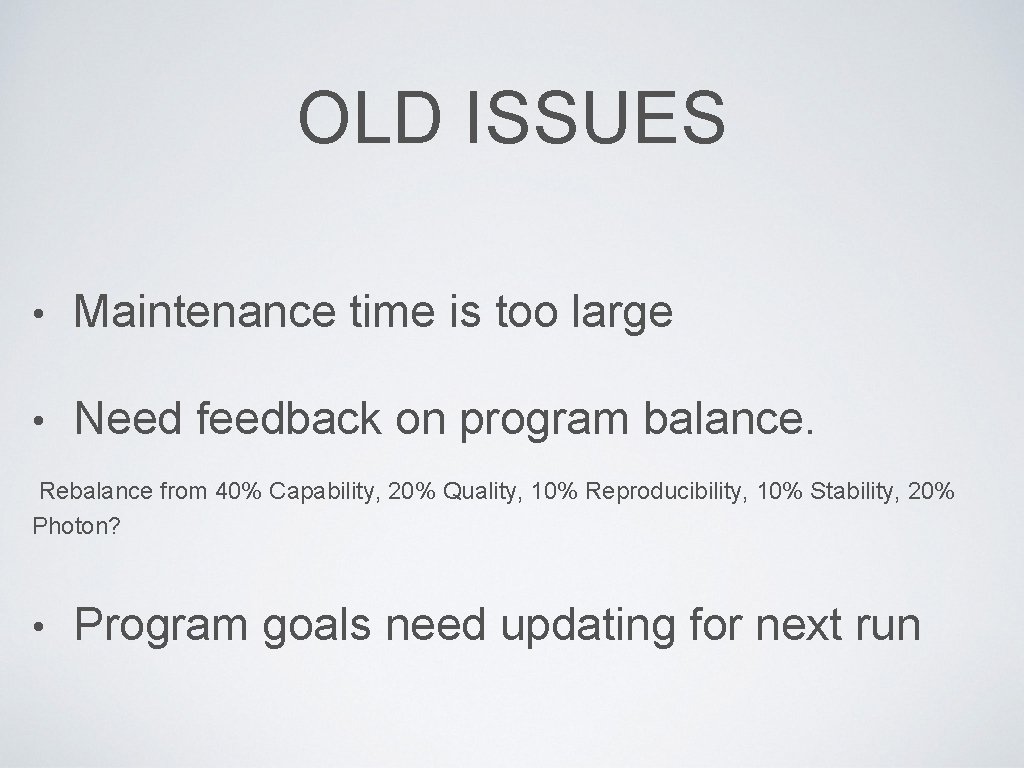
OLD ISSUES • Maintenance time is too large • Need feedback on program balance. Rebalance from 40% Capability, 20% Quality, 10% Reproducibility, 10% Stability, 20% Photon? • Program goals need updating for next run
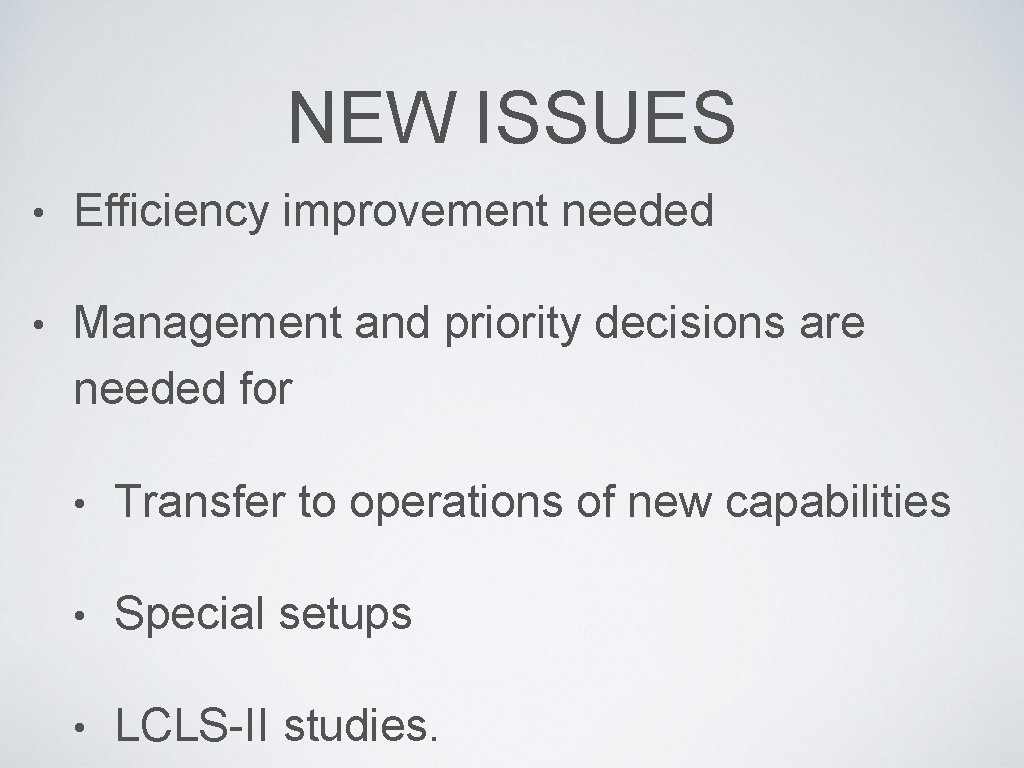
NEW ISSUES • Efficiency improvement needed • Management and priority decisions are needed for • Transfer to operations of new capabilities • Special setups • LCLS-II studies.
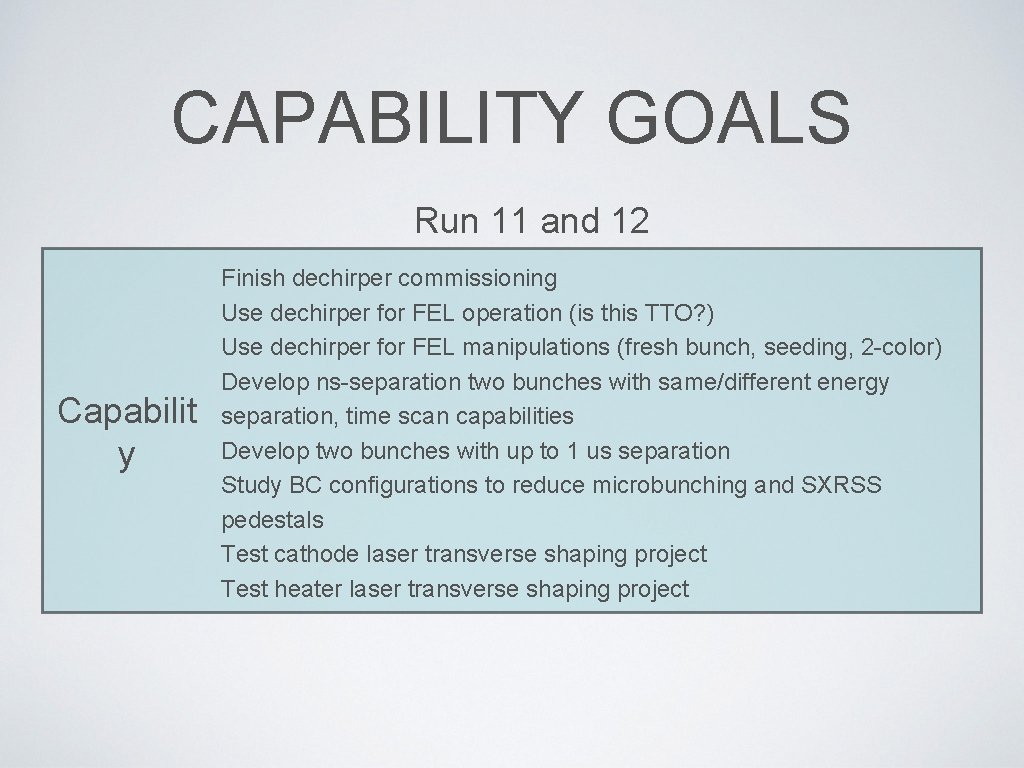
CAPABILITY GOALS Run 11 and 12 Capabilit y Finish dechirper commissioning Use dechirper for FEL operation (is this TTO? ) Use dechirper for FEL manipulations (fresh bunch, seeding, 2 -color) Develop ns-separation two bunches with same/different energy separation, time scan capabilities Develop two bunches with up to 1 us separation Study BC configurations to reduce microbunching and SXRSS pedestals Test cathode laser transverse shaping project Test heater laser transverse shaping project
STABILITY GOALS Run 11 and 12 Consistency: Meet or exceed energy stability goal (< SASE BW / 2) for > 75% of routine operation Stability Projects: Deuterium thyratrons installed to stations 20 -6 through 21 -2 Installation and demonstration of 2 new high power RF loads TTO of thyratron remote ranging New initiative: Investigate means to reduce frequency of interruptive RF station trips
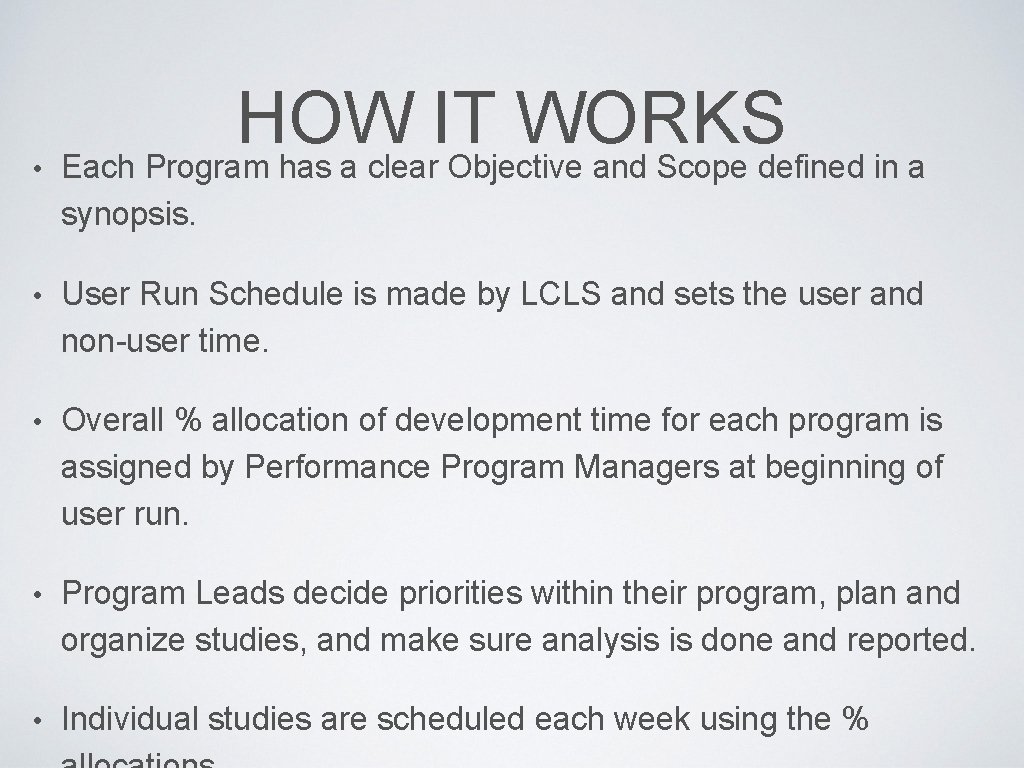
QUALITY GOALS Run 11 and 12 Qualit y Finish at least 12 of the 32 “in progress” studies. Generate at least 12 “proposals” Start at least 6 new studies Get peak m. J that is no lower than for Run 10 Get peak power that is no lower than for Run 10
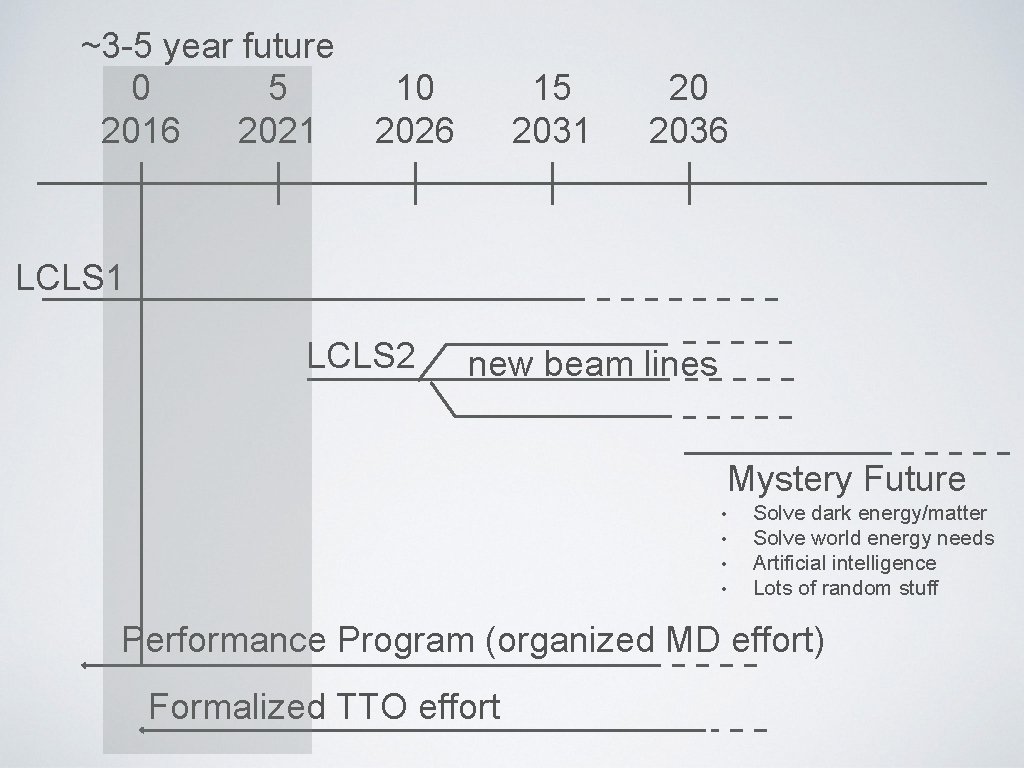
~3 -5 year future 0 5 2016 2021 10 2026 15 2031 20 2036 LCLS 1 LCLS 2 new beam lines Mystery Future • • Solve dark energy/matter Solve world energy needs Artificial intelligence Lots of random stuff Performance Program (organized MD effort) Formalized TTO effort
3 -5 YEAR IMPROVEMENTS • Studies for higher brightness and more photons per pulse, better pulse stability, reduced tune-up time • Studies and training involve Ops for better flexibility and efficiency to easily deliver pump-probe configurations polarization seeded beams very short bunches ? ? ? • We need to Consolidate and Push - this is the chance. In 2022 we will be learning how to deliver SC beams.
RUN 11 EXPECTATIONS • energy range 280 -11200 e. V • 1 -3 m. J/pulse • up to 25 ke. V at 1% pulse energy • variable pulse length 40 to 300 fs • pulse length <10 fs, and ~500 fs for soft x-rays, available • seeded pulse energy 7. 1 - 9. 5 ke. V, and “typical” seeded parameters include 5. 4? ? to 9. 5 ke. V; available from SASE in less than 30 minutes • two color, soft and hard, uncertain parameters
TRANSITION TO OPERATIONS
• New capabilities are proven within the DISCUSSION Capabilities program, but commissioning them and making them routinely available for users has become an increasingly large fraction of the non-user time. • Process and responsibilities are not well defined. • How do we decide how much time to give TTOs?
EXAMPLES • HXRSS - took ~50 shifts of MD time, about two years • XTCAV - commissioning started end of 2013 and went on for ? • SXRSS - commissioning started early 2014 and continues today
TTO PROJECTS • SXRSS • DELTA • laser timing for LCLS-I Ops • MBNCH • Dechirper
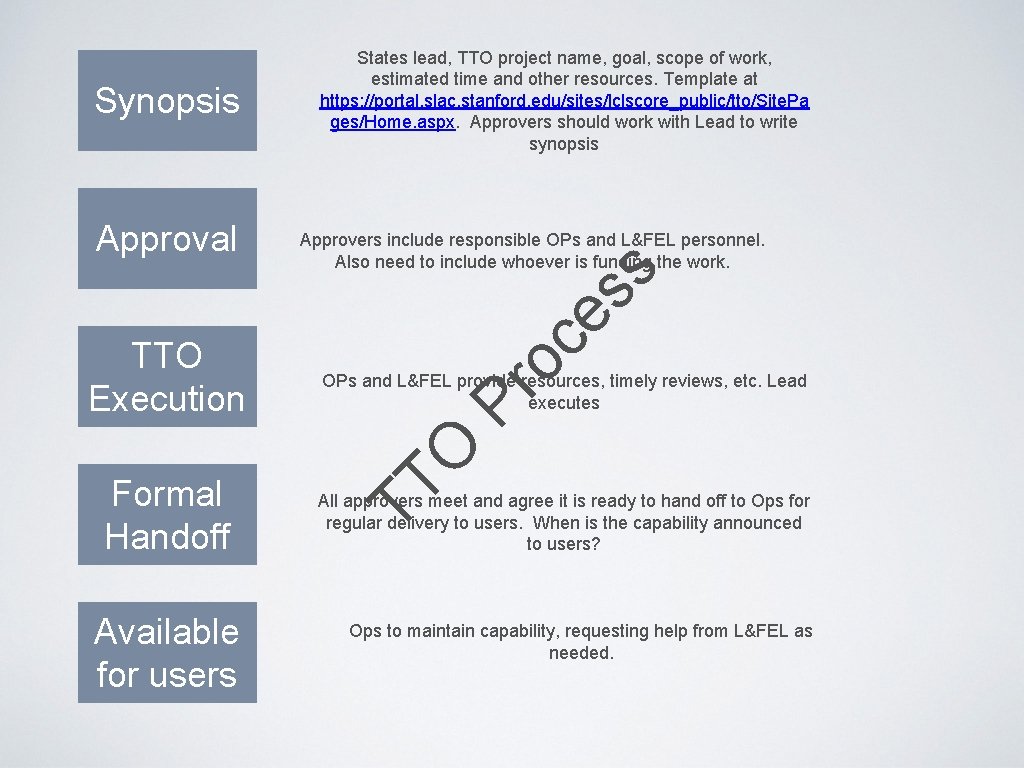
Approval Approvers include responsible OPs and L&FEL personnel. Also need to include whoever is funding the work. es s Synopsis States lead, TTO project name, goal, scope of work, estimated time and other resources. Template at https: //portal. slac. stanford. edu/sites/lclscore_public/tto/Site. Pa ges/Home. aspx. Approvers should work with Lead to write synopsis OPs and L&FEL provide resources, timely reviews, etc. Lead executes Formal Handoff All approvers meet and agree it is ready to hand off to Ops for regular delivery to users. When is the capability announced to users? Available for users TT O Pr oc TTO Execution Ops to maintain capability, requesting help from L&FEL as needed.
TTO WEBSITE • https: //portal. slac. stanford. edu/sites/lclscore_public/tto/Site. Pages/H ome. aspx • Contains synopses of projects
- Slides: 19