
Background The Autonomous People Mover APM is an
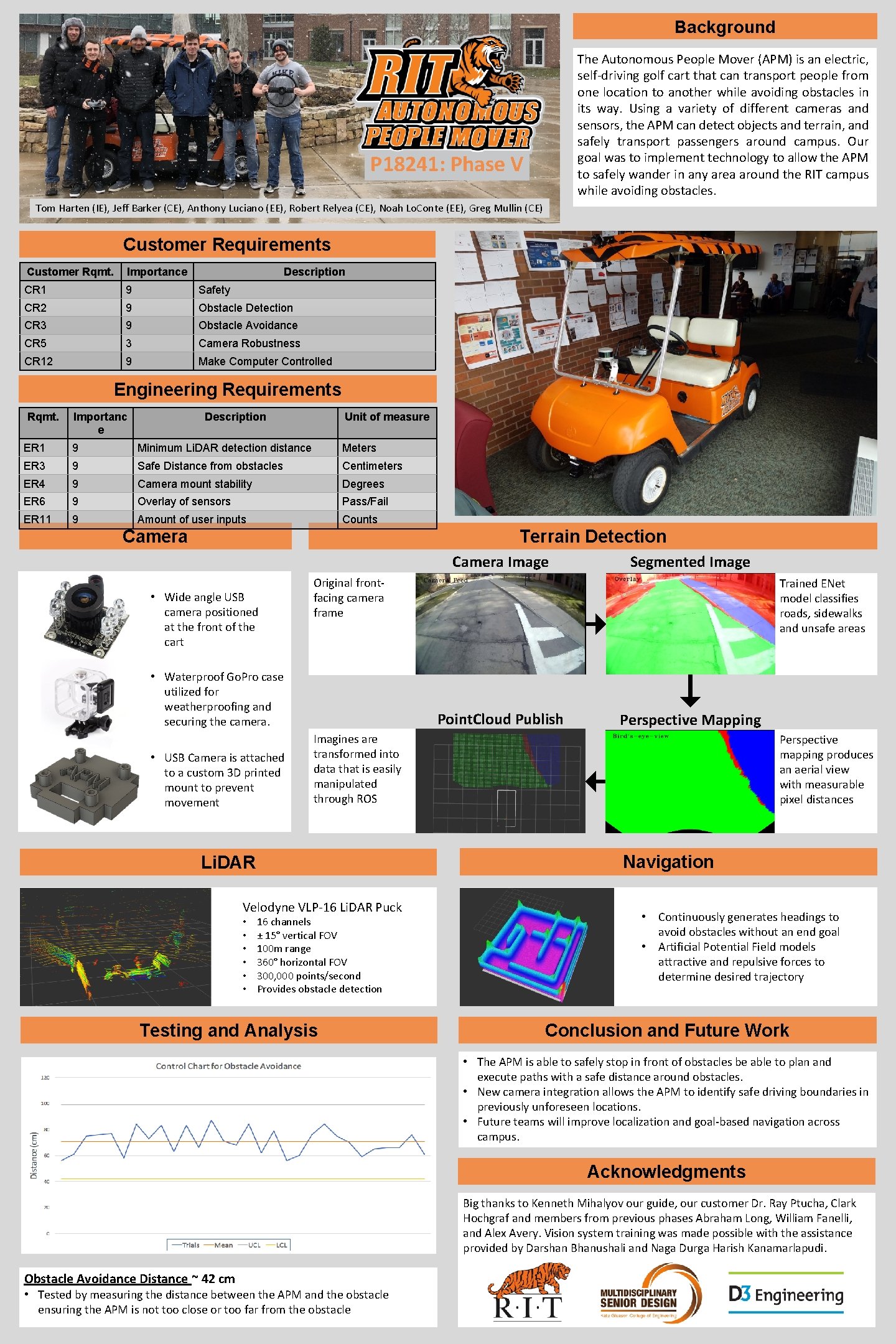
Background The Autonomous People Mover (APM) is an electric, self-driving golf cart that can transport people from one location to another while avoiding obstacles in its way. Using a variety of different cameras and sensors, the APM can detect objects and terrain, and safely transport passengers around campus. Our goal was to implement technology to allow the APM to safely wander in any area around the RIT campus while avoiding obstacles. P 18241: Phase V Tom Harten (IE), Jeff Barker (CE), Anthony Luciano (EE), Robert Relyea (CE), Noah Lo. Conte (EE), Greg Mullin (CE) Customer Requirements Customer Rqmt. Importance Description CR 1 9 Safety CR 2 9 Obstacle Detection CR 3 9 Obstacle Avoidance CR 5 3 Camera Robustness CR 12 9 Make Computer Controlled Engineering Requirements Rqmt. Importanc e Description Unit of measure ER 1 9 Minimum Li. DAR detection distance Meters ER 3 9 Safe Distance from obstacles Centimeters ER 4 9 Camera mount stability Degrees ER 6 9 Overlay of sensors Pass/Fail ER 11 9 Amount of user inputs Counts Camera Terrain Detection Camera Image • Wide angle USB camera positioned at the front of the cart Original frontfacing camera frame • Waterproof Go. Pro case utilized for weatherproofing and securing the camera. • USB Camera is attached to a custom 3 D printed mount to prevent movement Trained ENet model classifies roads, sidewalks and unsafe areas Point. Cloud Publish Perspective Mapping Imagines are transformed into data that is easily manipulated through ROS Perspective mapping produces an aerial view with measurable pixel distances Navigation Li. DAR Velodyne VLP-16 Li. DAR Puck • • • Segmented Image 16 channels ± 15° vertical FOV 100 m range 360° horizontal FOV 300, 000 points/second Provides obstacle detection Testing and Analysis • • Continuously generates headings to avoid obstacles without an end goal Artificial Potential Field models attractive and repulsive forces to determine desired trajectory Conclusion and Future Work • The APM is able to safely stop in front of obstacles be able to plan and execute paths with a safe distance around obstacles. • New camera integration allows the APM to identify safe driving boundaries in previously unforeseen locations. • Future teams will improve localization and goal-based navigation across campus. Acknowledgments Big thanks to Kenneth Mihalyov our guide, our customer Dr. Ray Ptucha, Clark Hochgraf and members from previous phases Abraham Long, William Fanelli, and Alex Avery. Vision system training was made possible with the assistance provided by Darshan Bhanushali and Naga Durga Harish Kanamarlapudi. Obstacle Avoidance Distance ~ 42 cm • Tested by measuring the distance between the APM and the obstacle ensuring the APM is not too close or too far from the obstacle
- Slides: 1