
Background Team Lucas Relkin Derek Rothrock Sara Wright
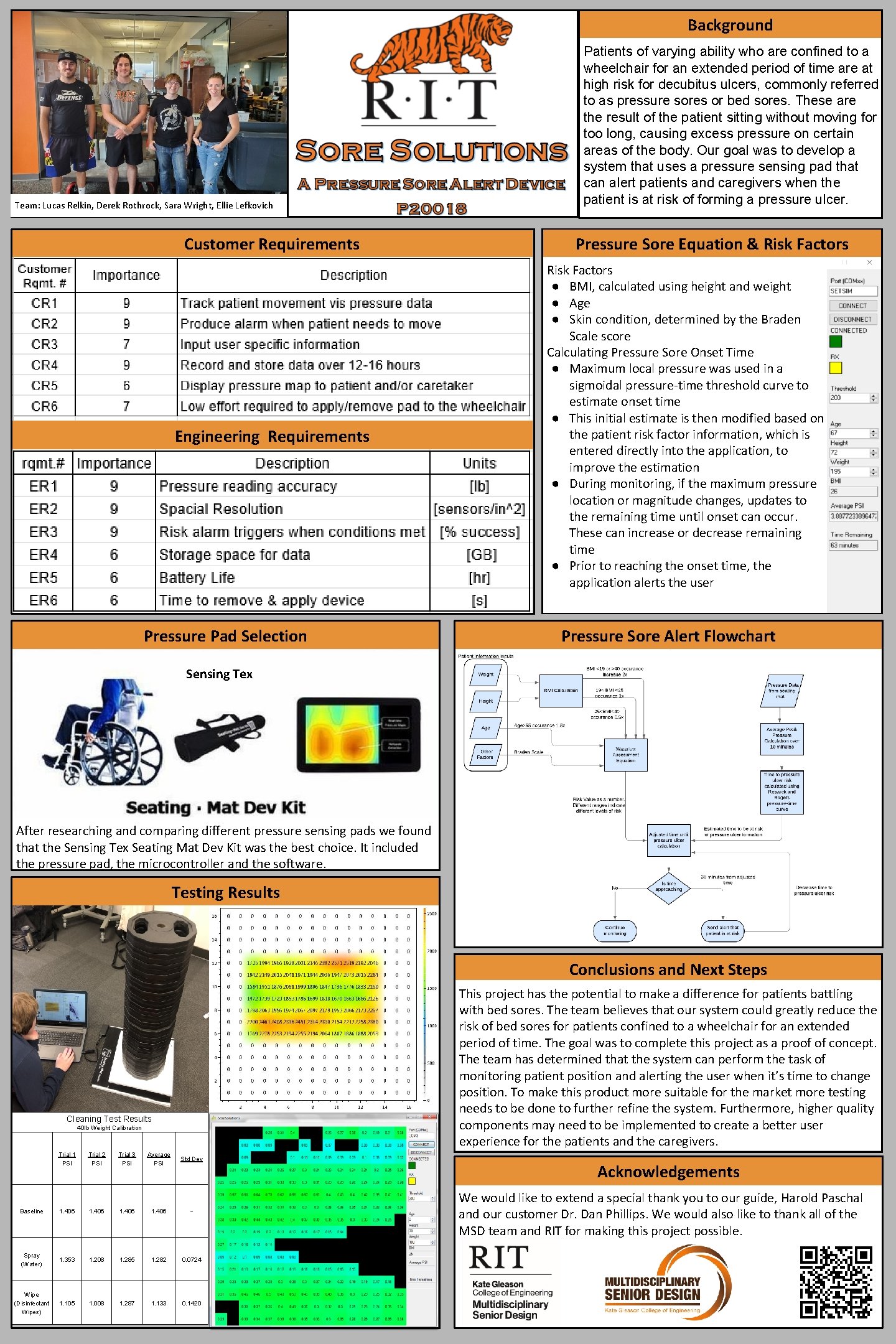
Background Team: Lucas Relkin, Derek Rothrock, Sara Wright, Ellie Lefkovich Customer Requirements Engineering Requirements Pressure Pad Selection Patients of varying ability who are confined to a wheelchair for an extended period of time are at high risk for decubitus ulcers, commonly referred to as pressure sores or bed sores. These are the result of the patient sitting without moving for too long, causing excess pressure on certain areas of the body. Our goal was to develop a system that uses a pressure sensing pad that can alert patients and caregivers when the patient is at risk of forming a pressure ulcer. Pressure Sore Equation & Risk Factors ● BMI, calculated using height and weight ● Age ● Skin condition, determined by the Braden Scale score Calculating Pressure Sore Onset Time ● Maximum local pressure was used in a sigmoidal pressure-time threshold curve to estimate onset time ● This initial estimate is then modified based on the patient risk factor information, which is entered directly into the application, to improve the estimation ● During monitoring, if the maximum pressure location or magnitude changes, updates to the remaining time until onset can occur. These can increase or decrease remaining time ● Prior to reaching the onset time, the application alerts the user Pressure Sore Alert Flowchart Sensing Tex After researching and comparing different pressure sensing pads we found that the Sensing Tex Seating Mat Dev Kit was the best choice. It included the pressure pad, the microcontroller and the software. Testing Results Conclusions and Next Steps This project has the potential to make a difference for patients battling with bed sores. The team believes that our system could greatly reduce the risk of bed sores for patients confined to a wheelchair for an extended period of time. The goal was to complete this project as a proof of concept. The team has determined that the system can perform the task of monitoring patient position and alerting the user when it’s time to change position. To make this product more suitable for the market more testing needs to be done to further refine the system. Furthermore, higher quality components may need to be implemented to create a better user experience for the patients and the caregivers. Cleaning Test Results 40 lb Weight Calibration Trial 1 PSI Trial 2 PSI Trial 3 PSI Average PSI Std Dev Baseline 1. 406 - Spray (Water) 1. 353 1. 208 1. 285 1. 282 0. 0724 Wipe (Disinfectant Wipes) 1. 105 1. 008 1. 287 1. 133 0. 1420 Acknowledgements We would like to extend a special thank you to our guide, Harold Paschal and our customer Dr. Dan Phillips. We would also like to thank all of the MSD team and RIT for making this project possible.
- Slides: 1