
Background modelling in AHEAD A Joint Research Activity
Background modelling in AHEAD A Joint Research Activity for background study, with application to current and future Space Missions Lorenzo Natalucci on behalf of a large collaboration (INAF, INFN, SRON, CESR, MPE, Soton University, CEA, …) Roma, February 9 -10, 2009 1
Motivation supporting the evaluation of space mission proposals against capability of satisfying the science requirements support instrument design / science definition support the definition of data analysis improve exchange of information among the groups, identify and prioritize issues Training young people, helping their approach to experimental studies Roma, February 9 -10, 2009 2
Main goals n Estimation of sensitivity for future missions Support dedicated studies, requiring detailed knowledge of the background components Improve physics within simulation tools (GEANT -4), according to the level of accuracy needed within applications Propose new requirements/standard models and practices Aim at a European Database of models/products? Roma, February 9 -10, 2009 3

Applications Application Detector types Missions (current & future) X-ray/CCD detector design CCDs XMM X-ray/ new detector types Microcalorimeters, APS, SDD etc IXO, EDGE/Xenia Hard X-rays/ Wide Field Telescopes Solid state (High-Z) INTEGRAL, SVOM, EDGE/Xenia, EXIST Hard X-rays/ focal plane Solid state (High-Z, Si) Simbol-X, SVOM, EDGE/Xenia, GRI Compton telescopes for soft γ-rays Si arrays (trackers), scintillators MEGA/GRIPS, DUAL Roma, February 9 -10, 2009 4
![Choosing input LEO, HEO, L 2 (Atmospheric from radiation ? ) Topics [1/2] environment](http://slidetodoc.com/presentation_image_h2/9131297f70ee470ef98aaef4f3400f0c/image-5.jpg "Choosing input LEO, HEO, L 2 (Atmospheric from radiation ? ) Topics [1/2] environment")
Choosing input LEO, HEO, L 2 (Atmospheric from radiation ? ) Topics [1/2] environment models Building instrument model: Input from detector performance Requiremen ts on ground calibrations? Effects of induced radioactivity and delayed activation (especially LEO) Simulation of low angle scattering of protons and electrons in X-ray mirror shells Support instrument Shielding optimization design Roma, February 9 -10, 2009 5
![Topics [2/2] n GEANT-4/ Physics modelling requirements: radioactive decay, fluorescence, Compton scattering, tracking etc.](http://slidetodoc.com/presentation_image_h2/9131297f70ee470ef98aaef4f3400f0c/image-6.jpg "Topics [2/2] n GEANT-4/ Physics modelling requirements: radioactive decay, fluorescence, Compton scattering, tracking etc.")
Topics [2/2] n GEANT-4/ Physics modelling requirements: radioactive decay, fluorescence, Compton scattering, tracking etc. Other tools needed for the analysis, end results, quality parameters, interface to data analysis software Assess accuracy of standard models for: radiation environment, GEANT-4 physics, detector performance parameters Address the level of accuracy of a result Roma, February 9 -10, 2009 6
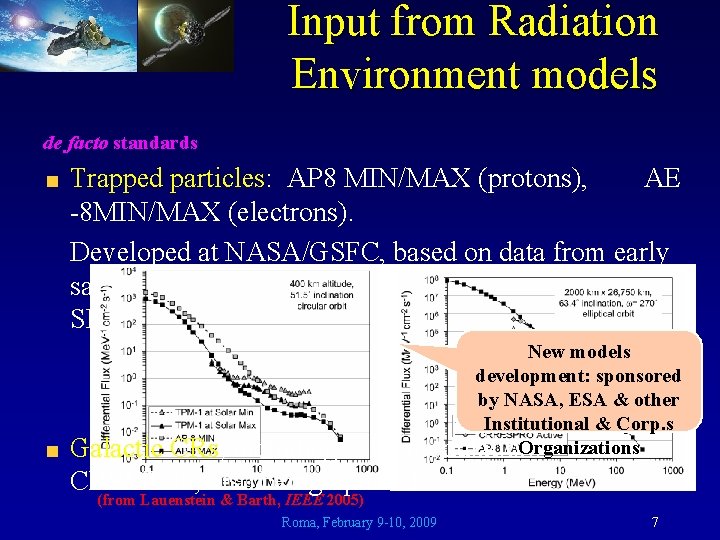
Input from Radiation Environment models de facto standards Trapped particles: AP 8 MIN/MAX (protons), AE -8 MIN/MAX (electrons). Developed at NASA/GSFC, based on data from early satellites (1958 -1979). Models available in SPENVIS, CREME 96. Many known limitations New models development: sponsored by NASA, ESA & other Institutional & Corp. s Organizations modulation: Galactic CRs, including solar CREME 86, also being updated (from Lauenstein & Barth, IEEE 2005) Roma, February 9 -10, 2009 7
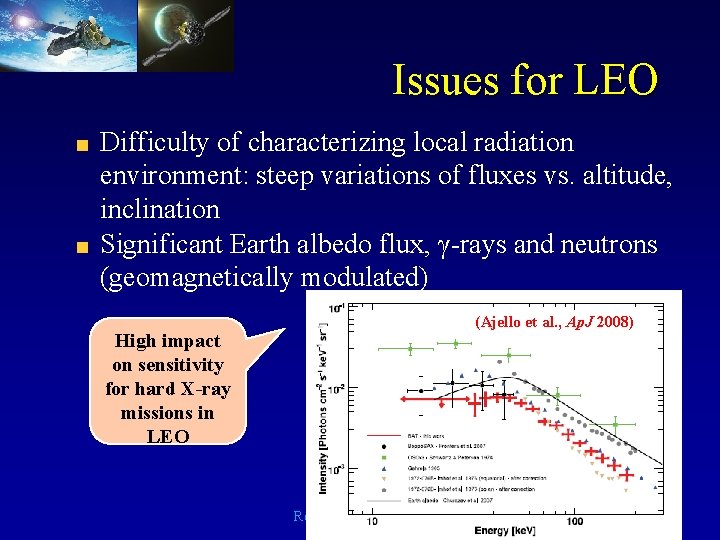
Issues for LEO Difficulty of characterizing local radiation environment: steep variations of fluxes vs. altitude, inclination Significant Earth albedo flux, γ-rays and neutrons (geomagnetically modulated) (Ajello et al. , Ap. J 2008) High impact on sensitivity for hard X-ray missions in LEO Roma, February 9 -10, 2009 8
Considerations on the role/use of GEANT-4 is the standard tool for the physical modelling of the interactions: its range extends down to low energy X-rays Possibility to establish collaboration with GEANT-4 development team: (a) identify the need for development of specific tools as additional extensions (b) training experimental teams, especially young people in the use (and development? ) of this tool Roma, February 9 -10, 2009 9
Methods Establish a co-operative research program and organizational structure with WGs working on topics Compare available models and data from currently flying observatories Discuss the different methods and assumptions for future space-borne instruments Identify the products of the simulations and the I/F to the data analysis S/W Discuss the requirements of a model/products database Roma, February 9 -10, 2009 10
Topics: prioritization Define input from radiation environment models (clearly establish needs, might be different than for engineering applications? ) Interactions and joint activities with instrumental teams to get reliable performance parameters Interface to data analysis tools (standardizing simulation/modelling data products) Encourage sinergy with GEANT-4 development Define background models standard (data, methods, tools, etc. ) Others TBD… Roma, February 9 -10, 2009 11
Computing resources: a low cost benchmark? Simulations are complex and time consuming: need much computing power Is it feasible to perform massive simulation runs on a “low cost” system? At IASF-Roma, a H/W cluster is being tested for INTEGRAL archive & analysis support. We plan to test it also as a benchmark for running GEANT-4 Roma, February 9 -10, 2009 12
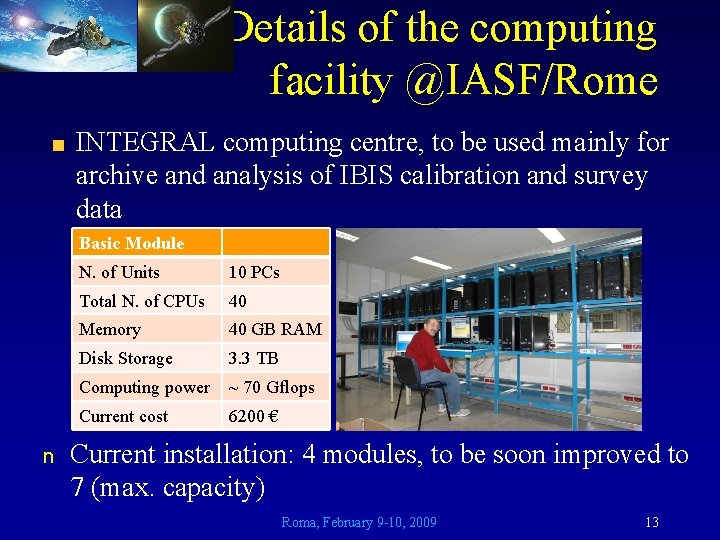
Details of the computing facility @IASF/Rome INTEGRAL computing centre, to be used mainly for archive and analysis of IBIS calibration and survey data Basic Module n N. of Units 10 PCs Total N. of CPUs 40 Memory 40 GB RAM Disk Storage 3. 3 TB Computing power ~ 70 Gflops Current cost 6200 € Current installation: 4 modules, to be soon improved to 7 (max. capacity) Roma, February 9 -10, 2009 13
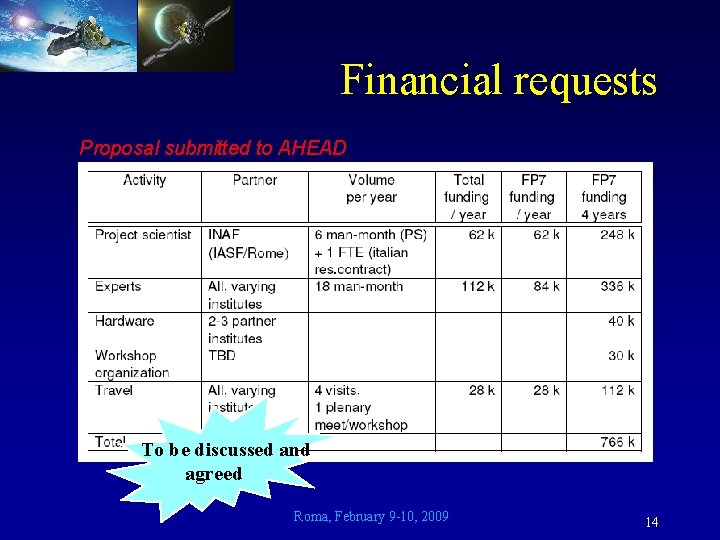
Financial requests Proposal submitted to AHEAD To be discussed and agreed Roma, February 9 -10, 2009 14
Links to other activities JRA-1, Detectors JRA-2, Optics for High Energy Astrophysics JRA-4, Data software and Analysis Support to NA-2, Identification of science goals and associated requirements NA-7, Outreach Management (support to co-ordinator, access to research grants, others TBD) Roma, February 9 -10, 2009 15
- Slides: 15