
Background Info Common classroom conditions can and do
Background Info • Common classroom conditions can and do affect many students some degree, at one time or another, in one way or other • Some students are especially vulnerable to classrooms' hazards (e. g. , children of poverty, nonnative speakers, those with attention deficits). • Students with learning disabilities are among the most vulnerable-at chronic risk for "not learning" under the aforementioned conditions, for long-term academic and social problems, and for lifelong debilitating sideeffects of their classroom experiences.
Manifestation of Intellectual Disabilities in the Classroom • Make sure the classroom is not crowded so the student doesn’t fade into the woodwork • Speak slowly so students don’t feel confused with verbal exchanges • Teachers should be lien ant with time • Teachers shouldn’t bring attention to the student’s disability in front of the class • Teachers should focus on student strengths • Avoid whole-group instruction and make individual lessons activity focused • Monitor student progress
Adaptations for students with Intellectual Disabilities Presentation accommodations allow a student to: • Listen to audio recordings instead of reading text. • Learn content from audiobooks, movies, videos and digital media instead of reading print versions. • Work with fewer items per page or line and/or materials in a larger print size. • Have a designated reader. • Hear instructions orally. • Record a lesson, instead of taking notes. • Have another student share class notes with him. • Be given an outline of a lesson. • Use visual presentations of verbal material, such as word webs and visual organizers. • Be given a written list of instructions.
Continued… Response accommodations allow a student to: • Give responses in a form (oral or written) that’s easier for him. • Dictate answers to a scribe. • Capture responses on an audio recorder. • Use a spelling dictionary or electronic spellchecker. • Use a word processor to type notes or give responses in class. • Use a calculator or table of “math facts. ” Setting accommodations allow a student to: • Work or take a test in a different setting, such as a quiet room with few distractions. • Sit where he learns best (for example, near the teacher). • Use special lighting or acoustics. • Take a test in small group setting. • Use sensory tools such as an exercise band that can be looped around a chair’s legs (so fidgety kids can kick it and quietly get their energy out). Timing accommodations allow a student to: • Take more time to complete a task or a test. • Have extra time to process oral information and directions. • Take frequent breaks, such as after completing a task. Scheduling accommodations allow a student to: • Take more time to complete a project. • Take a test in several timed sessions or over several days. • Take sections of a test in a different order. • Take a test at a specific time of day. Organization skills accommodations allow a student to: • Use an alarm to help with time management. • Mark texts with a highlighter. • Have help coordinating assignments in a book or planner. • Receive study skills instruction.
Continued… Assignment modifications allow a student to: • Complete fewer or different homework problems than peers. • Write shorter papers. • Answer fewer or different test questions. • Create alternate projects or assignments. Curriculum modifications allow a student to: • Learn different material (such as continuing to work on multiplication while classmates move on to fractions). • Get graded or assessed using a different standard than the one for classmates. • Be excused from particular projects
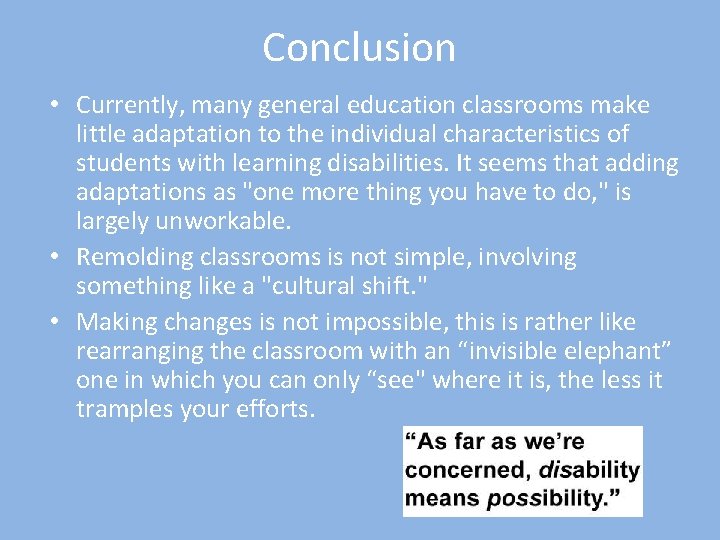
Conclusion • Currently, many general education classrooms make little adaptation to the individual characteristics of students with learning disabilities. It seems that adding adaptations as "one more thing you have to do, " is largely unworkable. • Remolding classrooms is not simple, involving something like a "cultural shift. " • Making changes is not impossible, this is rather like rearranging the classroom with an “invisible elephant” one in which you can only “see" where it is, the less it tramples your efforts.
References • Garnett, K. (2010). Thinking About Inclusion and Learning Disabilities: A Teachers Guide, pp 7 -12. Division of Learning Disabilities of the Council for Exceptional Children. • http: //www. ncld. org/studentsdisabilities/accommodationseducation/common-modificationsaccommodations
- Slides: 7