
BACKGROUND BELIEFS Critical Thinking Skills Lesson Objectives Learn

BACKGROUND BELIEFS Critical Thinking Skills
Lesson Objectives ■ Learn to distinguish between beliefs about matters of fact and beliefs about values. ■ Look at arguments and consider what those arguments say about the author’s world view. ■ Compare the world view of others to your own ■ Discuss the ways in which your own world view leads you to accept or reject new information.

All brillig toves are slithy. ■ Toves? ■ Slithy-ness? ■ Brillig things ? !? !
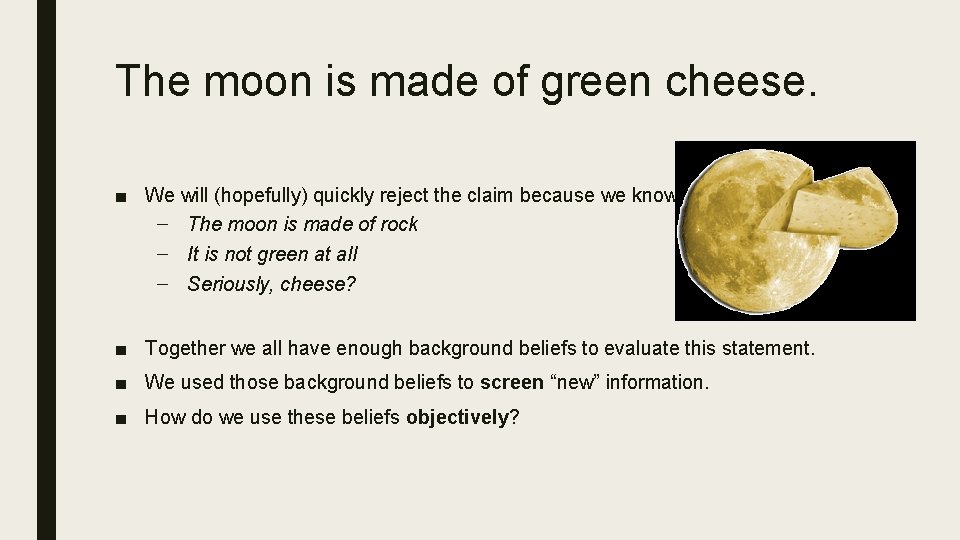
The moon is made of green cheese. ■ We will (hopefully) quickly reject the claim because we know: – The moon is made of rock – It is not green at all – Seriously, cheese? ■ Together we all have enough background beliefs to evaluate this statement. ■ We used those background beliefs to screen “new” information. ■ How do we use these beliefs objectively?
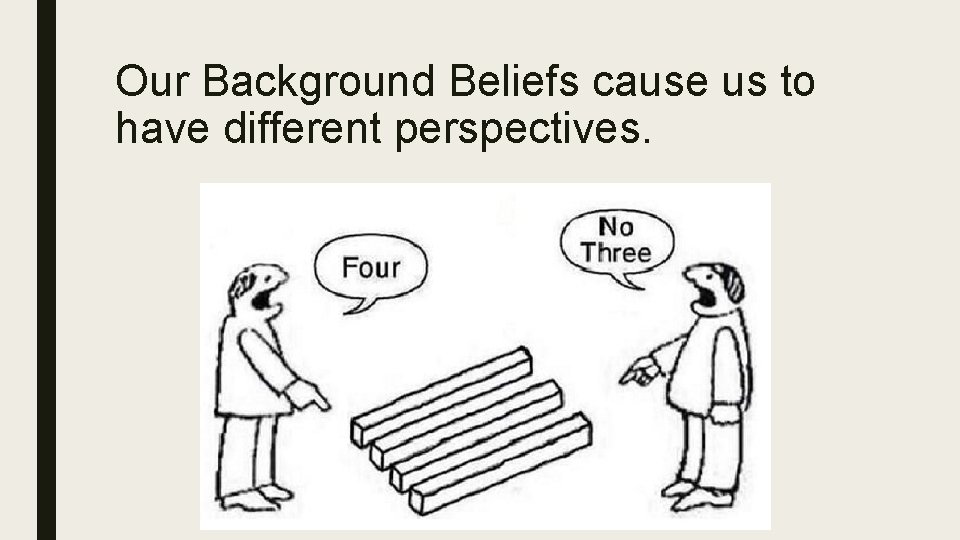
Our Background Beliefs cause us to have different perspectives.
Why do we have disagreements? Matters of Fact Matters of Value ■ Example: – What was the final score of last night’s baseball game? ■ Example: – Which of the players in last night’s game is the best hitter? ■ We can just look up the score to see who is right ■ No real right or wrong answer.
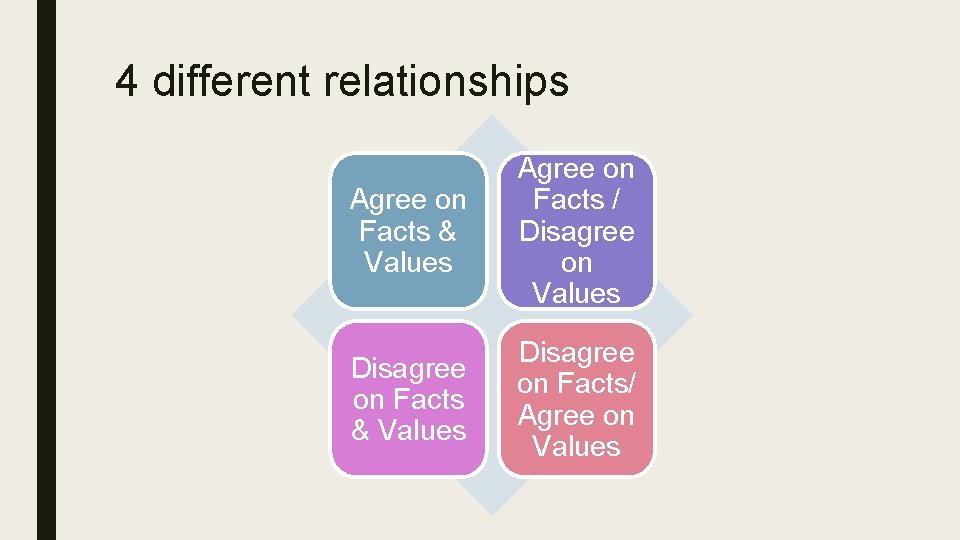
4 different relationships Agree on Facts & Values Agree on Facts / Disagree on Values Disagree on Facts & Values Disagree on Facts/ Agree on Values
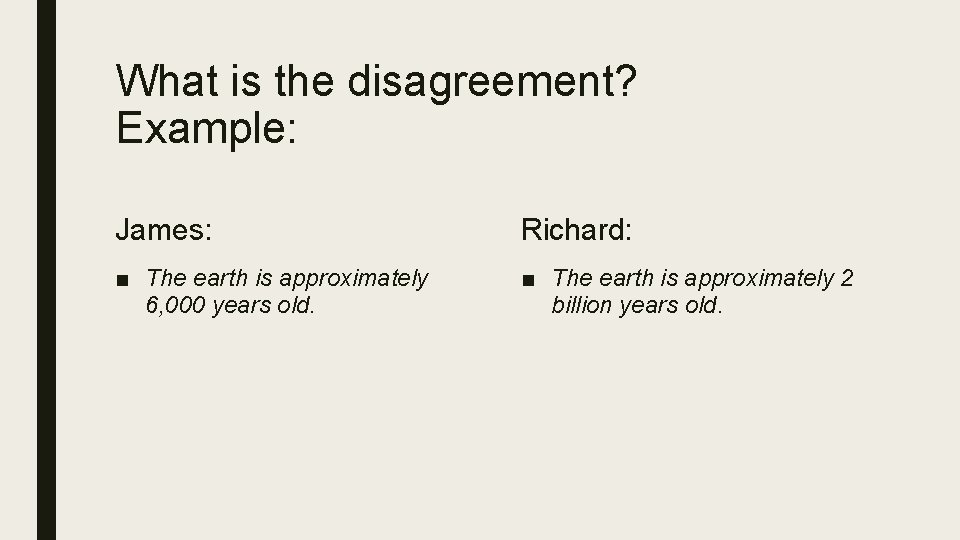
What is the disagreement? Example: James: Richard: ■ The earth is approximately 6, 000 years old. ■ The earth is approximately 2 billion years old.
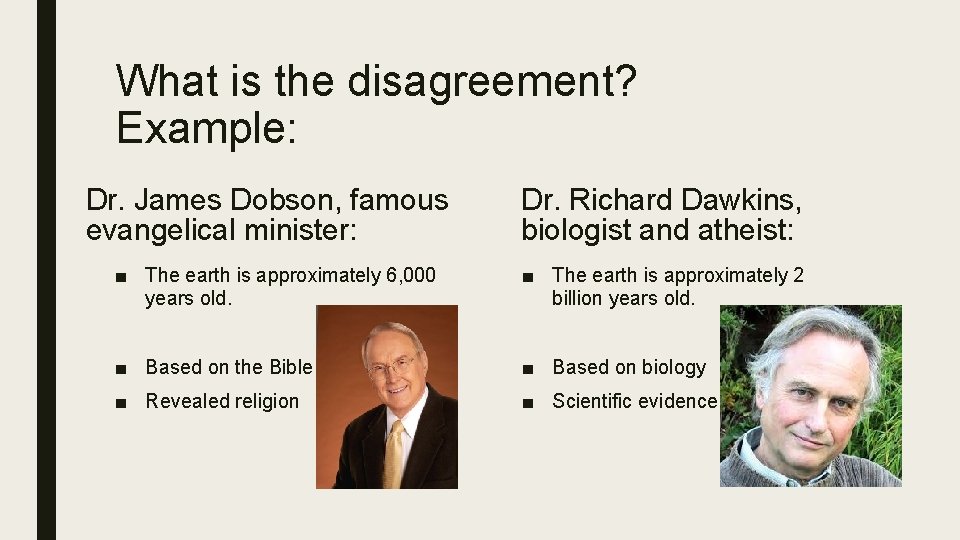
What is the disagreement? Example: Dr. James Dobson, famous evangelical minister: Dr. Richard Dawkins, biologist and atheist: ■ The earth is approximately 6, 000 years old. ■ The earth is approximately 2 billion years old. ■ Based on the Bible ■ Based on biology ■ Revealed religion ■ Scientific evidence
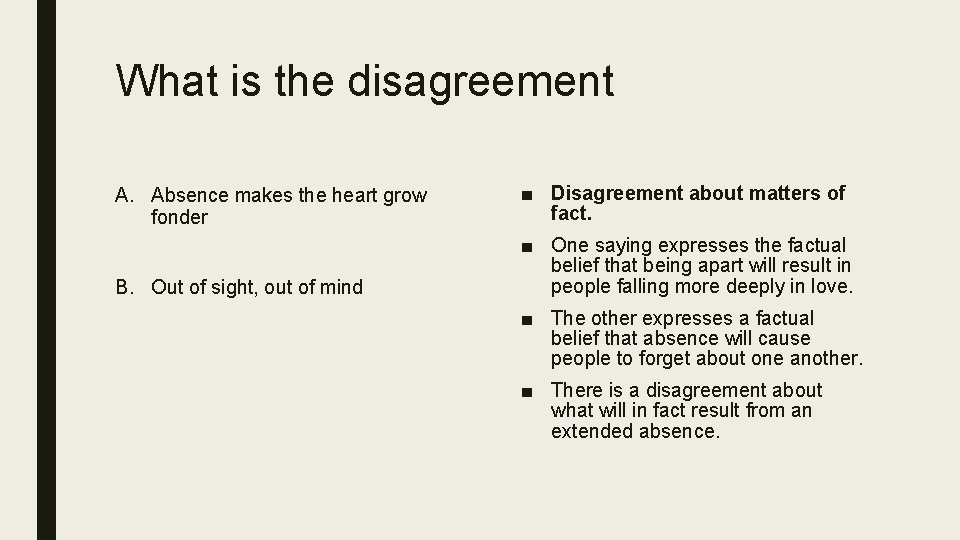
What is the disagreement A. Absence makes the heart grow fonder ■ Disagreement about matters of fact. B. Out of sight, out of mind ■ One saying expresses the factual belief that being apart will result in people falling more deeply in love. ■ The other expresses a factual belief that absence will cause people to forget about one another. ■ There is a disagreement about what will in fact result from an extended absence.
What is the disagreement? A. The race is not to the swift, nor the battle to the strong. – Ecclesiastes 9: 11 B. But that’s not the way to bet. – Jimmy the Greek, responding to Ecclesiastes ■ Disagreement about matters of fact. ■ Ecclesiastes is making the factual claim that the best athlete will not always win a contest. ■ Jimmy the Greek (an infamous bookie) is claiming that, in fact, the best athlete usually will win the contest.
What is the disagreement? A. War alone brings up to its highest tension all human energy and puts the stamp of nobility upon the peoples who have the courage to face it. —Benito Mussolini, Encyclopedia Italiana, 1932 ■ B. War crushes with bloody heel all justice, all happiness, all that is Godlike in man. In our age there can be no peace that is not honorable; there can be no war that is not dishonorable. —Charles Sumner, Addresses on War, 1904 ■ Sumner thinks war is awful. Disagreement about value. ■ Sumner and Mussolini disagree about the benefits of war. ■ Mussolini thinks that war is a good thing;
What is the disagreement? A. Next in importance to freedom and justice is popular education, without which neither freedom nor justice can be permanently maintained. — James A. Garfield B. Education is fatal to anyone with a spark of artistic feeling. Education should be confined to clerks, and even them it drives to drink. Will the world learn that we never learn anything that we did not know before? —George Moore, Confessions of a Young Man, 1888 ■ Disagreement about value. ■ Garfield and Moore arguing about the importance of education. ■ One claims that it is essential to the protection of freedom, while the other thinks it destroys the soul. ■ It is also possible to argue that the two disagree factually – Does education make people less happy?
What is the disagreement? A. Belief in the existence of god is as groundless as it is useless. The world will never be happy until atheism is universal. —J. O. La Mettrie, L’Homme Machine, 1865 B. Nearly all atheists on record have been men of extremely debauched and vile conduct. — J. P. Smith, Instructions on Christian Theology ■ Both factual and on values. ■ Smith offers a factual assertion: – All atheists are debauched and vile. ■ La Mettrie makes a value claim: – The world will never improve until the belief in God disappears.
What is the disagreement? A. How does it become a man to behave towards the American government today? I answer, that he cannot without disgrace be associated with it. —Henry David Thoreau, An Essay on Civil Disobedience, 1849 B. With all the imperfections of our present government, it is without comparison the best existing, or that ever did exist. —Thomas Jefferson, 1787 ■ Disagreement about values. ■ Jefferson and Thoreau agree that the U. S. is flawed, but disagree about whether the U. S. is still worthy of veneration. ■ Thoreau believes that the flaws are such that good men can only disassociate themselves from the U. S. ■ Jefferson believes that, despite the flaws, the U. S. is the best government available
What is the disagreement? A. Civilian deaths of all categories, less natural causes, have also declined considerably, by over 45 percent Iraqwide, since the height of the sectarian violence in December. —Gen. David Petraeus, Congressional Testimony B. The reports that you provide to us really require the willing suspension of disbelief. . If you look at all the evidence that's been presented, overall civilian deaths have risen. — Sen. Hillary Clinton, responding to Petraeus ■ Disagreement about matters of fact. ■ Clinton and Petraeus cannot possibly both be correct. ■ Either the number of civilian casualties increased or it decreased. ■ Determining which figure is correct is a matter of consulting records
What is the disagreement? A. A stitch in time saves nine. B. Better late than never. ■ Disagreement about value. ■ The two sayings express differing attitudes regarding the relative value of advance planning.
What is the disagreement? A. The right of revolution is an inherent one. When people are oppressed by their government, it is a natural right they enjoy to relieve themselves of the oppression, if they are strong enough, either by withdrawal from it, or by overthrowing it and substituting a government more acceptable. —Ulysses S. Grant, Personal Memoirs, vol. 1 B. Inciting to revolution is treason, not only against man, but against God. —Pope Leo XIII, Immortale Dei, 1885 ■ Disagreement about values. ■ President Grant and Pope Leo disagree about whether people have an inherent right to rebel against the government.
- Slides: 18