
Background and framework to Information resources management Information

Background and framework to Information resources management
Information has become a critical resources needed for the survival of any organization. We have other resources such as capital/finance, people , raw materials, land building, finally we have information resources (see diagram) Information explosion has become a cliché, some people see it as information pollution. But clearly the production, handling and dissemination of information has come of age as a respectable industry. But the primary discipline responsible for the improving and management of information, such as computer science, automation, library science, telecommunication and information science have not fully joined theory and practice to harness information resources in a very efficient and effective way to support service users
Information explosion Computer science: data explosion- referring to the proliferation of computerized data files, data base and information systems Political science: knowledge explosion- referring to the transition from modern society to post modern society. The availability of information, organized and distilled into knowledge, regarding the physiology and psychology of human
Buckland(1999) observed that information has to do with becoming informed, reducing ignorance and uncertainty. A universally acceptable definition is however, very elusive.
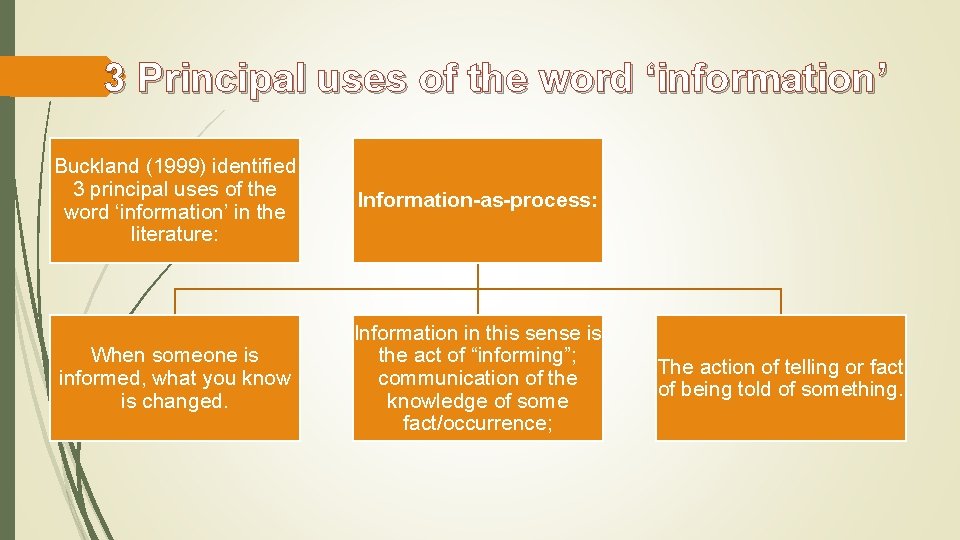
3 Principal uses of the word ‘information’ Buckland (1999) identified 3 principal uses of the word ‘information’ in the literature: Information-as-process: When someone is informed, what you know is changed. Information in this sense is the act of “informing”; communication of the knowledge of some fact/occurrence; The action of telling or fact of being told of something.
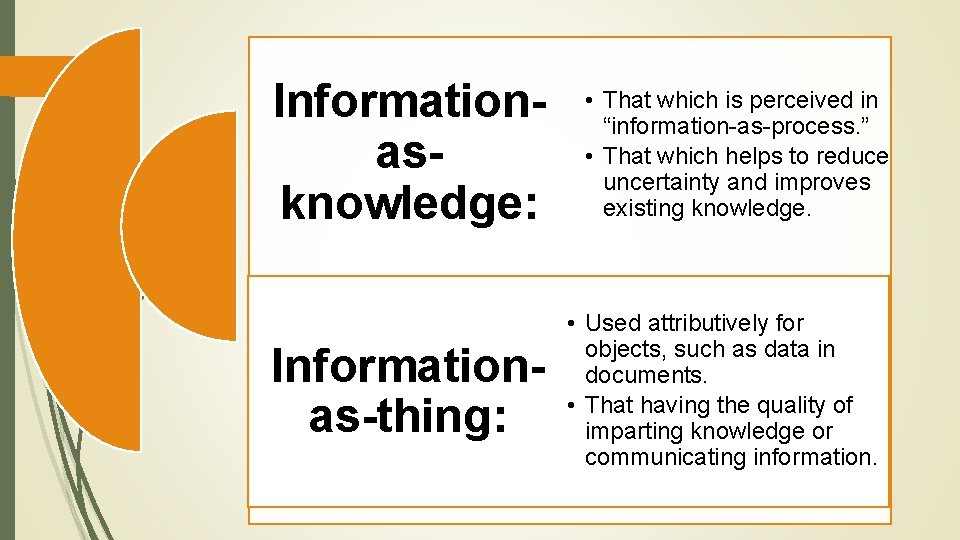
Informationasknowledge: Informationas-thing: • That which is perceived in “information-as-process. ” • That which helps to reduce uncertainty and improves existing knowledge. • Used attributively for objects, such as data in documents. • That having the quality of imparting knowledge or communicating information.
DIKW Chain Information is used in different disciplines and professions to represent different types and levels of organized symbols or ideas – such as: Data, Knowledge, and Wisdom The DIKW chain helps to explain the interrelationships and overlaps between the concepts of data, information, knowledge and wisdom.
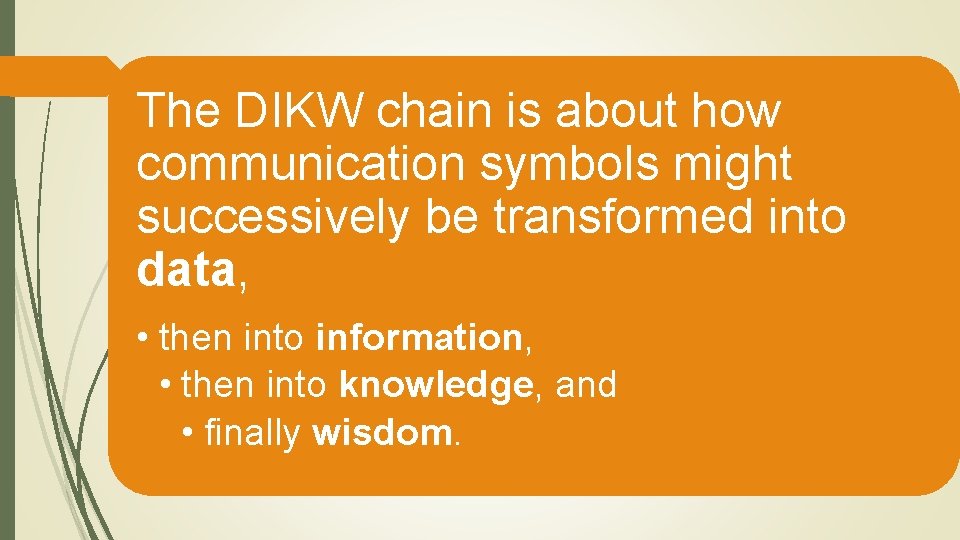
The DIKW chain is about how communication symbols might successively be transformed into data, • then into information, • then into knowledge, and • finally wisdom.
Understanding DIKW Data is raw (raw facts). It simply exists and has no significance beyond its existence (in and of itself). It can exist in any form, usable or not. It does not have meaning of itself. Information - data that has been given meaning by way of relational connection. Knowledge - the appropriate collection of information, such that it's intent is to be useful. Wisdom - It beckons to give us understanding about which there has previously been no understanding, and in doing so, goes far beyond understanding itself.
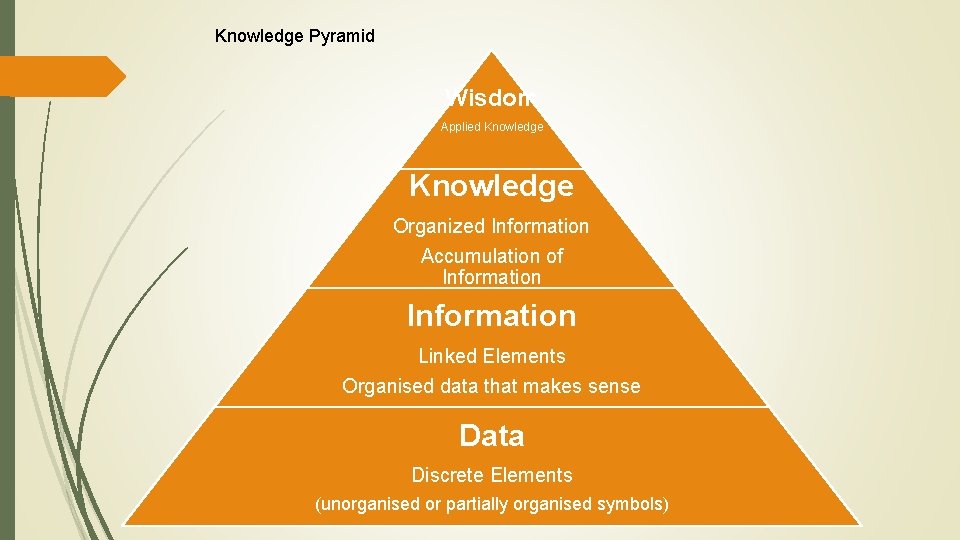
Knowledge Pyramid Wisdom Applied Knowledge Organized Information Accumulation of Information Linked Elements Organised data that makes sense Data Discrete Elements (unorganised or partially organised symbols)
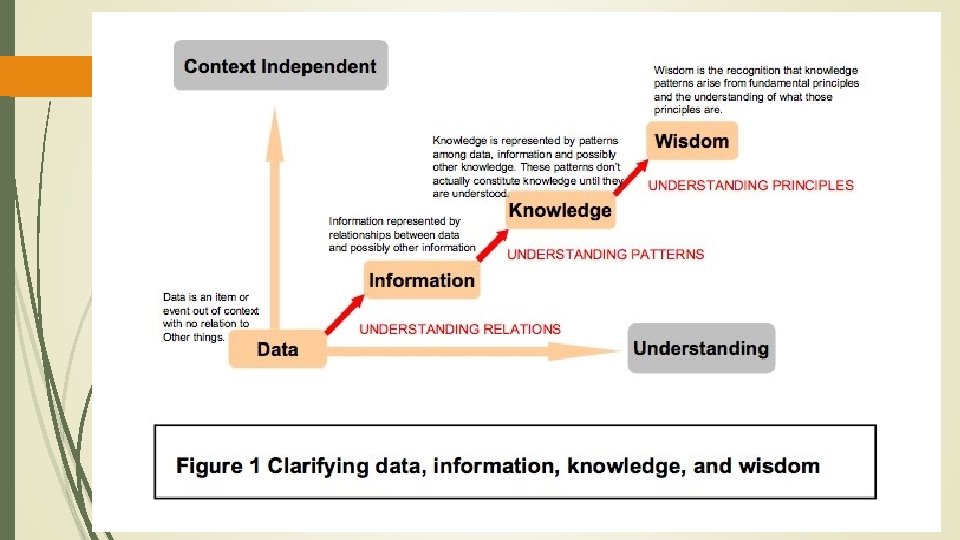
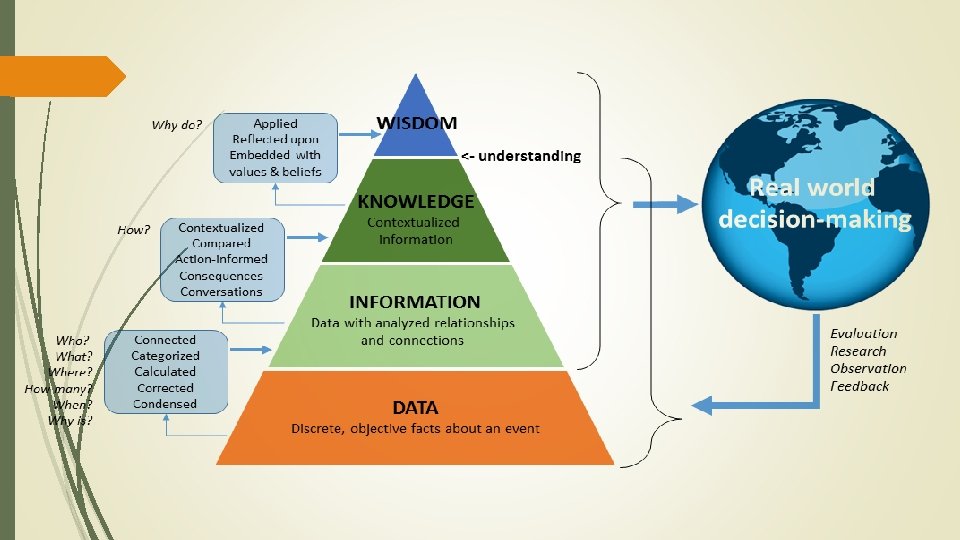
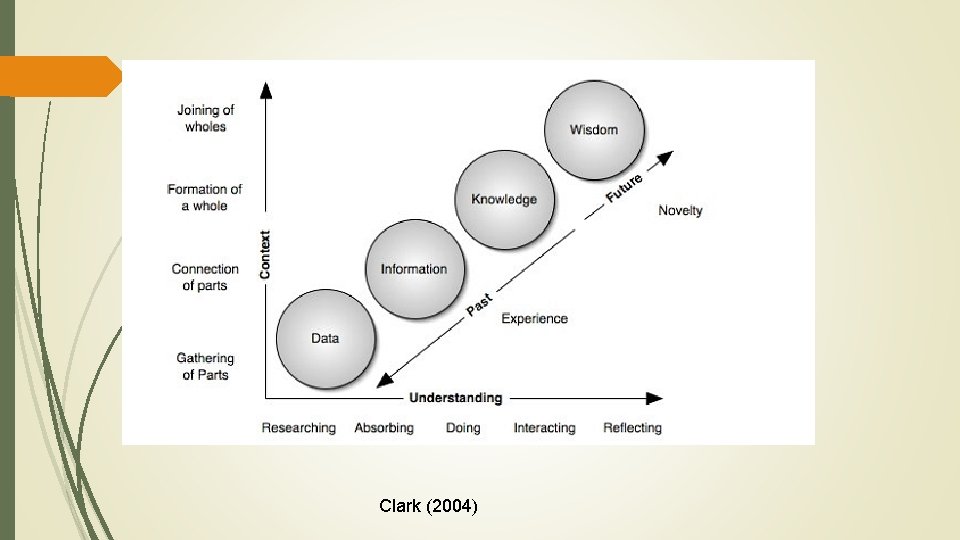
Clark (2004)

Information is defined as meaningful communication symbols transferred between any two points in human communication or machine networks (Aina, Mutula & Tiamiyu, 2008). Popoola (2006) defined information as facts, news, opinions, messages, symbols, signals and processed data that are capable of improving the knowledge state of a user on a random phenomenon.
Aina (2004) defines information as follows: • Increasing the state of knowledge of recipient; • Resolving uncertainty; • Value in decision-making; • A physical surrogate of knowledge; • All published and unpublished knowledge about any given subject; • Body of knowledge.
NOTES It should be noted that the user not just the sender is involved in the transformation of data into information. Processed/analysed data is not information until it is understood by the user. Information is therefore knowledge and understanding that is usable by the recipient.
Information – hierarchy of definitions Braman (1989) developed a four level hierarchical definitions of information – Each based on a category of definitions drawn from many different fields: Information as a Resource Information as a Commodity Information as a Perception of Pattern Information as a Constitutive force in Society.
. . . as a Resource Information as a resource usually encompasses any information content represented in anyway, embodied in any format and handled by any physical processor. Information – its creators, processors and users are viewed as discrete and isolated entities. Information comes in pieces unrelated to bodies of knowledge.
. . . as a Commodity A notion incorporating: ‘The exchange of information among people and related activities as well as its use’. Implies buyers, sellers and a market. Information as commodity has economic power.
. . . as Perception of pattern Concept of Information is broadened by the addition of context. Information is seen as having ‘a past & a future’. It is seen to be affected by motive & other environmental & casual factors. According to Shannon & Weaver – Information is a measure of the predictability of the signal, or the number of choices open to the sender.
. . as a constitutive force in society Information is seen as having a role in shaping social context. It is not just affected by its environment, but is itself an actor affecting other elements in the environment.
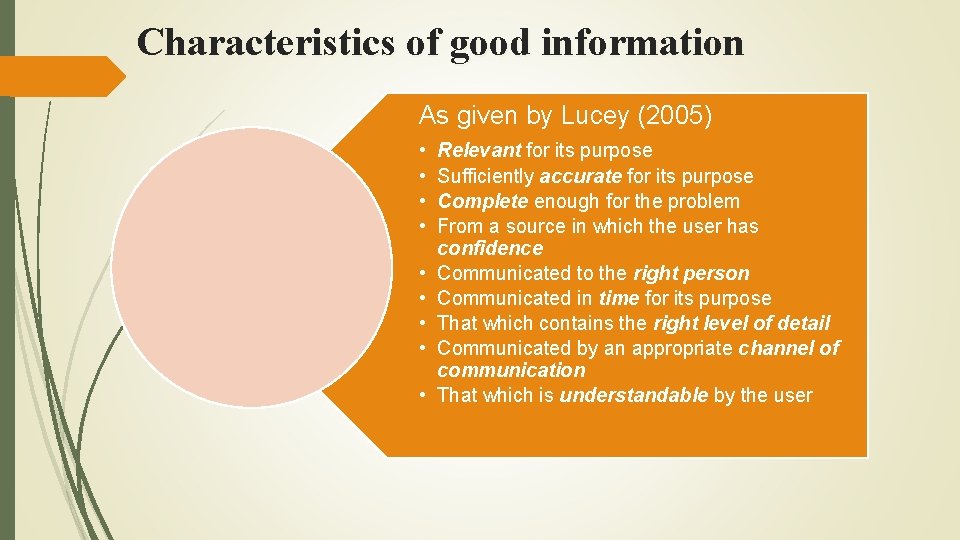
Characteristics of good information As given by Lucey (2005) • • • Relevant for its purpose Sufficiently accurate for its purpose Complete enough for the problem From a source in which the user has confidence Communicated to the right person Communicated in time for its purpose That which contains the right level of detail Communicated by an appropriate channel of communication That which is understandable by the user
Relevance Information must be relevant to the problem being considered. • An overriding quality affected by some other qualities.
Accuracy Information should be sufficiently accurate for it to be relied upon by the user and for the purpose for which it is intended. Should not be confused with precision.
Completeness Ideally, all the information required for a decision should be available. Information is said to be complete in respect of the key elements of the problem.
Confidence in the source Users must have confidence in the source. Confidence is enhanced when: The source has been reliable in the past; There is good communication between the information producer and the user.
Communication to the right person Users have reasons/activities demanding their use of information. Information providers need to understand the potential users of information in order to direct information exactly where it is required.
Timing Good information is that which is communicated in time to be used. Information should be produced at a frequency which is related to the type of activity involved.
Detail Information should contain the least amount of detail consistent with effective decision making. Users of information should not be overloaded with unnecessary information.
Channel of Communication For information to be usable, it must be transmitted by means of a communication process. • Face-to-face communication • Written communication • Visual communication • Oral communication • Electronic communication The channel of communication should be selected considering – • The nature & purpose of the information; • The speed required; • The requirements of the user.
Understandability is what transforms data into information. If information is not understood, it cannot be used and thus cannot add value. Factors affecting understandability: Preferences of the user; Remembered knowledge; Environmental factors; Language.
Information Classifications Considering the many characteristics of information, it can also be classified in numerous ways: By source: e. g. internal, external, primary, secondary, Government By nature: e. g. quantitative, qualitative, formal, informal By level: e. g. strategic, tactical, operational By time: e. g. historical, present, future By frequency: e. g. continuous (real time), hourly, daily, monthly, annually By use: e. g. planning, control, decision making By form: e. g. written, aural, visual, sensory By occurrence: e. g. at planned intervals, occasional, on demand By type: e. g. detailed, summarised, aggregated, abstracted
Functions performed by information The reduction of uncertainty As an aid to monitoring and control As a means of communication As a memory supplement As an aid to simplification
Information Life-Cycle Stages of information management – i. e. from the point of creation till it is discarded. Robek, et al. (1996): Production Dissemination and use Storage and Provision for current access Decisions on the retention/destruction Archiving of documents.
It is the stages through which Information passes from the creation till the time it dies Information life cycle can be defined as the stages through which every written or computerized information go through, from conception, creation, processing, management, storage, retrieval, use to its final archiving or destruction.
Eight stages. • Information Creation: this stage involves the creation or production of information from data which is a raw fact • Information transformation/Manipulation: this includes summarizes analyzing, organizing, indexing calculation. Etc • Information Storage: information is recorded or stored either in paper, diskette, CDROM, computer files, for future use • Information Retrieval: at this stage, Information that has been stored can be accessed or retrieved when needed • Transfer/dissemination: Information is communicated verbally or through any of the available media • Information use: Information is put to use either for decision making, creating awareness, reducing uncertainty or entertainment among others. • Evaluation of Information: Information is needed or checked decision of what to keep or discard is made at this stage • Information disposal: Information that is no longer relevant to the user is either archived or destroyed.
Formats of Information 1. Print Format: all information materials that appear on paper i. e Information on papers e. g books, magazines, serials, journals. 2. None Print: Information that is not on print…audio-visual materials this includes films, 3 D objects, cartographic materials, charts, pictures, maps. 3. Electronic format: Information in electronic form such as online information, like email, e-books, e-bulleting, news-paper. They can be stored or access through media such as computer systems, external drives, CD-ROM, DVD, diskettes. 4. Oral and Aural: Aural deals with Information gotten while listening. I, e making use of sense of hearing while oral deals with speech or speaking. Aural or oral information are at play most times during information dissemination.
Information Classifications Considering the many characteristics of information, it can also be classified in numerous ways: By source: e. g. internal, external, primary, secondary, Government By nature: e. g. quantitative, qualitative, formal, informal By level: e. g. strategic, tactical, operational By time: e. g. historical, present, future By frequency: e. g. continuous (real time), hourly, daily, monthly, annually By use: e. g. planning, control, decision making By form: e. g. written, aural, visual, sensory By occurrence: e. g. at planned intervals, occasional, on demand By type: e. g. detailed, summarised, aggregated, abstracted
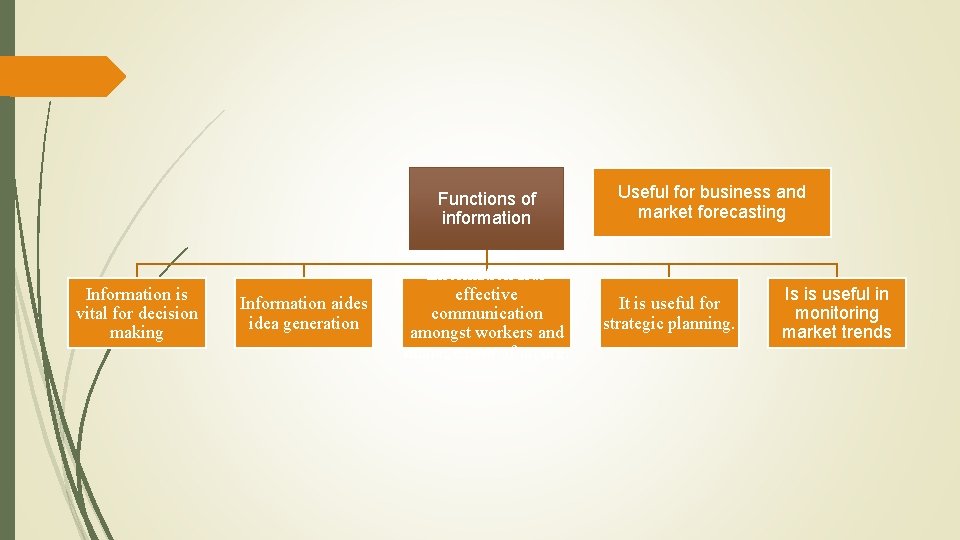
Functions of information Information is vital for decision making Information aides idea generation Information aids effective communication amongst workers and management of an org. Useful for business and market forecasting It is useful for strategic planning. Is is useful in monitoring market trends
Management: Management means that act of managing, it is the process of organizing, directing, controlling, planning, and leading a group of people towards achieving results, it is the process of getting things done through others (Influencing) Information management: this is the collection and management of information from one or more sources and the distribution of that information to one or more audiences. This sometimes involves those who have a stake or right to that information
Information Resources Management: Deals with the management of Information as a resources it is a concept that deals with the collection, storage, process maintenance, dissemination and use of information by individuals and organization. Information resources management deals with managing in information at 1. 2. 3. 4. Personal level Interpersonal level Intra personal level organizational level Global level
Evolution of information resources management The concept information resources management has been within us for a long time. Numerous articles and monographs has been published in this concept IRM has been thoroughly studied forming a corpus of knowledge which can help organization in need of it. Definition of IRM Information Resources Management is one of the concepts which attracts the attention of many scholars and researchers. With many definitions of IRM available Forest w Horton (1979) views Information Resources management as the frame work within which to accomplish the management of data, in an orderly and systematic fashion. According to him, Resources Management system includes all methods and procedures for collecting and processing information on a particular resources( i. e men, money, machine. ) He concludes that, IRM covers all information resources covers all “ information sources, services and individual information systems which are functional oriented to some aspects of the organizations operational activities.
Other definitions includes Elizabeth adams (1985) her view is IRM is a top management function to develop a set of policies, programs, and procedures to efficiently and effectively plan, manage and control information requirements and supporting information handling resources. James Kerr ( 1991) In his book, Information resources management defines Information Resources Management as the Practices of managing information as a corporate asset. Causes for the inception of Information Resources Management There at least three events which lead or triggered the inception of irm 1. Information Explosion 2. Proliferation of Paper 3. Extensive use of Information handling technologies
Information Explosion Information explosion describes the exponential growth of information, Books, journals, newspapers, research reports, proceedings and correspondence, as well as radio, television, telephone, computers, computer networks, online services, CD-ROMs, satellites all contribute to the flood of information, this is just a short list illustrative enough to show the diversity of available media. Information Resources management came into the picture as the way out to the issues of information explosion. How to use the hug amount of information available to us for the betterment of an organization The Proliferation of Paper Most Information is still stored in paper form, and important records cannot be accessed due to hug amount of records. The situation can only be improved and changed through the application of new technology as computers, networks. IRM provides a means of organizing efficiently this pile of papers files while reducing its quantity and increasing its usefulness. Extensive use of Information Handling technologies The third event which help to bring about IRM was the extensive use of information technology. It changed the way we organize business and governmental affairs, run the economy, plan agriculture and changes in our social and cultural lives. The computer technology offered an opportunity to reorganize our activities such as the way we store, retrieve and process Information. The attention of human mind switched from tangible resources such as raw materials, equipment, property finance, energy and labour to some more elusive resources such as information and knowledge.
Hundreds of books and articles were written with one goal in common to explain the way people can benefit from the new concept of information handling based on powerful computer technology. Management of information resources, using the great capabilities of computers to store, retrieve and process information become the main topics for many researchers and information scientists
ISLANDS OF IRM Library and technical information centres Data processing Information services/public information offices Research and statistical information management Office systems Telecommunication Paper works Records management
RESOURCES: CONCEPT Resources are any assets, including cash or any other real or personal property, that an individual (or the individual's spouse or alien sponsor, if any) owns and can convert to cash to be used for his or her support and maintenance. Any cash or other property received from the sale, exchange, or other disposition of a resource retains the character of a resource. Such resource conversions are not considered to produce income. Resources may be either liquid or nonliquid. This distinction is important for purposes of determining whether a resource may be excluded as non-business property essential for self-support
Resource: Concept contd and whether the individual or couple whose resources exceed the resource limits might qualify for conditional benefit payments. Liquid resources include cash and any other resource that can be converted to cash within 20 working days. (Saturdays, Sundays, and federal holidays do not count as working days. ) Examples are cash, stocks, bonds, mutual funds, promissory notes, personal and real property contracts or mortgages, and financial accounts (including joint accounts).

Non-liquid resources. Nonliquid resources are all resources that cannot be converted to cash within 20 working days. Nonliquid resources include: Personal property such as vehicles, machinery, livestock, household goods, and personal effects. Real Property such as land, buildings, or other objects that are attached permanently to the land. Some kinds of resources may be either liquid or non-liquid depending on whether they can actually be converted to cash within 20 working days.
Developmental Stages of information resources management 1. 2. 3. 4. 5. Paper-work management (19 th century) 1950 s Centralization of data processing (early 1960 s-1970) Information Resources Management early (1970 -1980 s) Competitive business intelligence (1980 -1990 s) Strategic information management (1990 s till date) Information from IRM Perspective 1. Something with measurable characteristics e. g anything that has method of collection, life cycle 2. Something of fundamental value e. g money, capital goods, labour, raw materials. 3. It is an input which can be transferred in to useful output It can help achieve organizational goals and objectives
Types of Resource 1. Money/capital resource 2. the people resource 3. land building resource 4. material and equipment resource 5. idea( research & development) resource 6. Information resources management
Money/capital Resource This refers to the doctrine of measurement, application and use of valuable resource. In economics, capital goods, or real capital are those already-produced durable goods that are used in production of goods or services. Capital is distinct from land in that capital must itself be produced by human labor before it can be a factor of production. At any moment in time, total physical capital may be referred to as the capital stock (which is not to be confused with the capital stock of a business entity. )

Money/capital resource In a fundamental sense, capital consists of any produced thing that can enhance a person's power to perform economically useful work —a stone or an arrow is capital for a caveman who can use it as a hunting instrument, and roads are capital for inhabitants of a city. Capital is an input in the production function. Homes and personal autos are not capital but are instead durable goods because they are not used in a production effort. Money capital, which represents obligations, and is liquidated as money for trade, and owned by legal entities. It is in the form of capital assets, traded in financial markets. Its market value is not based on the historical accumulation of money invested but on the perception by the market of its expected revenues and of the risk entailed.
Human/people resource William R. Tracey, in The Human Resources Glossary defines Human Resources as: "The people that staff and operate an organization"; as contrasted with the financial and material resources of an organization. Human Resources is also the organizational function that deals with the people and issues related to people such as compensation, hiring, performance management, and training. A Human Resource is a single person or employee within your organization.
Human/people Resources As companies reorganize to gain competitive edge, human resources plays a key role in helping companies deal with a fast-changing competitive environment and the greater demand for quality employees. Research conducted by The Conference Board has found six key people-related activities that human resources completes to add value to a company:
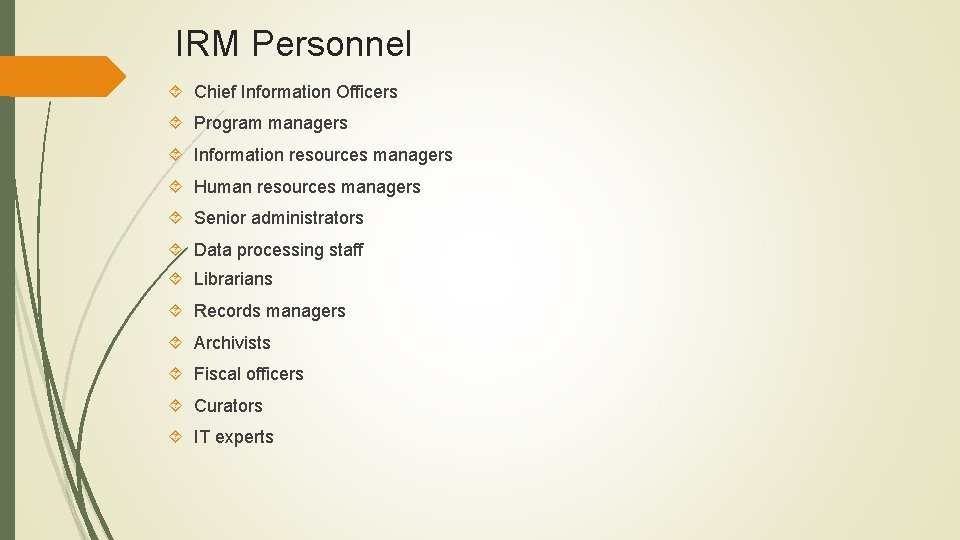
IRM Personnel Chief Information Officers Program managers Information resources managers Human resources managers Senior administrators Data processing staff Librarians Records managers Archivists Fiscal officers Curators IT experts
- Slides: 57