
Backcross Breeding History of Backcrossing Harlan and Pope

Backcross Breeding
History of Backcrossing • • Harlan and Pope, 1922 Smooth vs. rough awn Decided to backcross smooth awn After 1 BC, progeny resembled Manchuria

Terminology • Recurrent parent (RP) - parent you are transferring trait to • Donor or nonrecurrent parent (DP) source of desirable trait • Progeny test - when trait is recessive
Single dominant gene for disease resistance- pre flowering • Cross recurrent parent (rr) with resistant donor parent (RR) - all F 1 s are Rr • Cross F 1 to RP to produce BC 1 progeny which are 1 Rr: 1 rr • Evaluate BC 1 s before flowering and discard rr plants; cross Rr plants to RP
Single dominant gene for disease resistance- pre flowering • BC 2 F 1 plants evaluated, rr plants discarded, Rr plants crossed to RP • …. BC 4 F 1 plants evauated, rr plants discarded, Rr plants selfed to produce BC 4 F 2 seeds, which are 1 RR: 2 Rr: 1 rr • BC 4 F 2 plants evaluated before flowering, rr discarded, R_ selfed and harvested by plant, then progeny tested. Segregating rows discarded, homozygous RR rows kept and tested.
Single dominant gene - post flowering • Cross susceptible RP (rr) with resistant DP (RR) all F 1 s are Rr • Cross F 1 to RP to produce BC 1 progeny which are 1 Rr: 1 rr • BC 1 F 1 plants crossed to RP, trait evaluated before harvest, susceptible plants discarded • BC 2 F 1 plants (1 Rr: 1 rr) are crossed to RP, trait evaluated before harvest, susceptible plants discarded
Single dominant gene - post flowering • Procedure followed through BC 4 • Seeds from each BC 4 F 2 individual are harvested by plant and planted in rows • Segregating rows are discarded, homozygous RR rows are maintained, harvested and tested further
Single recessive allele progeny test in same season • Cross susceptible (RR) RP to resistant (rr) DP • F 1 plants crossed to RP, BC 1 seeds are 1 RR: 1 Rr • All BC 1 plants crossed to RP and selfed to provide seeds for progeny test • Screen BC 1 F 2 plants before BC 2 F 1 plants flower. BC 1 F 1 plants that are RR will have only RR progeny. BC 1 F 1 plants that are Rr will produce BC 1 F 2 progeny that segregate for resistance.
Single recessive allele progeny test in same season • BC 2 F 1 plants from heterozygous (Rr) BC 1 plants are crossed to RP; those from susceptible (RR) BC 1 plants are discarded • BC 2 F 2 selfed seed is harvested for progeny testing • Progeny tests are conducted before BC 3 F 1 plants flower. Only plants from (Rr) BC 2 plants are crossed to RP
Single recessive allele progeny test in same season • Each BC 4 F 1 plant is progeny tested. Progeny from susceptible BC 3 plants are all susceptible and family is discarded • If progeny test completed before flowering, only homozygous resistant (rr) plants are selfed. Otherwise, all plants selfed and only seed from (rr) plants harvested. • Additional testing of resistant families required.
Single recessive allele - progeny test in different season • Cross susceptible (RR) RP to resistant (rr) DP • F 1 plants crossed to RP, seeds are 1 RR: 1 Rr • BC 1 plants selfed, seed harvested by plant • BC 1 F 2 plants grown in progeny rows, evaluated, seed from resistant (rr) rows is harvested. BC 1 F 3 progeny crossed to RP to produce BC 2 F 1 seeds.
Single recessive allele - progeny test in different season • BC 2 F 1 plants crossed to RP to obtain BC 3 F 1 seeds which are 1 Rr: 1 RR • BC 3 F 1 plants are selfed, and progeny are planted in rows • BC 3 F 2 seeds are harvested from resistant (rr) progeny rows • Resistant BC 3 F 3 plants crossed to RP to produce BC 4 F 1 seeds
Single recessive allele - progeny test in different season • BC 4 F 1 plants selfed and produce 1 RR: 2 Rr: 1 rr progeny • BC 4 F 2 plants selfed and resistant ones harvested by plant • Resistant families tested further
Importance of cytoplasm • For certain traits (e. g. male sterility) it is important that a certain cytoplasm be retained • In wheat, to convert a line to a male sterile version the first cross should be made as follows: Triticum timopheevi (male sterile) x male fertile wheat line. From that point on, the recurrent parent should always be used as the male.
Probability of transferring genes • How many backcross progeny should be evaluated? • Consult table in Fehr, p. 367; for example in backcrossing a recessive gene, to have a 95% probability of recovering at least 1 Rr plant, you need to grow 5 backcross progeny.
Probability of transferring genes • To increase the probability to 99% and the number of Rr plants to 3, you must grow 14 progeny • If germination is only 80%, you must grow 14/0. 8 = 18 progeny
Recovery of genes from RP • Ave. recovery of RP = 1 -(1/2)n+1, where n is the number of backcrosses to RP • The percentage recovery of RP varies among the backcross progeny • For example, in the BC 3, if the DP and RP differ by 10 loci, 26% of the plants will be homozygous for the 10 alleles of the RP; remainder will vary.
Recovery of genes from RP • Selection for the RP phenotype can hasten the recovery of the RP • If the number of BC progeny is increased, selection for RP can be effective
Linkage Drag • Backcrossing provides opportunity for recombination between the favorable gene(s) from the RP and the unfavorable genes that may be linked • Recombination fraction has a profound impact: with c=0. 5, P(undesirable gene will be eliminated) with 5 BC is 0. 98 • with c=0. 02, P(undesirable gene will be eliminated) with 5 BC is 0. 11
Backcrossing for Quantitative Characters • Choose DPs that differ greatly from RP to increase the likelihood of recovery of desired trait (earliness example) • Effect of environment on expression of trait can be a problem in BC quantitative traits
Backcrossing for Quantitative Characters • Consider selfing after each BC • Expression of differences among plants will be greater • May be possible to practice selection • Single plant progeny test will not be worthwhile; must use replicated plots
Other Considerations • Marker assisted backcrossing • Assume that you have a saturated genetic map • Make cross and backcross • To hasten the backcrossing process, select against the donor genotype (except for the marker(s) linked to the gene of interest) in backcross progeny
Marker-Assisted Backcrossing • May improve efficiency in three ways: – 1) If phenotyping is difficult – 2) Markers can be used to select against the donor parent in the region outside the target – 3) Markers can be used to select rare progeny that result from recombinations near the target gene
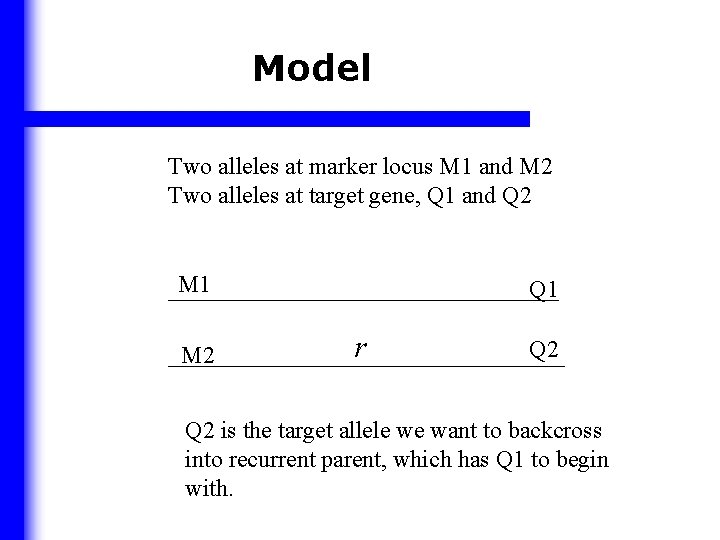
Model Two alleles at marker locus M 1 and M 2 Two alleles at target gene, Q 1 and Q 2 M 1 M 2 Q 1 r Q 2 is the target allele we want to backcross into recurrent parent, which has Q 1 to begin with.
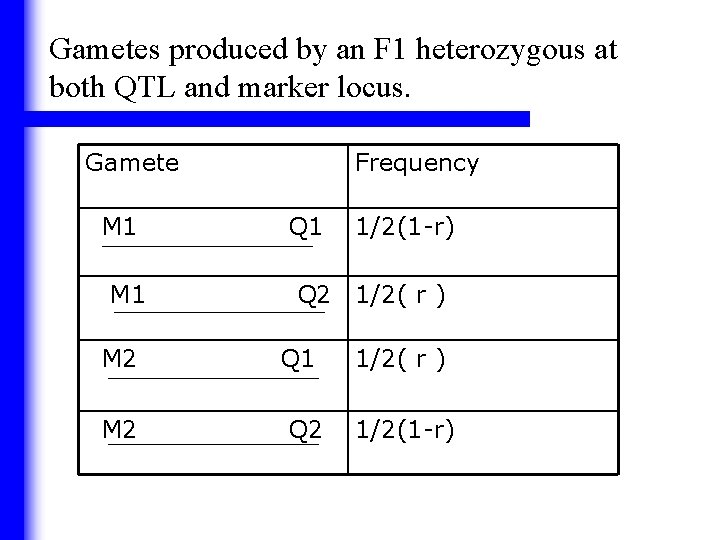
Gametes produced by an F 1 heterozygous at both QTL and marker locus. Gamete M 1 M 2 Frequency Q 1 1/2(1 -r) Q 2 1/2( r ) Q 1 Q 2 1/2( r ) 1/2(1 -r)
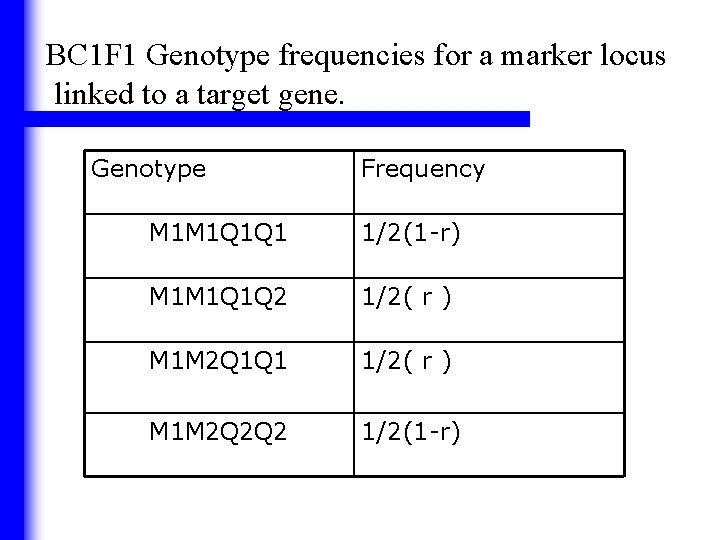
BC 1 F 1 Genotype frequencies for a marker locus linked to a target gene. Genotype Frequency M 1 M 1 Q 1 Q 1 1/2(1 -r) M 1 M 1 Q 1 Q 2 1/2( r ) M 1 M 2 Q 1 Q 1 1/2( r ) M 1 M 2 Q 2 Q 2 1/2(1 -r)
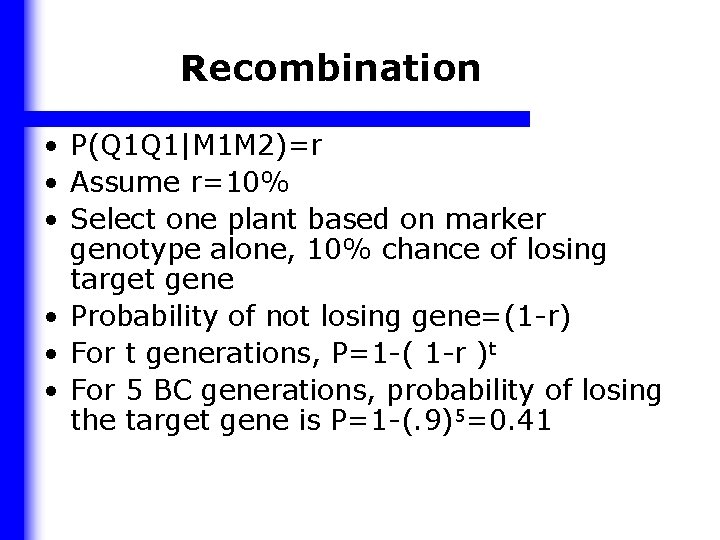
Recombination • P(Q 1 Q 1|M 1 M 2)=r • Assume r=10% • Select one plant based on marker genotype alone, 10% chance of losing target gene • Probability of not losing gene=(1 -r) • For t generations, P=1 -( 1 -r )t • For 5 BC generations, probability of losing the target gene is P=1 -(. 9)5=0. 41
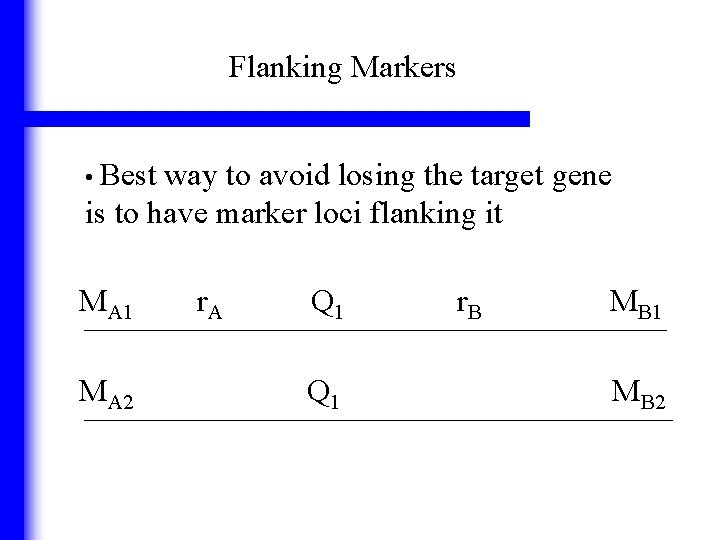
Flanking Markers • Best way to avoid losing the target gene is to have marker loci flanking it MA 1 MA 2 r. A Q 1 r. B MB 1 MB 2
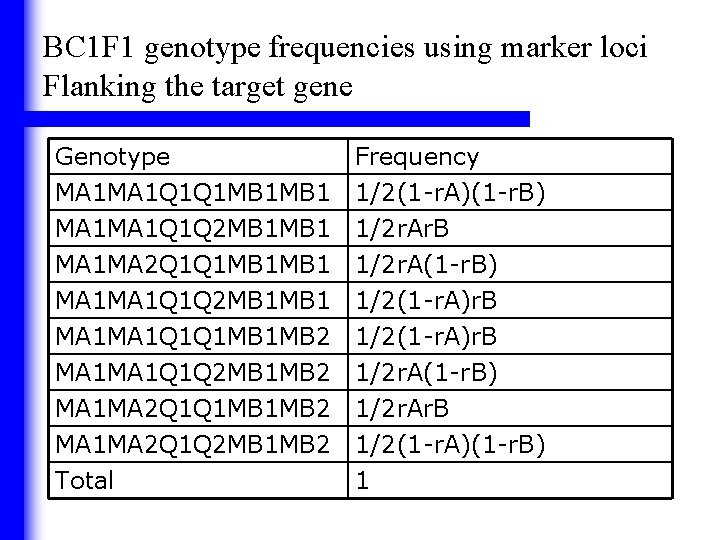
BC 1 F 1 genotype frequencies using marker loci Flanking the target gene Genotype MA 1 Q 1 Q 1 MB 1 MA 1 Q 1 Q 2 MB 1 MA 1 MA 2 Q 1 Q 1 MB 1 Frequency 1/2(1 -r. A)(1 -r. B) 1/2 r. Ar. B 1/2 r. A(1 -r. B) MA 1 Q 1 Q 2 MB 1 MA 1 Q 1 Q 1 MB 2 MA 1 Q 1 Q 2 MB 1 MB 2 MA 1 MA 2 Q 1 Q 2 MB 1 MB 2 Total 1/2(1 -r. A)r. B 1/2 r. A(1 -r. B) 1/2 r. Ar. B 1/2(1 -r. A)(1 -r. B) 1
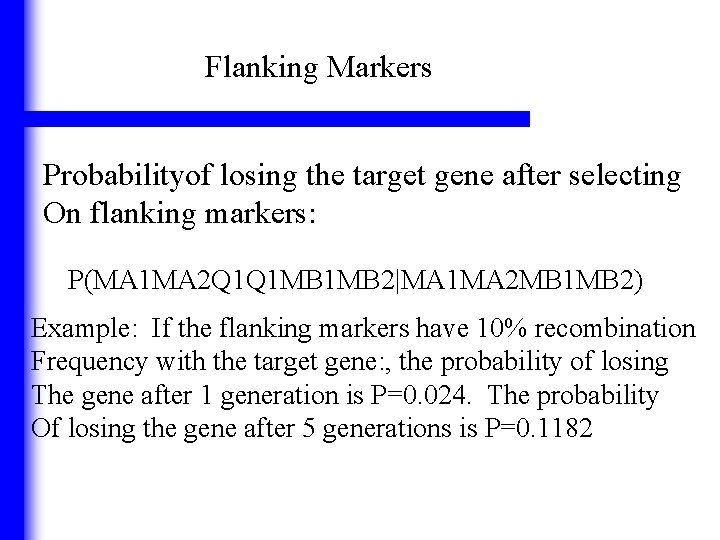
Flanking Markers Probabilityof losing the target gene after selecting On flanking markers: P(MA 1 MA 2 Q 1 Q 1 MB 2|MA 1 MA 2 MB 1 MB 2) Example: If the flanking markers have 10% recombination Frequency with the target gene: , the probability of losing The gene after 1 generation is P=0. 024. The probability Of losing the gene after 5 generations is P=0. 1182
Other Considerations • Backcross breeding is viewed as a conservative approach • The goal is to improve an existing cultivar • Meanwhile, the competition moves past
Backcross Populations • May be used as breeding populations instead of F 2, for example • Studies have shown that the variance in a backcross population can exceed that of an F 2 • Many breeders use 3 -way crosses, which are similar to backcrosses
- Slides: 32