
Backcasting Working backwards to implement a preferred future
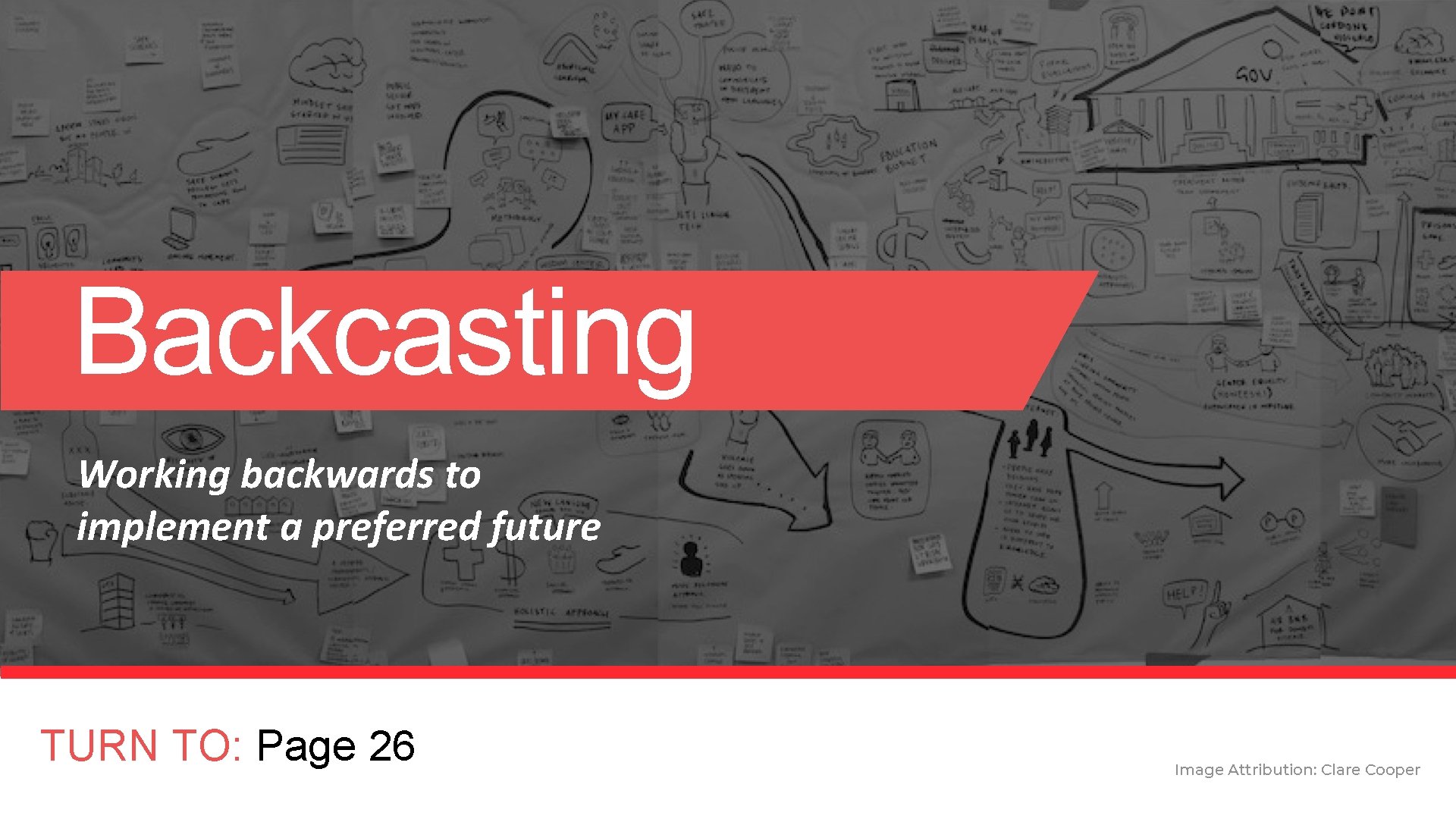
Backcasting Working backwards to implement a preferred future TURN TO: Page 26 Image Attribution: Clare Cooper
Backcasting Example: Image Attribution: Lorum ipsum dolor

PAGE 26 Backcasting YOU WILL NEED 2+ people, pen, paper and sticky notes In this exercise, you will apply backcasting to a future scenario to determine some of the most important events, policies or processes needed to bring it into being. Focus on your own design problem, or follow the ‘Environmentally Resilient Communities’ brief (p. 205). See p. 206 for an example of the outcomes from backcasting. 1 2 3 4 5 6 [flexible] [15 mins] [30 mins] [15 mins] [flexible] Lorum ipsum dolor sit amet Image Attribution: Clare Cooper

PAGE 20 Backcasting YOU WILL NEED 2+ people, pen, paper and sticky notes In this exercise, you will apply backcasting to a future scenario to determine some of the most important events, policies or processes needed to bring it into being. Focus on your own design problem, or follow the ‘Environmentally Resilient Communities’ brief (p. 205). See p. 206 for an example of the outcomes from backcasting. 1 2 3 4 5 6 [flexible] [15 mins] [30 mins] [15 mins] [flexible] Lorum ipsum dolor sit amet Image Attribution: Clare Cooper

PAGE 26 Backcasting YOU WILL NEED 2+ people, pen, paper and sticky notes In this exercise, you will apply backcasting to a future scenario to determine some of the most important events, policies or processes needed to bring it into being. Focus on your own design problem, or follow the ‘Environmentally Resilient Communities’ brief (p. 205). See p. 206 for an example of the outcomes from backcasting. 1 2 3 4 5 6 [flexible] [15 mins] [30 mins] [15 mins] [flexible] Lorum ipsum dolor sit amet

PAGE 26 Backcasting YOU WILL NEED 2+ people, pen, paper and sticky notes In this exercise, you will apply backcasting to a future scenario to determine some of the most important events, policies or processes needed to bring it into being. Focus on your own design problem, or follow the ‘Environmentally Resilient Communities’ brief (p. 205). See p. 206 for an example of the outcomes from backcasting. 1 2 3 4 5 6 [flexible] [15 mins] [30 mins] [15 mins] [flexible] Lorum ipsum dolor sit amet Image Attribution: Clare Cooper

PAGE 26 Backcasting YOU WILL NEED 2+ people, pen, paper and sticky notes In this exercise, you will apply backcasting to a future scenario to determine some of the most important events, policies or processes needed to bring it into being. Focus on your own design problem, or follow the ‘Environmentally Resilient Communities’ brief (p. 205). See p. 206 for an example of the outcomes from backcasting. 1 2 3 4 5 6 [flexible] [15 mins] [30 mins] [15 mins] [flexible] Lorum ipsum dolor sit amet Image Attribution: Clare Cooper
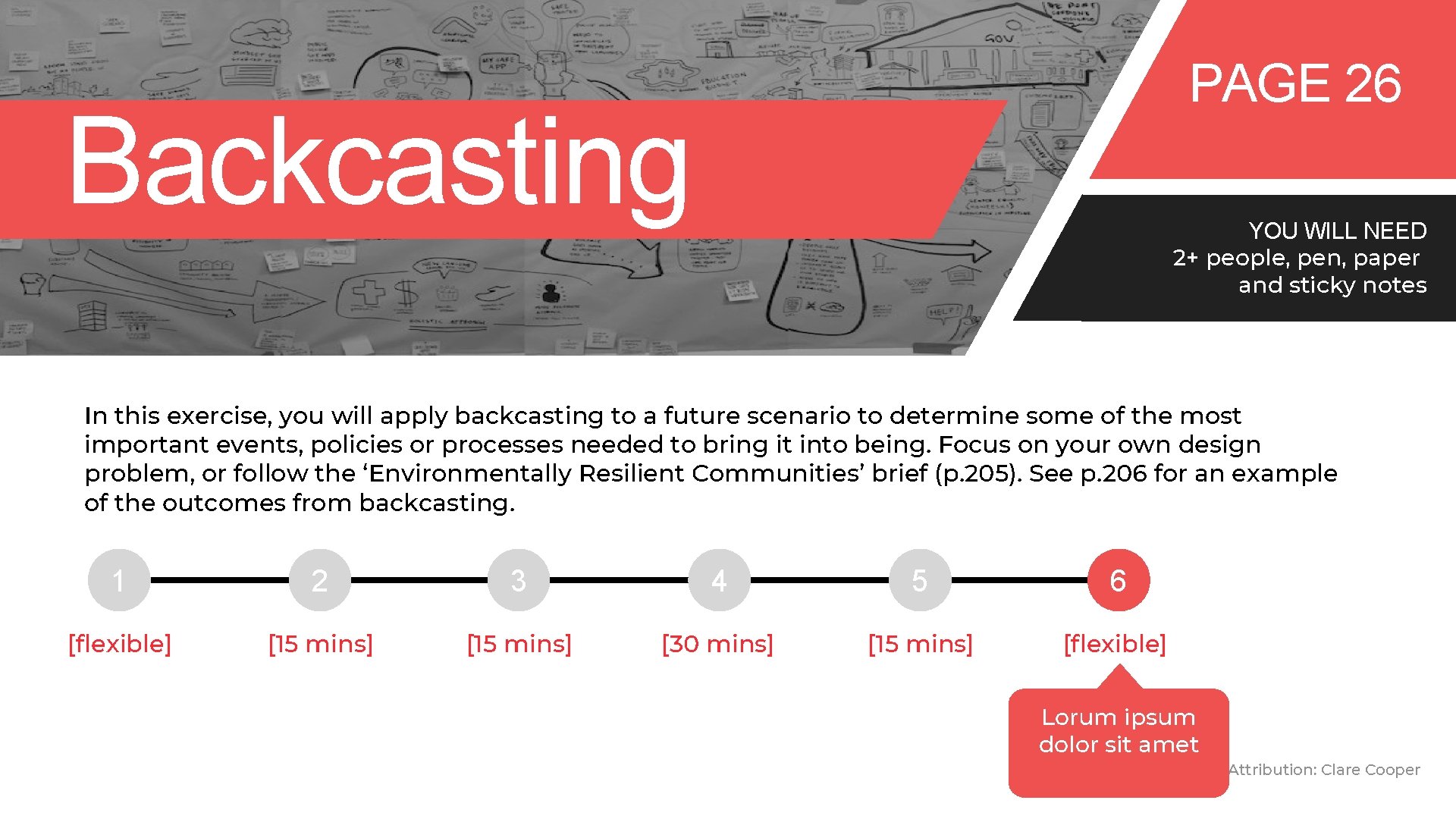
PAGE 26 Backcasting YOU WILL NEED 2+ people, pen, paper and sticky notes In this exercise, you will apply backcasting to a future scenario to determine some of the most important events, policies or processes needed to bring it into being. Focus on your own design problem, or follow the ‘Environmentally Resilient Communities’ brief (p. 205). See p. 206 for an example of the outcomes from backcasting. 1 2 3 4 5 6 [flexible] [15 mins] [30 mins] [15 mins] [flexible] Lorum ipsum dolor sit amet Image Attribution: Clare Cooper
Share your work! Upload photos of your work: 1) 2) 3) 4) 5) Go to: add URL here Enter the password: password Upload a photo and caption of your work Wait for moderation View others’ ideas A note to facilitators: Use this slide to give instructions for post-exercise sharing activities. These could take the form of facilitator-guided discussions, mini-presentations, or digital sharing via existing platforms (e. g. padlet) - as described here. Delete this paragraph when ready.
Design. Think Make. Break. Repeat. This work is licensed under a Creative Commons Attribution-Non. Commercial. Share. Alike 4. 0 International License. Designed by the authors of “Design. Think. Make. Break. Repeat. A Handbook of Methods” (BIS Publishers). www. designthinkmakebreakrepeat. com How to use these slides These companion slides for the published book “Design Think Make Break Repeat: A Handbook of Methods”, support facilitation of the published exercises during workshops, tutorials or other guided design sessions. Slide 1: Title. Introduce the method, using the description from the book. Slide 2: Examples. Use this slide to add your own images/examples of the method in use, or extra information. Slide 3+: Steps. Use one slide for each step of the method, to track timing and progress. The tip boxes can be used to offer extra guidance for specific steps, where needed. Slide 4: Sharing. Results of the exercise are shared and discussed, in an appropriate format. Slide design by: Hamish Henderson, Madeleine Borthwick
- Slides: 10