
Back to menu Accidents COSHH Electricity Fire First
Back to menu Accidents COSHH Electricity Fire First Aid HASAWA HSE Heights Health and safety in construction Noise PPE PUWER Introduction RIDDOR Safety signs Storage
Health and safety in construction Back to menu Accidents COSHH Menu screen Electricity Fire First Aid HASAWA HSE Heights Noise These Power. Point slides cover the topics identified by the buttons on the left Select from the menu on the left of the screen by clicking on the button. PPE PUWER RIDDOR Safety signs Storage To begin the presentation, left click your mouse, press Enter or an arrow key.
Back to menu Accidents COSHH Electricity Fire First Aid HASAWA HSE Heights Health and safety in construction Noise PPE PUWER Accidents at work RIDDOR Safety signs Storage
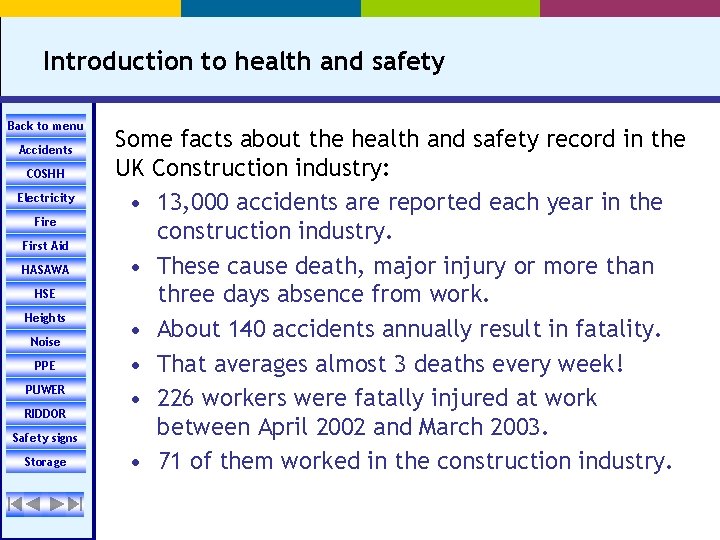
Introduction to health and safety Back to menu Accidents COSHH Electricity Fire First Aid HASAWA HSE Heights Noise PPE PUWER RIDDOR Safety signs Storage Some facts about the health and safety record in the UK Construction industry: • 13, 000 accidents are reported each year in the construction industry. • These cause death, major injury or more than three days absence from work. • About 140 accidents annually result in fatality. • That averages almost 3 deaths every week! • 226 workers were fatally injured at work between April 2002 and March 2003. • 71 of them worked in the construction industry.
Accidents Back to menu Accidents COSHH Electricity Fire First Aid HASAWA HSE Heights Noise PPE PUWER RIDDOR Safety signs Storage What is an accident? Definitions: • An accident is an unforeseen, unplanned and uncontrolled event. • An unfortunate event resulting especially from carelessness or ignorance. Outcomes of accidents: • Accidents lead to injury to people, damage to plant, machinery and equipment or other loss. • Some accidents lead to serious injury, fatality or serious damage to property.
What causes accidents? Back to menu Accidents COSHH Electricity Fire First Aid HASAWA HSE Heights Noise PPE PUWER RIDDOR Safety signs Storage According to Health and Safety Executive reports the main causes of accidents in construction are: • falling through fragile roofs and roof-lights; • falling from ladders, scaffolds and other work places; • being struck by excavators, lift trucks or dumpers; • overturning vehicles; • being crushed by collapsing structures.
Accidents – cost to employers Back to menu Accidents COSHH Electricity Fire First Aid HASAWA HSE Heights Noise PPE PUWER RIDDOR Safety signs Storage Accidents can cost employers serious money, for example, through: • increased insurance premiums; • fines; • compensation claims; • damage to property or machinery – replacement costs; • loss of production – time; • loss of the employee’s time.
Accidents – cost to employees Back to menu Accidents COSHH Electricity Fire First Aid HASAWA HSE Heights Noise PPE PUWER RIDDOR Safety signs Storage Individual employees can suffer: • death; • serious injury; • pain and/or long term suffering; • disability. Additionally: • Wages can be lost through employees being absent from work as the site may be closed for an investigation, or through personal injury and being unable to go to work.
Accidents - reporting Back to menu Accidents COSHH Electricity Fire First Aid HASAWA HSE Heights Noise PPE PUWER RIDDOR Safety signs Storage The law requires that all accidents are reported. • All accidents need to be reported and entered into the accident book. • Serious accidents and those where employees are absent as a result of an accident for more than 3 days must be reported to the Enforcing Authority (Health and Safety Executive).
Health and Safety at Work etc. Act 1974 Back to menu Accidents COSHH Electricity Fire First Aid HASAWA Legislation has been introduced to make us all pay more attention to health and safety. But legislation alone will not prevent an accident from happening. If we follow the rules we reduce the risk of an accident. HSE Heights Noise PPE The rules are known as: • Health and Safety at Work etc. Act 1974. PUWER RIDDOR Safety signs Storage Legislation is enforced by: • The Health and Safety Executive (HSE).

Back to menu Accidents COSHH Electricity Fire First Aid HASAWA End HSE Heights Noise Return to menu PPE PUWER RIDDOR Safety signs Storage
Back to menu Accidents COSHH Electricity Fire First Aid HASAWA HSE Heights Health and safety in construction Noise PPE PUWER Health and Safety Executive RIDDOR Safety signs Storage
Health and Safety Executive Back to menu Accidents COSHH Electricity Fire First Aid HASAWA HSE Heights Noise PPE PUWER RIDDOR Safety signs Storage The role of Inspectors from the Health and Safety Executive (HSE) or the Local Authority includes: • administering health and safety law; • overseeing and controlling health, safety and welfare; • visiting workplaces to check that people are complying with the rules; • helping you to understand what you need to do; • enforcing the law only when something is seriously wrong.
Health and Safety Executive Back to menu Accidents COSHH Electricity Fire First Aid HASAWA HSE Heights Noise PPE PUWER RIDDOR Safety signs Storage Powers and duties of inspectors include: • entering premises to examine and investigate; • seizing evidence; • measuring, recording, etc; • questioning staff; • serving notices, for example, improvement (remedy), prohibition (stop work); • avoiding imminent danger – to seize and destroy; • prosecute for offences.
Health and Safety Executive Back to menu Accidents COSHH Electricity Fire First Aid HASAWA HSE Heights Noise PPE PUWER RIDDOR Safety signs Storage HSE must be informed of the following: • Start of any building work lasting more than six weeks. • Employment of workers for more than 21 hours per week. • Employment or transfer of young people (under 18). • Accidents resulting in death or major injury. • Poisoning or suffocation incidents resulting in medication.
Health and safety records Back to menu Accidents COSHH Electricity Fire First Aid HASAWA HSE Heights Noise PPE PUWER The following are examples of records to be kept on a site or in a workplace: • General Register for building operations and works of engineering construction. • Accident Book where all accidents will be recorded. • Record of any dangerous occurrences. • Register of all persons appointed to carry out specialist activities. RIDDOR Safety signs Storage Cont’d. . .
Health and safety records Back to menu Accidents COSHH Electricity Fire First Aid HASAWA HSE Heights Noise PPE PUWER RIDDOR Safety signs Storage • Record of inspections, examinations and special tests such as scaffolding, excavations, lifting appliances and so on. • Register and certificate of shared welfare arrangements. • Certificate of tests carried out on plant and equipment.
Employer’s responsibilities Back to menu Accidents COSHH Electricity Fire First Aid HASAWA HSE Heights Noise PPE PUWER RIDDOR Safety signs Storage Employers have a responsibility to: • provide information, instruction and training for employees; • provide adequate supervision and safe systems of work and safe means of access and egress; • provide and maintain machinery and equipment; • provide safe handling, use and storage of materials and substances; • provide necessary personal protective clothing and equipment; Cont’d. . .
Employer’s responsibilities Back to menu Accidents COSHH Electricity Fire First Aid HASAWA HSE Heights Noise PPE PUWER RIDDOR Safety signs Storage • produce a written safety policy (when an employer has 5 employees or more); • provide adequate welfare facilities; • consult with employees over health and safety; • have in place adequate measures for emergencies including fire; • provide first aid; • record and report accidents, diseases and dangerous occurrences; • protect employees from noise which may cause hearing loss.
Employee’s responsibilities Back to menu Accidents COSHH Electricity Fire First Aid HASAWA HSE Heights Noise PPE PUWER RIDDOR Safety signs Storage Employees have a responsibility to follow the training and instruction given, and in particular to: • keep the workplace clean and tidy; • wear the correct clothing; • report any accidents or hazardous situations; • always use the correct and safe way of doing something; • observe any safety signs or notices; • co-operate with their employer; • not do anything that they feel is too dangerous or might harm them or others; • ask if unsure of anything.
Summary – preventing accidents Back to menu Accidents COSHH Electricity Fire First Aid HASAWA HSE Heights Noise PPE PUWER RIDDOR Safety signs Storage All • • employees can help prevent accidents by: following the training and instructions given; following the employer’s workplace procedures; reporting hazardous situations; keeping the workplace clean and tidy; not fooling around at work; using common sense and being alert; asking when unsure of what to do or how to do something.

Back to menu Accidents COSHH Electricity Fire First Aid HASAWA End HSE Heights Noise Return to menu PPE PUWER RIDDOR Safety signs Storage
Back to menu Accidents COSHH Electricity Fire First Aid HASAWA HSE Heights Health and safety in construction Noise PPE Health and Safety at Work etc. Act 1974 PUWER RIDDOR Safety signs Storage
Why is legislation necessary? Back to menu Accidents COSHH Electricity Fire Legislation has become necessary because individuals and organisations do not naturally adopt safe practice. Failure to comply with legislation (the law) may result in criminal proceedings. First Aid HASAWA HSE Heights Noise PPE PUWER RIDDOR Safety signs Storage Health and safety legislation in construction includes: • Health and Safety at Work etc. Act 1974. • The Construction (Health, Safety and Welfare) Regulations 1996 (HSW). • The Provision and Use of Work Equipment Regulations 1998 (PUWER). • Control of Substances Hazardous to Health Regulations 2002 (COSHH).
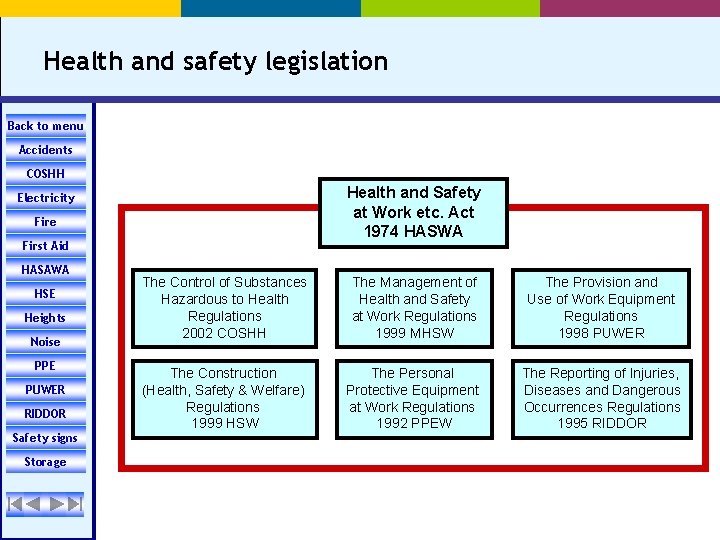
Health and safety legislation Back to menu Accidents COSHH Health and Safety at Work etc. Act 1974 HASWA Electricity Fire First Aid HASAWA HSE Heights Noise PPE PUWER RIDDOR Safety signs Storage The Control of Substances Hazardous to Health Regulations 2002 COSHH The Management of Health and Safety at Work Regulations 1999 MHSW The Provision and Use of Work Equipment Regulations 1998 PUWER The Construction (Health, Safety & Welfare) Regulations 1999 HSW The Personal Protective Equipment at Work Regulations 1992 PPEW The Reporting of Injuries, Diseases and Dangerous Occurrences Regulations 1995 RIDDOR
Health and Safety at Work etc. Act 1974 Back to menu Accidents COSHH Electricity Fire First Aid HASAWA HSE Heights Noise PPE PUWER RIDDOR Safety signs Storage The HASAWA oversees all other legislation and regulations. It is a single Act which enables and enforces simple rules and laws. It has four main objectives: 1. To secure the health, safety and welfare of all persons at work. 2. To protect the general public from risk to health and safety arising out of work activities. 3. To control the use, handling, storage and transportation of explosives and highly flammable substances. 4. To control the release of noxious or offensive substances into the atmosphere.
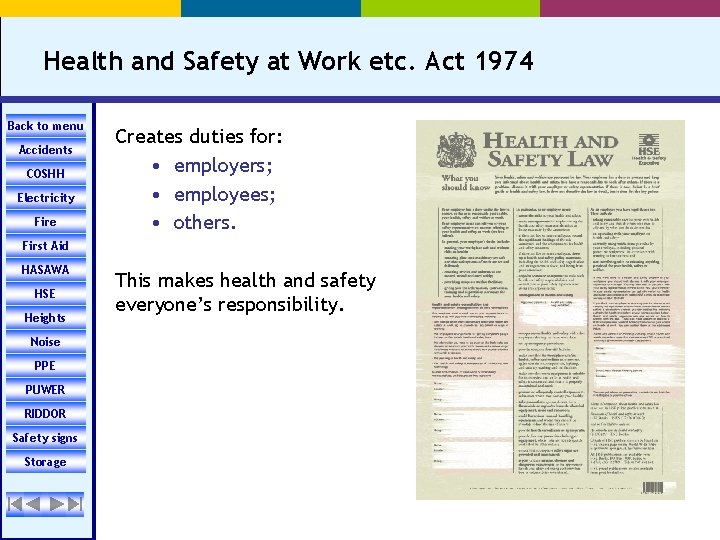
Health and Safety at Work etc. Act 1974 Back to menu Accidents COSHH Electricity Fire Creates duties for: • employers; • employees; • others. First Aid HASAWA HSE Heights Noise PPE PUWER RIDDOR Safety signs Storage This makes health and safety everyone’s responsibility.
The Management of Health and Safety at Work Regulations 1999 (MHSW) Back to menu Accidents COSHH Electricity Fire First Aid HASAWA HSE Heights Noise PPE PUWER RIDDOR The Management of Health and Safety at Work Regulations (MHSW) covers: • risk assessments; • planning organising and control of health and safety arrangements; • health surveillance; • appointment of competent persons; • appropriate procedures for imminent danger; • contacts with emergency services; Safety signs Storage Cont’d. . .
The Management of Health and Safety at Work Regulations 1999 (MHSW) Back to menu Accidents COSHH Electricity Fire First Aid HASAWA HSE Heights Noise PPE PUWER RIDDOR Safety signs Storage • • • provision information for employees; co-operation with fire procedures; temporary workers; new or expectant mothers; protection of young people.
The Construction (Health, Safety and Welfare) Regulations 1996 (HSW) Back to menu Accidents COSHH Electricity Fire First Aid HASAWA HSE Heights Noise PPE PUWER RIDDOR Safety signs Storage What the Regulations are about: ‘Impose requirements with respect to the health, safety and welfare of persons at work carrying out construction work and of others who may be affected by that work’.
The Construction (Health, Safety and Welfare) Regulations 1996 (HSW) Back to menu Accidents COSHH Electricity Fire First Aid HASAWA HSE Heights Noise PPE PUWER RIDDOR Safety signs Storage The Regulations impose requirements on: • employers, the self-employed and others who control the way in which construction work is carried out; • employees in respect of their own actions; • every person at work as regards co-operation with others and the reporting of danger.

Back to menu Accidents COSHH Electricity Fire First Aid HASAWA End HSE Heights Noise Return to menu PPE PUWER RIDDOR Safety signs Storage
Back to menu Accidents COSHH Electricity Fire First Aid HASAWA Health and safety in construction HSE Heights Noise Provision and Use of Work Equipment Regulations 1998 (PUWER) PPE PUWER RIDDOR Safety signs Storage
The Provision and Use of Work Equipment Regulations 1998 (PUWER) Back to menu Accidents COSHH Electricity Fire First Aid HASAWA HSE Heights Noise PPE PUWER RIDDOR Safety signs Storage The Regulations impose requirements on: • employers, the self-employed and others who control the way in which construction work is carried out; • employees in respect of their own actions; • every person at work as regards co-operation with others and the reporting of danger.
The Provision and Use of Work Equipment Regulations 1998 (PUWER) Back to menu Accidents COSHH Electricity Fire First Aid HASAWA HSE This regulation applies to all work equipment. It sets the standard for the provision and use of work equipment in the workplace. The primary objective is to provide safe equipment and ensure it is safe to use. The range of equipment covered by the Regulations includes: Heights Noise PPE PUWER RIDDOR Safety signs Storage • • • hammers; portable drills; drill bits; shovels; wheelbarrows; • • • dumper trucks; cranes; scaffolding; mobile access platforms; wood working machines.
The Provision and Use of Work Equipment Regulations 1998 (PUWER) Back to menu Accidents COSHH Electricity Fire First Aid HASAWA HSE Heights Noise PPE PUWER RIDDOR Safety signs Storage Employers must train staff in the safe use of work equipment. Training must be adequate and include: • users; • supervisors; • managers. The training must include safe work methods, possible risks and precautions to be taken whilst using work equipment.

Back to menu Accidents COSHH Electricity Fire First Aid HASAWA End HSE Heights Noise Return to menu PPE PUWER RIDDOR Safety signs Storage
Back to menu Accidents COSHH Electricity Fire First Aid HASAWA Health and safety in construction HSE Heights Noise The Personal Protective Equipment at Work Regulations (PPEW) PPE PUWER RIDDOR Safety signs Storage
The Personal Protective Equipment at Work Regulations 1992 (PPEW) Back to menu Accidents COSHH These rules set out duties governing the provision and use of PPE in the workplace. Electricity Fire First Aid HASAWA HSE Heights Noise PPE means all equipment worn or held by a person at work which protects against risks to health and safety. It includes clothing that gives protection from the weather. PPE PUWER RIDDOR Safety signs Storage The PPE at Work regulations state that PPE must be supplied and used at work wherever there is a risk to health and safety that cannot be adequately controlled in other ways.
The Personal Protective Equipment at Work Regulations 1992 (PPEW) Back to menu Accidents COSHH Electricity This means PPE is a last resort and must be used where other precautions cannot reduce the risk of injury. Fire First Aid HASAWA HSE Heights Noise PPE PUWER RIDDOR Safety signs Storage Whenever PPE is the only effective means of controlling risk of injury or health: • employers must make sure that it is available for use at work; • it must be supplied at no cost to employee.
Personal Protective Equipment Back to menu Accidents COSHH Electricity Fire First Aid HASAWA So why do we need PPE? • there are over 1000 airborne substances identified as being potentially harmful; • occupational asthma affects more than 70, 000 people, with this number increasing annually. HSE Heights Noise PPE PUWER RIDDOR Safety signs Storage People wear protective clothing or use protective equipment: • because they have been told to; • because it makes sense.
Personal Protective Equipment Back to menu Accidents COSHH Electricity Fire First Aid HASAWA HSE Heights Noise PPE PUWER RIDDOR Safety signs Storage The Personal Protective Equipment Regulations 1992 apply to all work situations. Its fundamental principle is that if you cannot prevent, you must protect. Therefore: • It is important to use the correct PPE for the job. • PPE must fit correctly. • Employers must supply suitable PPE. • Employees must use PPE correctly.
Personal Protective Equipment Ear protection Back to menu Accidents COSHH Remember that our hearing is easily damaged and this damage is permanent and cannot be reversed. Electricity Fire First Aid HASAWA HSE Heights A Risk Assessment will determine when ear protection must be worn or will be required. Report any defects with equipment to supervisor. Noise PPE PUWER RIDDOR Safety signs Storage There are two basic types of ear protector: • ear plugs; • ear muffs.
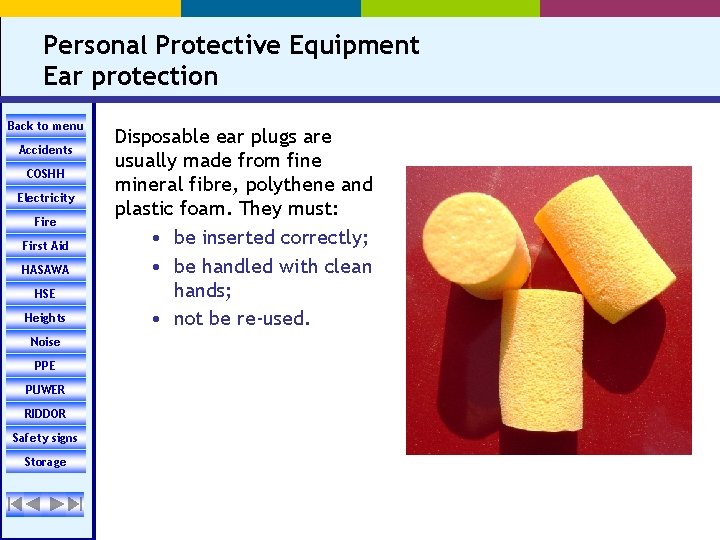
Personal Protective Equipment Ear protection Back to menu Accidents COSHH Electricity Fire First Aid HASAWA HSE Heights Noise PPE PUWER RIDDOR Safety signs Storage Disposable ear plugs are usually made from fine mineral fibre, polythene and plastic foam. They must: • be inserted correctly; • be handled with clean hands; • not be re-used.
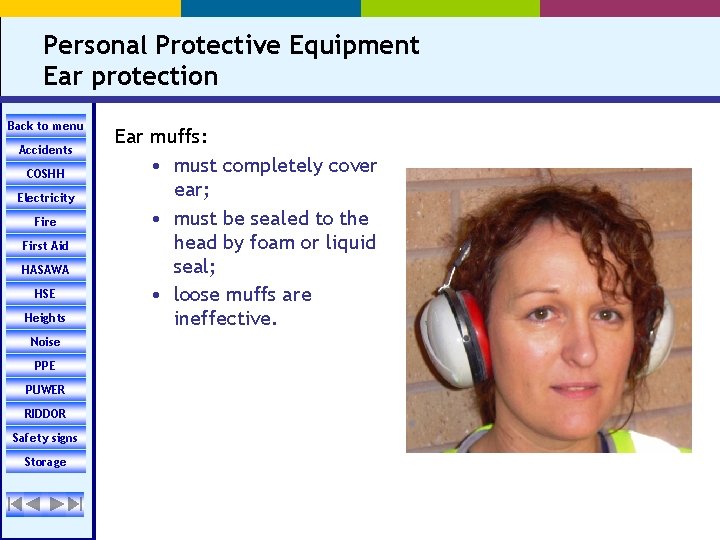
Personal Protective Equipment Ear protection Back to menu Accidents COSHH Electricity Fire First Aid HASAWA HSE Heights Noise PPE PUWER RIDDOR Safety signs Storage Ear muffs: • must completely cover ear; • must be sealed to the head by foam or liquid seal; • loose muffs are ineffective.
Personal Protective Equipment Eye protection Back to menu Accidents COSHH Electricity Fire First Aid HASAWA HSE Heights Noise PPE PUWER RIDDOR Safety signs Storage Eye protection is required by law if there is any possibility of eye injury, for example when: • grinding; • welding; • hammering ; • cutting. Or when using: • hot metal; • chemicals.
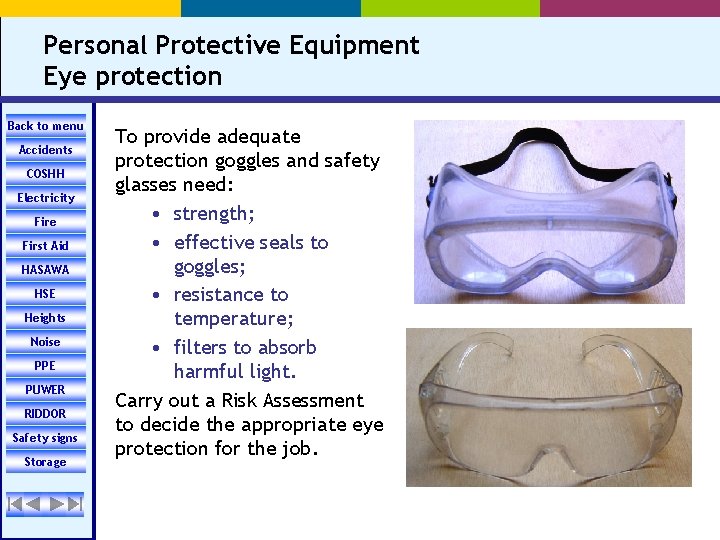
Personal Protective Equipment Eye protection Back to menu Accidents COSHH Electricity Fire First Aid HASAWA HSE Heights Noise PPE PUWER RIDDOR Safety signs Storage To provide adequate protection goggles and safety glasses need: • strength; • effective seals to goggles; • resistance to temperature; • filters to absorb harmful light. Carry out a Risk Assessment to decide the appropriate eye protection for the job.
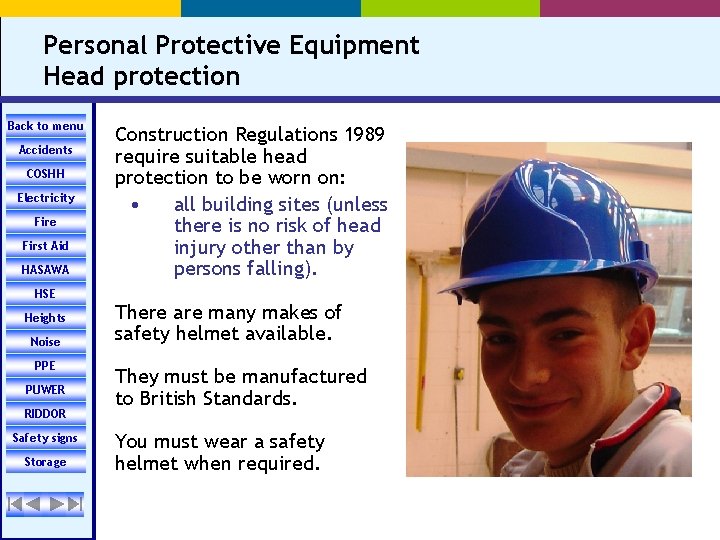
Personal Protective Equipment Head protection Back to menu Accidents COSHH Electricity Fire First Aid HASAWA HSE Heights Noise PPE PUWER RIDDOR Safety signs Storage Construction Regulations 1989 require suitable head protection to be worn on: • all building sites (unless there is no risk of head injury other than by persons falling). There are many makes of safety helmet available. They must be manufactured to British Standards. You must wear a safety helmet when required.
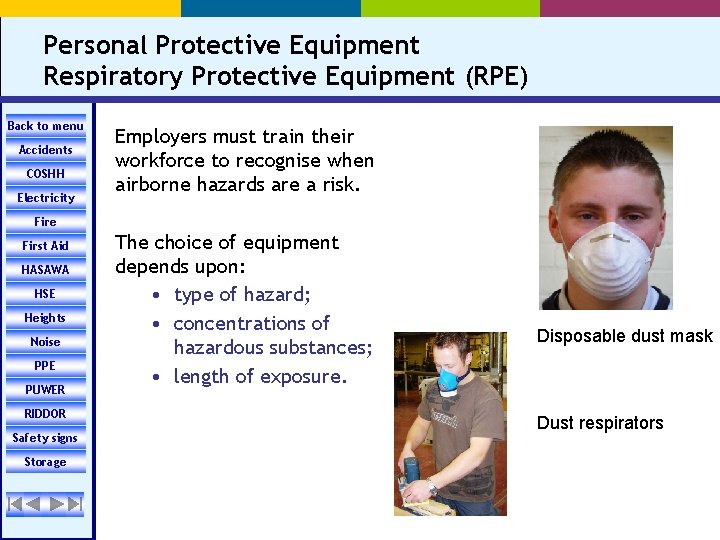
Personal Protective Equipment Respiratory Protective Equipment (RPE) Back to menu Accidents COSHH Electricity Employers must train their workforce to recognise when airborne hazards are a risk. Fire First Aid HASAWA HSE Heights Noise PPE PUWER RIDDOR Safety signs Storage The choice of equipment depends upon: • type of hazard; • concentrations of hazardous substances; • length of exposure. Disposable dust mask Dust respirators
Personal Protective Equipment Skin protection Back to menu Accidents COSHH Electricity Fire First Aid HASAWA HSE Heights Noise PPE PUWER RIDDOR Safety signs Storage Examples of potentially harmful substances include: • pitch, tar, bitumen; • cement, brick, stone dust; • tile, plaster dust; • paint, varnish, lacquer, adhesives; • wood dust, fibre glass, resins; • solvents, fuels, oils; • spirits, thinners, acids, alkalis.
Personal Protective Equipment Skin protection Back to menu Accidents COSHH Electricity Fire First Aid HASAWA HSE Heights Noise PPE PUWER RIDDOR Safety signs Storage Ways to protect your skin from risks includes: • gloves, gauntlets; • overalls or coveralls; • goggles, safety glasses or visor; • aprons; • safety footwear – steel toe caps and mid-sole protection; • leggings.
Personal Protective Equipment Summary Back to menu Accidents COSHH Electricity Fire First Aid HASAWA HSE Heights Noise PPE PUWER RIDDOR Safety signs Storage You must wear appropriate protection for the job to be done. A Risk Assessment carried out before the job starts will determine the appropriate PPE to wear. Remember that: • PPE must be worn when required. • It must be suitable to the work to be carried out. • You must use PPE as directed. • You must report any faulty equipment. • If unsure about anything, you must ask your supervisor.

Back to menu Accidents COSHH Electricity Fire First Aid HASAWA End HSE Heights Noise Return to menu PPE PUWER RIDDOR Safety signs Storage
Back to menu Accidents COSHH Electricity Fire First Aid HASAWA Health and safety in construction HSE Heights Noise Reporting of Injuries and Dangerous Occurrences Regulations (RIDDOR) PPE PUWER RIDDOR Safety signs Storage
The Reporting of Injuries, Diseases and Dangerous Occurrences Regulations (RIDDOR) Back to menu Accidents COSHH Electricity Fire First Aid HASAWA HSE Heights The RIDDOR are about reporting accidents. They cover: • deaths and major injuries; • incapacity to work for more than 3 days; • specified diseases; • dangerous occurrences or near misses. Noise PPE PUWER RIDDOR Safety signs Storage Any of these must be reported to the HSE using the prescribed form. This is available on the web at www. riddor. gov. uk
The Reporting of Injuries, Diseases and Dangerous Occurrences Regulations (RIDDOR) Back to menu Accidents COSHH Electricity Fire First Aid HASAWA HSE Heights Noise PPE PUWER RIDDOR Safety signs Storage It is vital that accurate records are kept of any incident. For example, records may be kept by: • keeping copies of report forms in a filing system; • recording the details on a computer; • keeping a written log in a notebook.
The Reporting of Injuries, Diseases and Dangerous Occurrences Regulations (RIDDOR) Back to menu Accidents COSHH Electricity If you choose to report the incident by telephone or through the website, the Incident Contact Centre will post you back a copy of the record held. Fire First Aid HASAWA HSE Heights Noise PPE PUWER RIDDOR Safety signs Storage You will be able to make amendments to the record if you feel the report is not fully accurate.
The Reporting of Injuries, Diseases and Dangerous Occurrences Regulations (RIDDOR) Back to menu Accidents COSHH Electricity Fire First Aid HASAWA HSE Heights Noise PPE PUWER RIDDOR Safety signs Storage The RIDDOR Regulations apply to the following personnel: • employers; • employees; • self-employed; • trainees; • other people injured on employers’ premises such as visitors.
The Reporting of Injuries, Diseases and Dangerous Occurrences Regulations (RIDDOR) Back to menu Accidents COSHH Electricity Fire First Aid HASAWA HSE Heights Noise PPE PUWER RIDDOR Safety signs Storage Examples of major injuries include: • any fracture, other than to the fingers, thumbs or toes; • amputation of any limb; • dislocation of the shoulder, hip, knee or spine; • loss of sight or penetrating eye injury.
The Reporting of Injuries, Diseases and Dangerous Occurrences Regulations (RIDDOR) Back to menu Accidents COSHH Electricity Fire First Aid HASAWA HSE Heights Noise PPE PUWER RIDDOR Safety signs Storage Examples of serious conditions include: • certain eye injuries; • electric shock requiring attention; • unconsciousness through lack of oxygen; • decompression sickness; • poisoning; • acute illness due to exposure to certain materials; • hospitalisation for more than 24 hours.
The Reporting of Injuries, Diseases and Dangerous Occurrences Regulations (RIDDOR) Back to menu Accidents COSHH Electricity Fire First Aid HASAWA HSE Heights Noise PPE PUWER RIDDOR Safety signs Storage Examples of reportable diseases include: • certain poisonings; • some skin diseases such as occupational dermatitis and skin cancer; • lung diseases including occupational asthma, farmer's lung, pneumoconiosis, asbestosis; • infections such as hepatitis, tuberculosis, anthrax, legionellosis and tetanus; • other conditions such as occupational cancer, decompression illness and vibration white finger.
The Reporting of Injuries, Diseases and Dangerous Occurrences Regulations (RIDDOR) Back to menu Accidents COSHH Electricity Fire First Aid HASAWA HSE Heights Noise PPE PUWER RIDDOR Safety signs Storage Examples of reportable occurrences include: • structural collapses such as buildings or scaffolds; • fires and explosions; • releases of gases or other dangerous substances; • failure of breathing apparatus while in use; • incidents with dangerous substances in transit; • contact with or arcing of overhead cables.
RIDDOR - Summary Back to menu Accidents COSHH Electricity Fire First Aid HASAWA The RIDDOR Regulations cover: • deaths, major injuries and incapacity to work for more than 3 days; • specified diseases; • dangerous occurrences or near misses. HSE Heights Noise PPE PUWER RIDDOR Safety signs Storage And finally, remember: • Keep records of all reports. • RIDDOR involves everyone at work.

Back to menu Accidents COSHH Electricity Fire First Aid HASAWA End HSE Heights Noise Return to menu PPE PUWER RIDDOR Safety signs Storage
Back to menu Accidents COSHH Electricity Fire First Aid HASAWA Health and safety in construction HSE Heights Noise Control of Substances Hazardous to Health (COSHH) PPE PUWER RIDDOR Safety signs Storage
Control of Substances Hazardous to Health Back to menu Accidents COSHH Electricity Fire First Aid HASAWA HSE Heights These Regulations are usually referred to as COSHH and they contain responsibilities for: • employers; • employees; • self employed; • sub contractors. Noise PPE PUWER RIDDOR Safety signs Storage The regulations are aimed at protecting people when working with substances hazardous to their health.
Control of Substances Hazardous to Health Back to menu Accidents COSHH Electricity Fire First Aid HASAWA HSE Heights Noise PPE PUWER RIDDOR Safety signs Storage Employers have a responsibility to: • assess risks to health caused by substances used at work; • prevent or control exposure; • ensure use of control methods; • monitor the work environment; • carry out necessary health surveillance; • provide information, instruction and training as necessary; • provide suitable storage for hazardous substances.
Control of Substances Hazardous to Health Back to menu Accidents COSHH Electricity Fire First Aid HASAWA HSE Heights Noise PPE PUWER RIDDOR Safety signs Storage Employees have a responsibility to: • co-operate with the employer; • make correct use of control measures (safe systems, safety equipment); • report all defects (plant, machinery and safety equipment and other control measures); • attend medical examinations when required; • provide health information to medical advisers when necessary.
Control of Substances Hazardous to Health Back to menu Accidents COSHH Electricity Fire First Aid Hazardous substances are either: • specified by law; • recognised from experience; • recognised with common sense. HASAWA HSE Heights Examples of hazardous substances include: cement plaster wood PUWER paint MDF paints RIDDOR thinners solvents bitumen oil grease dust Noise PPE Safety signs Storage fumes
Control of Substances Hazardous to Health Back to menu Accidents COSHH Electricity Fire First Aid HASAWA HSE Heights Noise PPE PUWER RIDDOR Safety signs Storage There may be hazardous substances all around our working and living environment. For example, toxic substances may already be on site: • in the soil from a previous use of the site; • in silica contained in masonry and mortars; • in accumulations of bird droppings; • in substances left by others; • in industrial waste; • in spillage of hazardous liquids.
Control of Substances Hazardous to Health Back to menu Accidents COSHH Electricity Fire First Aid COSHH does not apply to work with: • asbestos; • lead; • radioactive materials. HASAWA HSE Heights Noise These substances have their own specific legislation as they present a much greater hazard. PPE PUWER RIDDOR Safety signs Storage Specialist training is required to work with these substances.
Control of Substances Hazardous to Health Back to menu Accidents COSHH Electricity Fire Harmful substances may include: • solid materials; • liquid; • gas; • micro-organisms. First Aid HASAWA HSE Heights Noise PPE Hazardous substances can be: • breathed in; • absorbed through skin; • swallowed. PUWER RIDDOR Safety signs Storage Effects vary between individuals. Some may be instant and result in long term illness or even death.
COSHH – Things to remember Back to menu Accidents COSHH Electricity Fire First Aid HASAWA HSE Heights Noise PPE PUWER RIDDOR Safety signs Storage Think about the working environment: • What are the hazards? • What are the rules? (safe systems, safety equipment) • Who else is involved? Can I endanger them? Can they endanger me? • How do I plan the work? • Does everything work correctly? • Do not use unsafe equipment and report all defects.
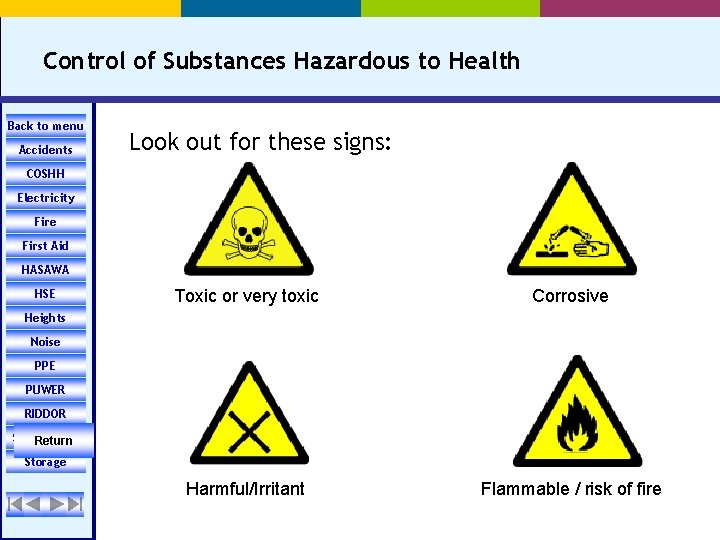
Control of Substances Hazardous to Health Back to menu Accidents Look out for these signs: COSHH Electricity Fire First Aid HASAWA HSE Toxic or very toxic Corrosive Harmful/Irritant Flammable / risk of fire Heights Noise PPE PUWER RIDDOR Safety signs Return Storage

Back to menu Accidents COSHH Electricity Fire First Aid HASAWA End HSE Heights Noise Return to menu PPE PUWER RIDDOR Safety signs Storage
Back to menu Accidents COSHH Electricity Fire First Aid HASAWA HSE Heights Noise Health and safety in construction PPE PUWER First aid RIDDOR Safety signs Storage
First aid Back to menu Accidents COSHH Electricity Fire First Aid HASAWA HSE Heights Noise PPE PUWER RIDDOR Safety signs Storage Employers have to make sure they: • can treat employees and others who are injured or become ill at work; • appoint a first aider(s), depending on the number of employees; • assess the risk involved in the workplace; • nominate an ‘appointed person’ to take charge where the risk is low and/or there a few employees. Most large companies have first aiders and appointed persons.
First aid – the kit Back to menu Accidents COSHH Electricity Fire First Aid HASAWA HSE Heights Noise PPE PUWER RIDDOR A basic first aid kit should contain: – – – 20 x individually wrapped sterile adhesive dressings (6). 2 x sterile eye pads. 6 x Individually wrapped triangular bandages (2). 6 x safety pins (2). 6 x medium sized wrapped sterile un-medicated wound dressings. – 2 x large sized wrapped sterile un-medicated wound dressings (1). – 3 x extra large sized wrapped sterile un-medicated wound dressings. – 1 x guidance leaflet ‘First Aid at Work’ (1). Safety signs Storage (numbers in brackets apply to travelling first aid kits)
First aid – do you know? Back to menu Accidents COSHH Electricity Fire First Aid HASAWA HSE Heights Noise PPE PUWER RIDDOR Safety signs Storage It is important that all employees know about first aid arrangements in the workplace. Employers have to tell employees by: • displaying notices and signs stating where the first aid kit is; • naming the appointed person and saying where to find them. Ask yourself: • do you know where your own workplace first aid kit is? • do you know who your appointed first aider is?
Summary - First aid Back to menu Accidents COSHH Electricity Fire First Aid HASAWA HSE Heights Noise PPE PUWER RIDDOR Safety signs Storage There are over 13, 000 accidents reported each year in construction! • The majority of these could easily have been prevented by employers and operatives following basic safety procedures. • An employer has to provide first aid materials to deal with minor injuries or conditions such as cuts, fractures, burns, and so on. • If you follow safe working procedures, you can make a difference.

Back to menu Accidents COSHH Electricity Fire First Aid HASAWA End HSE Heights Noise Return to menu PPE PUWER RIDDOR Safety signs Storage
Back to menu Accidents COSHH Electricity Fire First Aid HASAWA HSE Heights Noise Health and safety in construction PPE PUWER Preventing fire RIDDOR Safety signs Storage
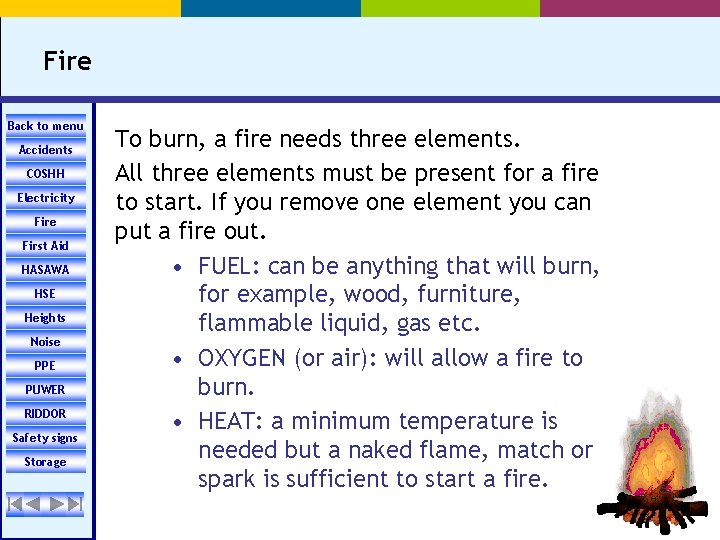
Fire Back to menu Accidents COSHH Electricity Fire First Aid HASAWA HSE Heights Noise PPE PUWER RIDDOR Safety signs Storage To burn, a fire needs three elements. All three elements must be present for a fire to start. If you remove one element you can put a fire out. • FUEL: can be anything that will burn, for example, wood, furniture, flammable liquid, gas etc. • OXYGEN (or air): will allow a fire to burn. • HEAT: a minimum temperature is needed but a naked flame, match or spark is sufficient to start a fire.
Reducing fire risk Back to menu Accidents COSHH Electricity Fire First Aid HASAWA HSE Heights Noise PPE PUWER RIDDOR Safety signs Storage Things which might help reduce the risk of fire being started or people being harmed if there is a fire are: • not smoking at work (no smoking areas should be designated); • maintaining all electrical appliances in a safe manner; • good housekeeping, being tidy; • removing combustible materials outside to a safe place.
Reducing fire risk Back to menu Accidents COSHH Electricity Fire First Aid HASAWA HSE Heights Noise PPE PUWER RIDDOR Safety signs Storage Help prevent fires by: • not storing highly flammable liquids unless necessary; • disposing of cigarettes carefully; • having clearly marked fire points nearby; • having procedures if there is a fire; • putting up signs and notices so people know what to do; • having regular evacuation drills; • keeping fire exits clear; • testing fire alarms frequently.
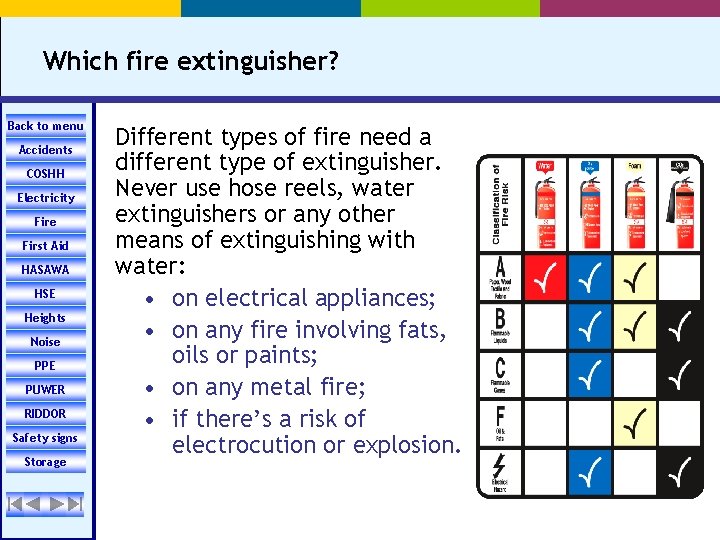
Which fire extinguisher? Back to menu Accidents COSHH Electricity Fire First Aid HASAWA HSE Heights Noise PPE PUWER RIDDOR Safety signs Storage Different types of fire need a different type of extinguisher. Never use hose reels, water extinguishers or any other means of extinguishing with water: • on electrical appliances; • on any fire involving fats, oils or paints; • on any metal fire; • if there’s a risk of electrocution or explosion.
In case of fire Back to menu Accidents COSHH Electricity Fire First Aid HASAWA HSE Heights Noise PPE PUWER RIDDOR Safety signs Storage If a fire does break out, no matter how small: • raise the fire alarm; • call the fire brigade; • close all doors and windows to prevent spread; • leave the building.
Fire - summary Back to menu Accidents COSHH Electricity Fire First Aid HASAWA HSE Heights Noise PPE PUWER RIDDOR Safety signs Storage At the end of this presentation you will have learnt: • fire requires three elements: heat, oxygen, fuel. Remove one element and the fire will not burn. • all fire extinguishers are colour-coded for the type of fire they can be used on; • you will reduce fire risk in the first place by keeping a clear and tidy workplace; • you need to know the location of your own workplace fire evacuation procedure; • you need to know how to raise the alarm.

Back to menu Accidents COSHH Electricity Fire First Aid HASAWA End HSE Heights Noise Return to menu PPE PUWER RIDDOR Safety signs Storage
Back to menu Accidents COSHH Electricity Fire First Aid HASAWA HSE Heights Noise Health and safety in construction PPE PUWER Electricity RIDDOR Safety signs Storage
Working with power: electrical safety Back to menu Accidents COSHH Electricity Fire First Aid HASAWA Electricity is a very dangerous form of energy because: • it is invisible; • it can start fires; • it can kill. HSE Heights Noise PPE PUWER In the construction industry about 7 people are killed each year by electrocution. RIDDOR Safety signs Storage Many more are seriously injured.
Working with power tools Back to menu Accidents COSHH Electricity Fire First Aid HASAWA HSE Heights Noise PPE PUWER RIDDOR Safety signs Storage Here are some tips for safe use of power tools: • Follow the safety procedures and never tamper with live electrical cables or machinery. • Make sure any electrical equipment including power tools are in good condition and safe to work with. • Do not plug in the power tool before checking it. Remember: • If you plug in the power tool and there is a fault, you could be seriously injured or killed. • Minor shocks can trigger a secondary accident such as a fall from height.
Working with power tools Back to menu Accidents COSHH Electricity Fire First Aid HASAWA HSE Heights Noise PPE PUWER RIDDOR Safety signs Storage Before • • • use always check the body of the power tool: Is it clean? Is it dry? Has it got a Portable Appliance Testing (PAT) label? • Are there any visible cracks? • Are there any loose or missing parts?
Working with power tools Back to menu Accidents COSHH Electricity Fire First Aid HASAWA HSE Heights Noise PPE PUWER RIDDOR Safety signs Storage Before for: • • use always check the cable of the power tool bare wires; frayed ends; cuts or burns; other obvious damage.
Working with power tools Back to menu Accidents COSHH Electricity Fire First Aid Before use always check the voltage label of the power tool: • Is it 110 volts? • Does it have a 110 volt yellow plug? HASAWA HSE Heights Noise PPE PUWER RIDDOR Safety signs Storage Before use always check the plug of the power tool for: • cracks; • loose or misshapen pins.
Working with power tools - summary Back to menu Accidents COSHH Electricity Fire First Aid HASAWA HSE Heights Noise PPE PUWER RIDDOR Safety signs Storage Don’t forget! • Check the voltage: is it 110 volts? Does it have a 110 volt yellow plug? • Are the tool, cable and plug in good condition? • Know how to isolate power in an emergency. • Although there is no set order for checking portable power tools, it is good practice to plan your own procedure. • Get into the habit of checking every power tool before you use it. • Your life may depend on it!

Back to menu Accidents COSHH Electricity Fire First Aid HASAWA End HSE Heights Noise Return to menu PPE PUWER RIDDOR Safety signs Storage
Back to menu Accidents COSHH Electricity Fire First Aid HASAWA HSE Heights Noise Health and safety in construction PPE PUWER Noise RIDDOR Safety signs Storage
What is noise? Back to menu Accidents COSHH Electricity Fire First Aid • Any sound that is especially loud, harsh or disagreeable constitutes noise. • Sound travels in waves through the air. HASAWA HSE Heights Noise PPE PUWER RIDDOR Safety signs Storage Our ears collect sounds, then pass on the information to the brain by pressure vibrating on the ear drum. We measure noise in Decibels (d. B - units of sound)
How can noise damage our hearing? Back to menu Accidents COSHH Electricity Fire First Aid HASAWA HSE Heights Noise PPE PUWER RIDDOR Safety signs Storage Our hearing is sensitive and needs to be protected. • When sound levels are too high or prolonged, we slowly damage our hearing. • Over time, the range of sounds we pick up is less and less. Ear protection must be worn where you see this sign. Typical ear protectors
When will noise damage our hearing? Back to menu Accidents COSHH Electricity Fire First Aid HASAWA HSE Heights Noise PPE PUWER RIDDOR Safety signs Storage Our hearing can be damaged by: • exposure to loud noise over a period of time; • constant noise, even at lower levels; • sudden noise; • air pressure from an explosion. These are all dependent on: • the distance between you and the noise source; • the length of time of exposure to the noise; • the personal protective equipment being worn.
Measuring noise Back to menu Accidents COSHH Electricity Fire First Aid HASAWA HSE Heights Noise PPE PUWER RIDDOR Safety signs Storage The Noise at Work Regulations identify three ‘action levels’ or ‘daily personal exposure’ to noise: 1 st action level: 85 d. B (80 d. B from April 2006) • employees can request and be provided with suitable and efficient personal ear protection. 2 nd action level: 90 d. B (85 d. B from April 2006) • employees are provided with suitable personal ear protection. Peak action level: 140 d. B • employees must wear protection.
Eliminate, reduce, isolate and control noise Back to menu Accidents COSHH Electricity Fire First Aid HASAWA HSE Heights Noise PPE PUWER RIDDOR Safety signs Storage To eliminate noise: • use different types of tools and materials. To reduce noise: • maintain tools, dampen noise with absorbers or buy new tools with improved sound levels. To isolate noise: • use sound barriers, sound insulating separate rooms, and so on. To control noise: • plan and establish “quiet hours” and sound level limits.
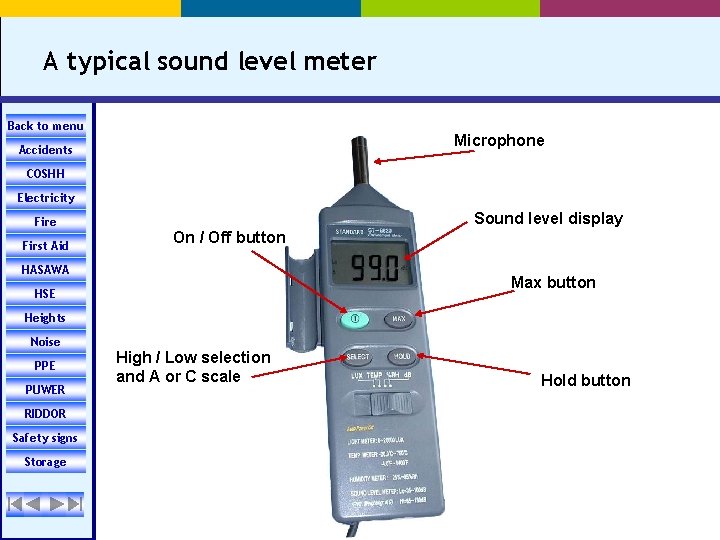
A typical sound level meter Back to menu Microphone Accidents COSHH Electricity Sound level display Fire First Aid On / Off button HASAWA Max button HSE Heights Noise PPE PUWER RIDDOR Safety signs Storage High / Low selection and A or C scale Hold button
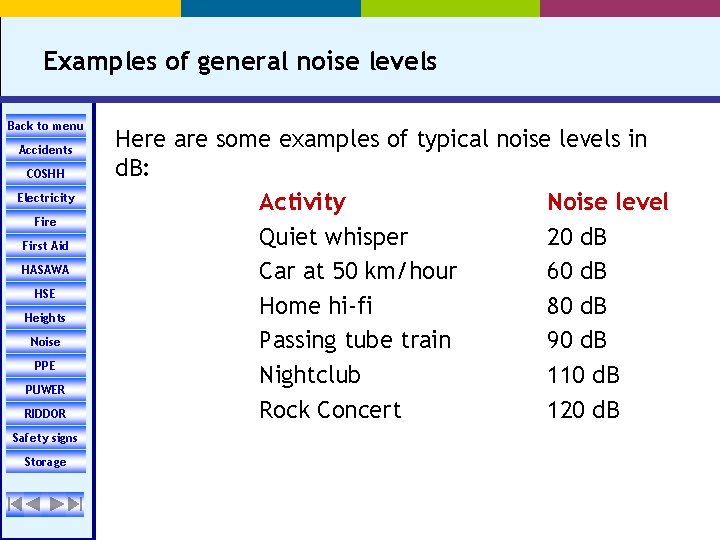
Examples of general noise levels Back to menu Accidents COSHH Electricity Fire First Aid HASAWA HSE Heights Noise PPE PUWER RIDDOR Safety signs Storage Here are some examples of typical noise levels in d. B: Activity Noise level Quiet whisper 20 d. B Car at 50 km/hour 60 d. B Home hi-fi 80 d. B Passing tube train 90 d. B Nightclub 110 d. B Rock Concert 120 d. B
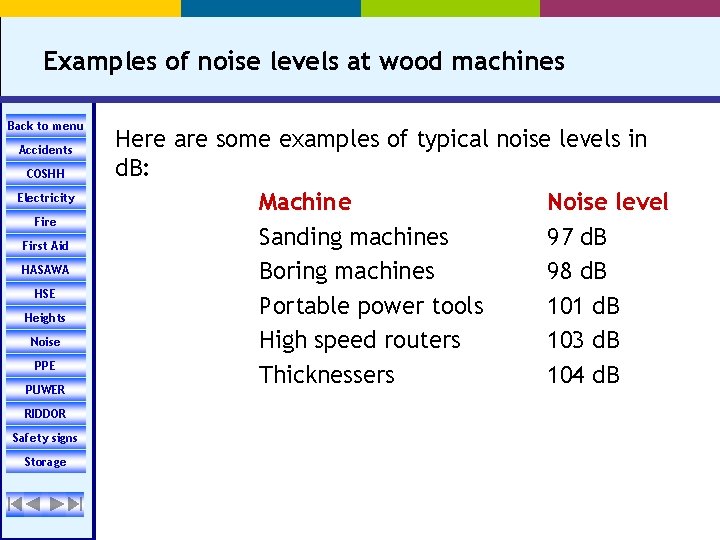
Examples of noise levels at wood machines Back to menu Accidents COSHH Electricity Fire First Aid HASAWA HSE Heights Noise PPE PUWER RIDDOR Safety signs Storage Here are some examples of typical noise levels in d. B: Machine Noise level Sanding machines 97 d. B Boring machines 98 d. B Portable power tools 101 d. B High speed routers 103 d. B Thicknessers 104 d. B
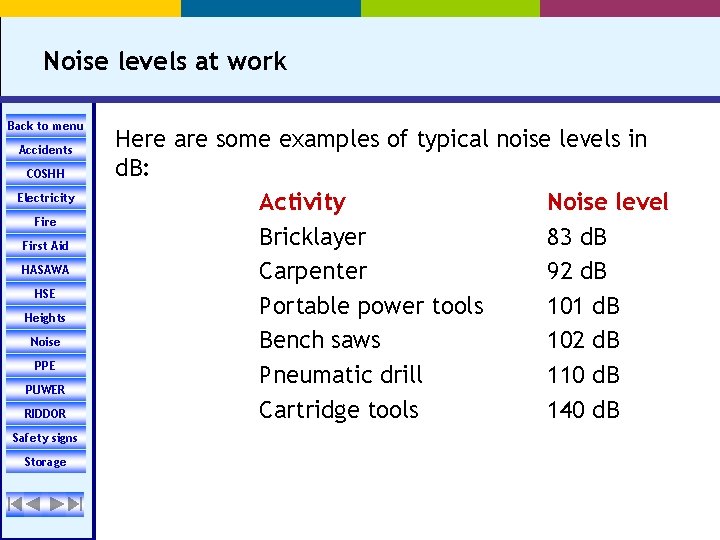
Noise levels at work Back to menu Accidents COSHH Electricity Fire First Aid HASAWA HSE Heights Noise PPE PUWER RIDDOR Safety signs Storage Here are some examples of typical noise levels in d. B: Activity Noise level Bricklayer 83 d. B Carpenter 92 d. B Portable power tools 101 d. B Bench saws 102 d. B Pneumatic drill 110 d. B Cartridge tools 140 d. B
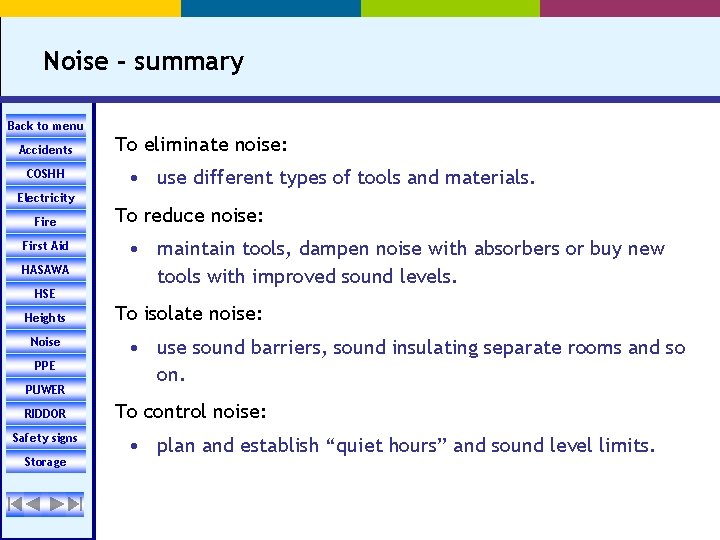
Noise - summary Back to menu Accidents COSHH Electricity Fire First Aid HASAWA HSE Heights Noise PPE PUWER RIDDOR Safety signs Storage To eliminate noise: • use different types of tools and materials. To reduce noise: • maintain tools, dampen noise with absorbers or buy new tools with improved sound levels. To isolate noise: • use sound barriers, sound insulating separate rooms and so on. To control noise: • plan and establish “quiet hours” and sound level limits.

Back to menu Accidents COSHH Electricity Fire First Aid HASAWA End HSE Heights Noise Return to menu PPE PUWER RIDDOR Safety signs Storage
Back to menu Accidents COSHH Electricity Fire First Aid HASAWA HSE Heights Noise Health and safety in construction PPE PUWER Safety signs RIDDOR Safety signs Storage
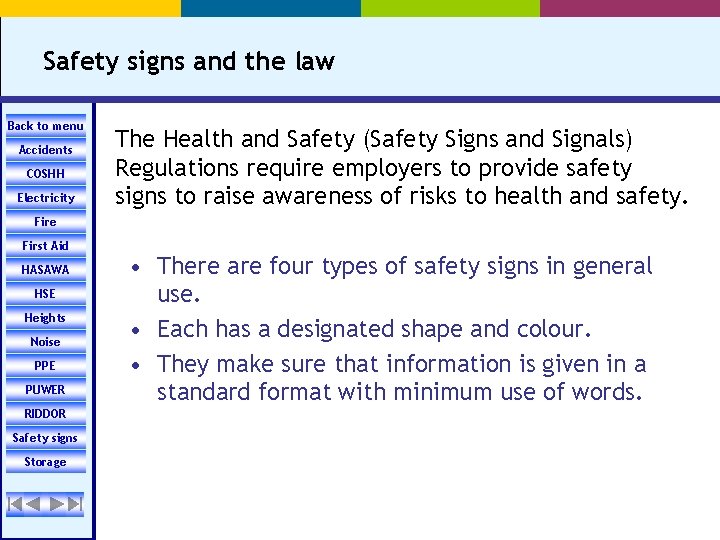
Safety signs and the law Back to menu Accidents COSHH Electricity The Health and Safety (Safety Signs and Signals) Regulations require employers to provide safety signs to raise awareness of risks to health and safety. Fire First Aid HASAWA HSE Heights Noise PPE PUWER RIDDOR Safety signs Storage • There are four types of safety signs in general use. • Each has a designated shape and colour. • They make sure that information is given in a standard format with minimum use of words.
Safety signs Back to menu Accidents COSHH Electricity Fire First Aid HASAWA HSE Heights Noise PPE PUWER RIDDOR Safety signs Storage Remember the general duties of employees: • To co-operate with the employer by observing signs; • To comply with the law and the employer’s safe systems of work; • To use safety equipment properly and correctly; • Not to tamper with, deface, or remove safety signs.
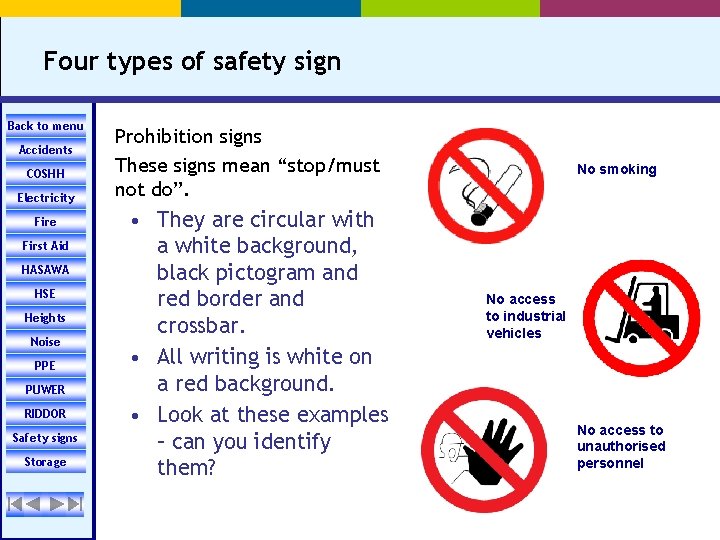
Four types of safety sign Back to menu Accidents COSHH Electricity Fire First Aid HASAWA HSE Heights Noise PPE PUWER RIDDOR Safety signs Storage Prohibition signs These signs mean “stop/must not do”. • They are circular with a white background, black pictogram and red border and crossbar. • All writing is white on a red background. • Look at these examples – can you identify them? No smoking No access to industrial vehicles No access to unauthorised personnel
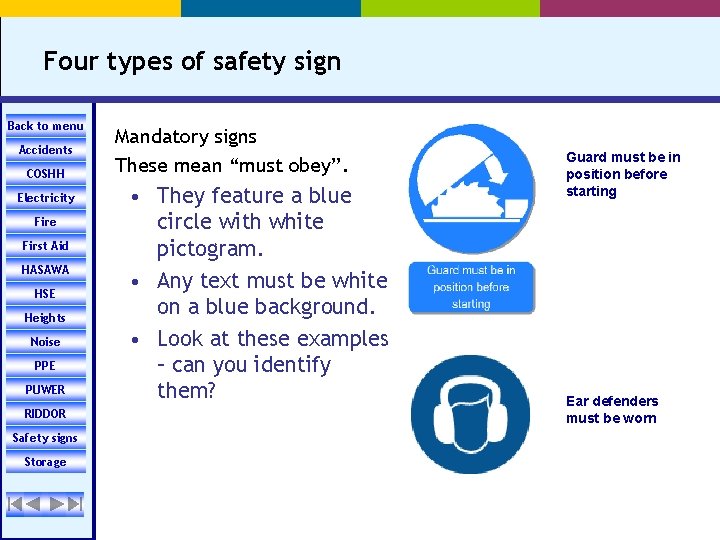
Four types of safety sign Back to menu Accidents COSHH Electricity Fire First Aid HASAWA HSE Heights Noise PPE PUWER RIDDOR Safety signs Storage Mandatory signs These mean “must obey”. • They feature a blue circle with white pictogram. • Any text must be white on a blue background. • Look at these examples – can you identify them? Guard must be in position before starting Ear defenders must be worn
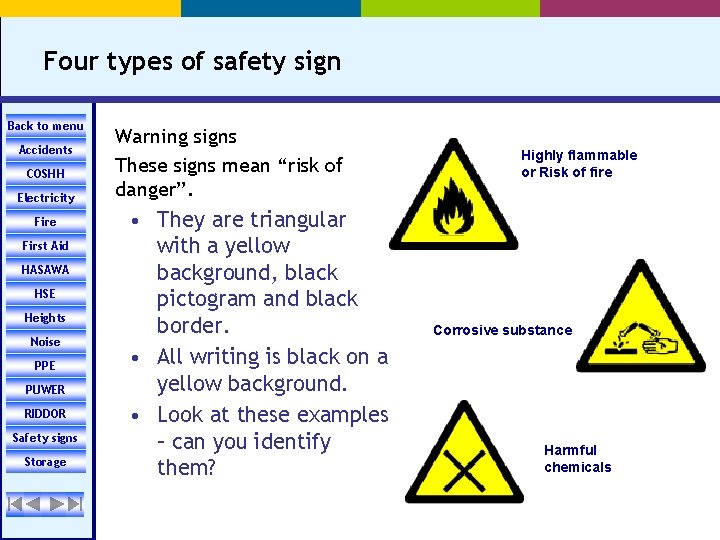
Four types of safety sign Back to menu Accidents COSHH Electricity Fire First Aid HASAWA HSE Heights Noise PPE PUWER RIDDOR Safety signs Storage Warning signs These signs mean “risk of danger”. • They are triangular with a yellow background, black pictogram and black border. • All writing is black on a yellow background. • Look at these examples – can you identify them? Highly flammable or Risk of fire Corrosive substance Harmful chemicals
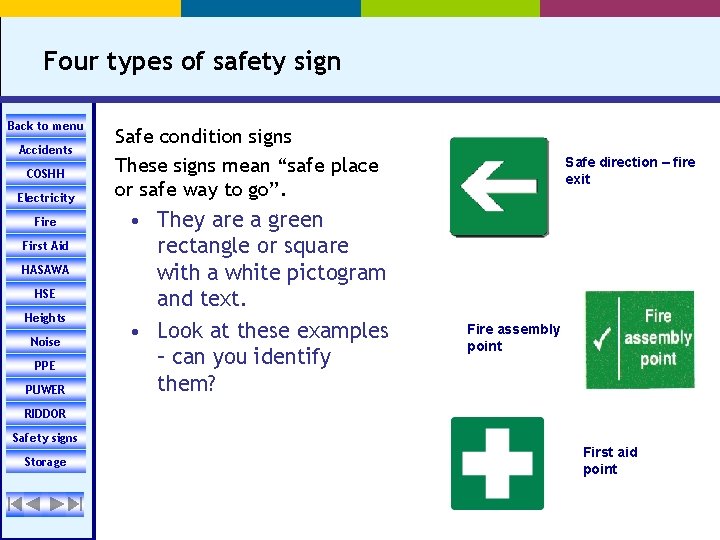
Four types of safety sign Back to menu Accidents COSHH Electricity Fire First Aid HASAWA HSE Heights Noise PPE PUWER Safe condition signs These signs mean “safe place or safe way to go”. • They are a green rectangle or square with a white pictogram and text. • Look at these examples – can you identify them? Safe direction – fire exit Fire assembly point RIDDOR Safety signs Storage First aid point
Safety signs - summary Back to menu Accidents COSHH Electricity Fire First Aid HASAWA HSE Heights Noise PPE PUWER RIDDOR Safety signs Storage There are four types of safety signs in general use: • Prohibition. • Mandatory. • Warning. • Safe condition. Each have a designated shape and colour. If you are unsure about the meaning of a sign or the risks involved in a task always ask your supervisor.

Back to menu Accidents COSHH Electricity Fire First Aid HASAWA HSE Heights End Noise PPE Return to menu PUWER RIDDOR Safety signs Storage
Back to menu Accidents COSHH Electricity Fire First Aid HASAWA HSE Heights Noise Health and safety in construction PPE PUWER Site layout and storage of materials RIDDOR Safety signs Storage
Site layout Back to menu Accidents COSHH Electricity A construction site can be seen as a temporary workshop or store from which a contractor will erect a building. Fire First Aid HASAWA HSE Heights Noise PPE PUWER RIDDOR Safety signs Storage A site should be planned to minimise movement of: • operatives; • materials; • plant. Points to consider when planning layout: • comply with HASAWA; • comply with Construction Regulations.
Safe storage of materials Back to menu Accidents COSHH Electricity Fire First Aid When storing materials, we must consider: • materials ready for use; • materials required at a later date; • protection, safety and security. HASAWA HSE Heights Noise PPE Material storage areas should be: • convenient for site access; • convenient for the building itself. PUWER RIDDOR Safety signs Storage Different materials have different requirements. We must consider phased deliveries of materials.
Safe storage of materials Back to menu Accidents COSHH Electricity Fire First Aid Large valuable items such as: • Door/window frames, PVC pipes & drainage fittings should be stored in a fenced and locked compound. HASAWA HSE Heights Noise PPE PUWER RIDDOR Safety signs Storage Smaller valuable items such as: • Ironmongery, fixings such as nails and screws, copper pipe, electrical wire and fittings should be stored in lockable covered site huts.
Safe storage of materials Back to menu Accidents COSHH Electricity Fire First Aid HASAWA HSE Heights Noise PPE PUWER RIDDOR Safety signs Storage Materials have different storage requirements. For example, materials stored outside must be: • protected from the weather; • stored and stacked safely; • located to avoid site congestion; • stored clear of machinery and fire fighting equipment; • stored as close as safely possible to working area; • kept clear from edges of excavations.
Safe storage of materials Back to menu Accidents COSHH Electricity Fire First Aid HASAWA HSE Heights Noise PPE PUWER RIDDOR Safety signs Storage Some materials are best stored indoors for protection from the elements and security: • Materials such as adhesives, paints, varnishes, putties and mastics can dry out if stored at too high temperature. • Flammable liquids such as white spirit, thinner, petrol and some paints and varnishes should be stored in a cool, dry lockable place. • Non durable materials such as timber, cement and plaster require weather protection.
Safe storage of materials Back to menu Accidents COSHH Electricity Fire First Aid HASAWA HSE Heights Noise PPE PUWER RIDDOR Safety signs Storage • Boxed or canned dry materials such as powder adhesives, wallpaper paste, fillers and detergents become useless if exposed to moisture. • Similar items should be stored next to each other using shelving or a bin system and clearly labelled. • Keep a tally card record or a computerised system. • Heavy items should be stored at low level. • New deliveries should be stored at back of existing stock, first in, first out.

Back to menu Accidents COSHH Electricity Fire First Aid HASAWA HSE Heights End Noise PPE Return to menu PUWER RIDDOR Safety signs Storage
Back to menu Accidents COSHH Electricity Fire First Aid HASAWA HSE Heights Noise Health and safety in construction PPE PUWER Working at height RIDDOR Safety signs Storage
Working at height – statistics Back to menu Accidents COSHH Electricity Fire First Aid HASAWA HSE Heights Noise PPE PUWER RIDDOR Safety signs Storage Falls are the main cause of accident in construction: • Falls from heights are the most common cause of fatal injuries in construction (50%). • Around 24% of falls are from ladders, causing around 515 injuries per year. • About 150 injuries per year are caused by falls from scaffolding. • About 128 injuries per year are caused by falls from work area/platforms.
Working at height - issues Back to menu Accidents COSHH Electricity Fire First Aid HASAWA HSE Heights Noise PPE PUWER RIDDOR Safety signs Storage The most common accidents involve: • over-reaching; • balancing; • equipment failure; • misuse of equipment; • unexpected movement (particularly where ladders are involved); • failure of a fragile surface; • working in poor weather conditions; • injuries from falling objects.
The Work at Height Regulations 2005 Back to menu Accidents COSHH Electricity Fire First Aid HASAWA HSE Heights Noise PPE PUWER RIDDOR Safety signs Storage The Work at Height Regulations 2005 came into effect on 6 April 2005. The Regulations will apply to all work at height where there is a risk of a fall liable to cause personal injury. Duty holders must: • avoid work at height where they can; • use work equipment or other measures to prevent falls where they cannot avoid working at height; • where they cannot eliminate the risk of a fall, use work equipment or other measures to minimise the distance and consequences of a fall should one occur.
The Work at Height Regulations 2005 Back to menu Accidents COSHH A place is ‘at height’ if a person could be injured falling from it, even if it is at or below ground level. Electricity Fire First Aid HASAWA HSE Heights Noise PPE PUWER RIDDOR Safety signs Storage The Regulations require duty holders to ensure: • all work at height is properly planned and organised; • all work at height takes account of weather conditions that could endanger health and safety; • those involved in work at height are trained and competent; • the place where work at height is done is safe; • equipment for work at height is appropriately inspected; • the risks from fragile surfaces are properly controlled; • the risks from falling objects are properly controlled.
Working at height – some reasons for incidents Back to menu Accidents COSHH Electricity Fire First Aid HASAWA HSE Heights Noise PPE PUWER RIDDOR Safety signs Storage Incidents usually arise due to poor management control rather than because of equipment failure. Some of the most common reasons are: • Failure to recognise a problem. • Failure to ensure that safe systems of work are followed. • Failure to provide a safe system of work. • Inadequate information, instruction, training or supervision provided. • Failure to use appropriate equipment. • Failure to provide safe plant and equipment.
Working at height Back to menu Accidents COSHH Electricity Fire First Aid HASAWA HSE Heights Noise PPE PUWER RIDDOR Safety signs Storage Make sure that you: • plan and organise what you do; • work from a safe and secure place or platform with proper edge protection; • only use scaffolds and scaffold towers that are completely erected; • use powered access equipment safely; • protect holes and leading edges, for example, with guard rails and toe boards; • make sure that you are trained and competent; • raise any problems with your supervisor.
Working at height – dos and don’ts Back to menu Accidents COSHH Electricity Fire First Aid HASAWA When working on a roof, avoid: • working in poor weather; • working on sloping roofs without proper edge protection; • throwing down waste or equipment. HSE Heights Noise PPE PUWER RIDDOR Safety signs Storage Take care when working on or near fragile roof material. Remember that you can fall through it as well as off it.
Working at height – dos and don’ts Back to menu Accidents COSHH Electricity Fire First Aid HASAWA HSE Heights Noise PPE PUWER RIDDOR Safety signs Storage Only use ladders for light work of short duration. • Use correct angle to prevent slipping (ratio of 1 in 4). • Make sure ladders are secured at top and bottom. • Always make sure ladders are properly maintained. • Never paint any ladder as this can hide defects. • Never use a ladder with missing or damaged parts. • Never over-reach.
Types and use of access equipment Back to menu Accidents COSHH Electricity Fire First Aid HASAWA HSE Heights Noise PPE PUWER RIDDOR Safety signs Storage Work which can not be carried out from ground level will require a working platform with appropriate guard rails. These include: • scaffolding; • mobile/static towers; • lightweight staging; • hop-ups; • ladders.
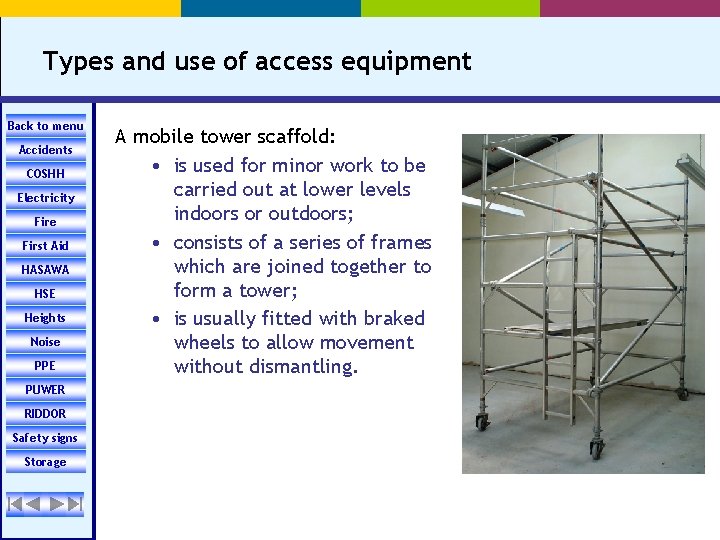
Types and use of access equipment Back to menu Accidents COSHH Electricity Fire First Aid HASAWA HSE Heights Noise PPE PUWER RIDDOR Safety signs Storage A mobile tower scaffold: • is used for minor work to be carried out at lower levels indoors or outdoors; • consists of a series of frames which are joined together to form a tower; • is usually fitted with braked wheels to allow movement without dismantling.
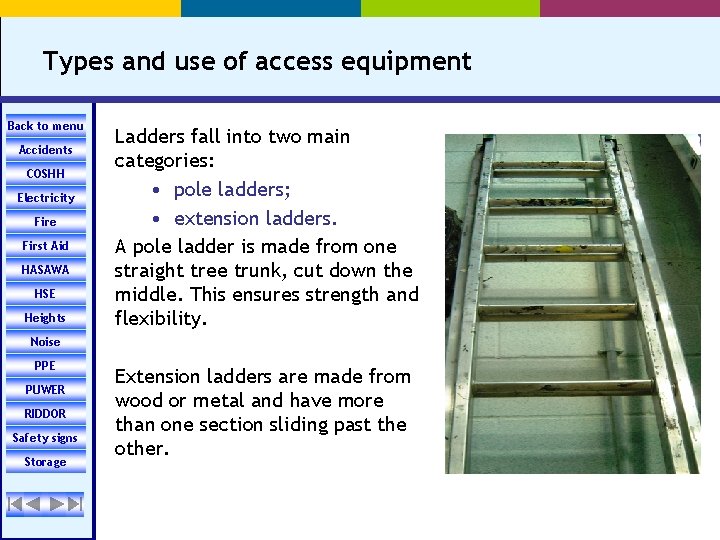
Types and use of access equipment Back to menu Accidents COSHH Electricity Fire First Aid HASAWA HSE Heights Ladders fall into two main categories: • pole ladders; • extension ladders. A pole ladder is made from one straight tree trunk, cut down the middle. This ensures strength and flexibility. Noise PPE PUWER RIDDOR Safety signs Storage Extension ladders are made from wood or metal and have more than one section sliding past the other.
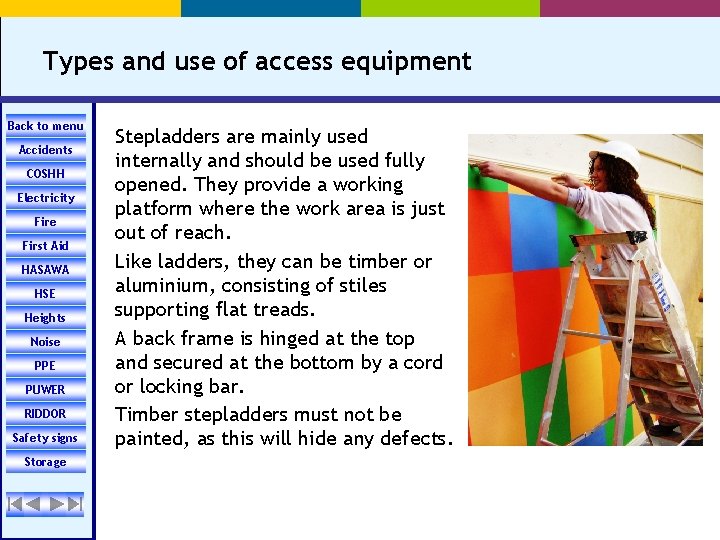
Types and use of access equipment Back to menu Accidents COSHH Electricity Fire First Aid HASAWA HSE Heights Noise PPE PUWER RIDDOR Safety signs Storage Stepladders are mainly used internally and should be used fully opened. They provide a working platform where the work area is just out of reach. Like ladders, they can be timber or aluminium, consisting of stiles supporting flat treads. A back frame is hinged at the top and secured at the bottom by a cord or locking bar. Timber stepladders must not be painted, as this will hide any defects.
Types and use of access equipment - summary Back to menu Accidents COSHH Electricity Fire First Aid HASAWA HSE Heights Noise PPE PUWER RIDDOR Safety signs Storage • There is enough variety of access equipment for any job at height to be carried out safely. • If you find any defects on a scaffold or working platform report it immediately to your supervisor and take appropriate action to make sure no-one else can use it. • If in doubt always ask your supervisor.
Back to menu Accidents COSHH Electricity Fire First Aid HASAWA HSE Heights End Noise PPE Return to menu PUWER RIDDOR Safety signs Storage
- Slides: 141