
Back to Basics VFR COMMUNICATIONS NONTOWERED AIRPORTS MIKE
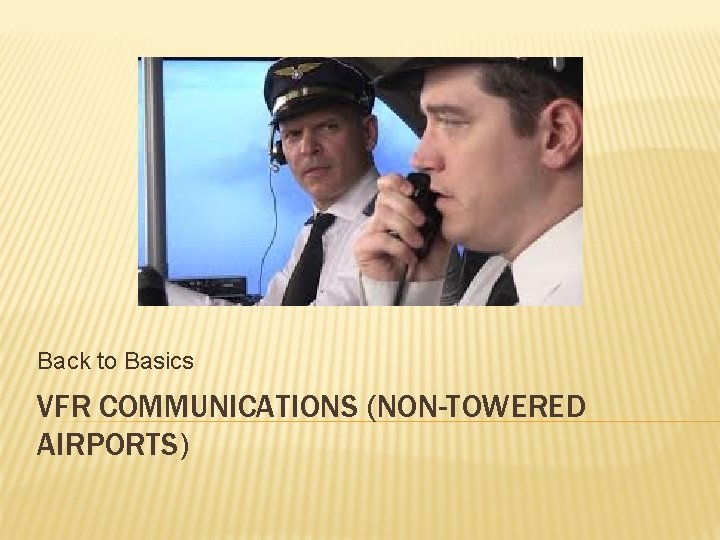
Back to Basics VFR COMMUNICATIONS (NON-TOWERED AIRPORTS)
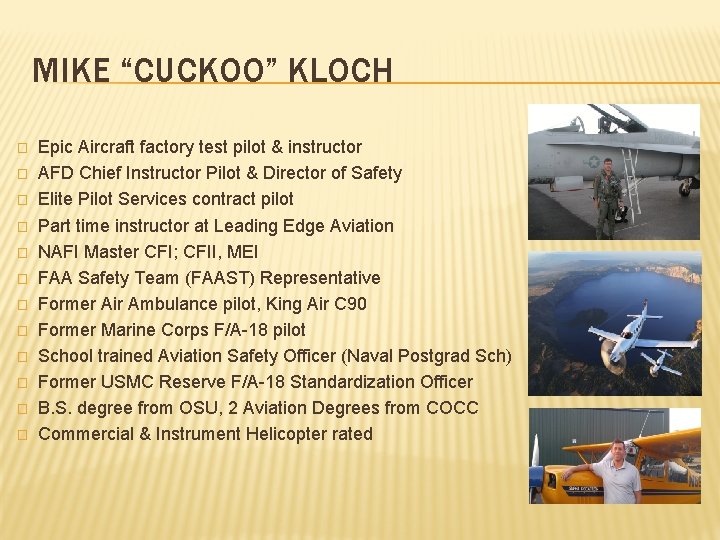
MIKE “CUCKOO” KLOCH � � � Epic Aircraft factory test pilot & instructor AFD Chief Instructor Pilot & Director of Safety Elite Pilot Services contract pilot Part time instructor at Leading Edge Aviation NAFI Master CFI; CFII, MEI FAA Safety Team (FAAST) Representative Former Air Ambulance pilot, King Air C 90 Former Marine Corps F/A-18 pilot School trained Aviation Safety Officer (Naval Postgrad Sch) Former USMC Reserve F/A-18 Standardization Officer B. S. degree from OSU, 2 Aviation Degrees from COCC Commercial & Instrument Helicopter rated
AGENDA � � � � The Problem and the Solution The Goal Radio Technique When & Where to Talk The 7 Deadly Sins of Radio Communications Communication Format Words & Phrases to Avoid Do Not’s Examples of Bad Radio Calls Other Communications Teaching Tips Benefits of Good Radio Work The Challenge
THE PROBLEM Problem There is an excess of bad radio communications at non-towered airports Why? Lack of literature? � One of the lease emphasized parts of pilot training � A lack of understanding of the importance of good communications � Accepting “good enough” �
THE SOLUTION Solution � Study what makes good radio communications and practice! � Think about how you sound to the others receiving your calls. Will your call be useful to anyone? � Learn/Teach correct comms. from the beginning and accept nothing less!
WHY IS THIS IMPORTANT � Why do we talk on the radio at a non-towered airport? - SAFETY!!
THE GOAL � Good radio transmissions are timely, precise, concise and disciplined. � Bad radio transmissions are slow (or late, or early), sloppy, long-winded and disorganized, filled with pauses and extraneous verbiage. Good radio work is the hallmark of a proficient, intelligent professional pilot. � Every pilot’s goal must be to convey the relevant information needed in a short period of time with the fewest number of words possible.
PRECISE, CONCISE AND STANDARDIZED � Rule number one of aviation radio: Be precise and concise. � Rule number two of aviation radio: Follow the standard sequence.
RADIO TECHNIQUE 1. 2. 3. 4. 5. 6. Make sure the radio is audible Make sure that all microphone jacks are completely plugged in. If the aircraft you are flying is equipped with an audio panel, make sure you know how to use it. Place the microphone close to your lips, perhaps even touching them. Listen before you transmit, especially if you have just changed frequencies. Think before you transmit!!

RADIO TECHNIQUE (CONT. ) 7. 8. 9. 10. Speak clearly, and not too quickly If you don’t receive an immediate reply to your transmission, be patient. Be alert to the sounds or the lack of sounds in your receiver. Practice proper (and efficient) call sign use
WHEN & WHERE TO TALK � According to AIM Table 4 -1 -1, Summary of Recommended Communication Procedures, when to make inbound calls � 10 miles out � Entering downwind � Base � Final � Leaving the runway
WHEN & WHERE TO TALK �A better list of when to talk inbound? � 10 Miles out � Any intermediate distance where deconfliction is necessary � Crossing midfield (optional) � Entering the 45 � Turning downwind � Turning Base � Turning Final
WHEN & WHERE TO TALK � Outbound calls per AIM Table 4 -1 -1 � Prior to Taxi � Prior to Takeoff � For example: “Frederick traffic, Bonanza One-Three Charlie departing Runway Two-Three, to the west, Frederick” or “closed traffic, ” as the case may be.
WHEN & WHERE TO TALK � In addition to the standard inbound & outbound calls, talk anytime there is a deconfliction issue or other hazard. � Intersection � “Bend Take-offs traffic, helicopter 3 AB taking off runway 16 at Alpha 2, Bend. ”
THE 7 DEADLY SINS OF RADIO COMMUNICATIONS 1. 2. 3. 4. 5. 6. 7. “With you” Roger is not a read back Starting every transmission with “ah…” or “and…” TMI (too much information) Using local landmarks for position reports Using IFR fixes at a non-towered airport “Any traffic in the area please advise. ”
COMMUNICATION FORMAT 1. YOU: 2. ME: 3. WHERE: 4. WHAT: 5. YOU: Whom you're calling (___Traffic) Who you are Your location (if needed) What you are doing (or your intentions) The airport you are at (___) “Bend traffic, Skyhawk seven sierra hotel, 10 miles East, 5, 500, inbound, Bend. ”
WORDS & PHRASES TO AVOID � “And. . ” – One of the worst comm habits out there. This is a bad habit that others pick up from hearing it used so often. Please stop! It’s a waste of airtime and very annoying. � “uh”, “um”, “er”, “ah” – Filler sounds when someone is thinking of what to say. Work hard to eradicate this bad habit. Think first, then talk! � “For” or “Fer” – For sounds like “four” which makes calls confusing. Fer is very informal and sounds unprofessional. 99% of the time not needed in a call. � � “To” – Sounds like “two”. Confusing, e. g. ‘turning final to one six”. “Last call” – Useless phrase. Who cares if what you just said is your last call? 99. 9% of the time no one cares and there is no value in saying so. If outbound and deconflicting with another aircraft and you want them to know you are switching frequencies then say that, e. g. “Skyhawk 3 AB switching frequency”. If you say “last call” and then end up transmitting again you are now a liar as it wasn’t your “last call”.
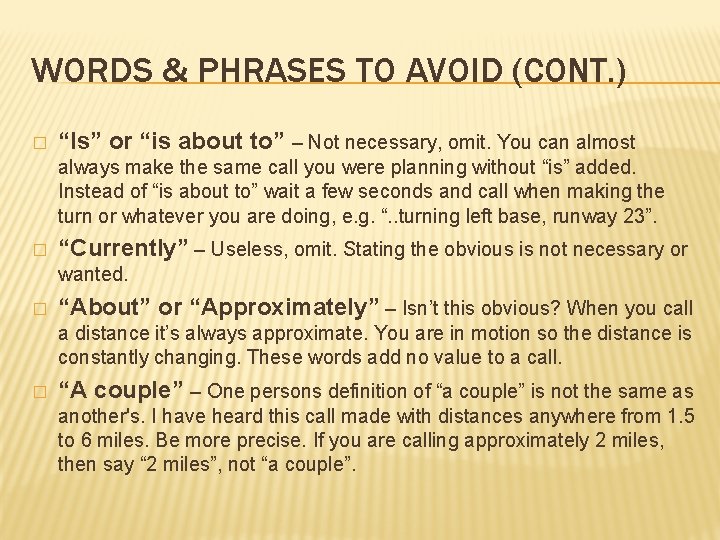
WORDS & PHRASES TO AVOID (CONT. ) � “Is” or “is about to” – Not necessary, omit. You can almost always make the same call you were planning without “is” added. Instead of “is about to” wait a few seconds and call when making the turn or whatever you are doing, e. g. “. . turning left base, runway 23”. � “Currently” – Useless, omit. Stating the obvious is not necessary or wanted. � “About” or “Approximately” – Isn’t this obvious? When you call a distance it’s always approximate. You are in motion so the distance is constantly changing. These words add no value to a call. � “A couple” – One persons definition of “a couple” is not the same as another's. I have heard this call made with distances anywhere from 1. 5 to 6 miles. Be more precise. If you are calling approximately 2 miles, then say “ 2 miles”, not “a couple”.
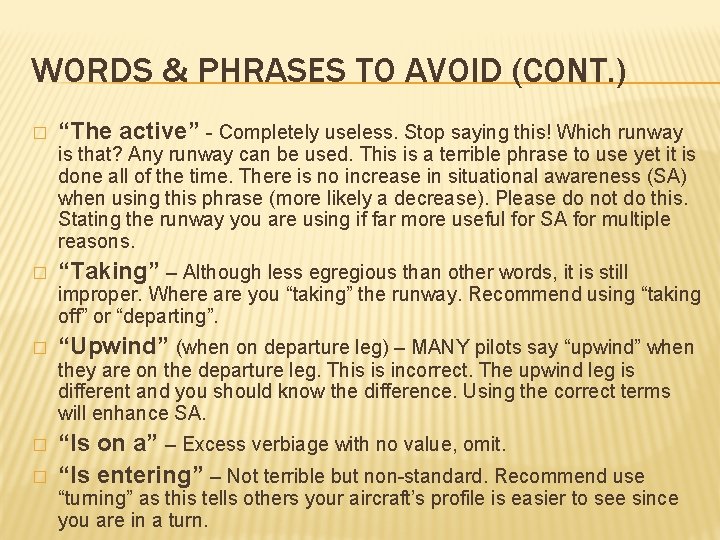
WORDS & PHRASES TO AVOID (CONT. ) � “The active” - Completely useless. Stop saying this! Which runway is that? Any runway can be used. This is a terrible phrase to use yet it is done all of the time. There is no increase in situational awareness (SA) when using this phrase (more likely a decrease). Please do not do this. Stating the runway you are using if far more useful for SA for multiple reasons. � “Taking” – Although less egregious than other words, it is still improper. Where are you “taking” the runway. Recommend using “taking off” or “departing”. � “Upwind” (when on departure leg) – MANY pilots say “upwind” when they are on the departure leg. This is incorrect. The upwind leg is different and you should know the difference. Using the correct terms will enhance SA. � � “Is on a” – Excess verbiage with no value, omit. “Is entering” – Not terrible but non-standard. Recommend use “turning” as this tells others your aircraft’s profile is easier to see since you are in a turn.
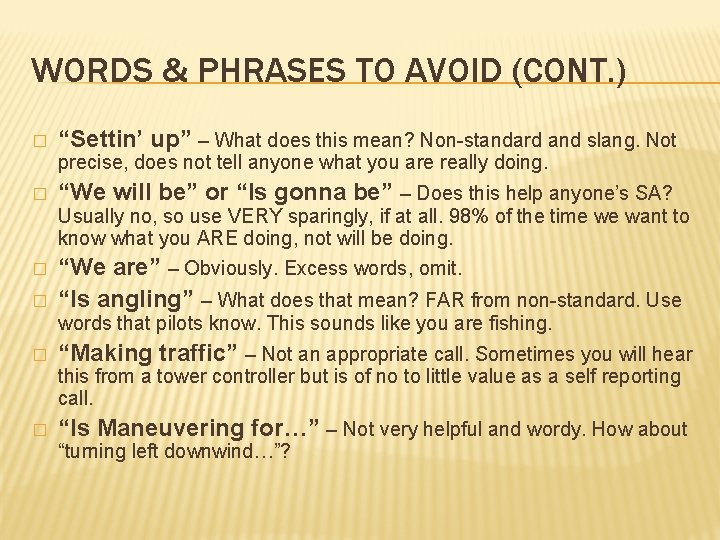
WORDS & PHRASES TO AVOID (CONT. ) � “Settin’ up” – What does this mean? Non-standard and slang. Not precise, does not tell anyone what you are really doing. � “We will be” or “Is gonna be” – Does this help anyone’s SA? Usually no, so use VERY sparingly, if at all. 98% of the time we want to know what you ARE doing, not will be doing. � � “We are” – Obviously. Excess words, omit. “Is angling” – What does that mean? FAR from non-standard. Use words that pilots know. This sounds like you are fishing. � “Making traffic” – Not an appropriate call. Sometimes you will hear this from a tower controller but is of no to little value as a self reporting call. � “Is Maneuvering for…” – Not very helpful and wordy. How about “turning left downwind…”?
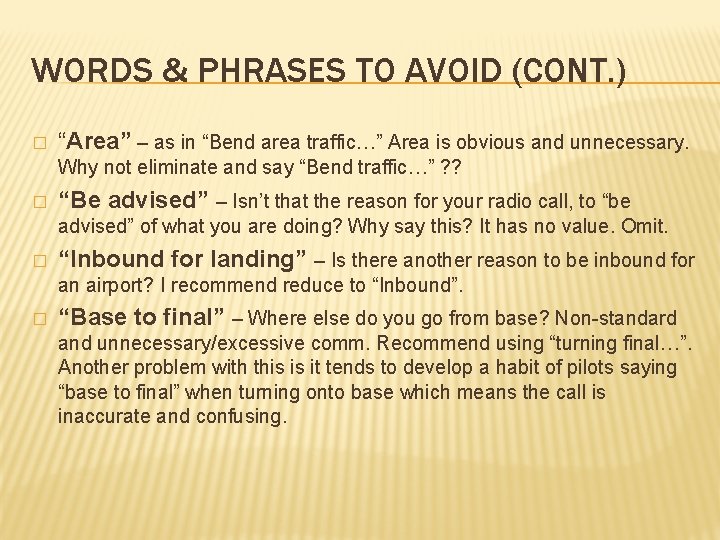
WORDS & PHRASES TO AVOID (CONT. ) � “Area” – as in “Bend area traffic…” Area is obvious and unnecessary. Why not eliminate and say “Bend traffic…” ? ? � “Be advised” – Isn’t that the reason for your radio call, to “be advised” of what you are doing? Why say this? It has no value. Omit. � “Inbound for landing” – Is there another reason to be inbound for an airport? I recommend reduce to “Inbound”. � “Base to final” – Where else do you go from base? Non-standard and unnecessary/excessive comm. Recommend using “turning final…”. Another problem with this is it tends to develop a habit of pilots saying “base to final” when turning onto base which means the call is inaccurate and confusing.
WORDS & PHRASES TO AVOID (CONT. ) � “Touch & go” (or similar, when other than on final) – Calling “Inbound”, “ 45” or “Downwind” “for touch & go’s is pretty useless and wastes airtime. No one is likely to remember (or care) that you are announcing T&Gs before you get to base of final. Recommend calling T&G on “final” call unless you think someone would benefit for spacing by saying it earlier, such as on base. � “Short Final” (esp. when 1+ miles out) – Unless in a fast (120 or + knot approach speed aircraft, calling “short final” before ½ mile from the runway is very inaccurate. Some have the habit of calling this when 1+ miles out and that is a long final, not a short one. This goes back to the problems of flying too big of a pattern. � “Line up and wait” – This is a tower call. There is not much time to be saved by entering runway and waiting for it to clear. Meanwhile you expose your backside to potential traffic on final. Recommend waiting at hold short until runway clear (or nearly so) then taking off without delay. Much safer procedure.
WORDS & PHRASES TO AVOID (CONT. ) � “Is clear of the active” (especially when not clear) – There are 2 big problems with this. 1) If the aircraft is not completely past the edge of the runway with a clear path in front of them to get past the hold short line then you are not clear. Many make this call much too soon. 2) “The active” is not proper and a useless phrase, as discussed earlier. � “Full stop” – This should be assumed unless stated otherwise. Recommend omit. An exception would be after completing touch & go’s, on the last landing state full stop as now you are doing something different. � “On the go” – After a T&G some pilots can be heard saying this. Why? If you announced a T&G then you will obviously be “on the go” after touching the runway. If one sat on the runway for an inordinate amount of time and made the call for deconfliction or SA then this would make much more sense.
WORDS & PHRASES TO AVOID (CONT. ) � “Taxi for the run-up area” – Unnecessary call if you are planning to go fly. An exception would be you are taxiing to a run-up area on a different runway for maintenance runs, etc.
DO NOT… � DO NOT make calls on CTAF that you can make on an area frequency. � DO NOT say you are doing something that you are not yet doing. � DO NOT get into arguments on CTAF! Save it for the ground. � DO NOT switch to a CTAF frequency and ask for an airport advisory if you have not listened for a couple of minutes.

COMMONLY HEARD BAD RADIO CALLS Bad: “And… Bend traffic, this is, uh, Skylane 123 AB at, um, about ten or fifteen miles to the, ah, west. . . no, I mean northwest. We will be entering a left 45 for left downwind to, uhh, runway 34. ” Good: “Bend traffic, Skylane 3 AB 10 miles west, 5, 000 ft, inbound. ”
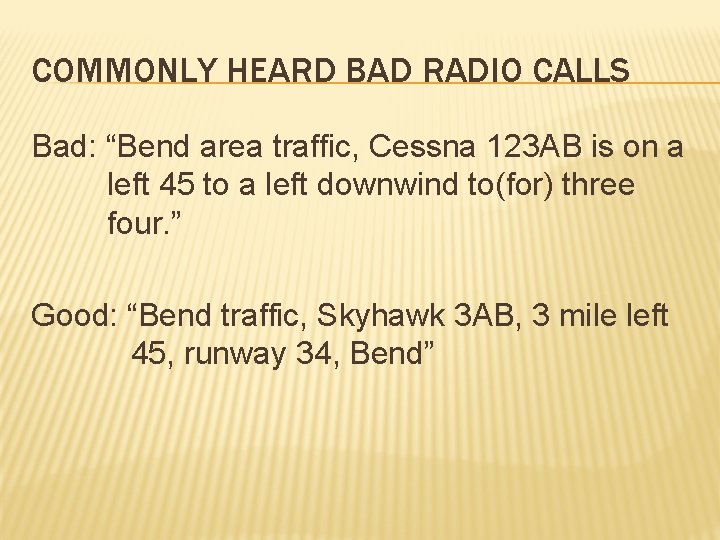
COMMONLY HEARD BAD RADIO CALLS Bad: “Bend area traffic, Cessna 123 AB is on a left 45 to a left downwind to(for) three four. ” Good: “Bend traffic, Skyhawk 3 AB, 3 mile left 45, runway 34, Bend”
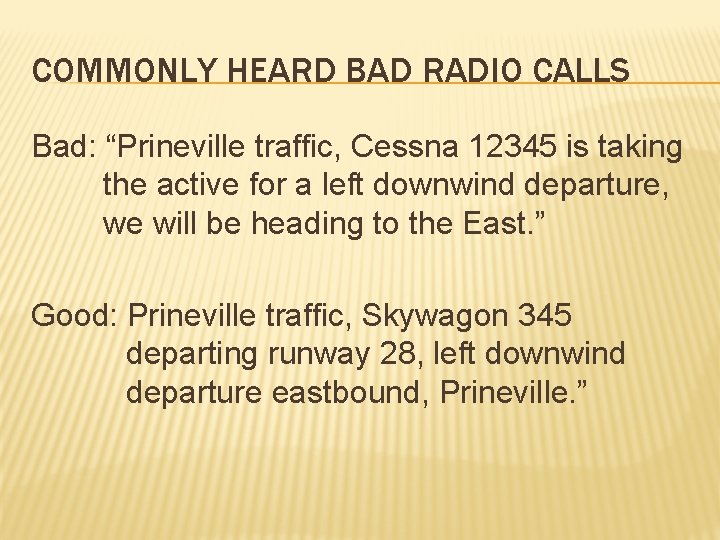
COMMONLY HEARD BAD RADIO CALLS Bad: “Prineville traffic, Cessna 12345 is taking the active for a left downwind departure, we will be heading to the East. ” Good: Prineville traffic, Skywagon 345 departing runway 28, left downwind departure eastbound, Prineville. ”
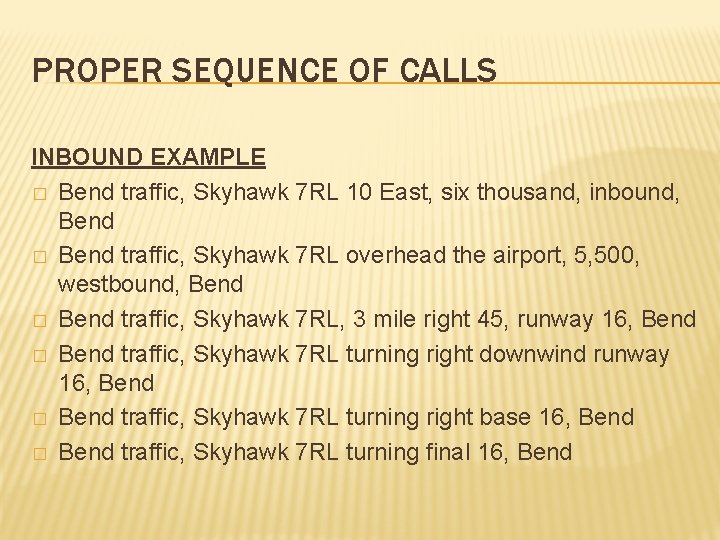
PROPER SEQUENCE OF CALLS INBOUND EXAMPLE � Bend traffic, Skyhawk 7 RL 10 East, six thousand, inbound, Bend � Bend traffic, Skyhawk 7 RL overhead the airport, 5, 500, westbound, Bend � Bend traffic, Skyhawk 7 RL, 3 mile right 45, runway 16, Bend � Bend traffic, Skyhawk 7 RL turning right downwind runway 16, Bend � Bend traffic, Skyhawk 7 RL turning right base 16, Bend � Bend traffic, Skyhawk 7 RL turning final 16, Bend
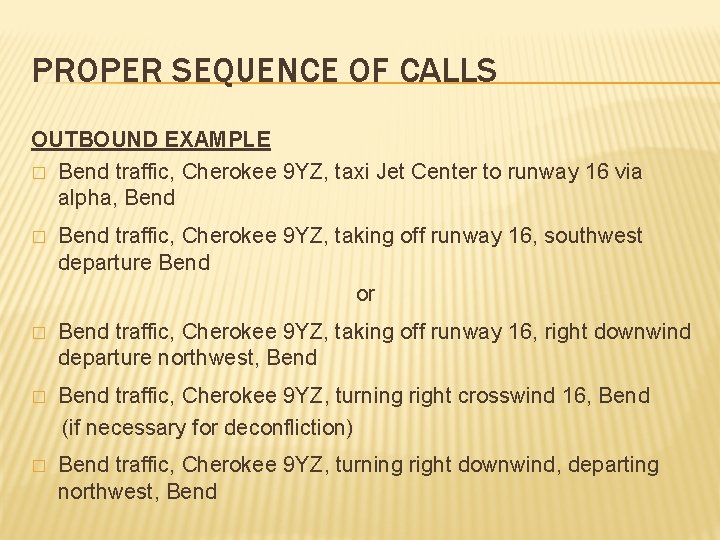
PROPER SEQUENCE OF CALLS OUTBOUND EXAMPLE � Bend traffic, Cherokee 9 YZ, taxi Jet Center to runway 16 via alpha, Bend � Bend traffic, Cherokee 9 YZ, taking off runway 16, southwest departure Bend or � Bend traffic, Cherokee 9 YZ, taking off runway 16, right downwind departure northwest, Bend � Bend traffic, Cherokee 9 YZ, turning right crosswind 16, Bend (if necessary for deconfliction) � Bend traffic, Cherokee 9 YZ, turning right downwind, departing northwest, Bend
PRACTICE INSTRUMENT APPROACHES � Pilots should announce position in both IFR and VFR terms. � “Bend traffic, Baron zero Charlie golf, HEKIL inbound, six -mile final, runway 16, Bend. or � “Bend traffic, Baron zero Charlie golf, four-mile final, RNAV 16 Zulu inbound, runway 16, Bend.
OTHER COMMUNICATIONS CTAF is not to be used for long conversations, so: � Use company (Base) frequency � Use an Air-to-Air frequency � Be Courteous!
TEACHING TIPS � Set a good example! � Get new Private Pilot candidates working on proper calls early � Give homework assignments on communications � � Read the AIM, Pilot/Controller Glossary and other sources of how to communicate well on the radio (See my references list). Critique radio calls often (good & bad calls)
TEACHING TIPS � Practice techniques: Chair fly! Visualize while making calls out loud � Make simulated radio calls while driving � Make a “tape (or cardboard) runway” on the floor & walk the pattern � Practice often!! � Listen to CTAF on portable radio and critique calls � Listen to Live. ATC. net � Other ideas? �
BENEFITS OF GOOD RADIO WORK � You're easily understood � Radio congestion is reduced � Anyone on frequency will recognize you as a pro � Good VFR calls helps lead to good IFR calls � ATC will be prejudiced in your favor � Most importantly…Everyone will be safer!
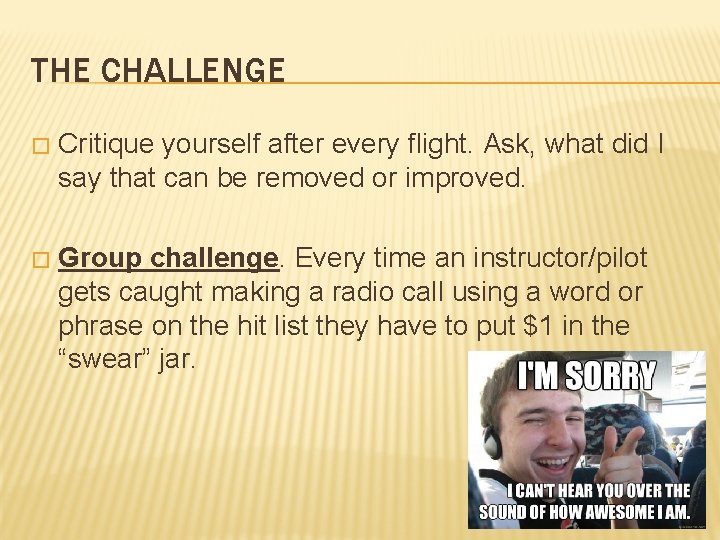
THE CHALLENGE � Critique yourself after every flight. Ask, what did I say that can be removed or improved. � Group challenge. Every time an instructor/pilot gets caught making a radio call using a word or phrase on the hit list they have to put $1 in the “swear” jar.
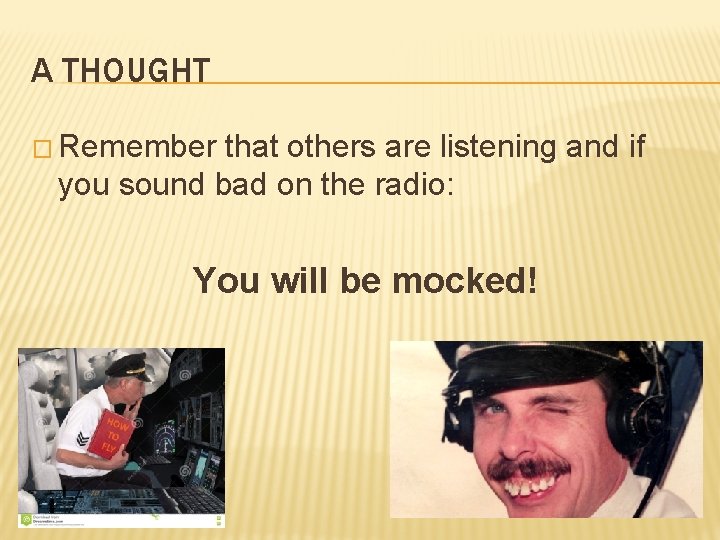
A THOUGHT � Remember that others are listening and if you sound bad on the radio: You will be mocked!
REFERENCES � AIM 4 -2 � Austin’s Very Easy Guide to Proper Radio Phraseology and Technique by Austin S. Collins (2012) � VFR COMMUNICATIONS FOR IDIOTS by Gary Gandy � Sportys Student Pilot News https: //studentpilotnews. com/2012/05/09/the-7 deadly-sins-of-radio-communications/ � The Pilot’s Radio Communications Handbook, 5 th Ed. By Paul E. Illman
CONTACT INFO Mike Kloch (541) 848 -77890 Mike. Kloch@gmail. com � For links to the listed references, tips for pilot, CFIs and more, go to my webpage: http: //mikekloch. com https: //mikekloch. com/home/advanced-airplane-learning/references/ � Constructive feedback is always welcome!
FAA WINGS https: //www. faasafety. gov/ FAA Wings awarded for: • Analysis of General Aviation fatal accidents & LOC • Promoting proficiency ground and flight training • Phase completion (roughly 3 hours ground & 2 to 4 hours flight) satisfies requirements for Flight Review • Shows you have an interest in safety
QUESTIONS?
THE END � Thanks for your attention & participation, “Last Call”
- Slides: 42