
Back to basics for Foundation design of Monopile

Back to basics…… for Foundation design of Monopile Support Structures By Victor Krolis 05/12/2007 European Offshore Wind energy conference 2007
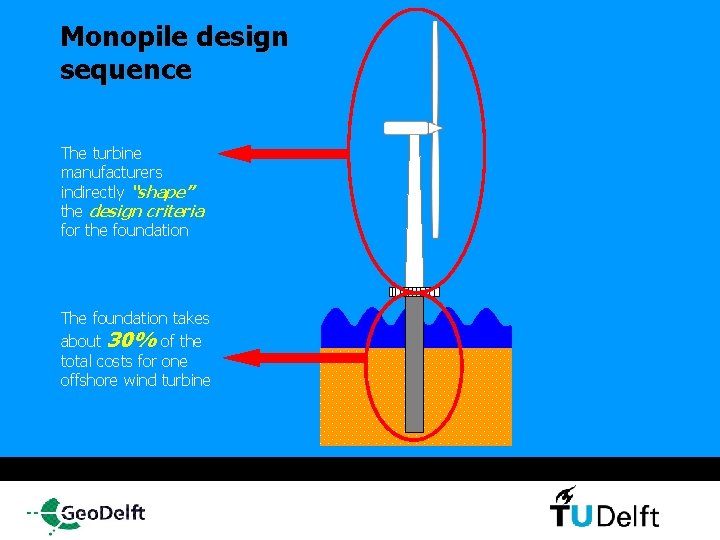
Monopile design sequence The turbine manufacturers indirectly “shape” the design criteria for the foundation The foundation takes about 30% of the total costs for one offshore wind turbine
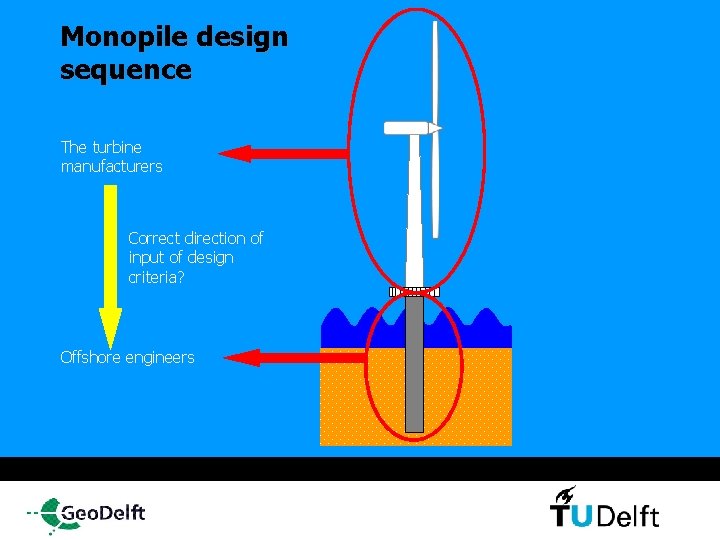
Monopile design sequence The turbine manufacturers Correct direction of input of design criteria? Offshore engineers
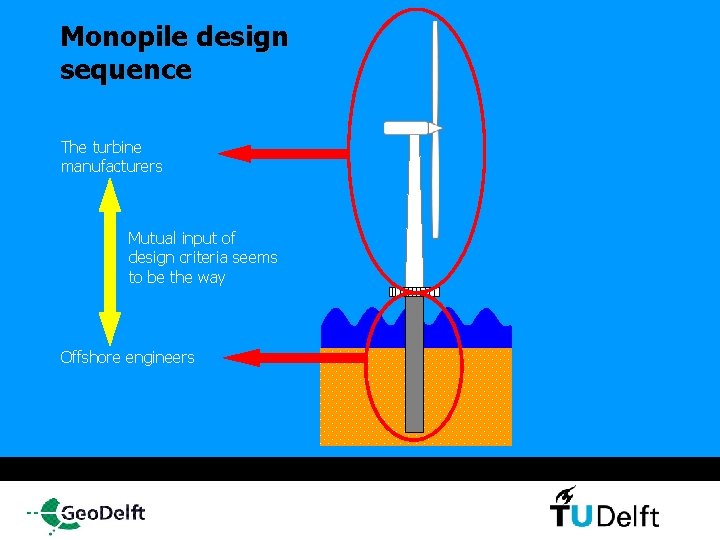
Monopile design sequence The turbine manufacturers Mutual input of design criteria seems to be the way Offshore engineers

Why mutual input of design criteria? Future: 5 MW and larger turbines
Why mutual input of design criteria? Future: 5 MW and larger turbines Heavier turbines
Why mutual input of design criteria? Future: 5 MW and larger turbines Heavier turbines Moving into deeper waters
Why mutual input of design criteria? Future: 5 MW and larger turbines Heavier turbines Moving into deeper waters Larger Monopiles (> 5 m. ) are needed since this is still an attractive type of support structure economic wise

Goal: To quantify the effects of design choices on the total mass (= €) by visualizing the mutual influences of basic design parameters such as the natural frequency, soil stiffness and the penetration depth
So…If larger pile diameters are needed, may the current API design methods be correlated to large diameter piles and still be considered to be an efficient method of foundation design?
So…If larger pile diameters are needed, may the current API design methods be correlated to large diameter piles and still be considered to be an efficient method of foundation design? API is based on empirical research conducted on pile diameters ranging from 0. 2 to 2 meters
How due high numbers of cyclic loading effect these large diameter piles?

Shouldn’t we go back to basics and evaluate the basic foundation design parameters for these large diameter piles?

Answer: YES!! Why?
Scale effects of large diameter monopiles • p-y method can become unconservative for large diameter piles: University of Duisburg-Essen performed Finite Element simulations for piles ranging from 1 to 6 m.
![Scale effects of large diameter monopiles Pile deflection y [m] Depth z [m] 33](http://slidetodoc.com/presentation_image_h/04a166c2879a83b041b44f6e2a6eb01a/image-16.jpg "Scale effects of large diameter monopiles Pile deflection y [m] Depth z [m] 33")
Scale effects of large diameter monopiles Pile deflection y [m] Depth z [m] 33 % SWM P-Y method FE FE 20 % 1 m Deflection lines of pile according to p-y method & SW method compared to the FE results [University of Duisburg-Essen, K. Lesny])
![Scale effects of large diameter monopiles Pile deflection y [m] Depth z [m] 50](http://slidetodoc.com/presentation_image_h/04a166c2879a83b041b44f6e2a6eb01a/image-17.jpg "Scale effects of large diameter monopiles Pile deflection y [m] Depth z [m] 50")
Scale effects of large diameter monopiles Pile deflection y [m] Depth z [m] 50 % SWM P-Y method FE 120 % 6 m Deflection lines of pile according to p-y method & SW method compared to the FE results [University of Duisburg-Essen, K. Lesny])
Effects of high numbers of cyclic loading Cyclic soil degradation: decrease of soil stiffness and strength
Effects of high numbers of cyclic loading How can this be quantified for large diameter piles?
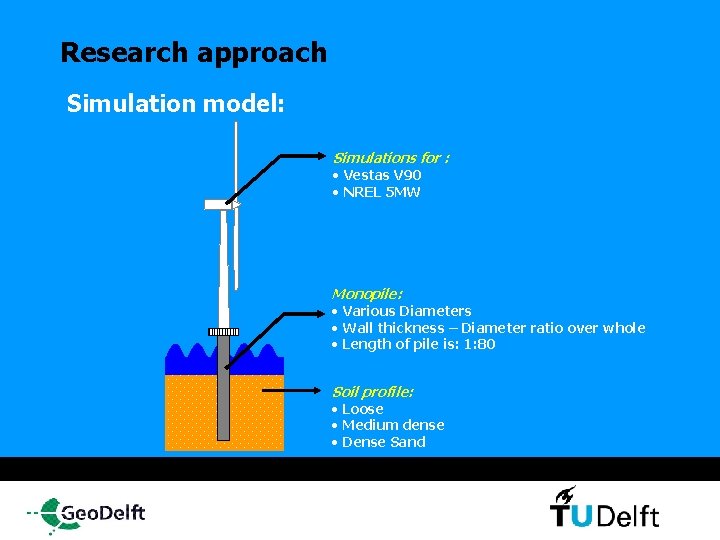
Research approach Simulation model: Simulations for : • Vestas V 90 • NREL 5 MW Monopile: • Various Diameters • Wall thickness – Diameter ratio over whole • Length of pile is: 1: 80 Soil profile: • Loose • Medium dense • Dense Sand
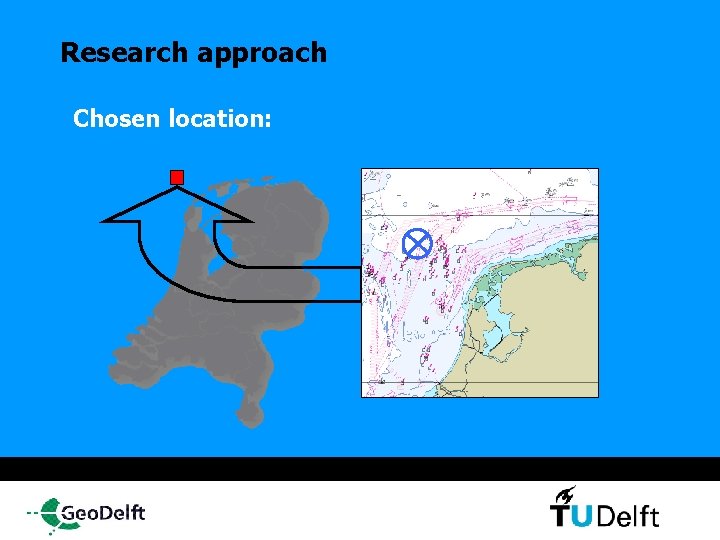
Research approach Chosen location:
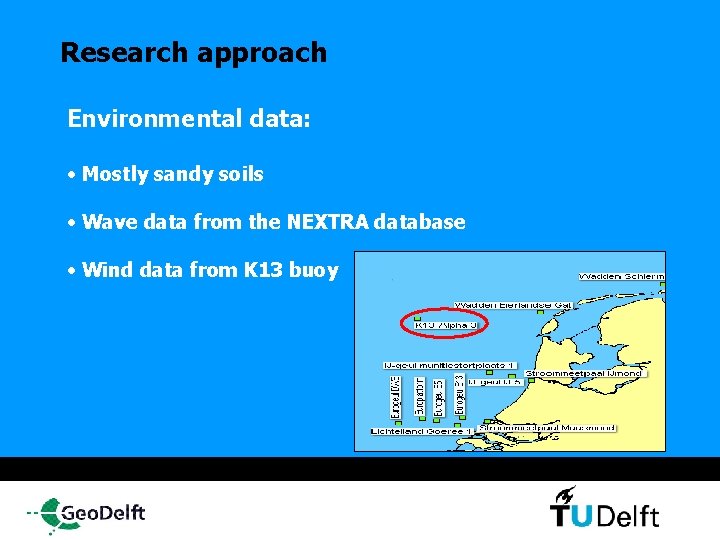
Research approach Environmental data: • Mostly sandy soils • Wave data from the NEXTRA database • Wind data from K 13 buoy
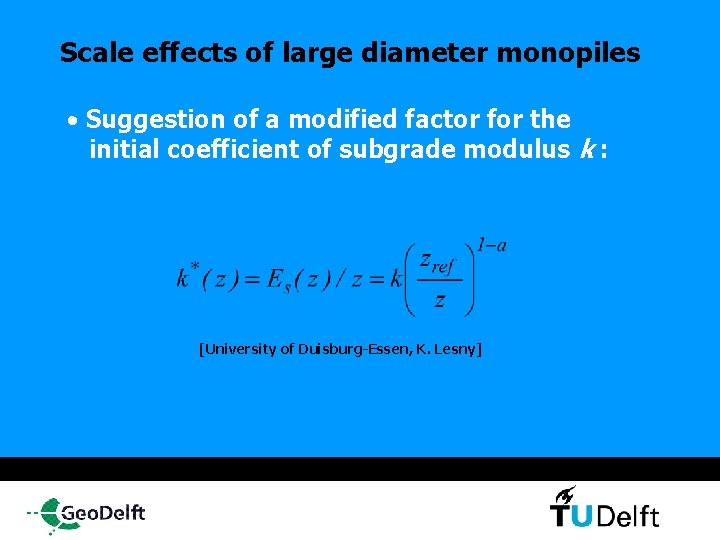
Scale effects of large diameter monopiles • Suggestion of a modified factor for the initial coefficient of subgrade modulus k : [University of Duisburg-Essen, K. Lesny]
Effects of high numbers of cyclic loading • Cyclic soil degradation: decrease of soil stiffness and strength • Structural ‘shakedown’: stabilizing of permanent deflections after N number of cycles. If not…the pile will fail
Effects of high numbers of cyclic loading • Cyclic soil degradation: decrease of soil stiffness and strength • Structural ‘shakedown’: stabilizing of permanent deflections after N number of cycles. If not…the pile will fail
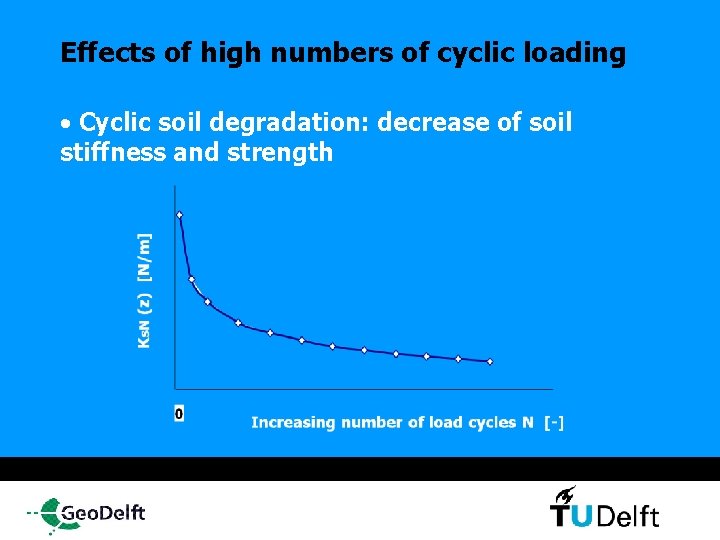
Effects of high numbers of cyclic loading • Cyclic soil degradation: decrease of soil stiffness and strength
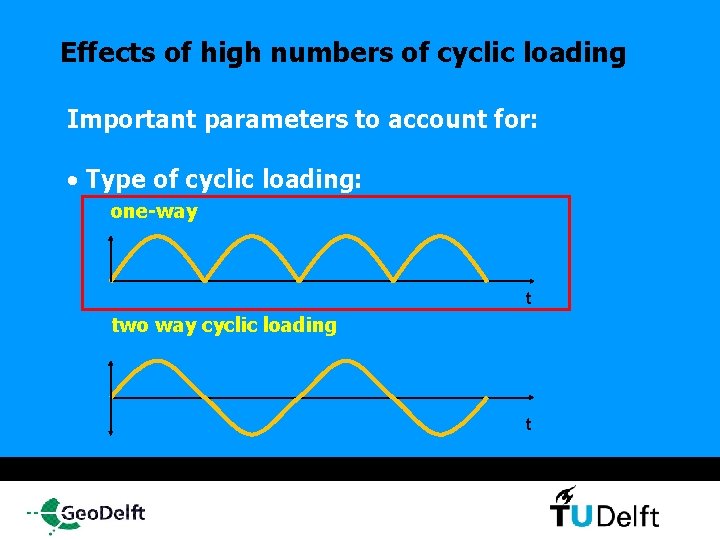
Effects of high numbers of cyclic loading Important parameters to account for: • Type of cyclic loading: one-way t two way cyclic loading t
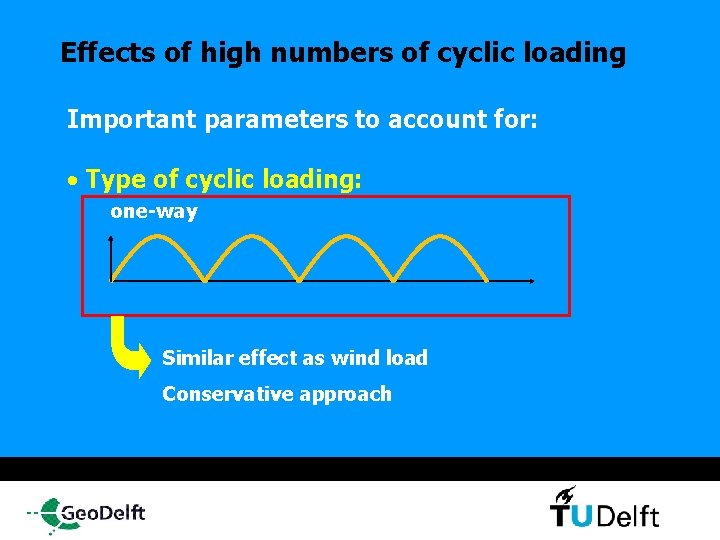
Effects of high numbers of cyclic loading Important parameters to account for: • Type of cyclic loading: one-way Similar effect as wind load Conservative approach
Effects of high numbers of cyclic loading Important parameters to account for: • Type of cyclic loading • Numbers of cyclic loading • Magnitude of cyclic loading
Effects of high numbers of cyclic loading Methods studied to quantify effects of soil stiffness degradation: • API 2000 (= p-y method) • Deterioration of Static p-y Curve (DSPY) method
Effects of high numbers of cyclic loading Methods studied to quantify effects of soil stiffness degradation: • API 2000 (= p-y method)
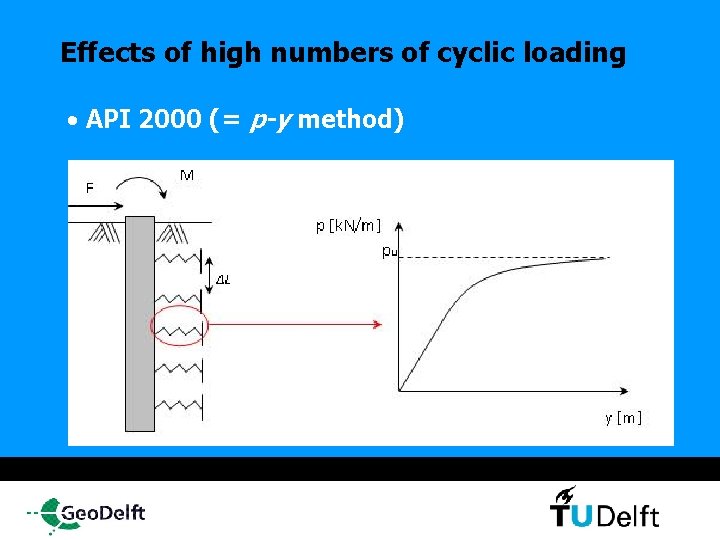
Effects of high numbers of cyclic loading • API 2000 (= p-y method)
Effects of high numbers of cyclic loading Difference between API & DSPY method: • API recommends a factor of A = 0. 9 to reckon with stiffness degradation:
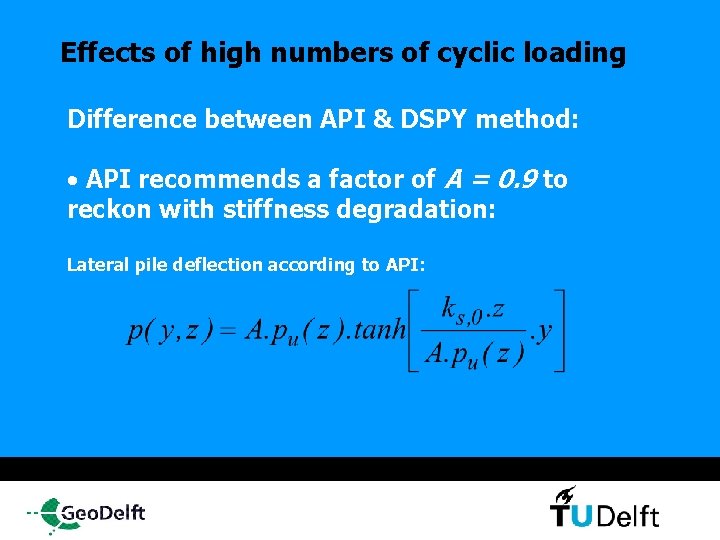
Effects of high numbers of cyclic loading Difference between API & DSPY method: • API recommends a factor of A = 0. 9 to reckon with stiffness degradation: Lateral pile deflection according to API:
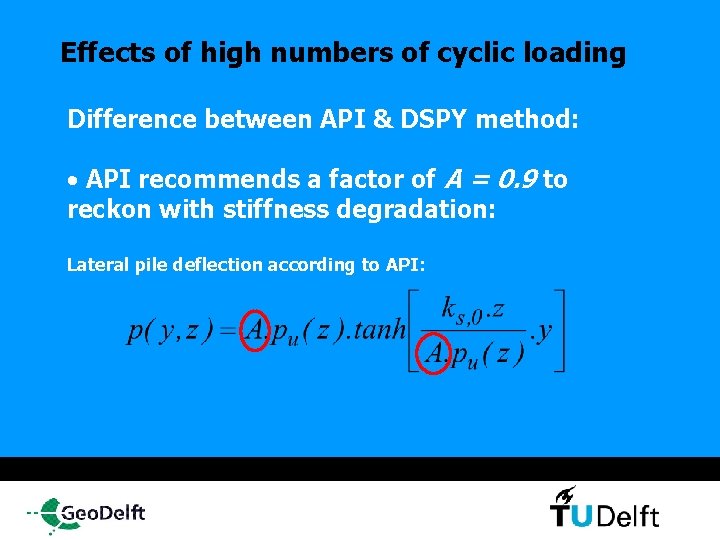
Effects of high numbers of cyclic loading Difference between API & DSPY method: • API recommends a factor of A = 0. 9 to reckon with stiffness degradation: Lateral pile deflection according to API:
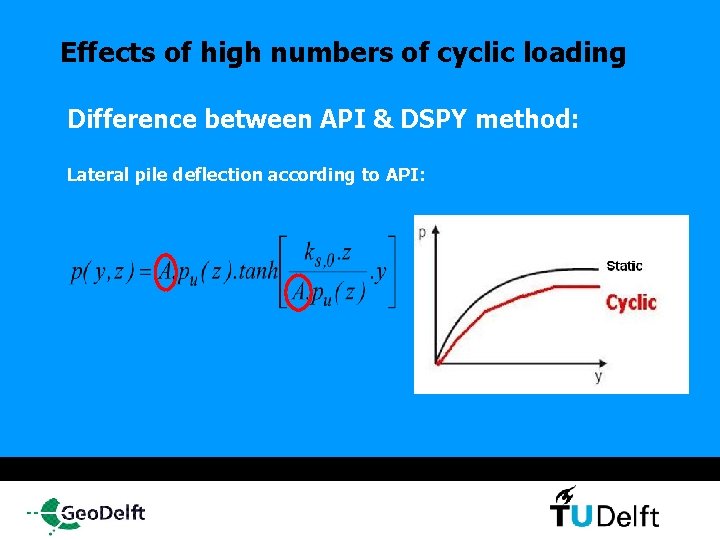
Effects of high numbers of cyclic loading Difference between API & DSPY method: Lateral pile deflection according to API:
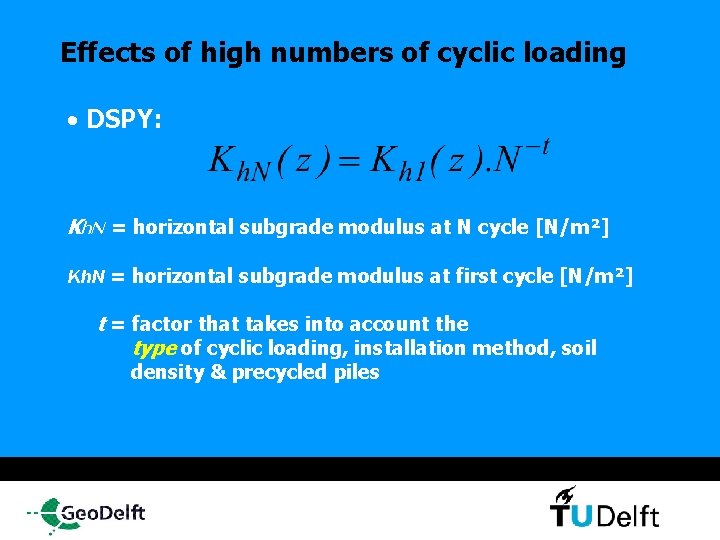
Effects of high numbers of cyclic loading • DSPY: Kh. N = horizontal subgrade modulus at N cycle [N/m²] Kh. N = horizontal subgrade modulus at first cycle [N/m²] t = factor that takes into account the type of cyclic loading, installation method, soil density & precycled piles
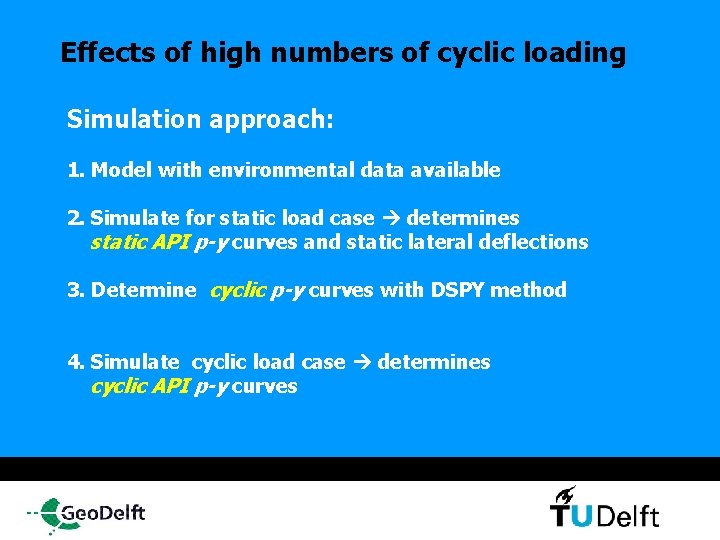
Effects of high numbers of cyclic loading Simulation approach: 1. Model with environmental data available 2. Simulate for static load case determines static API p-y curves and static lateral deflections 3. Determine cyclic p-y curves with DSPY method 4. Simulate cyclic load case determines cyclic API p-y curves
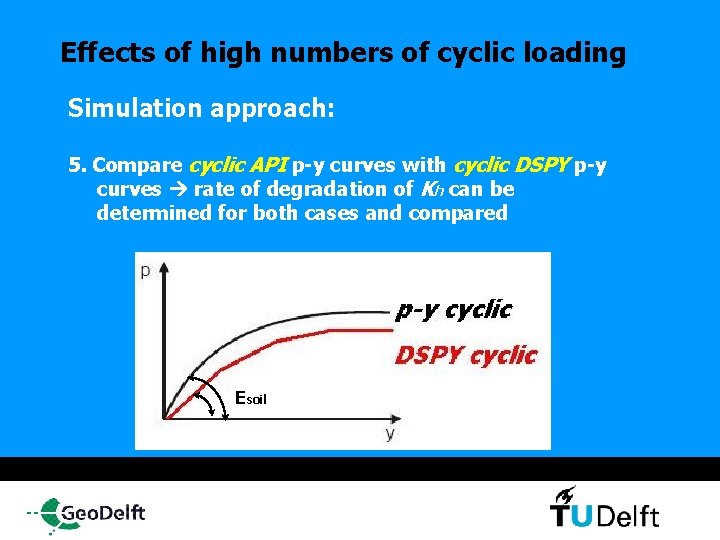
Effects of high numbers of cyclic loading Simulation approach: 5. Compare cyclic API p-y curves with cyclic DSPY p-y curves rate of degradation of Kh can be determined for both cases and compared Esoil
Effects of high numbers of cyclic loading Simulation approach: 6. Simulate relative pile-soil stiffness ratio as a function of number of cycles
Numerical model for parametric studies Basic design parameters considered are: • Natural frequency • Soil stiffness (= subgrade modulus) • Penetration depth
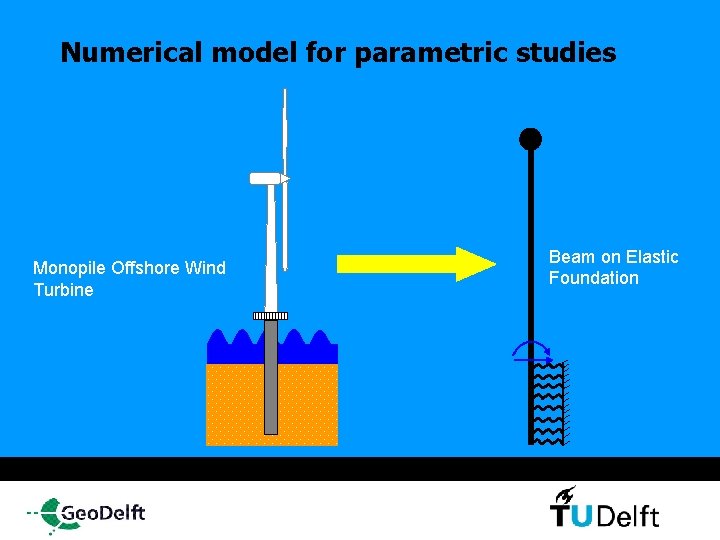
Numerical model for parametric studies Monopile Offshore Wind Turbine Beam on Elastic Foundation
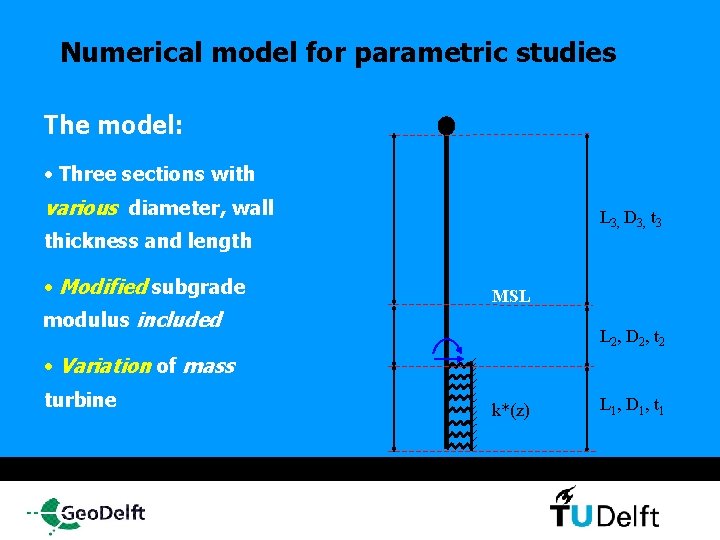
Numerical model for parametric studies The model: • Three sections with various diameter, wall L 3, D 3, t 3 thickness and length • Modified subgrade MSL modulus included L 2 , D 2 , t 2 • Variation of mass turbine k*(z) L 1 , D 1 , t 1
Analytical model for parametric studies Approach: Perform parametric studies for existing offshore wind turbines such as the Vestas V 90 and future turbines NREL 5 MW
Analytical model for parametric studies Make 3 D diagrams in which the effect of the diameter on the natural frequency, soil stiffness and penetration depth is visualized
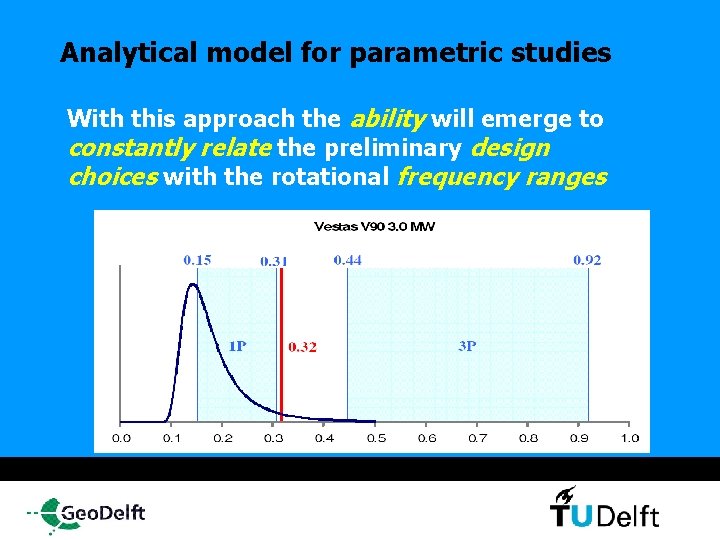
Analytical model for parametric studies With this approach the ability will emerge to constantly relate the preliminary design choices with the rotational frequency ranges

Acknowledgement This research is sponsored by Geodelft From January 2007 it will be incorporated in Deltares www. Deltares. nl

THANK YOU!!
- Slides: 48