
Back to Basics for APCS Success Stuart Reges

Back to Basics for APCS Success Stuart Reges, Principal Lecturer University of Washington Hélène Martin, CS teacher Garfield High School
Selective Timeline n n n n 1984: AP/CS first offered in Pascal 1998 -1999: AP/CS switches to C++ 2001 -2002: Dot com crash, CS enrollments plummet 2002: OOPSLA “Resolved: Objects have Failed” 2003 -2004: AP/CS switches to Java 2005: SIGCSE “Resolved: Objects Early has Failed” 2011: CMU and Berkeley switch CS 1 to Python 2011: Stuart Reges assures nervous teachers that AP/CS in Java is a fantastic course
More personal timeline n n n 2000: “Conservatively Radical Java in CS 1”: objects early through scaffolding 2004: Stuart hired by UW to fix intro with a plan to teach procedural Java 2005: Resolved: Objects Early has Failed 2006: first edition of Building Java Programs 2011: 4 textbooks with “objects late” in title, 3 rd edition of Building Java Programs
UW Results
Course Principles n n n Traditional procedural approach (back to basics): drawing on past wisdom Updated to use features of Java: using objects early, graphics (Drawing. Panel) Core of the course: challenging assignments many of which are nifty or practical Concrete practice problems to build programming skills: section problems, labs, exams, Practice. It Lots of support: army of undergraduate TAs, programming lab support
Why I’m sold n n “I've never come across a textbook that layers ideas so strategically and ingeniously well. The ideas are presented in an order and in a manner that made it impossible for me to get lost or bored. [. . . ] It taught so well, I couldn't wait to get my hands on problem after problem. This book made me crave problem solving and writing clean, inventive, non-redundant, well-commented code. ” n - Amazon review Applies to methodology; book is a nice-to-have! 6
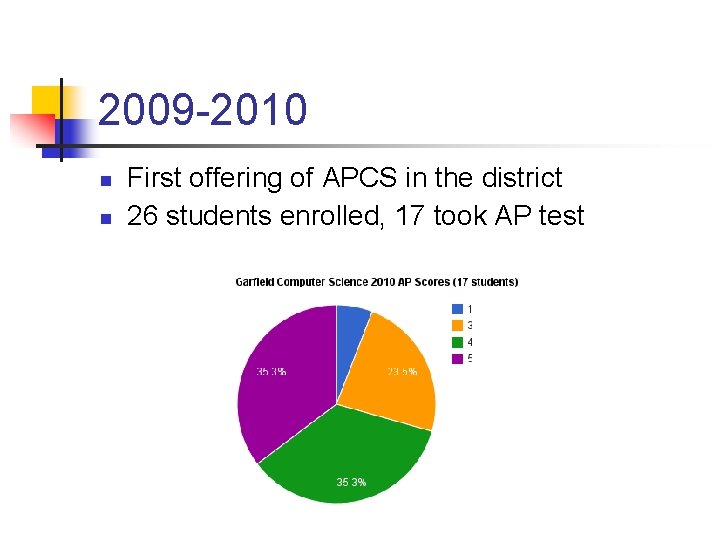
2009 -2010 n n First offering of APCS in the district 26 students enrolled, 17 took AP test
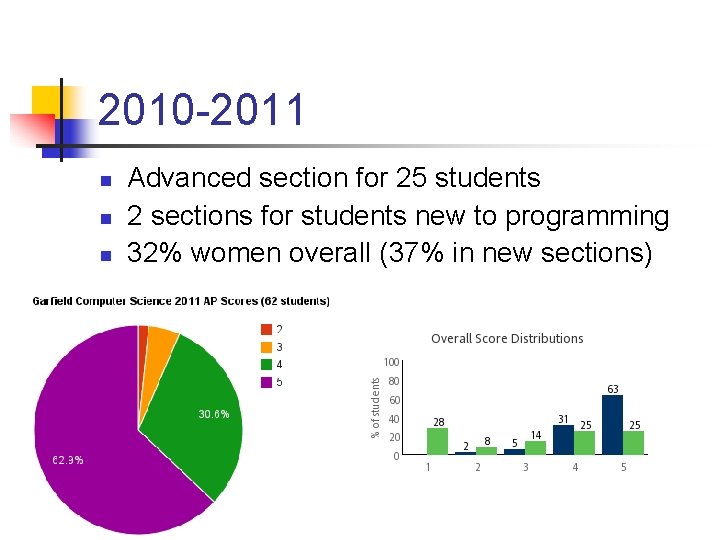
2010 -2011 n n n Advanced section for 25 students 2 sections for students new to programming 32% women overall (37% in new sections)
Garfield course structure n n n 1/4 lecture, group work without computers In-class time for experimenting Programming projects written from scratch Little to no homework Bi-weekly paper and pencil quizzes No real mention of AP test until February
Students know OOP n n January: writing classes as object blueprints Sophisticated Gridworld projects n 15 -puzzle n snake game n ant farm Heavily OO final projects AP report mean for OO multiple choice: 6. 4, 4. 9 nationally; group mean close to 7 on FRQ
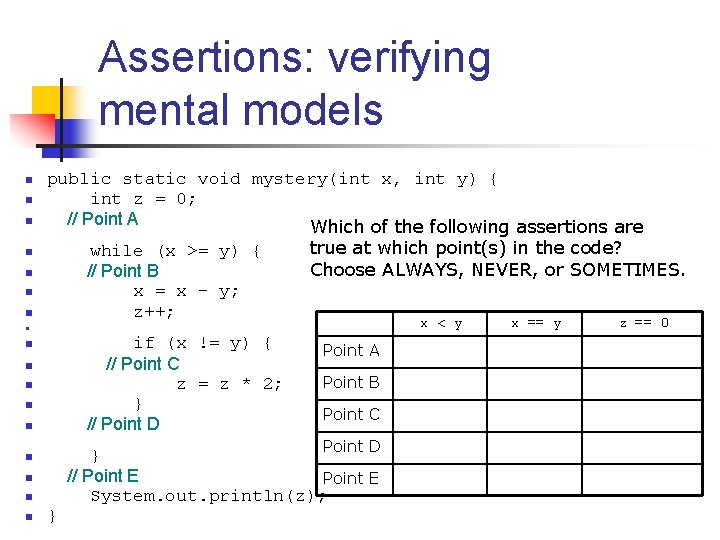
Assertions: verifying mental models n n n n public static void mystery(int x, int y) { int z = 0; // Point A Which of the following assertions are true at which point(s) in the code? while (x >= y) { Choose ALWAYS, NEVER, or SOMETIMES. // Point B x = x - y; z++; x < y n if (x != y) { // Point C z = z * 2; } // Point D n n n Point B Point C Point D n n Point A } } // Point E System. out. println(z); x == y z == 0
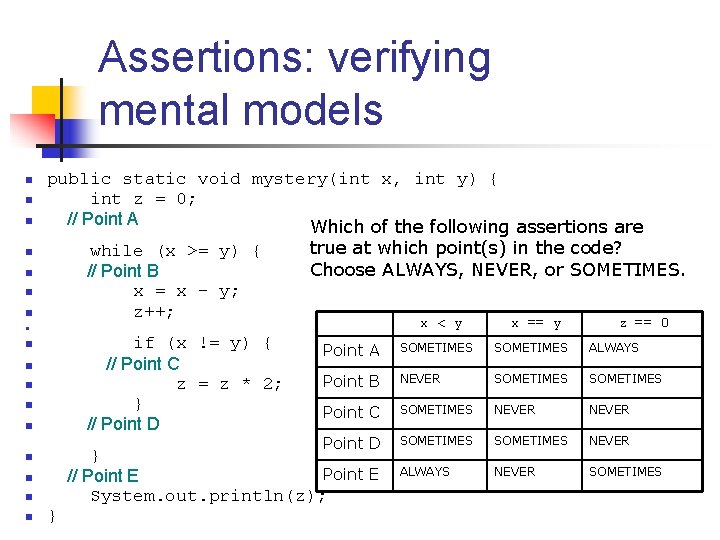
Assertions: verifying mental models n n n n public static void mystery(int x, int y) { int z = 0; // Point A Which of the following assertions are true at which point(s) in the code? while (x >= y) { Choose ALWAYS, NEVER, or SOMETIMES. // Point B x = x - y; z++; x < y n if (x != y) { // Point C z = z * 2; } // Point D n n n n n } x == y z == 0 Point A SOMETIMES ALWAYS Point B NEVER SOMETIMES Point C SOMETIMES NEVER Point D SOMETIMES NEVER ALWAYS NEVER SOMETIMES } Point E // Point E System. out. println(z);
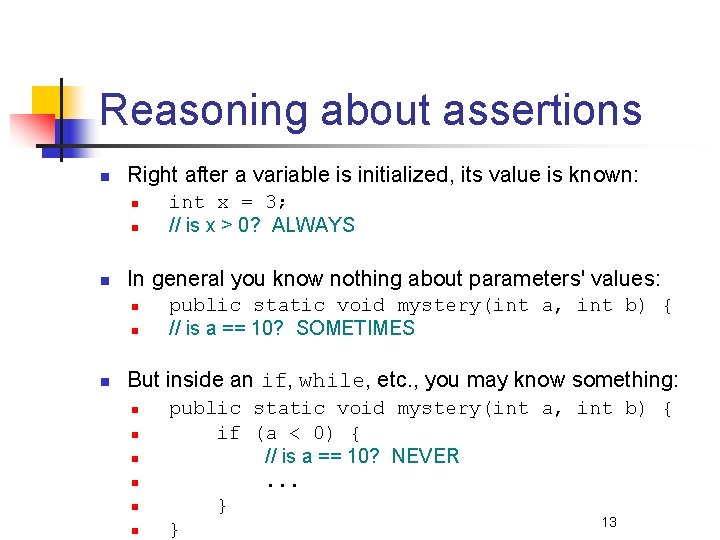
Reasoning about assertions n Right after a variable is initialized, its value is known: n n n In general you know nothing about parameters' values: n n n int x = 3; // is x > 0? ALWAYS public static void mystery(int a, int b) { // is a == 10? SOMETIMES But inside an if, while, etc. , you may know something: n n n public static void mystery(int a, int b) { if (a < 0) { // is a == 10? NEVER. . . } 13 }
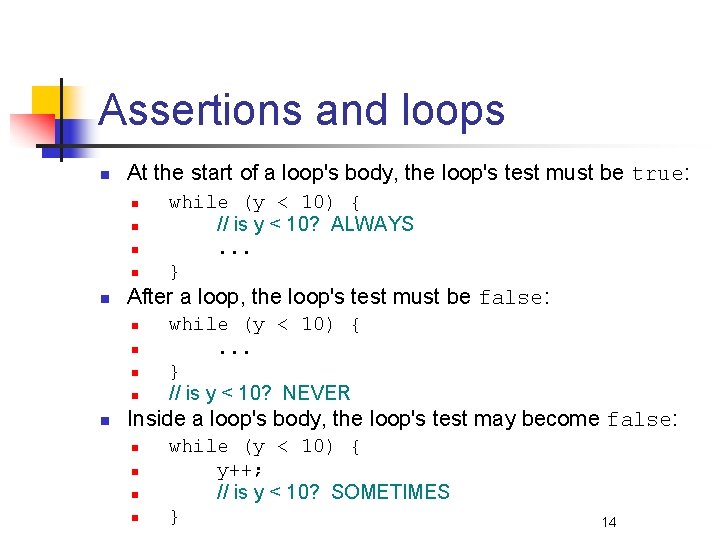
Assertions and loops n At the start of a loop's body, the loop's test must be true: n n n After a loop, the loop's test must be false: n n n while (y < 10) { // is y < 10? ALWAYS. . . } while (y < 10) {. . . } // is y < 10? NEVER Inside a loop's body, the loop's test may become false: n n while (y < 10) { y++; // is y < 10? SOMETIMES } 14
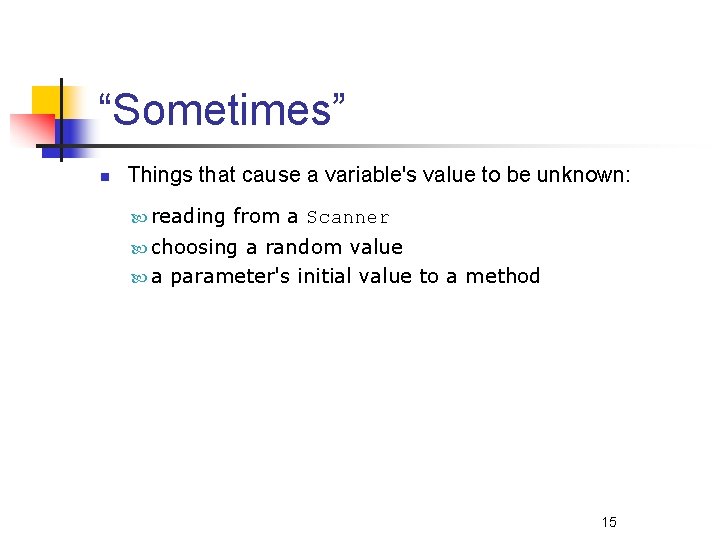
“Sometimes” n Things that cause a variable's value to be unknown: reading from a Scanner choosing a random value a parameter's initial value to a method 15
Transition to OOP 16
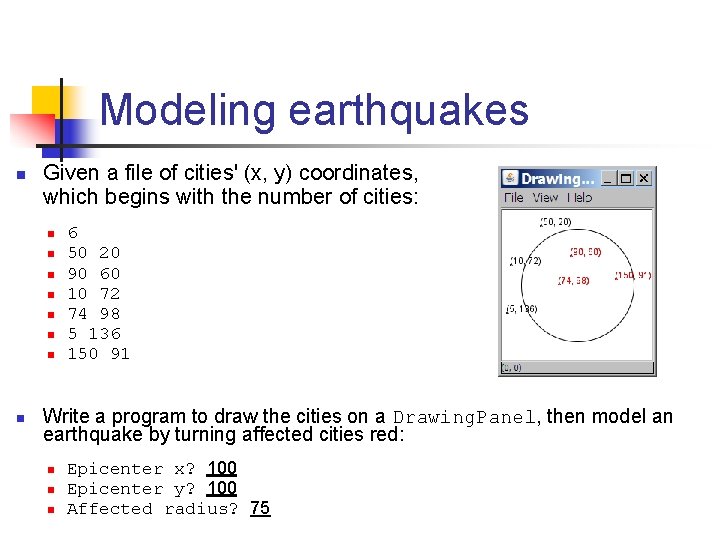
Modeling earthquakes n Given a file of cities' (x, y) coordinates, which begins with the number of cities: n n n n 6 50 20 90 60 10 72 74 98 5 136 150 91 Write a program to draw the cities on a Drawing. Panel, then model an earthquake by turning affected cities red: n n n Epicenter x? 100 Epicenter y? 100 Affected radius? 75
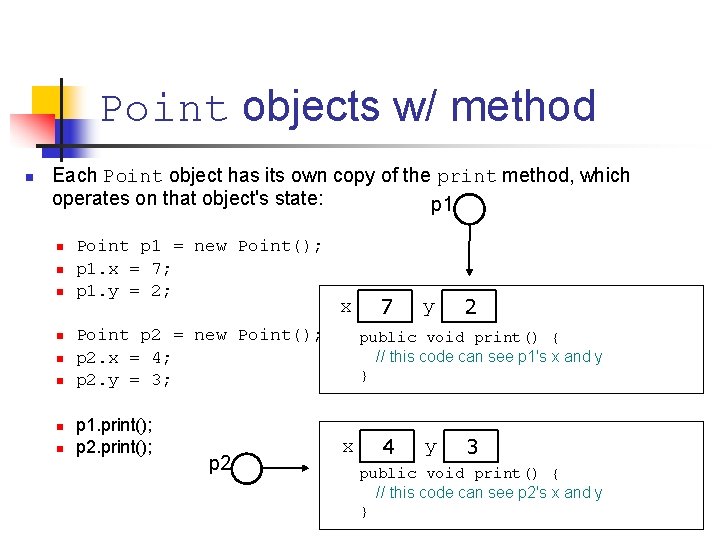
Point objects w/ method n Each Point object has its own copy of the print method, which operates on that object's state: p 1 n n n n Point p 1 = new Point(); p 1. x = 7; p 1. y = 2; x Point p 2 = new Point(); p 2. x = 4; p 2. y = 3; p 1. print(); p 2. print(); p 2 7 y 2 public void print() { // this code can see p 1's x and y } x 4 y 3 public void print() { // this code can see p 2's x and y }
Why encapsulation? n Abstraction between object and clients n Protects object from unwanted access Example: Can't fraudulently increase an Account's balance. n Can change the class implementation later Example: Point could be rewritten in polar coordinates (r, θ) with the same methods. n Can constrain objects' state (invariants) Example: Only allow Accounts with non-negative balance. Example: Only allow Dates with a month from 1 -12. 19
- Slides: 19