
Back muscles occipital muscles Muscles fasciae and movements
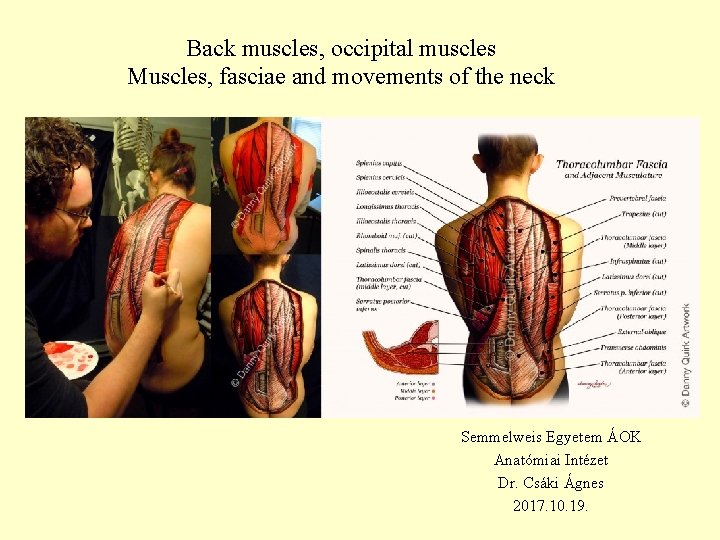
Back muscles, occipital muscles Muscles, fasciae and movements of the neck Semmelweis Egyetem ÁOK Anatómiai Intézet Dr. Csáki Ágnes 2017. 10. 19.
Back muscles The muscles of the back can be divided into three groups : Superficial – associated with movements of the shoulder. Spinohumeral muscles M. trapezius M. rhomboideus major et minor M. levator scapulae M. latissimus dorsi Intermediate – associated with movements of the thoracic cage. Serratus posterior superior Serratus posterior inferior Deep – associated with movements of the vertebral column erector spinae m. transversospinal muscles, interspinal, intertransverse and suboccipital muscles The deep muscles develop embryologically in the back, and are thus described as intrinsic muscles. The superficial and intermediate muscles do not develop in the back, and are classified as extrinsic muscles
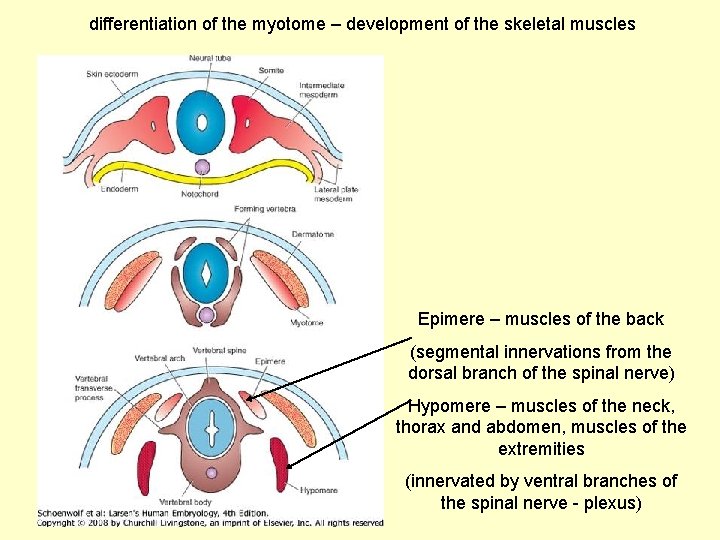
differentiation of the myotome – development of the skeletal muscles Epimere – muscles of the back (segmental innervations from the dorsal branch of the spinal nerve) Hypomere – muscles of the neck, thorax and abdomen, muscles of the extremities (innervated by ventral branches of the spinal nerve - plexus)
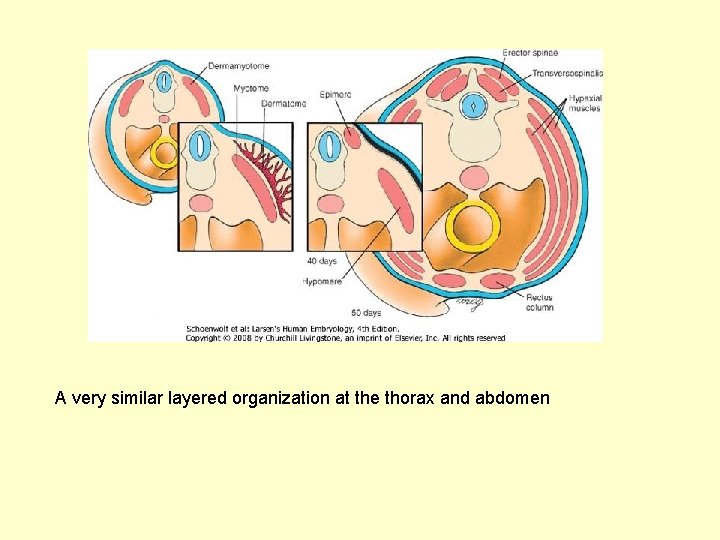
A very similar layered organization at the thorax and abdomen
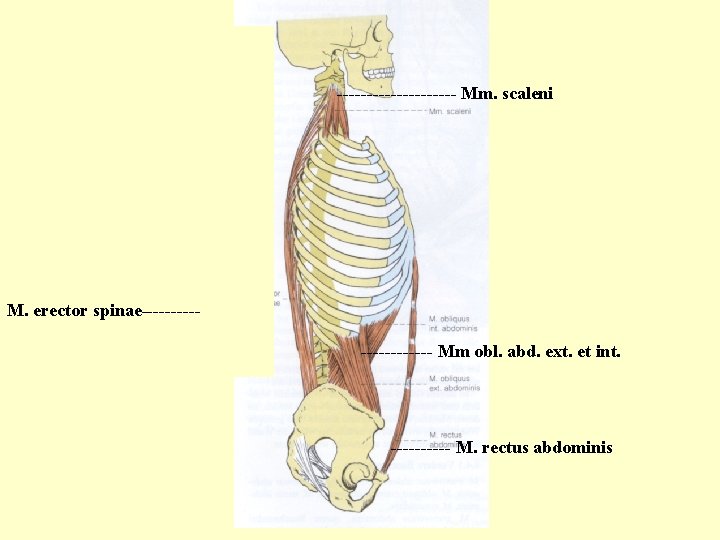
---------- Mm. scaleni M. erector spinae----------- Mm obl. abd. ext. et int. ----- M. rectus abdominis

Back muscles The muscles of the back can be divided into three groups : Superficial – associated with movements of the shoulder. Spinohumeral muscles migrate from the hypomere M. trapezius M. rhomboideus major et minor M. levator scapulae M. latissimus dorsi Intermediate – associated with movements of the thoracic cage. Serratus posterior superior Serratus posterior inferior Deep – associated with movements of the vertebral column erector spinae m. transversospinal muscles, interspinal, intertransverse and suboccipital muscles epimere

Superficial muscles – associated with movements of the shoulder. Trapezius muscle Originates from the skull(nuchal line), and the spinous processes of C 1 -T 12. The fibres attach to the clavicle, acromion and the scapula spine. Innervation : XI. cranial nerve (accessory nerve) M. trapezius M. latissimus dorsi Vertebra prominens, proc. spinosus Proc. spinosus The upper fibres of the trapezius elevates the scapula and rotates it during abduction of the arm. The middle fibres retract the scapula and the lower fibres pull the scapula inferiorly.

Latissimus dorsi broad origin from the spinous processes of T 6 -T 12, iliac crest, thoracolumbar fascia and the inferior three ribs attaches to the crest of lesser tubercule Innervation: Thoracodorsal nerve (brachial plexus) Actions: Extends, adducts and medially rotates the upper limb. Vertebra prominens, proc. spinosus M. latissimus dorsi Proc. spinosus
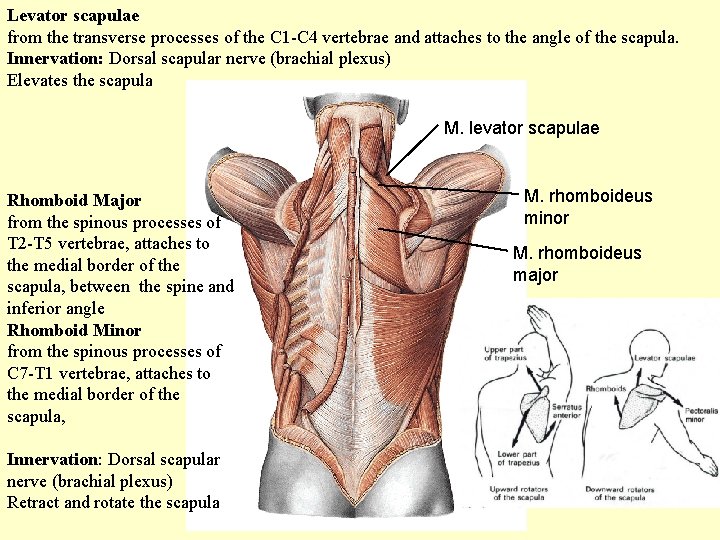
Levator scapulae from the transverse processes of the C 1 -C 4 vertebrae and attaches to the angle of the scapula. Innervation: Dorsal scapular nerve (brachial plexus) Elevates the scapula M. levator scapulae Rhomboid Major from the spinous processes of T 2 -T 5 vertebrae, attaches to the medial border of the scapula, between the spine and inferior angle Rhomboid Minor from the spinous processes of C 7 -T 1 vertebrae, attaches to the medial border of the scapula, Innervation: Dorsal scapular nerve (brachial plexus) Retract and rotate the scapula M. rhomboideus minor M. rhomboideus major

Intermediate – associated with movements of the thoracic cage. The serratus posterior superior is a thin, rectangular shaped muscle. It lies deep to the rhomboid muscles on the upper back. Attachments: Originates from the lower part of the ligamentum nuchae, and the cervical and thoracic spines (usually C 7 – T 3). The fibres pass in an inferolateral direction, attaching to ribs 2 -5. Innervation: Intercostal nerves Actions: Elevates ribs 2 -5 The serratus posterior inferior is broad and strong. It lies underneath the latissimus dorsi. Attachments: Originates from the thoracic and lumbar spines (usually T 11 – L 3). The fibres pass in a superolateral direction, attaching to ribs 9 -12. Innervation: Intercostal nerves Actions: Depresses ribs 9 -12. Serratus posterior superior m. Serratus posterior inferior m.
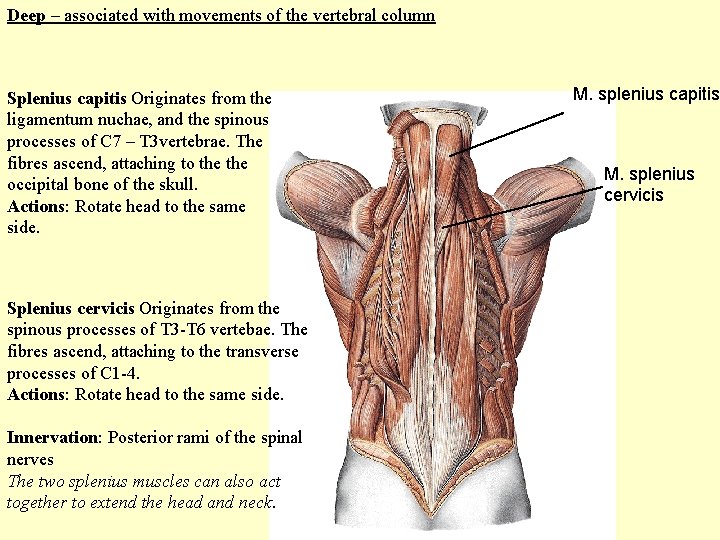
Deep – associated with movements of the vertebral column Splenius capitis Originates from the ligamentum nuchae, and the spinous processes of C 7 – T 3 vertebrae. The fibres ascend, attaching to the occipital bone of the skull. Actions: Rotate head to the same side. Splenius cervicis Originates from the spinous processes of T 3 -T 6 vertebae. The fibres ascend, attaching to the transverse processes of C 1 -4. Actions: Rotate head to the same side. Innervation: Posterior rami of the spinal nerves The two splenius muscles can also act together to extend the head and neck. M. splenius capitis M. splenius cervicis
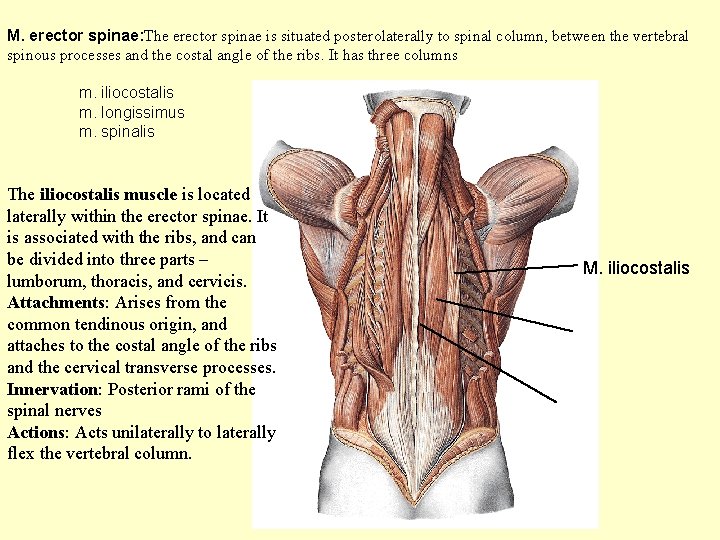
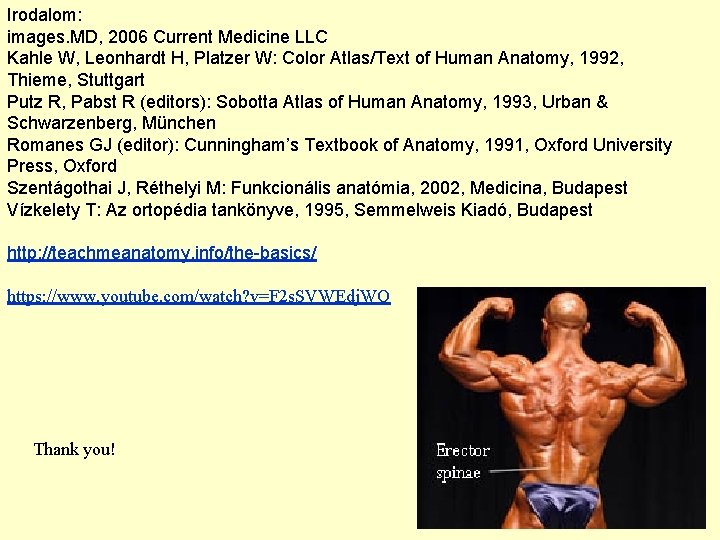
M. erector spinae: The erector spinae is situated posterolaterally to spinal column, between the vertebral spinous processes and the costal angle of the ribs. It has three columns m. iliocostalis m. longissimus m. spinalis The iliocostalis muscle is located laterally within the erector spinae. It is associated with the ribs, and can be divided into three parts – lumborum, thoracis, and cervicis. Attachments: Arises from the common tendinous origin, and attaches to the costal angle of the ribs and the cervical transverse processes. Innervation: Posterior rami of the spinal nerves Actions: Acts unilaterally to laterally flex the vertebral column. M. iliocostalis

The longissimus muscle is situated between the iliocostalis and spinalis. It is the largest of the three columns. It can be divided into three parts – thoracic, cervicis and capitis. Attachments: Arises from the common tendinous origin, and attaches to the lower ribs, the transverse processes of C 2 – T 12, and the mastoid process of the skull. Innervation: Posterior rami of the spinal nerves Actions: Acts unilaterally to laterally flex the vertebral column M. longissimus

The spinalis muscle is located medially within the erector spinae. It is the smallest of the three muscle columns. It can be divided into the thoracic, cervicis Attachments: Arises from the spinous processes and attaches to the spinous processes Innervation: Posterior rami of the spinal nerves Actions: Acts unilaterally to laterally flex the vertebral column. M. spinalis

Semispinalis capitis M. longissimus capitis M. Spinalis Lumborum, thoracis, cervicis M. Longissimus Thoracis, cervicis, capitis M. Iliocostalis Lumborum, thoracis, cervicis

Transversospinalis muscles are located underneath the erector spinae. They are a group of short muscles, associated with the transverse and spinous processes of the vertebral column There are three types of muscles in this group – the semispinalis, multifidus and rotatores. M. Semispinalis capitis M. Semispinalis cervicis Semispinalis m. Originates from the transverse processes of C 4 -T 10. The fibres ascend 5 -6 vertebral segments, attaching to the spinous processes of C 2 -T 4: semispinalis cervicis and to the occipital bone of the skull: semispinalis capitis

Multifidus m. Originates from the transverse processes The fibres ascend 2 -4 vertebral segments, attaching the spinous processes of the vertebrae. Mm. multifidi Mm. rotatores Rotatores m. Originates from the vertebral transverse processes. The fibres ascend, and attach to the lamina and spinous processes of the immediately superior vertebrae.

Minor Deep Intrinsic Muscles: Levatores costarum – Originates from the transverse processes of C 7 -T 11, and attaches to the rib immediately below. Acts to elevate the ribs. Interspinales: Spans between adjacent spinous processes. Acts to stablise the vertebral column. Intertranversarii– Spans between adjacent transverse processes. Acts to stablise the vertebral column.

Erector spinae Only the semispinalis is shown

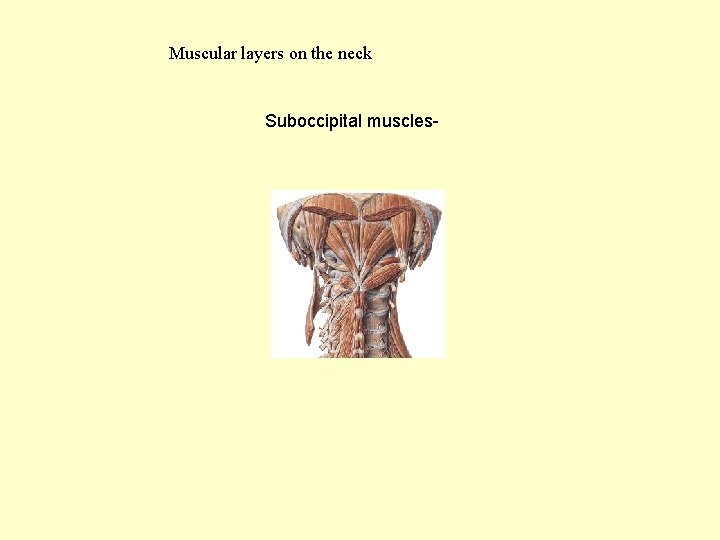
Muscular layers on the neck Suboccipital muscles-

Suboccipital muscles- suboccipital trigone M. rectus capitis post. Minor from the posterior tubercle of the C 1 vertebra (atlas) to the medial part of the inferior nuchal line of the occipital bone. M. rectus capitis post. Major from the spinous process of the C 2 vertebrae (axis), and inserts into the lateral part of the inferior nuchal line of the occipital bone. Obliquus capitis superior rom the transverse process of C 1 and attaches into the occipital bone (between the superior and inferior nuchal lines). M. obliquus capitis inferior from the posterior tubercle of the C 2 vertebra, and attaches into the transverse process of C 1. Actions: Extension and rotation of the head. Innervation: Suboccipital nerve (post. ramus of C 1)

Prevertebral muscles of the neck M. rectus capitis anterior M. rectus capitis lateralis M. longus capitis M. longus colli Scalenus muscles Actions: flex the head and neck anteriorly Innervation: ventral rami of spinal nerves

Scalenus muscles posterior anterior Name m. anterior scalene m. middle scalene m. posterior scalene Origin Insertion Function scalene tubercle on anterior tubercles of The three muscles: ipsilateral contraction causes ipsilateral the 1. rib the transverse processes of C 3 -C 6 flexion of the neck, posterior tubercles of and bilateral contraction causes anterior flexion behind of the neck the subclavian groove the transverse processes of C 2 -C 7 in case of forced respiration act as accessory on the 1. rib muscles of respiration posterior tubercles of 2. rib innervation : anterior rami of spinal nerves the transverse C 3 -C 8 processes of C 5 -C 7

Supra- and infrahyoid muscles The suprahyoid muscles are a group of four muscles, located superiorly to the hyoid bone of the neck. They all act to elevate the hyoid bone – an action involved in swallowing The infrahyoid muscles are a group of four muscles that are located inferiorly to the hyoid bone in the neck Depress the hyoid bone. Innervation: ventral rami of spinal nerves (ansa cervicalis)
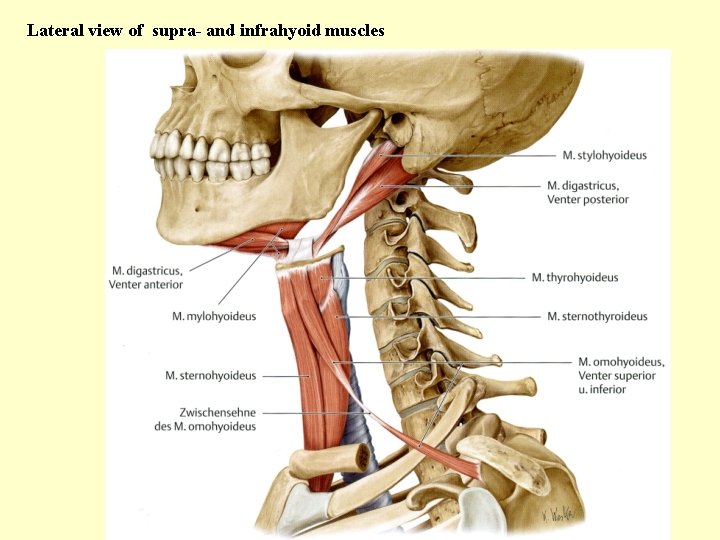
Lateral view of supra- and infrahyoid muscles

Superficial neck muscles Sternocleidomastoid m. Originates from the manubrium sterni and clavicle, inserts to the mastoid process of the skull ipsilateral contraction causes ipsilateral flexion and rotation of the head („ear comes near to the shoulder” bilateral contraction causes protraction of the head Innervation: IX cranial nerve (with the trapezius m. )
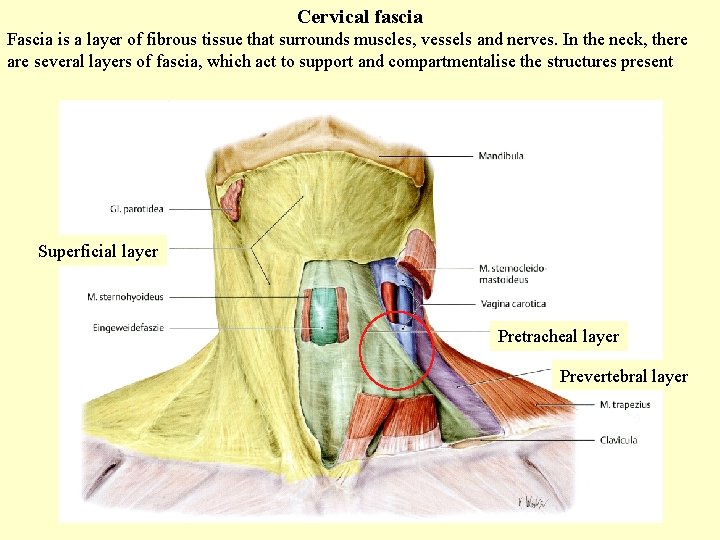
Cervical fascia Fascia is a layer of fibrous tissue that surrounds muscles, vessels and nerves. In the neck, there are several layers of fascia, which act to support and compartmentalise the structures present Superficial layer Pretracheal layer Prevertebral layer

Transverse section of the neck. The investing layer of fascia in highlighted in blue. The fascia completely envelopes the sternocleidomastoid and trapezius. Fascia cervicalis - Spf. Layer or investing layer - pretracheal layer (visceral part) (carotid sheath) - prevertebral layer
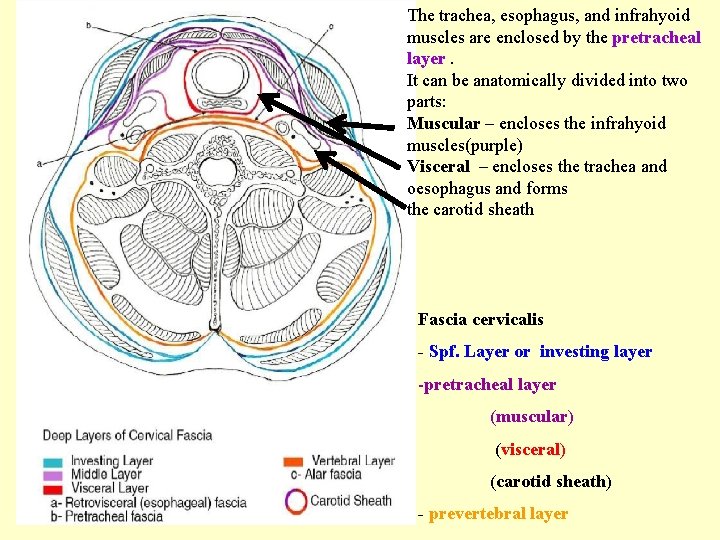
The trachea, esophagus, and infrahyoid muscles are enclosed by the pretracheal layer. It can be anatomically divided into two parts: Muscular – encloses the infrahyoid muscles(purple) Visceral – encloses the trachea and oesophagus and forms the carotid sheath Fascia cervicalis - Spf. Layer or investing layer -pretracheal layer (muscular) (visceral) (carotid sheath) - prevertebral layer

The prevertebral layer surrounds the vertebral column and its associated muscles (scalene, prevertebral, and deep muscles of the back) Fascia cervicalis - Spf. Layer or investing layer - pretracheal layer (visceral part) (carotid sheath) - prevertebral layer

The superficial layer and muscular part of pretracheal layer end at the sternum, but the visceral layer and the prevertebral layer continous downward to the thorax!! - inflammation

Auxiliary respiratory muscles Nasal muscles (nostrils widen) Scalenus anterior, medius et posterior (elevates upper ribs) Sternocleidomastoideus (elevates clavicle)
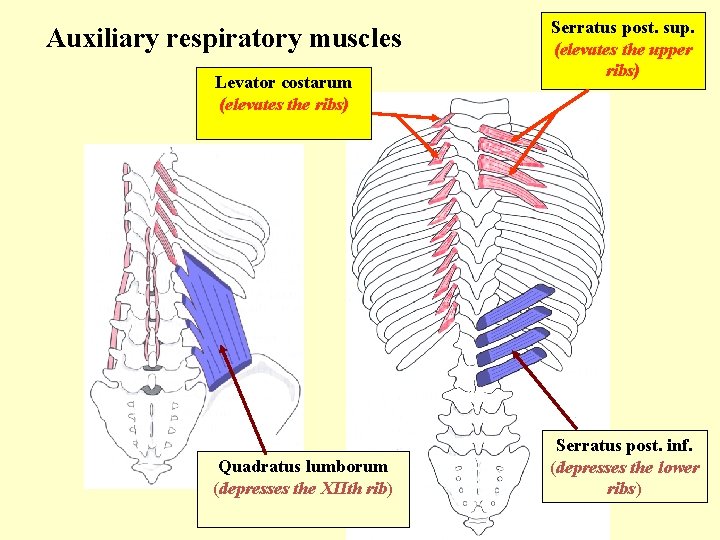
Auxiliary respiratory muscles Levator costarum (elevates the ribs) Quadratus lumborum (depresses the XIIth rib) Serratus post. sup. (elevates the upper ribs) Serratus post. inf. (depresses the lower ribs)

Movements of the cervical part Articulatio atlantooccipitalis articulatio ellipsoidea movements: flexio lateralis flexio ventralis és dorsalis Articulatio atlantoaxialis articulatio trochoidea movements: ¾ of rotation of the neck!!! Cervical spine direction of the articular surfaces: horizontal movements: flexio lateralis + small rotation flexio ventralis and dorsalis
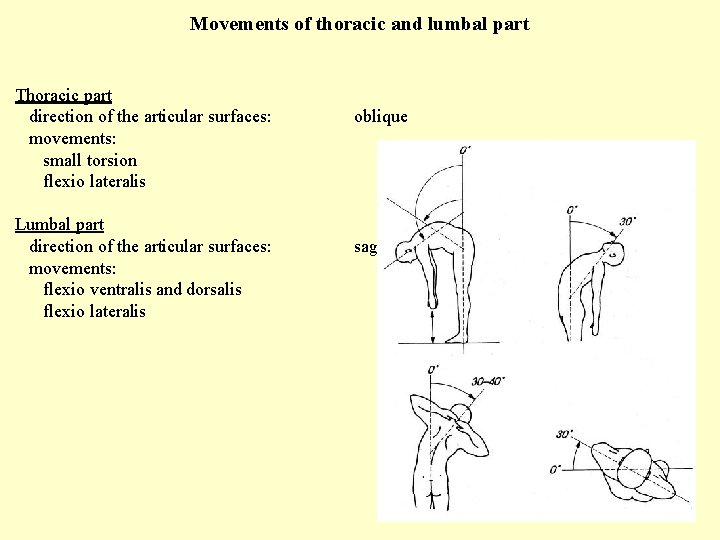
Movements of thoracic and lumbal part Thoracic part direction of the articular surfaces: movements: small torsion flexio lateralis Lumbal part direction of the articular surfaces: movements: flexio ventralis and dorsalis flexio lateralis oblique sagittal

Movements of the spine Rotation: -C. no -Lower Th. -L. hardly C lordosis T kyphosis L lordosis Lateralflexion C. -L. Th. hardly Anteflexion C. -L. lordosis decreased Th. kyphosis increased Dorsalflexion C. -L. lordosis increased Th. kyphosis decreased very: between the C. -Th. and L. -S. borderlands vulnerable !
Irodalom: images. MD, 2006 Current Medicine LLC Kahle W, Leonhardt H, Platzer W: Color Atlas/Text of Human Anatomy, 1992, Thieme, Stuttgart Putz R, Pabst R (editors): Sobotta Atlas of Human Anatomy, 1993, Urban & Schwarzenberg, München Romanes GJ (editor): Cunningham’s Textbook of Anatomy, 1991, Oxford University Press, Oxford Szentágothai J, Réthelyi M: Funkcionális anatómia, 2002, Medicina, Budapest Vízkelety T: Az ortopédia tankönyve, 1995, Semmelweis Kiadó, Budapest http: //teachmeanatomy. info/the-basics/ https: //www. youtube. com/watch? v=F 2 s. SVWEdj. WQ Thank you!
- Slides: 38