
Back 2 Basics with Proto Jonathan Bachrach MIT
Back 2 Basics with Proto Jonathan Bachrach MIT AI Lab
Proto • • • Goals Examples Relation Definition State Future
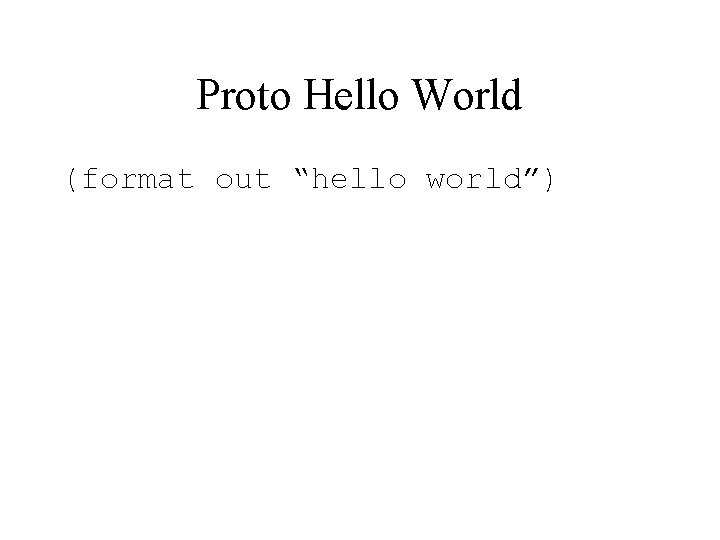
Proto Hello World (format out “hello world”)
Proto Goals • • Simple Productive Powerful Extensible Dynamic Efficient Real-time • Teaching and research vehicle • Electronic music is domain to keep it honest
Simplicity • 10 K lines 10 page manual • Hard limit – pressure makes pearls
Best of All Worlds • Want scripting and delivery language rolled into one • Tools work better • No artificial boundaries and cliffs • Never been done effectively • Electronic music forces realism
Proto Ancestors • Language Design is Difficult – Leverage proven ideas – Make progress in selective directions • Ancestors – Scheme – Cecil – Dylan
Proto <=> Scheme • Concise naming • Procedural macros • Objects all the way • Long-winded naming • Rewrite rule only • Only records
Proto <=> Cecil • Prefix syntax • Scheme inspired special forms • Infix syntax • Smalltalk inspired special forms
Proto <=> Dylan • • Prefix syntax Prototype-based Procedural macros Rationalized collection protocol / hierarchy • Always open • Predicate types • • Infix syntax Class-based Rewrite-rule only … Conflated collection protocol / hierarchy • Sealing • Fixed set of types
Object Orientation • Assume you know OO basics • Motivations: – Abstraction – Reuse – Extensibility
Prototype-based OO • Simplified object model • No classes • Cloning basic operation for instance and prototype creation • Prototypes are special objects that serve as classes • Inheritance follows cloned-from relation
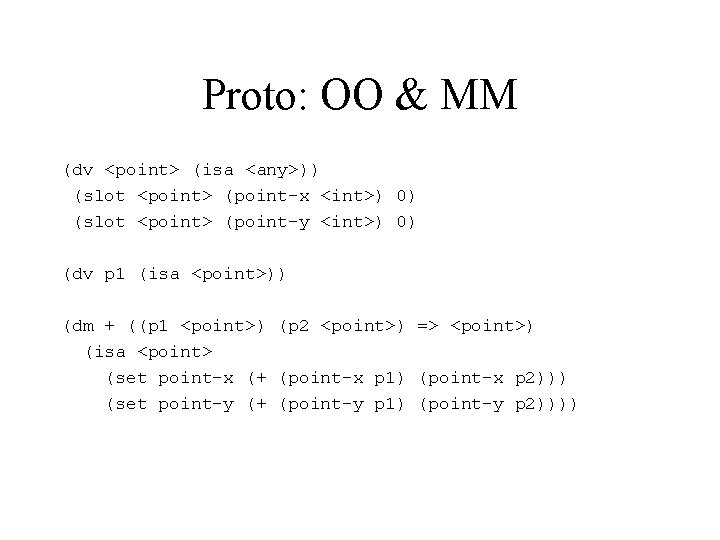
Proto: OO & MM (dv <point> (isa <any>)) (slot <point> (point-x <int>) 0) (slot <point> (point-y <int>) 0) (dv p 1 (isa <point>)) (dm + ((p 1 <point>) (p 2 <point>) => <point>) (isa <point> (set point-x (+ (point-x p 1) (point-x p 2))) (set point-y (+ (point-y p 1) (point-y p 2))))
Language Design: User Goals -- The “ilities” • • • Learnability Understandability Writability Modifiability Runnability Interoperability
Learnability • • Simple Small Regular Gentle learning curve • Perlis: “Symmetry is a complexity reducing concept…; seek it everywhere. ”
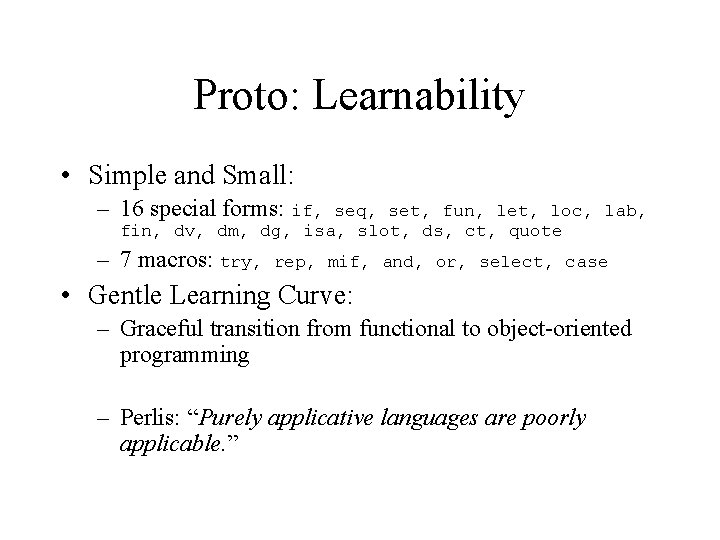
Proto: Learnability • Simple and Small: – 16 special forms: if, seq, set, fun, let, loc, lab, fin, dv, dm, dg, isa, slot, ds, ct, quote – 7 macros: try, rep, mif, and, or, select, case • Gentle Learning Curve: – Graceful transition from functional to object-oriented programming – Perlis: “Purely applicative languages are poorly applicable. ”
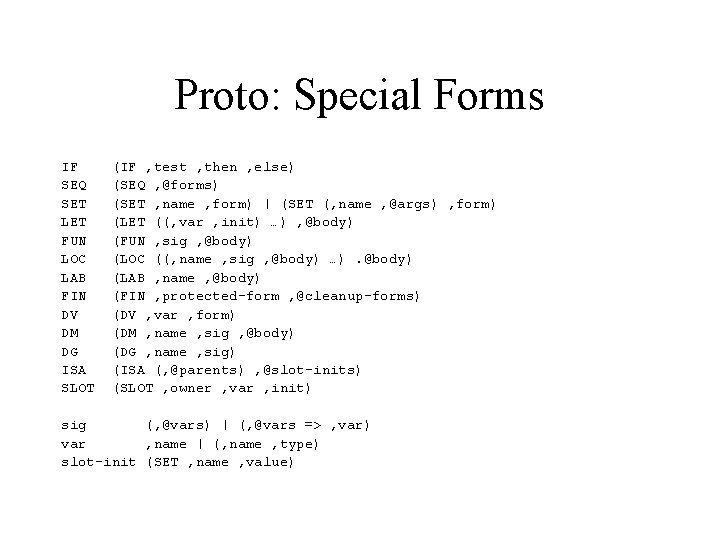
Proto: Special Forms IF SEQ SET LET FUN LOC LAB FIN DV DM DG ISA SLOT (IF , test , then , else) (SEQ , @forms) (SET , name , form) | (SET (, name , @args) , form) (LET ((, var , init) …) , @body) (FUN , sig , @body) (LOC ((, name , sig , @body) …). @body) (LAB , name , @body) (FIN , protected-form , @cleanup-forms) (DV , var , form) (DM , name , sig , @body) (DG , name , sig) (ISA (, @parents) , @slot-inits) (SLOT , owner , var , init) sig (, @vars) | (, @vars => , var) var , name | (, name , type) slot-init (SET , name , value)
Understandability • • • Natural notation Simple to predict behavior Modular Models application domain Concise
Proto: Understandability • Describable by a small interpreter – Size of interpreter is a measure of complexity of language • Regular syntax – Debatable whether prefix is natural, but it’s simple, regular and easy to implement
Writability • Expressive features and abstraction mechanisms • Concise notation • Domain-specific features and support • No error-prone features • Internal correctness checks (e. g. , typechecking) to avoid errors
Proto: Error Proneness • No out of language errors – At worst all errors will be be caught in language at runtime – At best potential errors such as “no applicable methods” will be caught statically earlier and in batch • Unbiased dispatching and inheritance – Example: Method selection not based on lexicographical order as in CLOS
Design Principle Two: Planned Serendipity • Serendipity: – M-W: the faculty or phenomenon of finding valuable or agreeable things not sought for • Orthogonality – Collection of few independent powerful features combinable without restriction • Consistency
Proto: Serendipity • Objects all the way down • Slots accessed only through calls to generic’s • Simple orthogonal special forms • Expression oriented • Example: – Exception handling can be built out of a few special forms: lab, fin, loc, …
Modifiability • Minimal redundancy • Hooks for extensibility included automatically • Users equal partner in language design • No features that make it hard to change code later
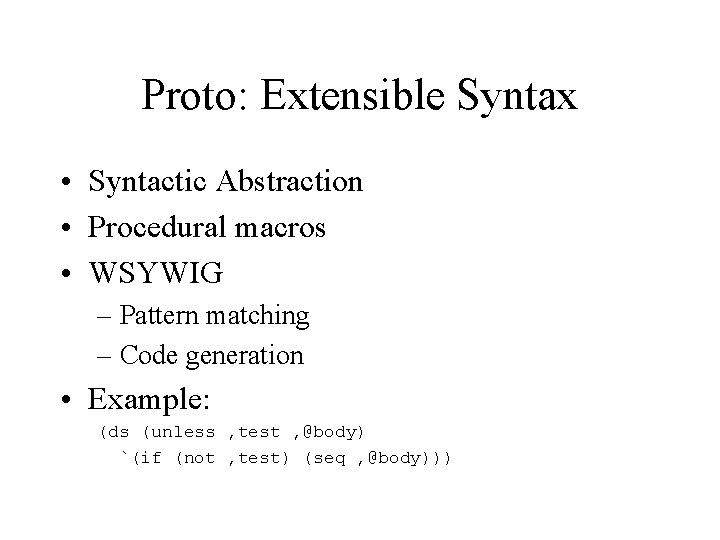
Proto: Extensible Syntax • Syntactic Abstraction • Procedural macros • WSYWIG – Pattern matching – Code generation • Example: (ds (unless , test , @body) `(if (not , test) (seq , @body)))
Proto: Multimethods • Can add methods outside original class definition: – (dm jb-print ((x <node>)) …) – (dm jb-print ((x <str>)) …)
Proto: Generic Accessors • All slot access goes through generic function calls • Can easily redefine these generic’s without affecting client code
Runnability • Features for programmers to control efficiency • Analyzable by compilers and other tools
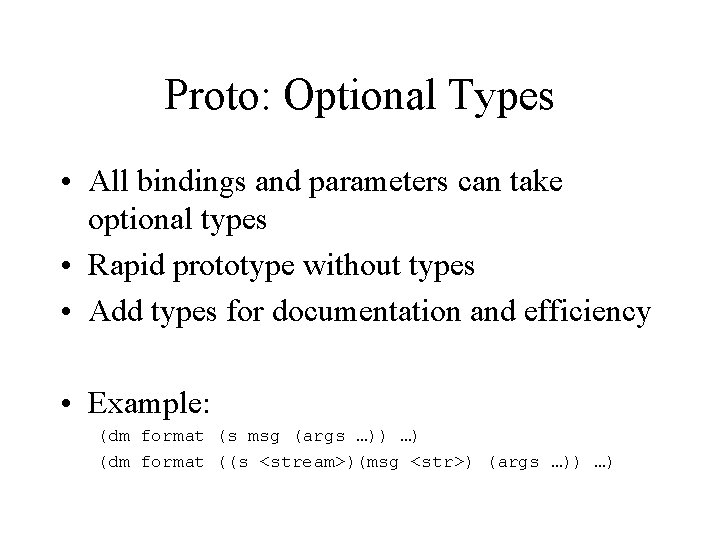
Proto: Optional Types • All bindings and parameters can take optional types • Rapid prototype without types • Add types for documentation and efficiency • Example: (dm format (s msg (args …)) …) (dm format ((s <stream>)(msg <str>) (args …)) …)
Proto: Pay as You Go • Don’t charge for features not used • Pay more for features used in more complicated ways • Examples: – Dispatch • Just function call if method unambiguous from argument types • Otherwise require dynamic method lookup – Proto’s bind-exit called “lab” • Local exits are set + goto • Non local exits must create a frame and stack alloc an exit closure
The Rub • Support for evolutionary programming creates a serious challenge for implementers • Straightforward implementations would exact a tremendous performance penalty
Implementation Strategy • Simple dynamic compilation • Maintains both – optimization and – interactivity
Initial Loose Compilation • Very quick compilation • Generate minimal dependencies – only names and macros
Dynamic Whole Program Compilation • Assume complete information • Perform aggressive type flow analysis – Chooses, clones and inlines methods • Compilation can be triggered manually, through dependencies, or through feedback
Dependency Tracking • Assumptions are tracked • Changed assumptions trigger recompilation • Based on Fun-O-Dylan approach – Dependencies logged on bindings – Record dependent and compilation stage
Simple Code Generator • Focus is on high-level optimizations • Potentially gen-code direct from AST with approximated peep-hole optimizations
Save Image • Save executable copy of image to disk – Maintains optimizations and dependencies – Uses dump/undump approach of emacs • Avoid hassles of – File formats – Databases – etc
Status • • • Fully bootstrapped Module system on line by week’s end Native code-gen in progress Dependency tracking by summer’s end Flow-typist by summer’s end
Research Directions • Language Design • Dynamic parameterized types • Dynamic Interfaces • Series • Macros • Language Implementation • Dynamic compilation • Analysis/optimizations • Visualization • Real-time
- Slides: 39