
Bachelor of Information Technology Systems Analysis Design IT
Bachelor of Information Technology Systems Analysis & Design IT 2405 07. System Design 7. 1 Introduction to System Design Nisansala Dharmasena Bertholameuse BSc Special (Hons) in IT, PGD in IT, MSc in IT, PGD in IR, Dip in Journalism, M. Phil. in Computer Science (Reading)
Bachelor of Information Technology Systems Analysis & Design IT 2405 7. System Design 7. 1 Introduction to System Design Nisansala Dharmasena Bertholameuse BSc Special (Hons) in IT, PGD in IT, MSc in IT, PGD in IR, Dip in Journalism, M. Phil. in Computer Science (Reading)
IT 2405 Systems Analysis & Design Intended Learning Outcomes After completing this module students should be able to; Identify and Differentiate between different System Design approaches.
IT 2405 Systems Analysis & Design Outline What Is An Information System? What Is System Analysis About? System Analysis vs. System Design System Analyst The Role of a System Analyst Traditional System Development Life Cycle (SDLC)
IT 2405 Systems Analysis & Design Outline Two Approaches to System Development System Design Approaches Model-Driven Approaches Rapid Application Development (RAD) Joint Application Development (JAD) System Design Tasks For In-House Development (Build) Tasks for Procurement Phase Research Technical Criteria and Options
IT 2405 Systems Analysis & Design Outline Solicit Proposals (or Quotes) From Vendors Validate Vendor Claims and Performances Evaluate and Rank Vendor Proposals Award Contract and Debrief Vendors Impact of Buy Decision on Remaining Life-Cycle Phases
IT 2405 Systems Analysis & Design What Is An Information System? An information system is a collection of interrelated components that collect, process and store, and provide as output the information needed to complete a business task.
IT 2405 Systems Analysis & Design Examples of Information Systems • Course registration system • Online order system • Online banking system
IT 2405 Systems Analysis & Design What Is System Analysis About? • Understanding the goals and strategies of the business. • Defining the information requirements that support those goals and strategies. • It is not about programming.
IT 2405 Systems Analysis & Design System Analysis vs. System Design System Analysis: Investigation of the problem and requirement rather than solution. System Design: A conceptual solution that fulfills the requirements, rather than implementation.
IT 2405 Systems Analysis & Design System Analyst A business professional who uses analysis and design techniques to solve business problems using information technology.
IT 2405 Systems Analysis & Design The Role of a System Analyst • Investigate, analyze, design, develop, install, evaluate, and maintain a company’s information systems. • Business knowledge. • Business problem solver. • Help translate business requirements into IT projects.
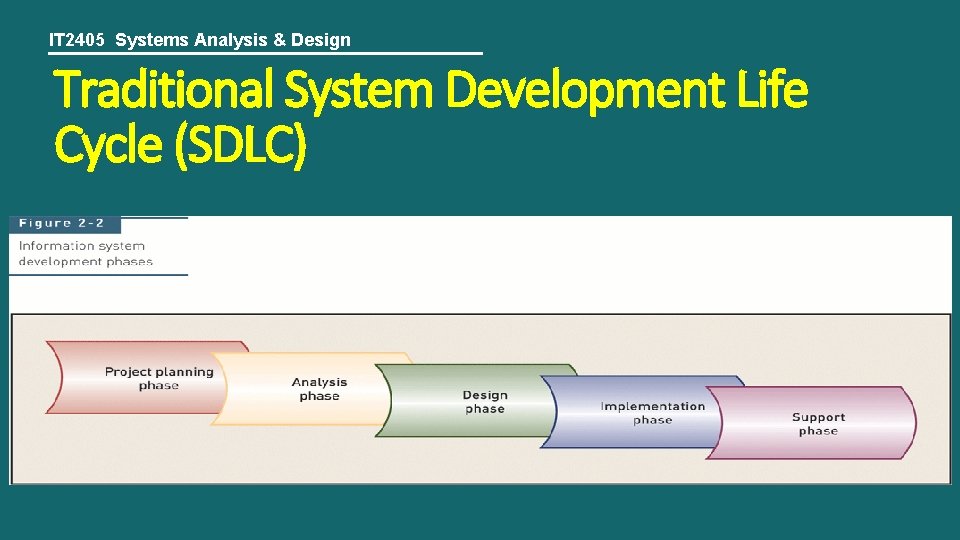
IT 2405 Systems Analysis & Design Traditional System Development Life Cycle (SDLC)
IT 2405 Systems Analysis & Design Traditional System Development Life Cycle (SDLC) • Project planning – initiate, ensure feasibility, plan schedule, obtain approval for project • Analysis – understand business needs and processing requirements • Design – define solution system based on requirements and analysis decisions • Implementation – construct, test, train users, and install new system • Support – keep system running and improve it
IT 2405 Systems Analysis & Design Two Approaches to System Development Traditional (Structured) approach Also called structured system development Structured analysis and design technique (SADT) Includes information engineering (IE) Object-oriented approach Also called OOA, OOD, and OOP Views information system as collection of interacting objects that work together to accomplish tasks
IT 2405 Systems Analysis & Design Systems design – the specification of a detailed computer -based solution. Also called physical design. systems analysis emphasizes the business problem systems design emphasizes the technical or implementation concerns of the system.
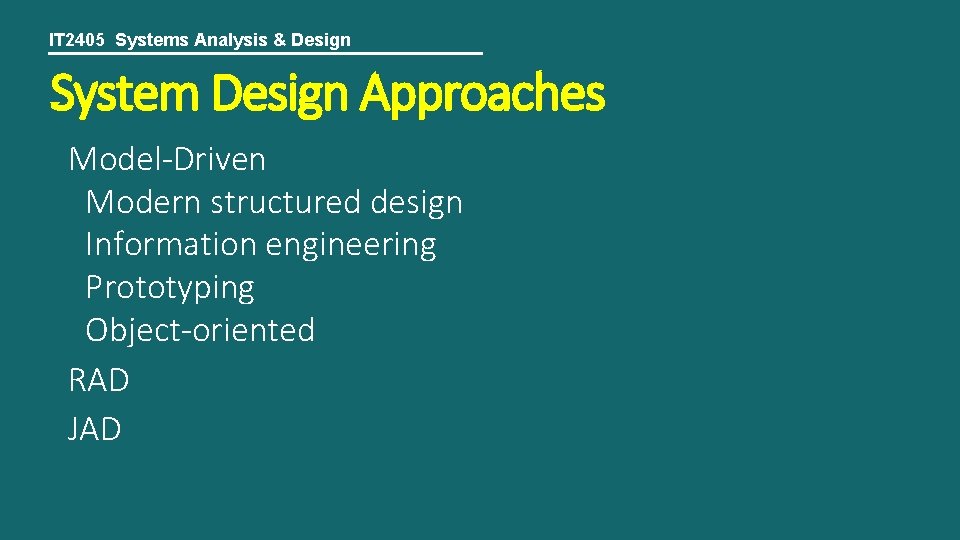
IT 2405 Systems Analysis & Design System Design Approaches Model-Driven Modern structured design Information engineering Prototyping Object-oriented RAD JAD
IT 2405 Systems Analysis & Design Question A New system requirements are identified by A. study of an existing system B. documenting the existing system. C. identifying current deficiencies and establishing new goals D. All of the above E. None of the above
IT 2405 Systems Analysis & Design Answer A New system requirements are identified by A. study of an existing system B. documenting the existing system. C. identifying current deficiencies and establishing new goals D. All of the above E. None of the above
IT 2405 Systems Analysis & Design Question Problem analysis is done during A. system design phase B. systems analysis phase C. before system test D. All of the above E. None of the above
IT 2405 Systems Analysis & Design Answer Problem analysis is done during A. system design phase B. systems analysis phase C. before system test D. All of the above E. None of the above
IT 2405 Systems Analysis & Design Model-Driven Approaches Model-driven strategy – a system design approach that emphasizes drawing system models to document technical and implementation aspects of a system.
IT 2405 Systems Analysis & Design Model-Driven Approaches – Modern Structured Design Modern structured design – a system design technique that decomposes the system’s processes into manageable components. Synonyms (although technically inaccurate) are topdown program design and structured programming. Design in a top-down hierarchy of modules Easier to implement and maintain (change).
IT 2405 Systems Analysis & Design Model-Driven Approaches – Modern Structured Design Modules should be highly cohesive Accomplish one function only Modules should be loosely coupled Minimally dependent on one another
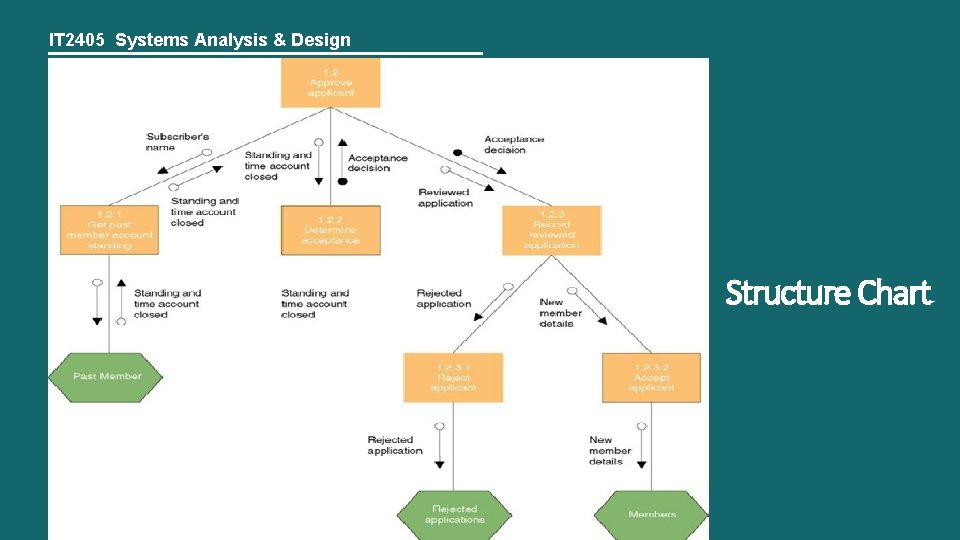
IT 2405 Systems Analysis & Design Structure Chart
IT 2405 Systems Analysis & Design Model-Driven Approaches – Information Engineering Information engineering (IE) – a model-driven and datacentered, but process-sensitive technique for planning, analyzing, and designing information systems. IE models are pictures that illustrate and synchronize the system’s data and processes. The primary tool of IE is a data model diagram.
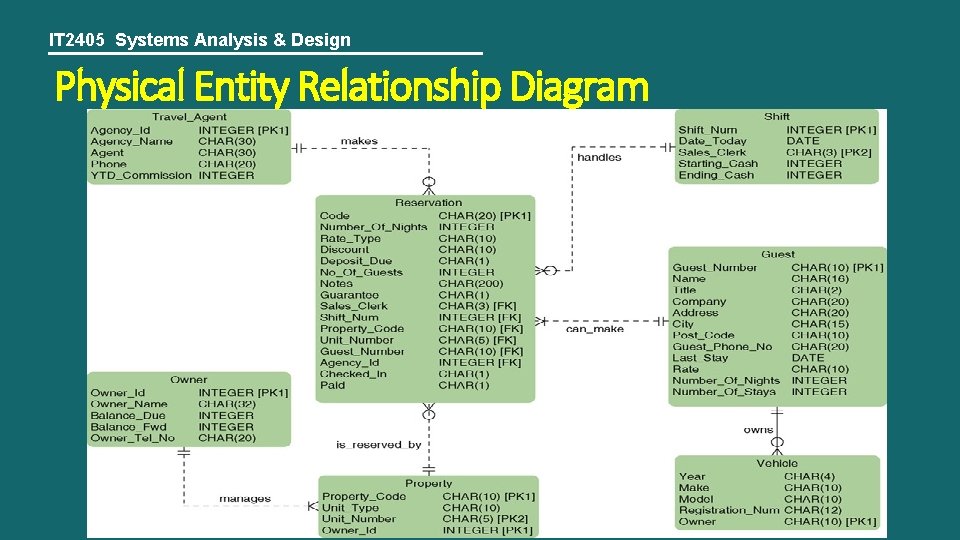
IT 2405 Systems Analysis & Design Physical Entity Relationship Diagram
IT 2405 Systems Analysis & Design Model-Driven Approaches – Prototyping Prototype – a small-scale, incomplete, but working sample of a desired system Iterative process involving a close working relationship between the designer and the users.
IT 2405 Systems Analysis & Design Model-Driven Approaches – Prototyping Key Benefits: Encourages and requires active end-user participation. Iteration accommodates end-users who tend to change their minds. Endorses philosophy that end-users won’t know what they want until they see it. Active model that end-users can interact with. Errors can be detected earlier. Can increase creativity as it allows for quicker user feedback. Accelerates several phases of the life cycle.
IT 2405 Systems Analysis & Design Model-Driven Approaches – Prototyping (con’t) Disadvantages and Pitfalls: Encourages “code, implement, and repair” life cycle that cause maintenance nightmares. Still need systems analysis phases, but so easy to skip. Cannot completely substitute a prototype for a paper specification (like architect without a blueprint). Numerous design issues are not addressed by prototyping.
IT 2405 Systems Analysis & Design Model-Driven Approaches – Prototyping (con’t) Often leads to premature commitment to a design. Scope and complexity of the system can expand out of control. Can reduce creativity in designs. Often suffer from slower performance because of language considerations (rapidly becoming a non-issue).
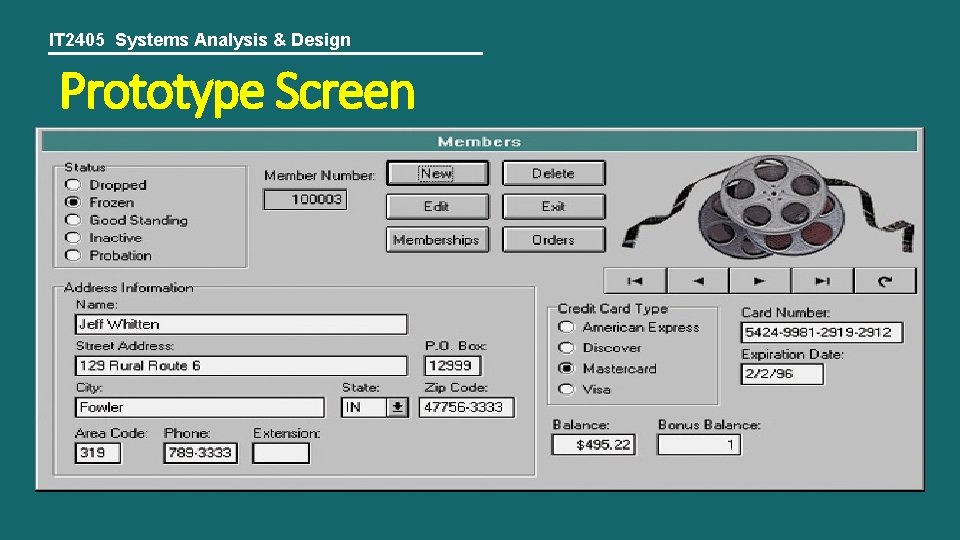
IT 2405 Systems Analysis & Design Prototype Screen
IT 2405 Systems Analysis & Design Model-Driven Approaches – Object-Oriented Design (OOD) techniques are used to refine the object requirements definitions identified earlier during analysis, and to define design specific objects. Extension of object-oriented analysis Attempt to eliminate the separation of concerns about data and process.
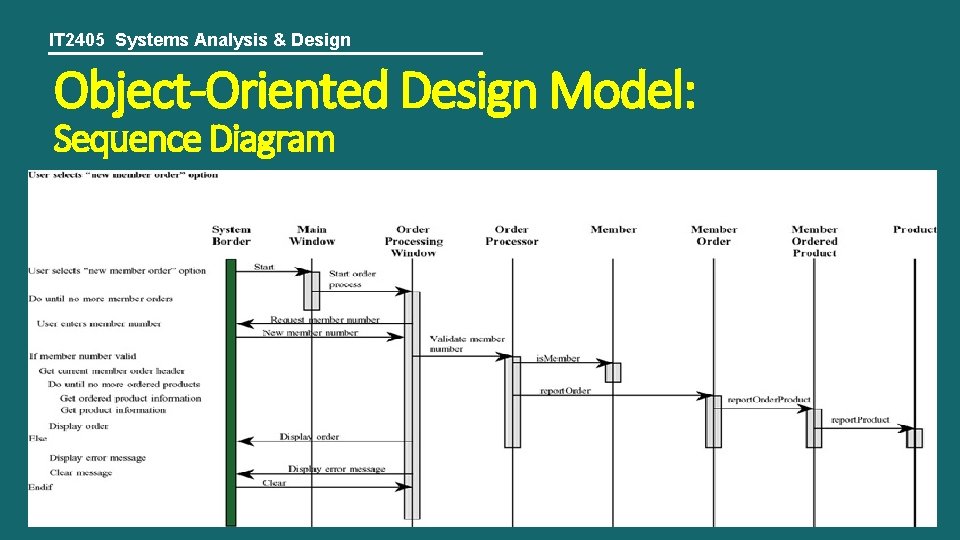
IT 2405 Systems Analysis & Design Object-Oriented Design Model: Sequence Diagram
IT 2405 Systems Analysis & Design Rapid Application Development (RAD) Rapid application development (RAD) – a systems design approach that utilizes structured, prototyping, and JAD techniques to quickly develop systems. The merger of various structured techniques to accelerate systems development Data-driven information engineering Prototyping Joint application development
IT 2405 Systems Analysis & Design Joint Application Development (JAD) is a technique that complements other systems analysis and design techniques by emphasizing participative development among system owners, users, designers, and builders. During the JAD sessions for systems design, the systems designer will take on the role of facilitator for possibly several full-day workshops intended to address different design issues and deliverables.
IT 2405 Systems Analysis & Design System Design Tasks For In-House Development (Build) Design the Application Architecture Define technologies to be used by (and used to build) one, more, or all information systems. Revise models as physical models Design the System Databases Database schema Optimized for implementation DBMS
IT 2405 Systems Analysis & Design System Design Tasks For In-House Development (Build) Design the System Interface Input, output, and dialogue specifications Prototypes Package Design Specifications to guide programmers Update Project Plan
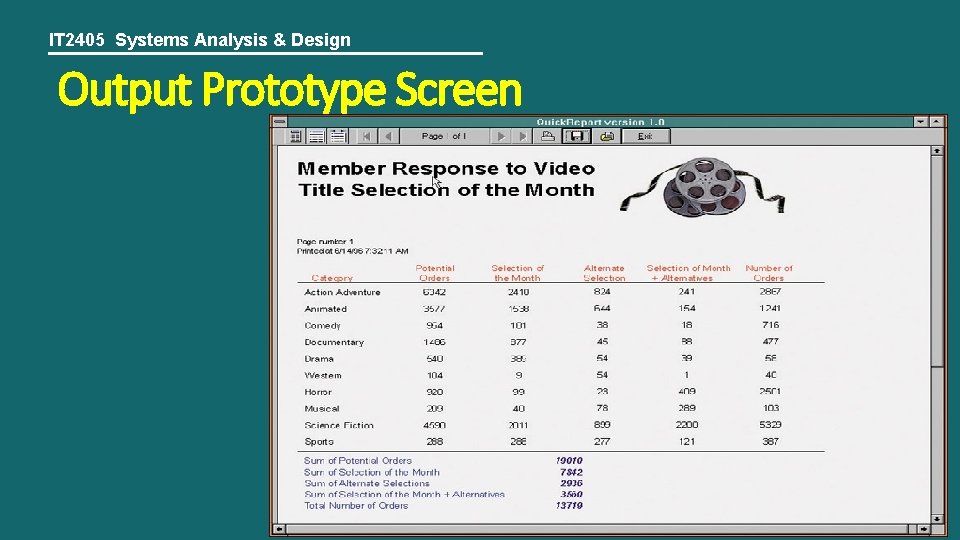
IT 2405 Systems Analysis & Design Output Prototype Screen
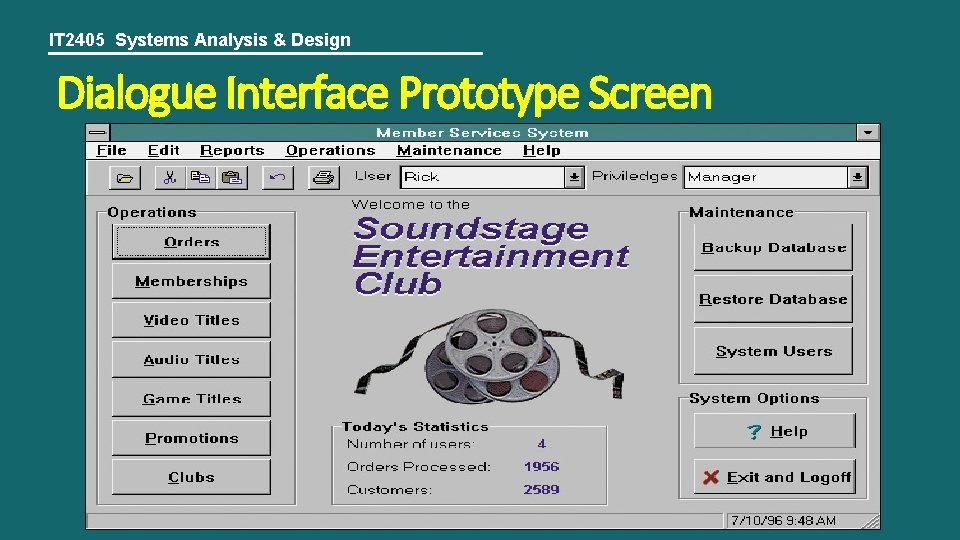
IT 2405 Systems Analysis & Design Dialogue Interface Prototype Screen
IT 2405 Systems Analysis & Design Tasks for Procurement Phase Research Technical Criteria and Options Solicit Proposals or Quotes from Vendors Validate Vendor Claims and Performances Evaluate and Rank Vendor Proposals Award Contract and Debrief Vendors
IT 2405 Systems Analysis & Design Research Technical Criteria and Options Magazines and journals Internal standards may exist for hardware and software selection. Information services are primarily intended to constantly survey the marketplace for new products and advise prospective buyers on what specifications to consider. Trade newspapers and periodicals offer articles and experiences on various types of hardware and software that you may be considering.
IT 2405 Systems Analysis & Design Solicit Proposals (or Quotes) From Vendors Request for Proposals (RFP) – used to communicate requirements and desired features to prospective vendors. Several different vendors and/or products are candidates. They will respond with a proposal. Request for Quotations (RFQ) – used when you have already decided on a specific product that can be acquired from multiple sources. They respond with a price quotation.
IT 2405 Systems Analysis & Design Typical Request For Proposal Outline I. Introduction A. Background B. Brief summary of needs C. Explanation of RFP document D. Call for action on part of vendor
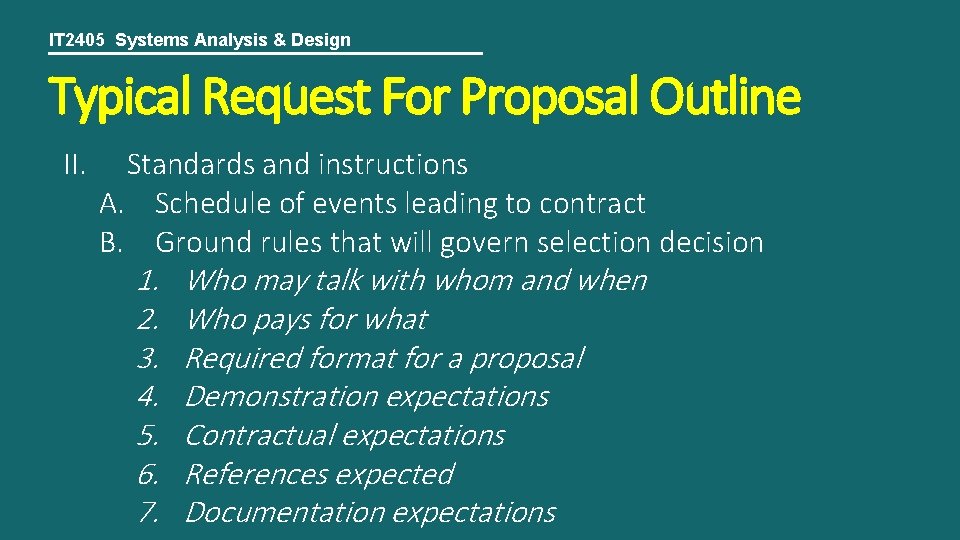
IT 2405 Systems Analysis & Design Typical Request For Proposal Outline II. Standards and instructions A. Schedule of events leading to contract B. Ground rules that will govern selection decision 1. 2. 3. 4. 5. 6. 7. Who may talk with whom and when Who pays for what Required format for a proposal Demonstration expectations Contractual expectations References expected Documentation expectations
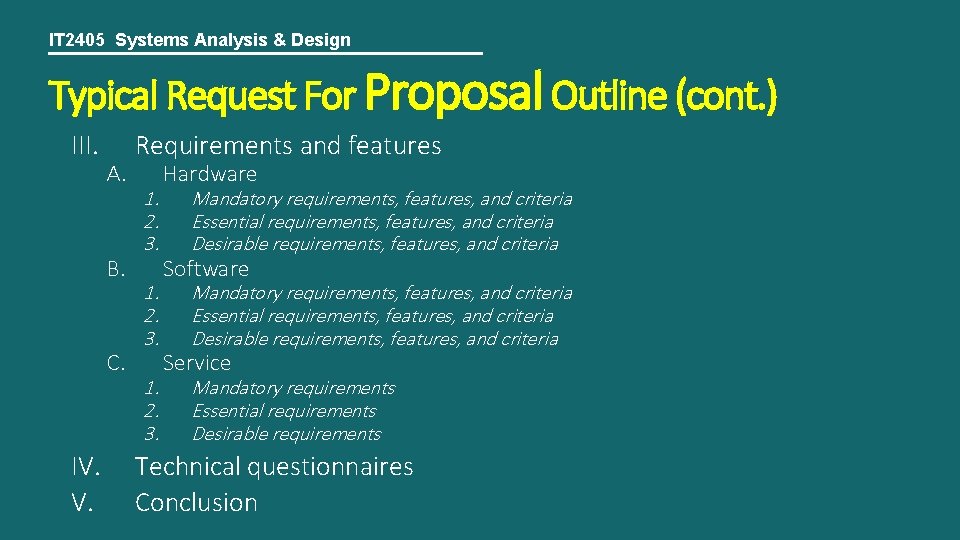
IT 2405 Systems Analysis & Design Typical Request For Proposal Outline (cont. ) III. A. B. C. IV. V. Requirements and features 1. 2. 3. Hardware Mandatory requirements, features, and criteria Essential requirements, features, and criteria Desirable requirements, features, and criteria Software Mandatory requirements, features, and criteria Essential requirements, features, and criteria Desirable requirements, features, and criteria Service Mandatory requirements Essential requirements Desirable requirements Technical questionnaires Conclusion
IT 2405 Systems Analysis & Design Validate Vendor Claims and Performances Review vendor proposals and eliminate any that does not meet all mandatory requirements. Validate the vendor claims and promises against validation criteria. User References Technical Manuals Demonstrations
IT 2405 Systems Analysis & Design Evaluate and Rank Vendor Proposals Feasibility assessment Scoring system Hard-dollar costs – you will have to pay to the selected vendor. Soft-dollar costs – additional costs you will incur if you select a particular vendor (to overcome a shortcoming, etc. )
IT 2405 Systems Analysis & Design Award Contract and Debrief Vendors Negotiate contract with selected vendor. Debrief vendors that submitted losing proposals. Not to offer a second chance. But to inform them of precise weaknesses in their proposals and/or products.
IT 2405 Systems Analysis & Design Impact of Buy Decision on Remaining Life-Cycle Phases Must integrate or interface the new system to other existing systems. Decision Analysis Make revisions in models to reflect purchased solution. Implement purchased solution. Integration problems lead to revised business requirements statements. Design Technical specification for a subset of programs to integrate purchased and built solutions.
IT 2405 Systems Analysis & Design Question The primary tool used in structured design is a: A. data-flow diagram B. module C. structure chart D. program flowchart E. None of the above
IT 2405 Systems Analysis & Design Answer The primary tool used in structured design is a: A. data-flow diagram B. module C. structure chart D. program flowchart E. None of the above
IT 2405 Systems Analysis & Design Question The approach used in top-down analysis and design is A) to identify the top level functions by combining many smaller components into a single entity B) to prepare flow charts after programming has been completed C) to identify a top level function and then create a hierarchy of lower-level modules and components D) All of the above E) None of the above
IT 2405 Systems Analysis & Design Answer The approach used in top-down analysis and design is A) to identify the top level functions by combining many smaller components into a single entity B) to prepare flow charts after programming has been completed C) to identify a top level function and then create a hierarchy of lower-level modules and components D) All of the above E) None of the above
IT 2405 Systems Analysis & Design Lesson Summary • Identify and Differentiate between different System Design approaches.
Bachelor of Information Technology Systems Analysis & Design IT 2405 7. System Design 7. 1 Introduction to System Design Nisansala Dharmasena Bertholameuse BSc Special (Hons) in IT, PGD in IT, MSc in IT, PGD in IR, Dip in Journalism, M. Phil. in Computer Science (Reading)
Bachelor of Information Technology Computer Systems I IT 1205 7. 1 Introduction to system design Nisansala Dharmasena Bertholameuse BSc Special (Hons) in IT, PGD in IT, MSc in IT, PGD in IR, Dip in Journalism, M. Phil. in Computer Science (Reading)
- Slides: 57