
BabesBolyai University Its multilingual profile Stefan Oltean Universitatea
Babes-Bolyai University. Its multilingual profile Stefan Oltean Universitatea Babes-Bolyai stoltean@lett. ubbcluj. ro
– Only by adopting a “multilingual ethos” and language policies can universities carry out their roles as institutions in the European Higher Education Area (Wolfgang Mackiewicz 2002)
Aims • to describe – BBU’s language policy – BBU’s LSP and CLIL practices; – BBU’s multilingual structure; and – BBU’s participations in multilingual projects
Documents • • • J. A. van Ek Objectives foreign language learning I Scope (1986); II Levels (1987), Council of Europe Press EU Commission, The European Language Portfolio, (Brussels 2000) Mackiewicz, Wolfgang, The Bologna Process and the Issue of Languages. A note from the Conseil Européen pour les Langue/European Language Council for the attention of the authorities and organizations carrying forward the Bologna Process. Brussels: CEL/ELC (2002) Multilingualism and New Learning Environments (Berlin, 2001) The Berlin Declaration (2001) The Bologna Process and the Issue of Languages. A note from the Conseil Européen pour les Langue/European Language Council for the attention of the authorities and organizations carrying forward the Bologna Process (Brussels, 2002) Universitatea Babeş-Bolyai. 2000. Carta Universităţii Babeş-Bolyai (“Charter of BabeşBolyai University”), (Cluj-Napoca, 2000) Universitatea Babeş-Bolyai, Pentru o politica lingvistica europeana in Universitatea BabeşBolyai. (“For a European Language Policy at Babeş-Bolyai University”), (Cluj-Napoca, 2001) Universitatea Babeş-Bolyai, Hotarâre privind reactualizarea politicii lingvistice a UBB (“Resolution for updating BBU’s language policy”), (Cluj-Napoca 2006) Babeş-Bolyai University, The Multicultural Profile. A new and open system (Cluj-Napoca, 2007)
The European Context • These documents highlight the importance of languages in European HE: – the need to improve student mobility, teaching staff mobility, mobility of researchers; – the need to promote the European dimension of HE through interinstitutional cooperation, curricular development and joint degrees; and – the need to create HE programs that enhance employability on the European labour market.
Guidelines for a language policy • teaching foreign languages at BA level and MA level; • teaching specialized topics in foreign languages (Content and language integrated learning - CLIL ); • Teaching the official language of the state to international students; • The formula recommended to HEI’s: 1 + 2 (language A [mother tongue] + language B and C)
The Romanian Context • Romanian = a “small” language • language policy at national level provided by Romanian legislation: ► two modern languages in schools in addition to the state language or mother tongue; ► one or two languages at the university. • multilingual and multicultural traditions in Transilvania (Romanian, Hungarian and German)
The regional context • BBU embodies the academic traditions of Transylvania: ► is one of Romania’s largest and oldest universities ► it has more than 50, 000 BA, MA and doctoral students, enrolled in 21 faculties; ► organizes programs along three study-lines (Romanian, Hungarian, German) and defines itself as a multilingual and multicultural HEI;
BBU’s Language Policy • BBU language policy (2001) – the first in a Romanian HEI – Pentru o politica lingvistica europeana în Universitatea Babes-Bolyai (“For a European Language Policy at BabeşBolyai University”). • 1 + 2 formula (mother tongue + two modern languages);
BBU’s Language Policy • First foreign language (Language B): English, French, German, Italian, Spanish or Russian; – sets level B 1 upon entrance to the university; – sets level B 2 (20 points out of 30) as the proficiency level for acceptance to the BA exam; – sets European type language certificates for admission to MA and doctoral programs, for tenure and for promotions at BBU, as well as for mobility grants abroad
BBU’s Language Policy • Second foreign language (Language C): any foreign language (including non. European languages) – Is obligatory at MA level – Is obligatory at some faculties – Sets the level of 15 points out of 30
BBU’s Language Policy • It contains provisions for the development of communicational competences and (inter)cultural competences; • It makes references to foreign languages for special purposes (LSP).
BBU’s Language Policy • It defines the activity of the Alpha and Lingua language centers of BBU; they shall – carry out language testing and issue language proficiency certificates: the Alpha and Lingua language certificates – teach foreign language classes for various purposes: ►reach the proficiency level for BA exam: B 2: (min. 20/30 p) ►improve proficiency level ►develop speaking skills ►culture and civilization, etc.
BBU’s Language Policy
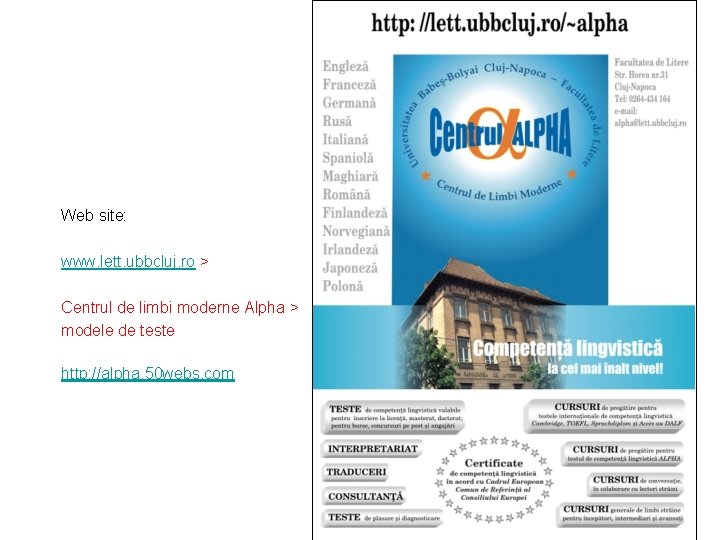
Web site: www. lett. ubbcluj. ro > Centrul de limbi moderne Alpha > modele de teste http: //alpha. 50 webs. com
BBU’s Language Policy • Defines the role of the specialized departments of the university in this language policy (teaching, testing) • The Department of Foreign Languages for Specific Purposes (LSP; culture, civilization); • The Department of Applied Modern Languages for Economics and Business Administration (LSP; culture, civilization); and • the foreign languages departments of the Faculty of Letters (language structure, literature, culture)
BBU’s Language Policy • Romanian as a foreign language is taught by the Department of Romanian language, culture and civilization, and the Alpha language center: ►teaching intensive courses for EU translators and interpreters ►teaching Romanian language classes to foreign students
BBU’s Language Policy
Study-lines at BBU • BBU’s multilingual profile is defined in Carta Universitatii Babeş-Bolyai - “Babes-Bolyai University Charter” – The university is organized along three study-lines • Romanian, • Hungarian, and • German, in which complete educational programs at BA, MA and Ph. D levels are offered.
Sudy-lines at BBU – each study-line • is headed by a vice-rector; • enjoys autonomy by making its own decisions with regard to human resources, research, publishing, international relations, development and study programs.
Sudy-lines at BBU • German at BBU • It is a regional and • an international language, – since the German study-line is attended by native speakers as well as by students for whom German is a foreign language; this status is the result of the language policiy;
Sudy-lines at BBU • Figures (2006) – 21 faculties, • 15 provide a curriculum in both Romanian and Hungarian, • 9 provide a curriculum in Romanian and in German, • 2 faculties (the Faculty of Reformed Theology and the Faculty of Roman-Catholic Theology) teach exclusively in Hungarian; – 172 programs (BA, MA, Ph. D) • 105 are in Romanian, • 52 full programs in Hungarian and • 13 full programs in German, at BA, MA or doctoral level. – students registered • 37, 711 students in the Romanian study-line, • 6, 672 in the Hungarian study-line, and • 1, 779 in the German study-line (Babeş-Bolyai University. The multicultural character 2008).
CLIL at BBU • BBU promotes programs in widely spoken languages – CLIL (English, French, German). BA programs in English (examples) Computer Science; Chemistry; Physics; American Studies; Environmental Science; Finances and Banks; Political Science; English Language and Literature;
CLIL at BBU MA programs in English (selections) • “Carbonate Rocks: Facies and Technical Use” – Faculty of Biology and Geology; • “Public Administration” – Faculty of Political Science • “Intercultural and Communication Philosophy” – Faculty of Political Science; • British Studies; • Irish Studies; • Current Trends in Linguistics; • Conference Interpreting – Faculty of Letters; (there are more than 50 MA programs in English)
CLIL at BBU Programs in French (selections) § Études europénnes comparées: L’Intelligence de l’Europe (MA) § Philosophie française (MA) § Langue et literature française § Belgian studies § Conference Interpreting (English, French, German) (MA) Programs in German: 13 full programs at BA, MA or doctoral level
• BBU’s language policy lives up to the requirements of bilingualism / multilingualism by promoting an education in (1) the national language, (2) a regional language, or (3) an international language.
Participation in European Multulingual Research Projects • BBU is member of ELC/CEL • BBU is represented in the board of ELC/CEL • BBU participates/participated in European projects on multilingualism: – TNP 2, TNP 3 -D – DYLAN (“Language Dynamics and Management of Diversity”) – FP 6 Project – LANQUA – EU project on quality in language teaching – MOLAN – EU project on motivation in language learning – MULTICOM – EU project on multilingual communicatin
Participation in European Multulingual Research Projects • within DYLAN the BBU team has assessed attitudes, representations and multilingual practices at BBU, by – conducting interviews, – administering questionnaires and – video-taping activities in foreign languages
Participation in European Multulingual Research Projects – Provisional findings: • Students, teaching staff and academic leadership endorse the multilingual and multicultural profile of the university; • English is at the top of preferences for LSP, followed by French and German (slim differences between French and German); • Spanish, Italian + Polish, Japanese and Norwegian are among the preferences
Participation in European Multulingual Research Projects – English is at the top of preferences for CLIL specializations, followed by German and French. – impact of practices on language practices: • New LSP textbooks, usable for distance learning, too: http: //granturi. ubbcluj. ro/autodidact; • new forms of language testing (constantly adjusted formulae for testing specialized language proficiency, or general language proficiency); • Updatings of the language policy (2006, 2008)
- Slides: 30