
BABAKIN SCIENCE RESEARCH CENTER SPACE RESEARCH INSTITUTE RAS
BABAKIN SCIENCE & RESEARCH CENTER SPACE RESEARCH INSTITUTE RAS SOLAR SAIL PROJECT MOSCOW 2001
SOLAR SAIL PROJECT BABAKIN SCIENCE & RESEARCH CENTER SPACE RESEARCH INSTITUTE RAS CONCEPT OF SOLAR SAIL PROJECT 1. Destination – Solar Sail spacecraft operational possibilities demonstration 2. Launch data – 2002 3. Launch vehicle – insertion by VOLNA LV (converted SLBM SS-N-18); launch from submarine from Barents Sea 4. Flight configuration – orbital flight; H =840 km, H =832 km, i=78° 5. Experiment duration – about 3 months
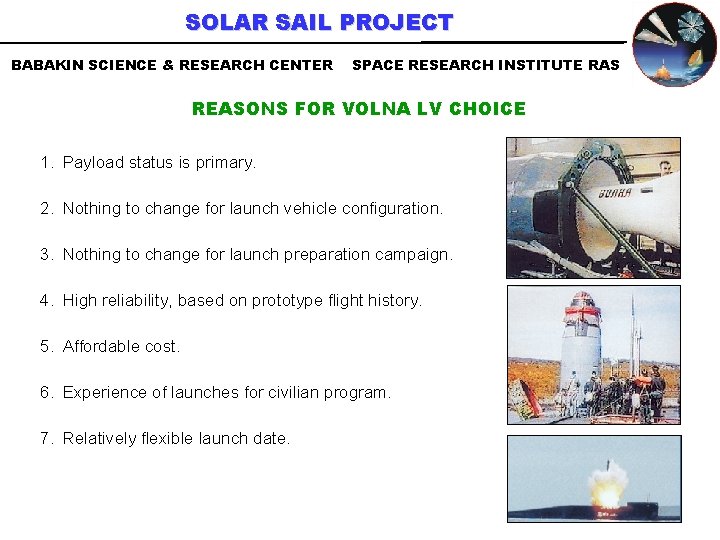
SOLAR SAIL PROJECT BABAKIN SCIENCE & RESEARCH CENTER SPACE RESEARCH INSTITUTE RAS REASONS FOR VOLNA LV CHOICE 1. Payload status is primary. 2. Nothing to change for launch vehicle configuration. 3. Nothing to change for launch preparation campaign. 4. High reliability, based on prototype flight history. 5. Affordable cost. 6. Experience of launches for civilian program. 7. Relatively flexible launch date.
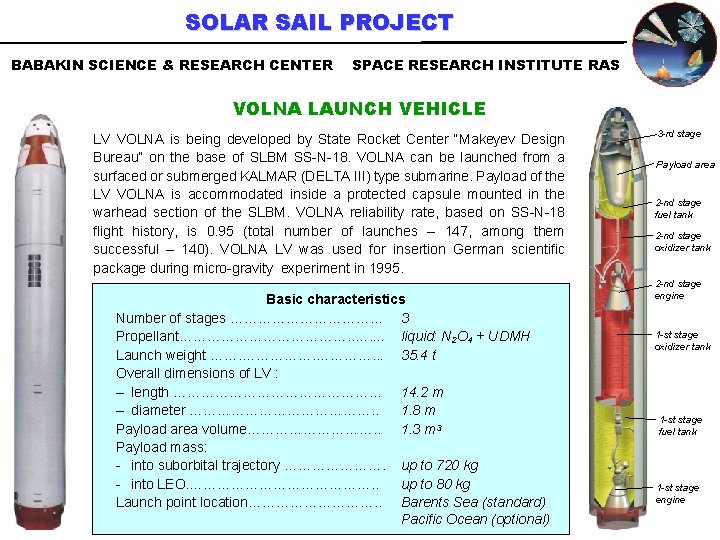
SOLAR SAIL PROJECT BABAKIN SCIENCE & RESEARCH CENTER SPACE RESEARCH INSTITUTE RAS VOLNA LAUNCH VEHICLE LV VOLNA is being developed by State Rocket Center “Makeyev Design Bureau” on the base of SLBM SS-N-18. VOLNA can be launched from a surfaced or submerged KALMAR (DELTA III) type submarine. Payload of the LV VOLNA is accommodated inside a protected capsule mounted in the warhead section of the SLBM. VOLNA reliability rate, based on SS-N-18 flight history, is 0. 95 (total number of launches – 147, among them successful – 140). VOLNA LV was used for insertion German scientific package during micro-gravity experiment in 1995. Basic characteristics Number of stages ……………… 3 Propellant………………. . …. … liquid: N 2 O 4 + UDMH Launch weight ……. …………. . . 35. 4 t Overall dimensions of LV : – length …………………… 14. 2 m – diameter …………………. . 1. 8 m Payload area volume……………. . 1. 3 m 3 Payload mass: - into suborbital trajectory …………………. up to 720 kg - into LEO. …………………. . up to 80 kg Launch point location……………. . Barents Sea (standard) Pacific Ocean (optional) 3 -rd stage Payload area 2 -nd stage fuel tank 2 -nd stage oxidizer tank 2 -nd stage engine 1 -st stage oxidizer tank 1 -st stage fuel tank 1 -st stage engine
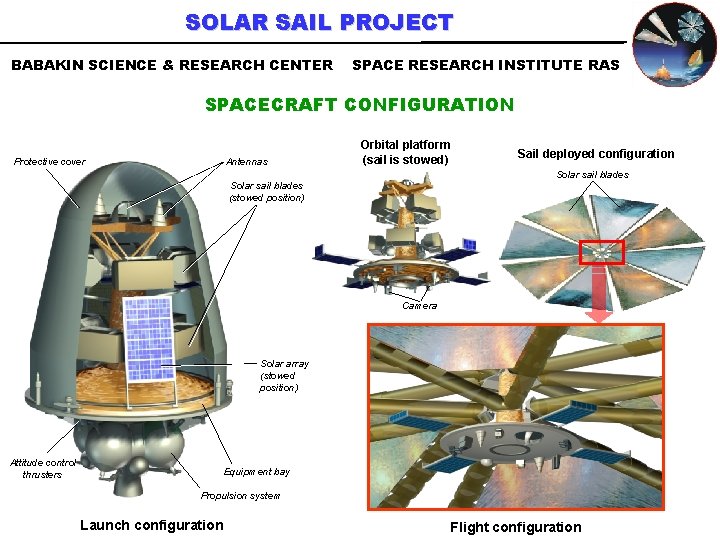
SOLAR SAIL PROJECT BABAKIN SCIENCE & RESEARCH CENTER SPACE RESEARCH INSTITUTE RAS SPACECRAFT CONFIGURATION Protective cover Antennas Orbital platform (sail is stowed) Sail deployed configuration Solar sail blades (stowed position) Camera Solar array (stowed position) Attitude control thrusters Equipment bay Propulsion system Launch configuration Flight configuration
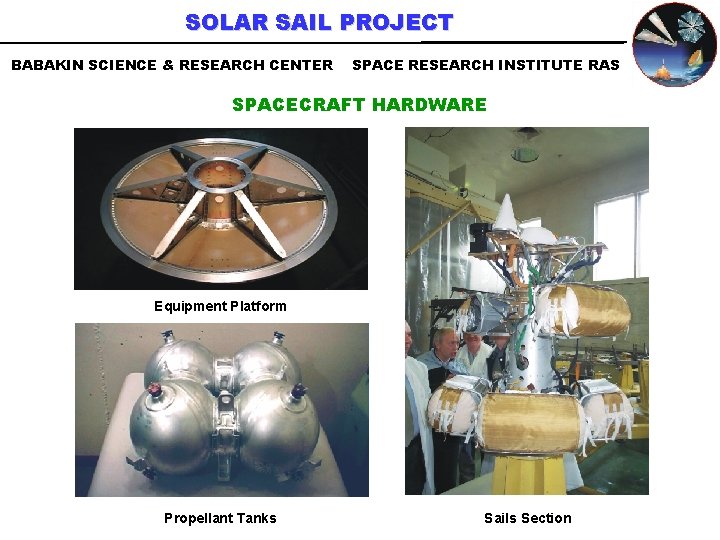
SOLAR SAIL PROJECT BABAKIN SCIENCE & RESEARCH CENTER SPACE RESEARCH INSTITUTE RAS SPACECRAFT HARDWARE Equipment Platform Propellant Tanks Sails Section
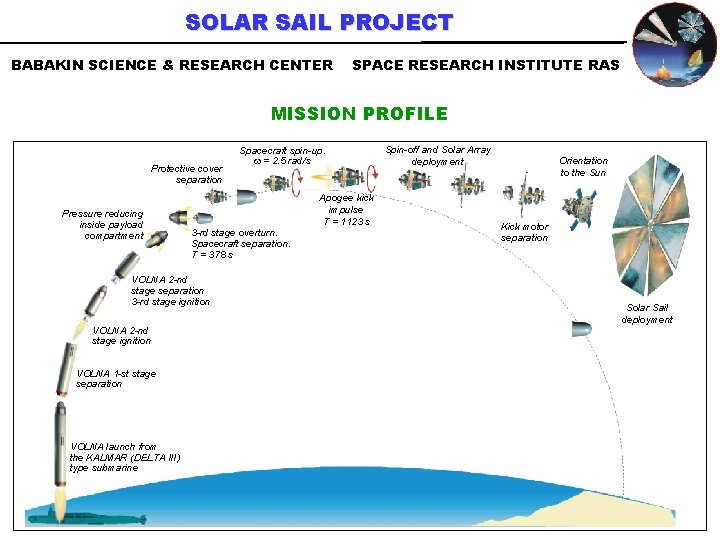
SOLAR SAIL PROJECT BABAKIN SCIENCE & RESEARCH CENTER SPACE RESEARCH INSTITUTE RAS MISSION PROFILE Protective cover separation Pressure reducing inside payload compartment 3 -rd stage overturn. Spacecraft separation. T = 378 s VOLNA 2 -nd stage separation 3 -rd stage ignition VOLNA 2 -nd stage ignition VOLNA 1 -st stage separation VOLNA launch from the KALMAR (DELTA III) type submarine Spacecraft spin-up. = 2. 5 rad/s Apogee kick impulse T = 1123 s Spin-off and Solar Array deployment Orientation to the Sun Kick motor separation Solar Sail deployment
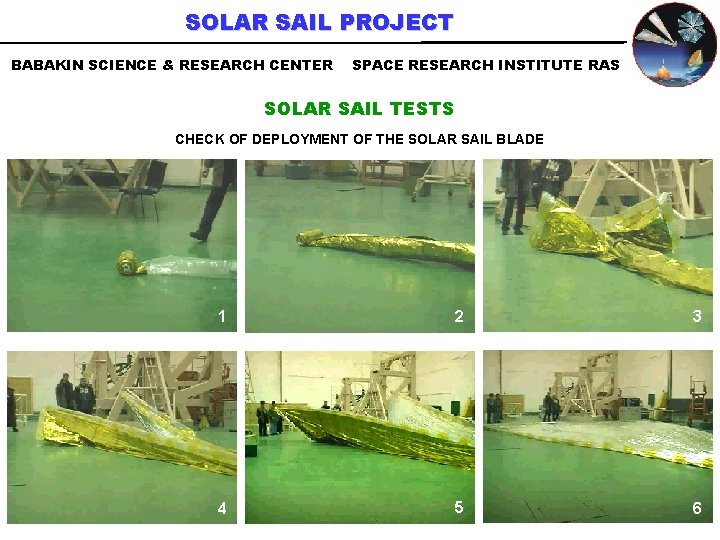
SOLAR SAIL PROJECT BABAKIN SCIENCE & RESEARCH CENTER SPACE RESEARCH INSTITUTE RAS SOLAR SAIL TESTS CHECK OF DEPLOYMENT OF THE SOLAR SAIL BLADE 1 2 3 4 5 6
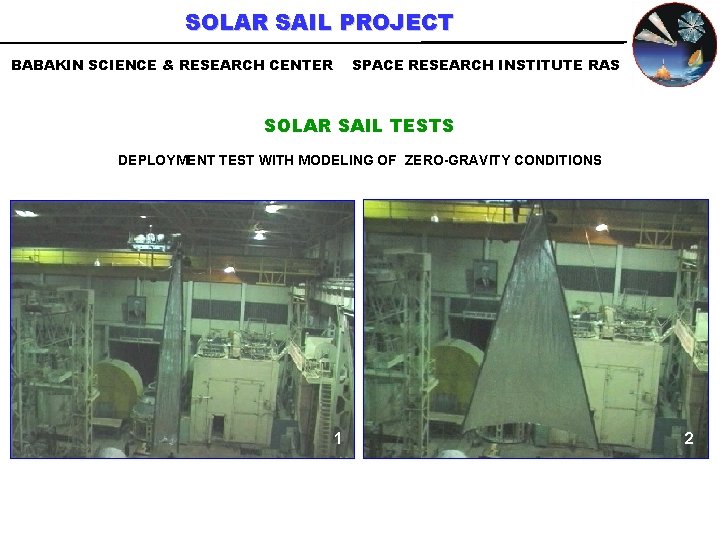
SOLAR SAIL PROJECT BABAKIN SCIENCE & RESEARCH CENTER SPACE RESEARCH INSTITUTE RAS SOLAR SAIL TESTS DEPLOYMENT TEST WITH MODELING OF ZERO-GRAVITY CONDITIONS 1 2
- Slides: 9