
Ba Bar Grid Computing Eleonora Luppi INFN and
Ba. Bar Grid Computing Eleonora Luppi INFN and University of Ferrara - Italy Eleonora Luppi - HEPDG 2005 May 23 2005
Ba. Bar Grid Project Overview HEP is one of the more interesting and interested testbed for GRID fully distributed technology Ba. Bar is a running experiments and needs a huge amount of computing resources Ba. Bar Grid Project motivations: • Simulation Production (SP): – 25 production sites running the same executable – Simulation Production (SP) in Ba. Bar is a typical distributed effort – The Grid concept is very appealing for SP • Analysis: • Ba. Bar uses several Tier-A in analysis context – A tool to automatically submit jobs where the data and CPU cycles are available could be very useful • The Grid. Ka Tier-A will only be accessible through Grid • Data Distribution: – Can be seen as a Grid application – The extraction from a Tier-A and transfer to a Tier-C of a deep-copy collection could nicely make use of Grid tools Eleonora Luppi - HEPDG 2005 May 23 2005
Ba. Bar Grid Project Overview (cont. ) The Babar Grid group has started to study the possibility to gridify Babar software At the beginning, no stable middleware was available Different approaches to start: • Soft migration from “standard” Ba. Bar software to Grid compatible software • Full gridification of Ba. Bar software • Grid tools for data distribution Simulation production, simpler than analysis, was the starting point Eleonora Luppi - HEPDG 2005 May 23 2005
Standard simulation production • Collect and centrally manage requests for simulation – Many user requests, many production jobs (>500, 000), many events – Web interface to relational DB • Distribute requests to production sites – Separate request into runs, usually 2 K events, each of them requires 5 -10 hours of computing – Assign to production sites “allocations” whose size depends on the size of the production farm (typically, a few million events) • Jobs require: – A specific release of the Ba. Bar software installed – Configuration and Conditions information for the Ba. Bar detector, stored in an Objectivity database at each site. – Detector noise information (Background Trigger), stored in Root files, accessed from an xrootd server at each site • Manage jobs at each site (Prod. Tools) – Set of perl scripts, interacting with relational DB – Automatic procedure to produce, merge and import runs to SLAC Eleonora Luppi - HEPDG 2005 May 23 2005
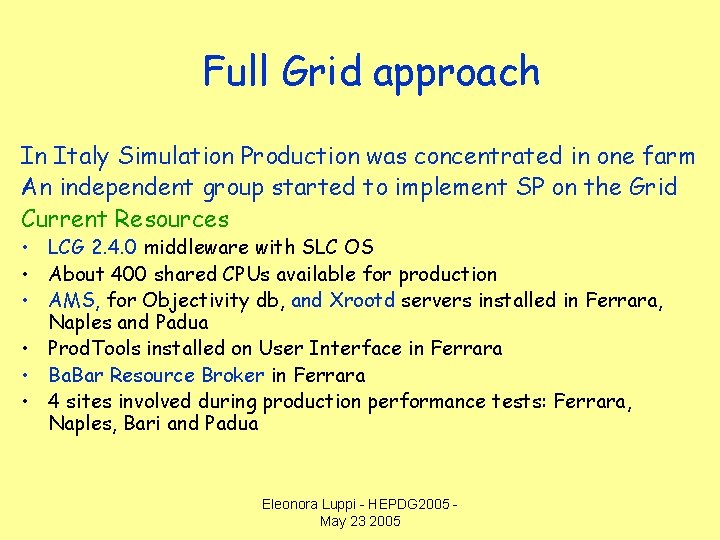
Full Grid approach In Italy Simulation Production was concentrated in one farm An independent group started to implement SP on the Grid Current Resources • LCG 2. 4. 0 middleware with SLC OS • About 400 shared CPUs available for production • AMS, for Objectivity db, and Xrootd servers installed in Ferrara, Naples and Padua • Prod. Tools installed on User Interface in Ferrara • Ba. Bar Resource Broker in Ferrara • 4 sites involved during production performance tests: Ferrara, Naples, Bari and Padua Eleonora Luppi - HEPDG 2005 May 23 2005
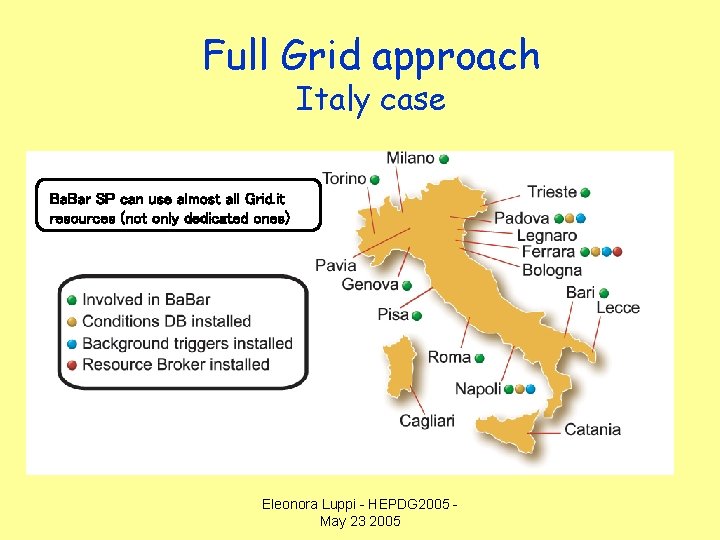
Full Grid approach Italy case Ba. Bar SP can use almost all Grid. it resources (not only dedicated ones) Eleonora Luppi - HEPDG 2005 May 23 2005
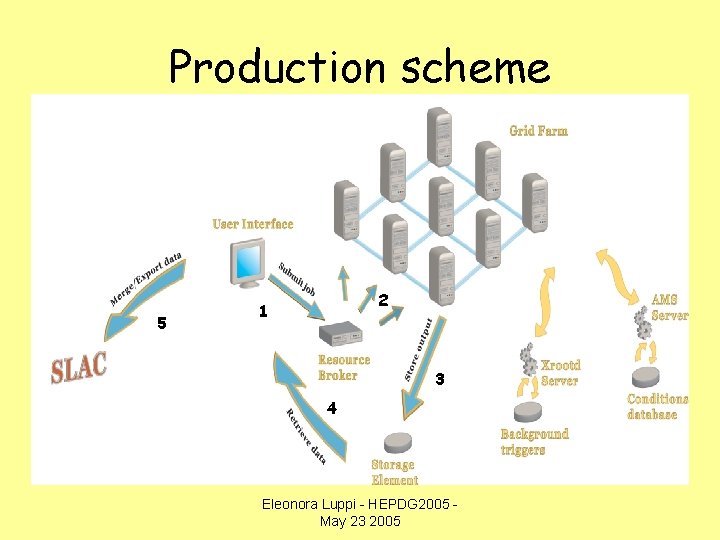
Production scheme 5 2 1 3 4 Eleonora Luppi - HEPDG 2005 May 23 2005
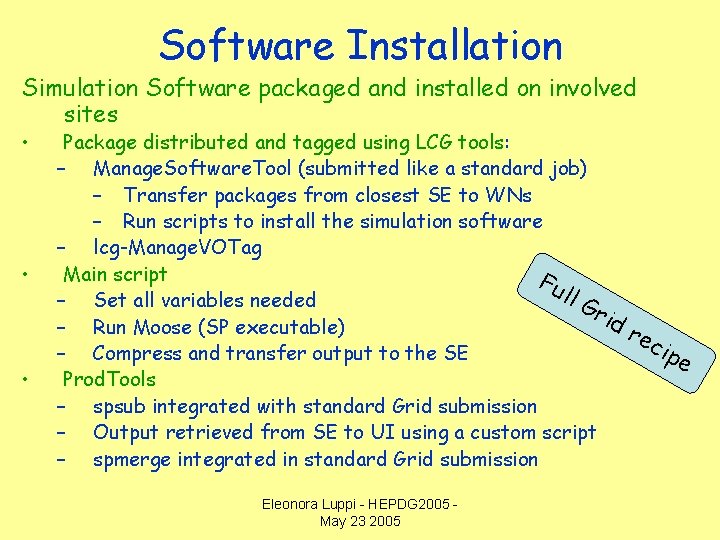
Software Installation Simulation Software packaged and installed on involved sites • • • Package distributed and tagged using LCG tools: – Manage. Software. Tool (submitted like a standard job) – Transfer packages from closest SE to WNs – Run scripts to install the simulation software – lcg-Manage. VOTag Main script Fu ll G – Set all variables needed rid – Run Moose (SP executable) re cip – Compress and transfer output to the SE e Prod. Tools – spsub integrated with standard Grid submission – Output retrieved from SE to UI using a custom script – spmerge integrated in standard Grid submission Eleonora Luppi - HEPDG 2005 May 23 2005
Test of true Production Results • Produced some thousands of runs of real SP 6 data • Mean elapsed time for run: ~ 8 hours (average on different sites) • A few jobs (<5%) automatically resubmitted after failure due to wrong sites configuration SP on Grid. it Future Plans • Add new Grid. it sites to the Ba. Bar VO • Add specific Ba. Bar resources (background trigger and Cdb servers) on more sites • Gridify Ba. Bar resources on Italian Tier 1 • Start true production of new SP 8 software release on the “Grid Farm” • Coordination with other national Grid sites Eleonora Luppi - HEPDG 2005 May 23 2005
Smooth migration approach • Ba. Bar in UK already had distributed infrastructure with 7 farms, each with the Ba. Bar software installed and local Objy Cond. DB etc. • Decision was to initially add “grid” to SP production on these farms rather than gridify the SP software • Used Globus to turn the remote farms into a single pseudo batch system • SP Jobs are built, merged and exported as at any other SP site • Submission is to Globus rather than a local batch system • The software is made up of three parts: migr – Submitter atio n re – Unpacker cipe – Monitoring • When a working prototype was ready, started moving that to LCG Eleonora Luppi - HEPDG 2005 May 23 2005
Completing migration… • • • UK farms reinstalled with SL All Ba. Bar UK Farm site are also Grid. PP Tier 2 sites LCG installed with minimal changes on UK farms Merging work done for UK-SPGrid and Italian-SPGrid Rewrite monitoring to monitor LCG Jobs Installation of Ba. Bar SP 8 software in LCG environment in progress Eleonora Luppi - HEPDG 2005 May 23 2005
US and Canada Grid Activity On the west side of Atlantic Ocean… Slac is an Open Science Grid site Ba. Bar should use OSG at Slac Sp Grid already tested in Europe, easier than analysis Ba. Bar should adopt OSG for SPGrid In Canada Ba. Bar Simulation Production is planned to use Grid. X 1 resources A LCG interface is possible, like ATLAS Eleonora Luppi - HEPDG 2005 May 23 2005
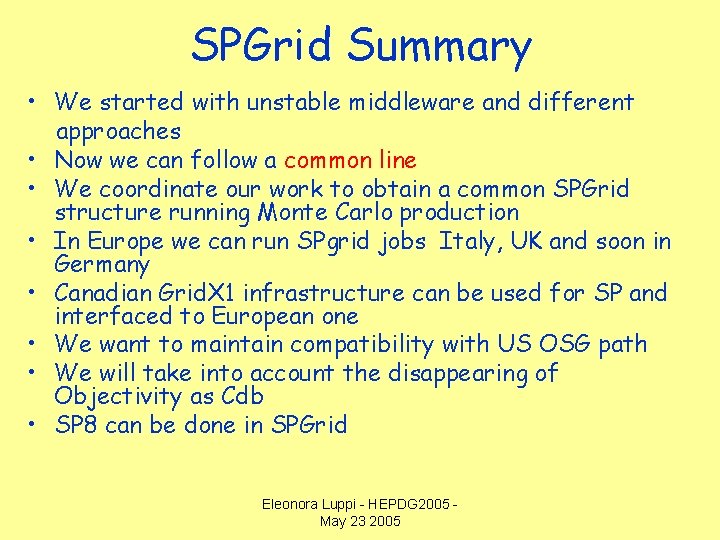
SPGrid Summary • We started with unstable middleware and different approaches • Now we can follow a common line • We coordinate our work to obtain a common SPGrid structure running Monte Carlo production • In Europe we can run SPgrid jobs Italy, UK and soon in Germany • Canadian Grid. X 1 infrastructure can be used for SP and interfaced to European one • We want to maintain compatibility with US OSG path • We will take into account the disappearing of Objectivity as Cdb • SP 8 can be done in SPGrid Eleonora Luppi - HEPDG 2005 May 23 2005
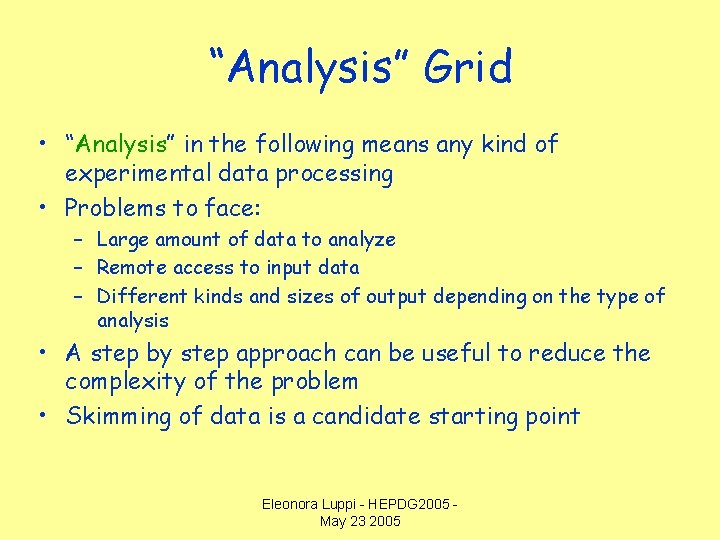
“Analysis” Grid • “Analysis” in the following means any kind of experimental data processing • Problems to face: – Large amount of data to analyze – Remote access to input data – Different kinds and sizes of output depending on the type of analysis • A step by step approach can be useful to reduce the complexity of the problem • Skimming of data is a candidate starting point Eleonora Luppi - HEPDG 2005 May 23 2005
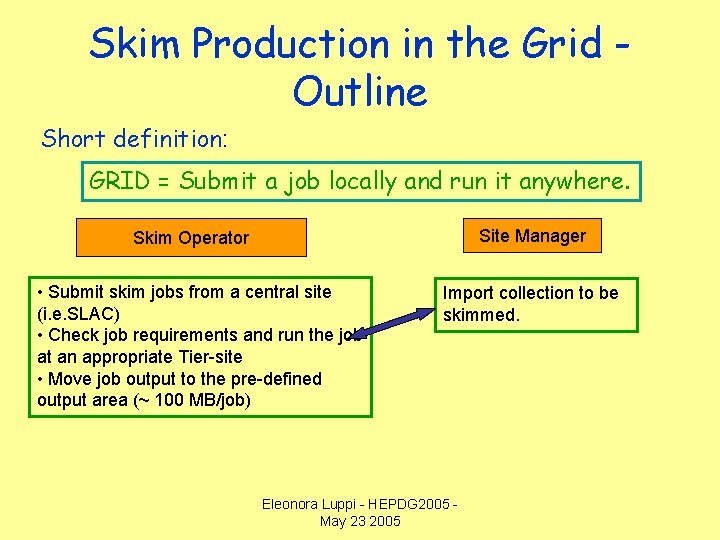
Skim Production in the Grid Outline Short definition: GRID = Submit a job locally and run it anywhere. Site Manager Skim Operator • Submit skim jobs from a central site (i. e. SLAC) • Check job requirements and run the job at an appropriate Tier-site • Move job output to the pre-defined output area (~ 100 MB/job) Import collection to be skimmed. Eleonora Luppi - HEPDG 2005 May 23 2005
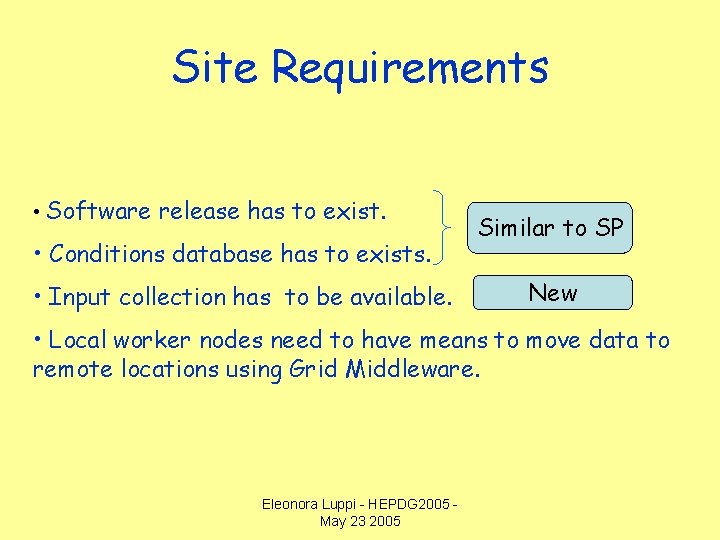
Site Requirements • Software release has to exist. • Conditions database has to exists. • Input collection has to be available. Similar to SP New • Local worker nodes need to have means to move data to remote locations using Grid Middleware. Eleonora Luppi - HEPDG 2005 May 23 2005
Data Distribution: Xrootd • Analysis needs efficient distributed data access – Scalable – Fault tolerant – Secure • Xrootd could be seen as an alternative to standard Grid (LCG. . . ) solutions – Xrootd was proposed also as a solution for some LHC experiments – Xrootd is distributed as part of CERN’s root package Eleonora Luppi - HEPDG 2005 May 23 2005
“Analysis” Summary • Step by step approach for the analysis • Skimming seems to be a good starting point • We need to study data handling possibilities to obtain an efficient and simple way to handle and maintain data, also in non-Ba. Bar sites • Results of tests with grid-analysis special infrastructures (see Alien and children) tell us that they can be interesting but need more support and stability Eleonora Luppi - HEPDG 2005 May 23 2005
Conclusions • SPGrid is a reality for true SP production • We are converging to a common solution • With the Grid resources available in the different national grids, we could have a huge quantity of computing time for our simulations • Our next goal is to have an Analysis Grid capable of running “standard” analysis programs (i. e. Skimming) • We need to give special attention to data handling tools Eleonora Luppi - HEPDG 2005 May 23 2005
- Slides: 19