
b Empathy Deep Insights Empathy is how you
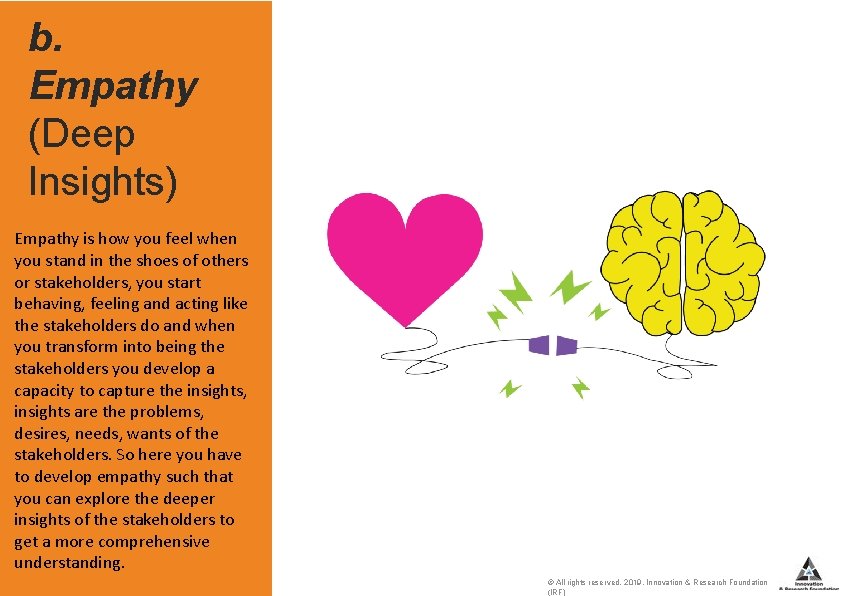
b. Empathy (Deep Insights) Empathy is how you feel when you stand in the shoes of others or stakeholders, you start behaving, feeling and acting like the stakeholders do and when you transform into being the stakeholders you develop a capacity to capture the insights, insights are the problems, desires, needs, wants of the stakeholders. So here you have to develop empathy such that you can explore the deeper insights of the stakeholders to get a more comprehensive understanding. © All rights reserved. 2019. Innovation & Research Foundation (IRF)
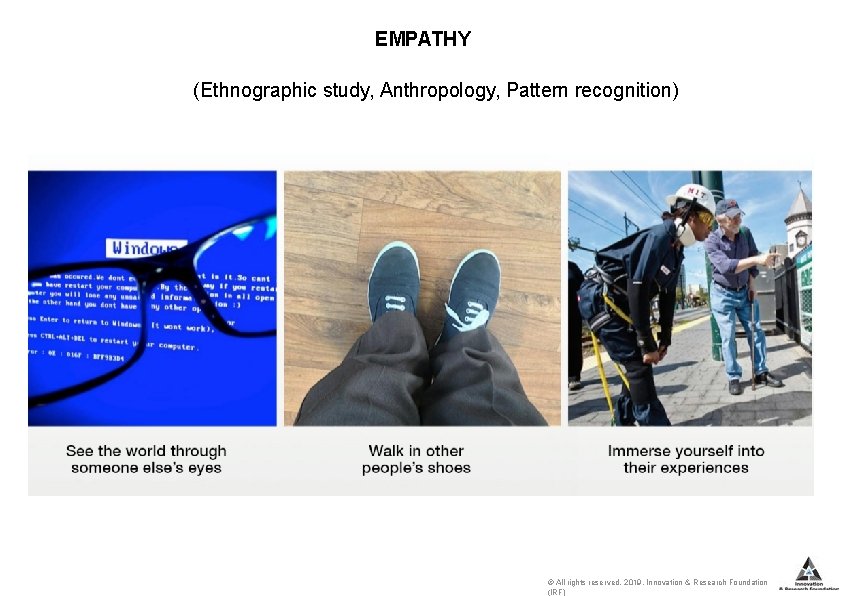
EMPATHY (Ethnographic study, Anthropology, Pattern recognition) © All rights reserved. 2019. Innovation & Research Foundation (IRF)
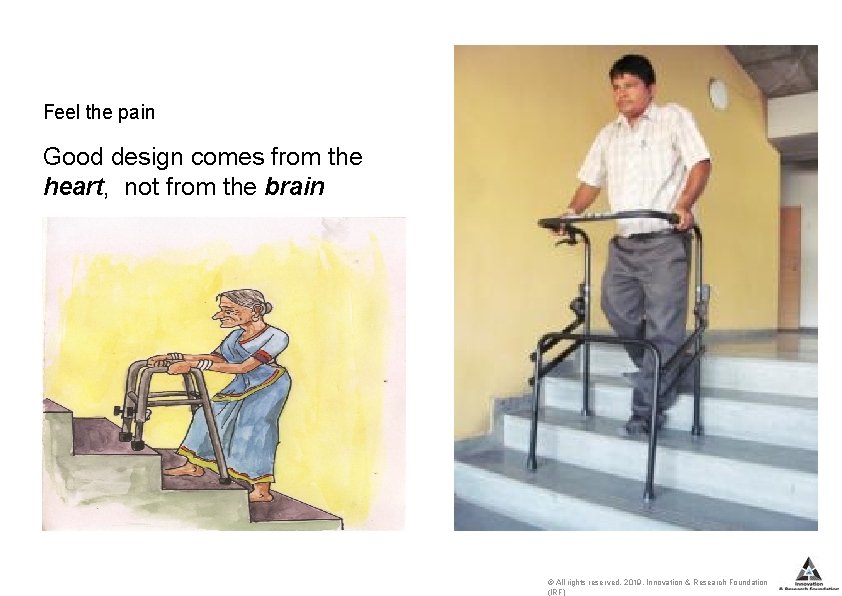
Feel the pain Good design comes from the heart, not from the brain © All rights reserved. 2019. Innovation & Research Foundation (IRF)
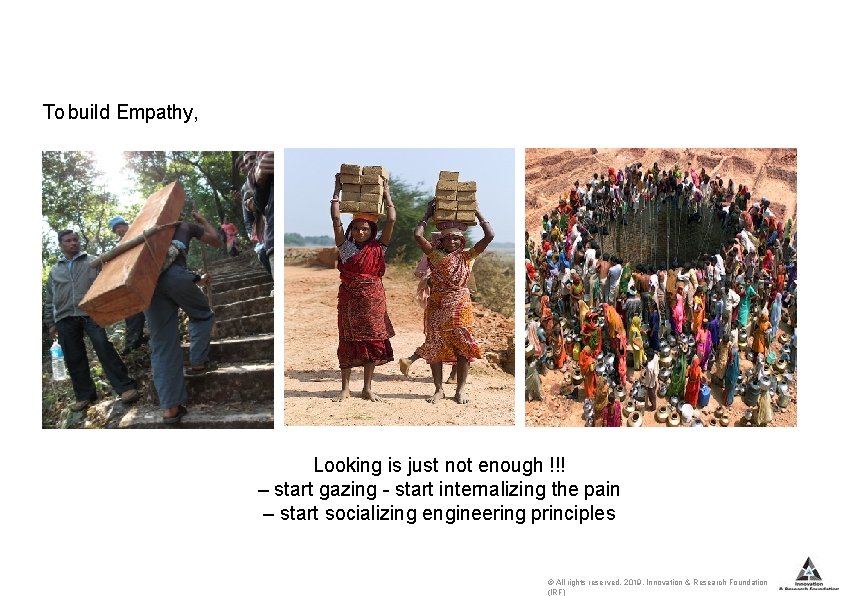
To build Empathy, Looking is just not enough !!! – start gazing - start internalizing the pain – start socializing engineering principles © All rights reserved. 2019. Innovation & Research Foundation (IRF)
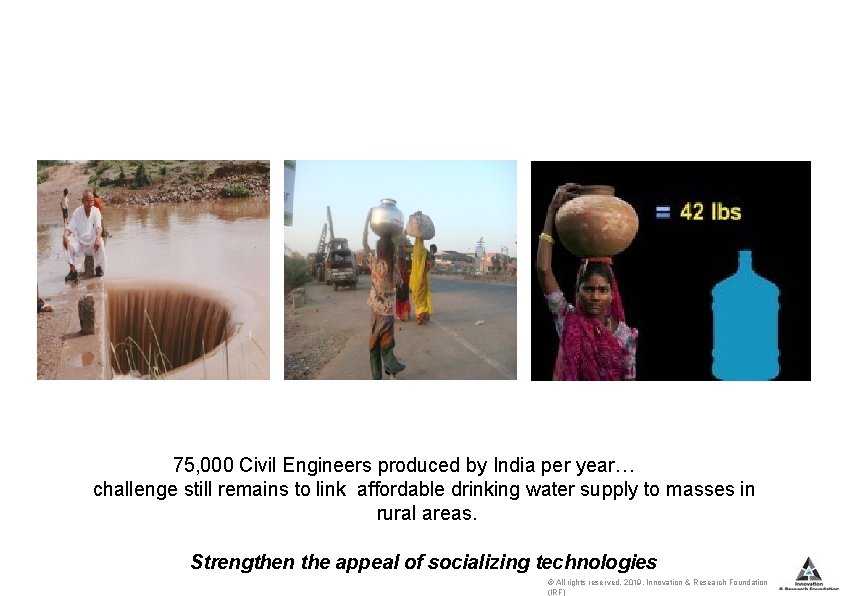
75, 000 Civil Engineers produced by India per year… challenge still remains to link affordable drinking water supply to masses in rural areas. Strengthen the appeal of socializing technologies © All rights reserved. 2019. Innovation & Research Foundation (IRF)
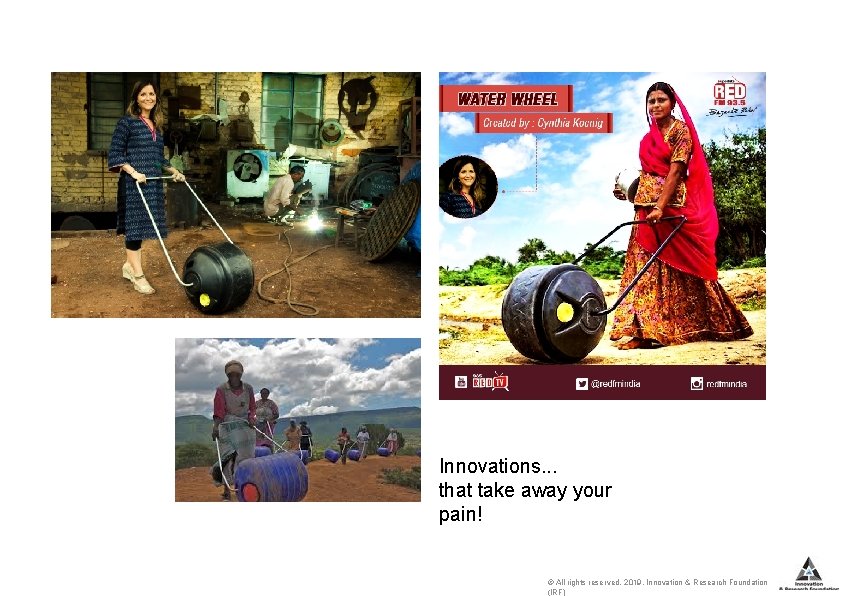
Innovations. . . that take away your pain! © All rights reserved. 2019. Innovation & Research Foundation (IRF)
How to Develop an Empathatic Approach? © All rights reserved. 2019. Innovation & Research Foundation (IRF)
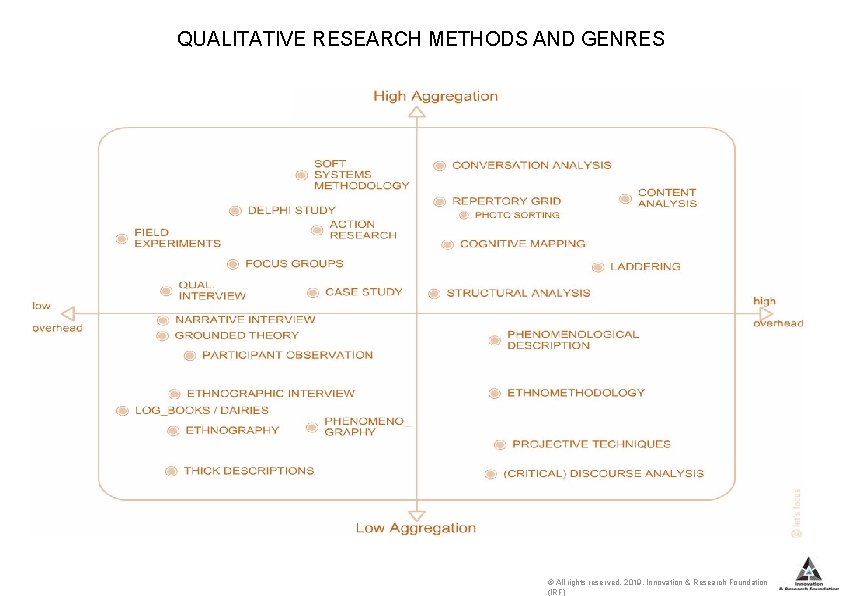
QUALITATIVE RESEARCH METHODS AND GENRES © All rights reserved. 2019. Innovation & Research Foundation (IRF)
Ethnographic Research methods What is fieldwork? Ethnographic fieldwork entails the extended residence of the researcher in a field setting (e. g. , community, village, institution), participating and observing the daily activities and behavior of the people where research is carried out. What is participant observation? Who are Key Informants (K. I. )? In PO the researcher shares as intimately as possible in the field and activities of the setting under study. This entails an extended residence period. The purpose is to develop an insider’s view of what is happening. K. I. Are the knowledgeable persons who are considered as authorities pertaining to the history and culture of the community/institution/plac e. (selection, rapport, marginal people) © All rights reserved. 2019. Innovation & Research Foundation (IRF)
Recording Observations 1. Keep field notebook 2. Take notes of your observations as you observe 3. Write down notes as soon as possible 4. Notes should include empirical observations and interpretations 5. Cross files - fill in date and time you made your observation 6. Analyze and interpret your observations, discerning patters of behavior, finding the underlying meaning in the thing you observed 30 mins © All rights reserved. 2019. Innovation & Research Foundation (IRF)
In-Depth Interviewing 1. Learn to listen, think and talk almost at the same time 2. Probe - how is that? In what way? How do you mean? What would be an example of that? 3. Review notes every night - observe activities/behavior “gaps” that must be further observed. 4. Combined with observation, interviews allow the researcher to understand the meanings people hold for their everyday activities 1. Introduce your self and your project 2. Share with them your objective and how are they important for you in your project 3. Build rapport 4. Ask questions that you feel your stakeholder can answer in depth, and try to pull out stories from the same 5. Capture their emotions/feelings 6. Ask questions 7. Always acknowledge them at the end of the interview 30 mins © All rights reserved. 2019. Innovation & Research Foundation (IRF)
Three General Categories of Interviews 1. Informal conversational interview - qualitative in-depth interviews are more like conversations than formal events with predetermined response catefories 2. The general interview guide approach 3. Standard open-ended interview 30 mins © All rights reserved. 2019. Innovation & Research Foundation (IRF)
Types/Stage s of Field Notes 1. Substantive field notes focus on the main observations, conversations, experiences and interviews 2. Methodological information documents the subjective impressions of the researcher observed in the datagathering context. 3. Analytical field notes contain preliminary stages of analysis. Here data is sorted, coded, and analyzed for the first time - gaps can be addressed and questions can be followed up. 4. Data Sheet should include date, place, and source of information. © All rights reserved. 2019. Innovation & Research Foundation (IRF)
The study of body movements/motion and its accompanying messages is a communication technique known as kinesics. The motion is analyzed systematically in a way that allows the researcher to see and measure significant patterns of communication process. Birdwhistel labels four channels of the coommunication process: vocal, visual, olfactory, and tactile. -Body language can express unconscious thoughts that may be essential for observers to decide if they are to analyze situations accurately. -Measuring devices are available for researchers to use not only in gaining a further understanding of kinesics but also in learning how to interpret body movements. © All rights reserved. 2019. Innovation & Research Foundation (IRF)
Other methods/ stratergies in community studies Flims, Vidoes and Photographs have a long history in anthropology, called vusual anthropology, or film ethnography. It relies on film and photograohs to capture the daily life of group under study. -Films provide visual records of passing natural events and may be used as permanent resources. -The concept and method of the research film have emerged and are compatible with the variety of research methods and have been used to describe how people navigate in public spaces and the use of space. -Research filming is a powerful tool for inquiry into past events. Film has the ability to capture visible phenomena seemingly yet always from the perspecting of the filmmaker. -Research film methodology requires the documentation of the time, place and subject of the filming as well as the photographer’s intent and interest. © All rights reserved. 2019. Innovation & Research Foundation (IRF)
Creating the Questionnaire using. . . 5 W & H : - List all Stake holders i. e. 6 - Each one create a questionnaire for 1 stake holder -The above stake holders should include User, Extreme User & Expert -Each Sub Group quickly discuss and finalize the most apt questions 30 mins - Laddering (7 Why) create interview questions Based on the previous questions NOW create why questions that will take one deeper into gaining insights FINALIZE THE QUESTIONNAIRES The Sub Groups exchange the questions and thus the other sub group can gather more meaningful questions. -Remember to collect as many stories from which will emerge the Journey Mapping (Minimum 1 per group i. e. 2 journey maps) Break the entire experience into specific parts © All rights reserved. 2019. Innovation & Research Foundation (IRF)
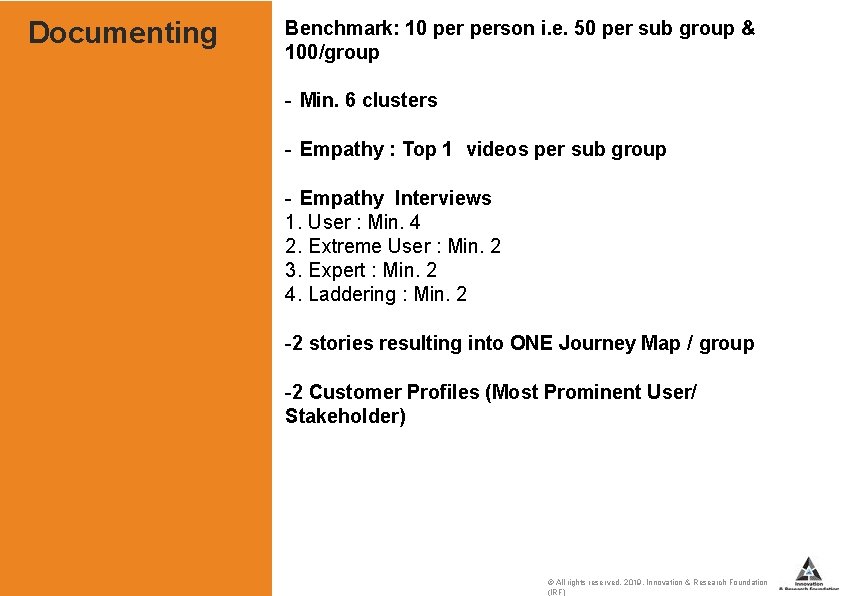
Documenting Benchmark: 10 person i. e. 50 per sub group & 100/group - Min. 6 clusters - Empathy : Top 1 videos per sub group - Empathy Interviews 1. User : Min. 4 2. Extreme User : Min. 2 3. Expert : Min. 2 4. Laddering : Min. 2 -2 stories resulting into ONE Journey Map / group -2 Customer Profiles (Most Prominent User/ Stakeholder) © All rights reserved. 2019. Innovation & Research Foundation (IRF)
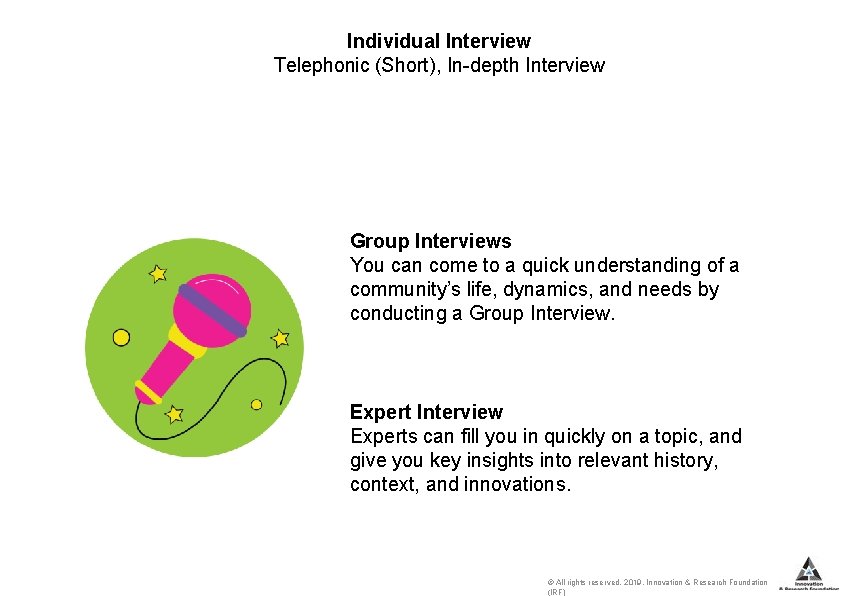
Individual Interview Telephonic (Short), In-depth Interview Group Interviews You can come to a quick understanding of a community’s life, dynamics, and needs by conducting a Group Interview. Expert Interview Experts can fill you in quickly on a topic, and give you key insights into relevant history, context, and innovations. © All rights reserved. 2019. Innovation & Research Foundation (IRF)
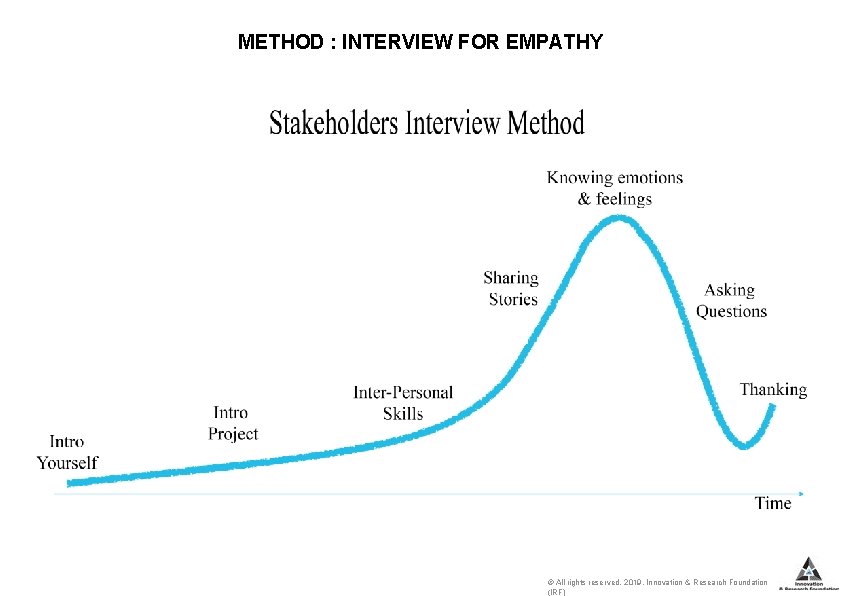
METHOD : INTERVIEW FOR EMPATHY © All rights reserved. 2019. Innovation & Research Foundation (IRF)
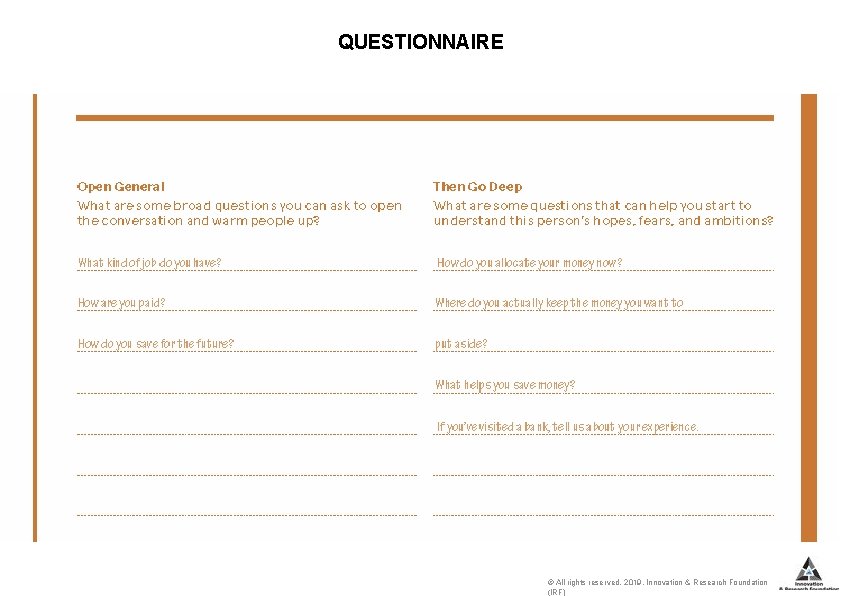
QUESTIONNAIRE © All rights reserved. 2019. Innovation & Research Foundation (IRF)
- Slides: 20