
B cell development Bcell development Process can be
B cell development
B-cell development Process can be divided into 3 broad stages: 1. Generation of mature and immunocompetent B cells (Maturation) 2. Activation of mature B- cells in the secondary lymphoid organs 3. Differentiation of activated B-cells into Plasma and memory B- cells
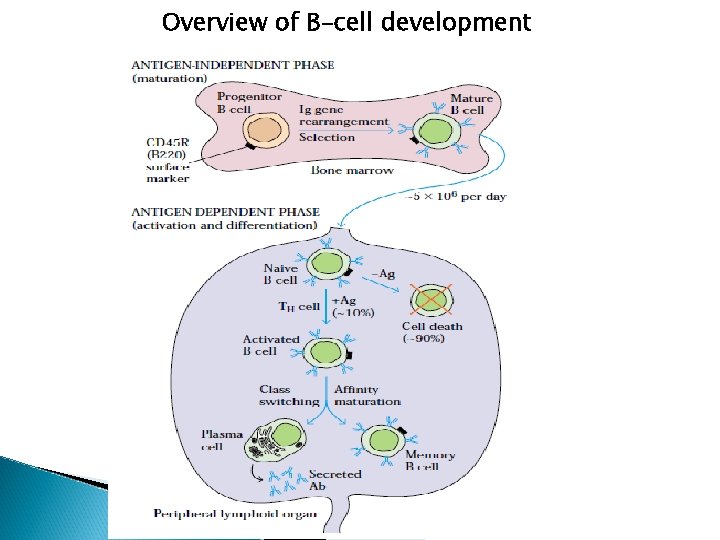
Overview of B-cell development
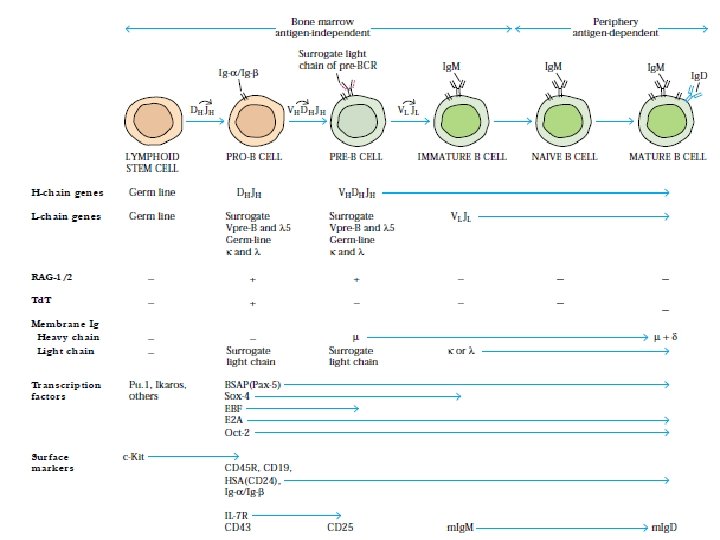
1. Maturation of B-cells � Known as antigen independent phase of B cell development � Before birth take place in fetal liver, yolk sac and fetal bone marrow � After birth process take place in bone marrow � The process involves: Ø Formation of progenitor B cell Ø Rearrangement of immunoglobulin genes Ø Co expression of Ig. M and Ig. D
Progenitor B cells (Pro B cells) � Process initiates when lymphoid stem cell differentiate into earliest distinctive lineage called pro B cells � Pro B cells carry tyrosine phosphatase CD 45 R � Proliferation and differentiation of Pro B cells into precursor B cells (Pre B-cells) require bone marrow stromal cell microenvironment � Stromal cells interact directly with Pro and Pre cells as well as secrete cytokine IL-7 � IL-7 is necessary for B cell development
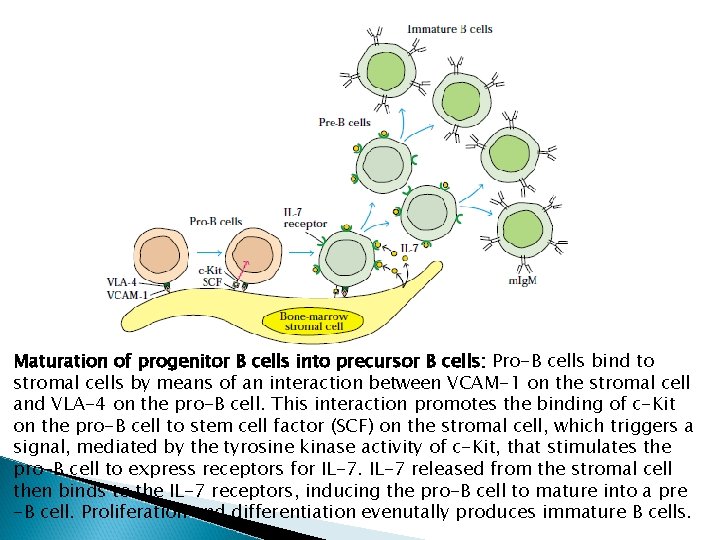
Maturation of progenitor B cells into precursor B cells: Pro-B cells bind to stromal cells by means of an interaction between VCAM-1 on the stromal cell and VLA-4 on the pro-B cell. This interaction promotes the binding of c-Kit on the pro-B cell to stem cell factor (SCF) on the stromal cell, which triggers a signal, mediated by the tyrosine kinase activity of c-Kit, that stimulates the pro-B cell to express receptors for IL-7 released from the stromal cell then binds to the IL-7 receptors, inducing the pro-B cell to mature into a pre -B cell. Proliferation and differentiation evenutally produces immature B cells.
Ig gene rearrangement during B cell development � In Pro B cell, rearrangement of heavy chain genes occur firstly � Generation of productive heavy chain convert Pro B cell into Pre B cell � Pre B cell now undergoes light chain genes rearrangement � Allelic exclusion ensure only one light chain isotype � Productive light and heavy chain combination commit cells to particular antigenic specificity � Immature B cell express m. Ig. M on cell surface
� RAG-1 and RAG-2 are active at Pro and Pre B cell stage � Td. T expression is turned off during part of Pre B-cell stage when light chain rearrangement occur � In bone marrow phase of development B cell expreses m. Ig. M is not fully functional and called immature B cells � Coexpression of Ig. M and Ig. D on cell surface signal the maturation
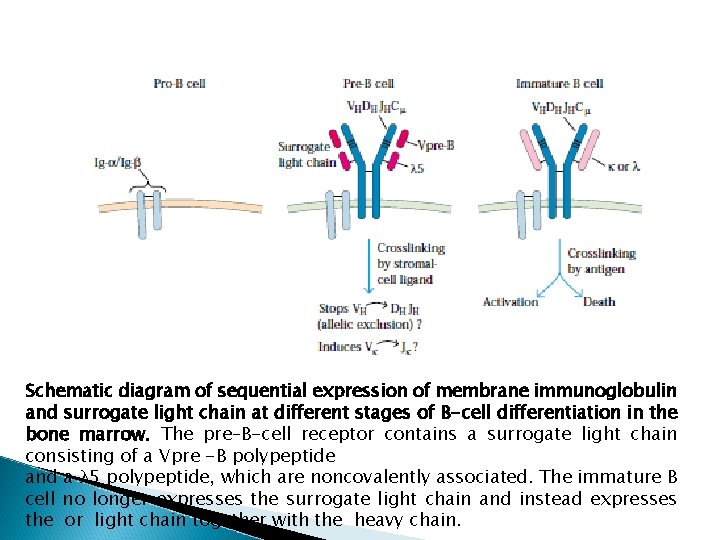
Schematic diagram of sequential expression of membrane immunoglobulin and surrogate light chain at different stages of B-cell differentiation in the bone marrow. The pre–B-cell receptor contains a surrogate light chain consisting of a Vpre -B polypeptide and a λ 5 polypeptide, which are noncovalently associated. The immature B cell no longer expresses the surrogate light chain and instead expresses the or light chain together with the heavy chain.
- Slides: 10