
B 4 a 4 cycle barrel processor Between
B 4 – a 4 cycle barrel processor • Between GPUs and FPGAs in core efficiency • HUGE on-chip memory; in the gigabyte range • Dynamic memory, needs memory process • Around half DRAM, half fabric + computation • Divergent control flow at full speed, not SIM(T/D) • Designed for swarm intelligence and tracing sparse voxel octrees • Perfect for pipeline / pipegraph processing (as long as it fits on chip) • Raytracing • Deep learning • Computational photography
Simple Processor & Fabric + Lakes of Memory • Core has memory-like metal complexity and clocks • 4 KB local memory • 64 KB global memory • 16 bit barrel ALU • Configurable: 4 x 16 bit threads, 2 x 32 bit threads or 1 x 64 bit thread • 8 thread contexts • Extremely high energy efficiency • Massively reduced data movement • Low clocks and voltages • Direct processing in memory • Rather than 16 Gbit DRAM in ~100 mm^2, get 8 Gbit DRAM + 16 k cores
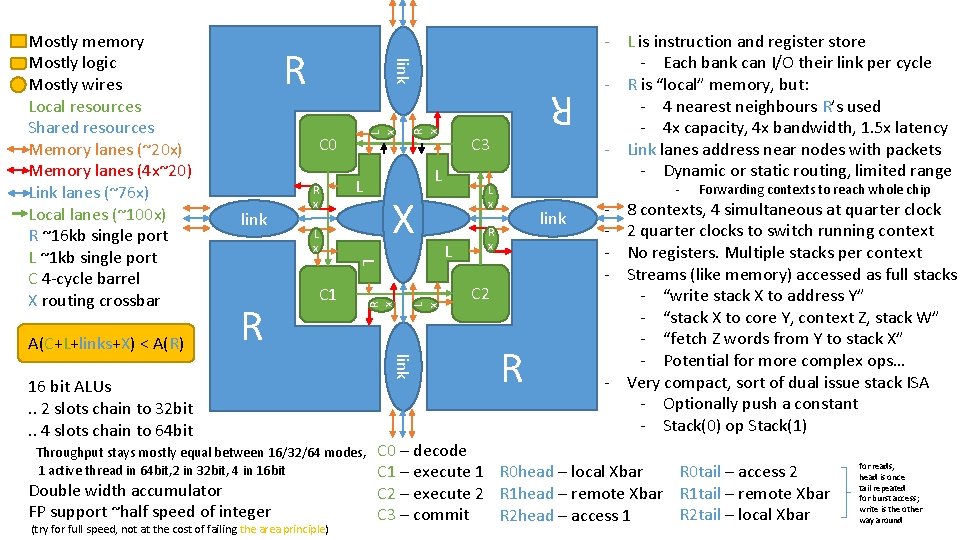
link R x C 0 X L x Throughput stays mostly equal between 16/32/64 modes, 1 active thread in 64 bit, 2 in 32 bit, 4 in 16 bit Double width accumulator FP support ~half speed of integer (try for full speed, not at the cost of failing the area principle) L x link 16 bit ALUs. . 2 slots chain to 32 bit. . 4 slots chain to 64 bit R x R C 1 C 3 L L R L x link A(C+L+links+X) < A(R) R L Mostly memory Mostly logic Mostly wires Local resources Shared resources Memory lanes (~20 x) Memory lanes (4 x~20) Link lanes (~76 x) Local lanes (~100 x) R ~16 kb single port L ~1 kb single port C 4 -cycle barrel X routing crossbar L x L link R x C 2 R - L is instruction and register store - Each bank can I/O their link per cycle - R is “local” memory, but: - 4 nearest neighbours R’s used - 4 x capacity, 4 x bandwidth, 1. 5 x latency - Link lanes address near nodes with packets - Dynamic or static routing, limited range - - Forwarding contexts to reach whole chip 8 contexts, 4 simultaneous at quarter clock 2 quarter clocks to switch running context No registers. Multiple stacks per context Streams (like memory) accessed as full stacks - “write stack X to address Y” - “stack X to core Y, context Z, stack W” - “fetch Z words from Y to stack X” - Potential for more complex ops… - Very compact, sort of dual issue stack ISA - Optionally push a constant - Stack(0) op Stack(1) C 0 – decode R 0 tail – access 2 C 1 – execute 1 R 0 head – local Xbar C 2 – execute 2 R 1 head – remote Xbar R 1 tail – remote Xbar R 2 tail – local Xbar C 3 – commit R 2 head – access 1 for reads, head is once tail repeated for burst access; write is the other way around
- Slides: 3