
B 200 SEMESTER 2 PROCESSES Module Prepared by

B 200 SEMESTER 2 PROCESSES Module Prepared by Iman El Sabaa imanelsabaa@arabou. edu. sa
Logistics and Competitive strategy Chapter Eleven By Martin Christopher
What is logistics Ø Ø Ø Logistics is the process of strategically managing the procurement, movement and storage of materials, parts and finished inventory (and the related information flows) through the organization and its marketing channels in such a way that current and future profitability are maximized through the cost-effective fulfillment of orders. imanelsabaa@arabou. edu. sa
Logistics and competitive advantage Firms can achieve competitive advantage through: 1. Differentiation, in the eyes of the customer, from its competition And 2. By operating at a lower cost and hence at greater profit. n imanelsabaa@arabou. edu. sa
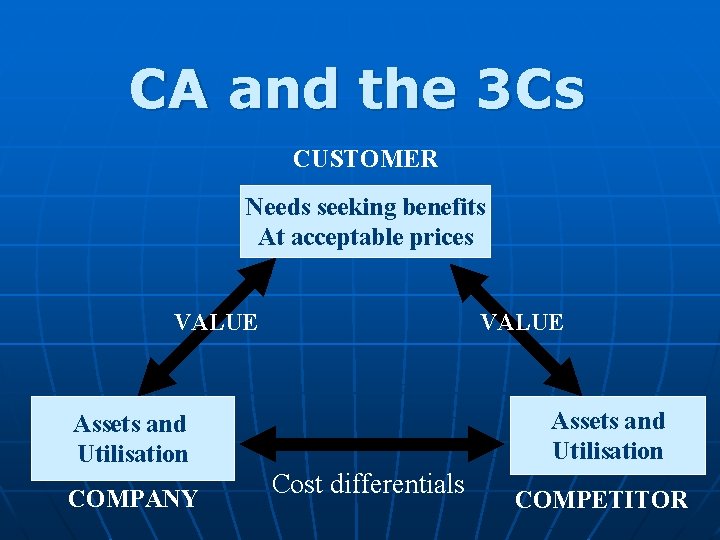
CA and the 3 Cs CUSTOMER Needs seeking benefits At acceptable prices VALUE Assets and Utilisation COMPANY Cost differentials COMPETITOR
Logistics and competitive advantage n n A position of enduring superiority over competitors in terms of customer preference may be achieved through logistics. Successful companies either have productivity advantage or they have a ‘value’ advantage or a combination of the two. imanelsabaa@arabou. edu. sa
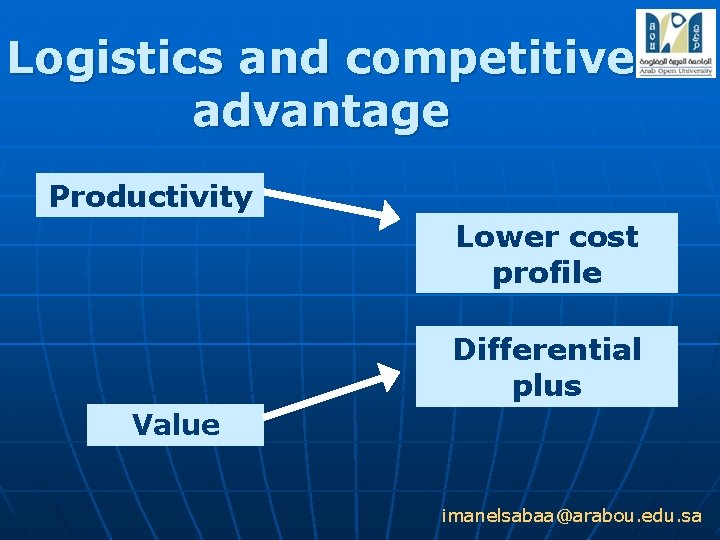
Logistics and competitive advantage Productivity Lower cost profile Differential plus Value imanelsabaa@arabou. edu. sa
Productivity advantage n 1. 2. There is substantial evidence to suggest that big is beautiful when it comes to cost advantage. This is partly due: to economies of scale to the impact of the "Experience Curve". See p 151 imanelsabaa@arabou. edu. sa
Productivity advantage n In this regard Logistics management can provide a multitude of ways to increase efficiency and productivity and hence contribute significantly to reduced unit costs. imanelsabaa@arabou. edu. sa
Value advantage n Customers don’t buy products, they buy benefits, these benefits may be intangible (image or reputation) In other words n Products are purchased for the promise of what they will “deliver”. imanelsabaa@arabou. edu. sa
Value advantage Adding value through differentiation is a powerful means of achieving a defensible advantage in the market. But How it could be achieved? 1. Value segments approach 2. Services augmented offers n imanelsabaa@arabou. edu. sa
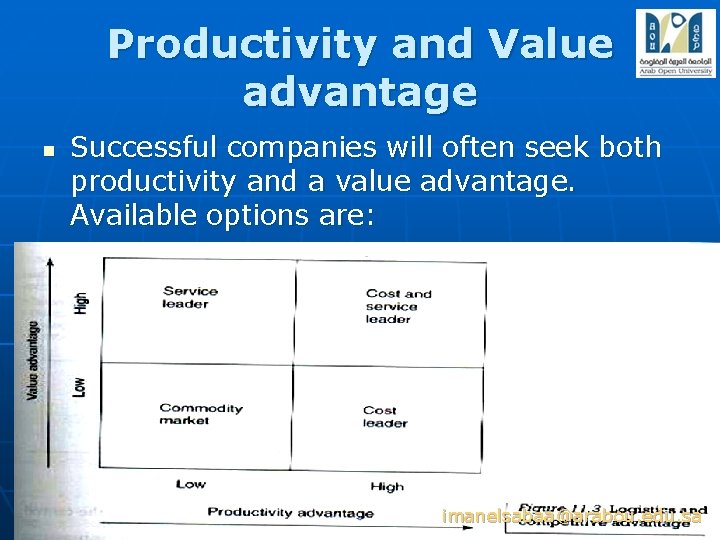
Productivity and Value advantage n Successful companies will often seek both productivity and a value advantage. Available options are: imanelsabaa@arabou. edu. sa
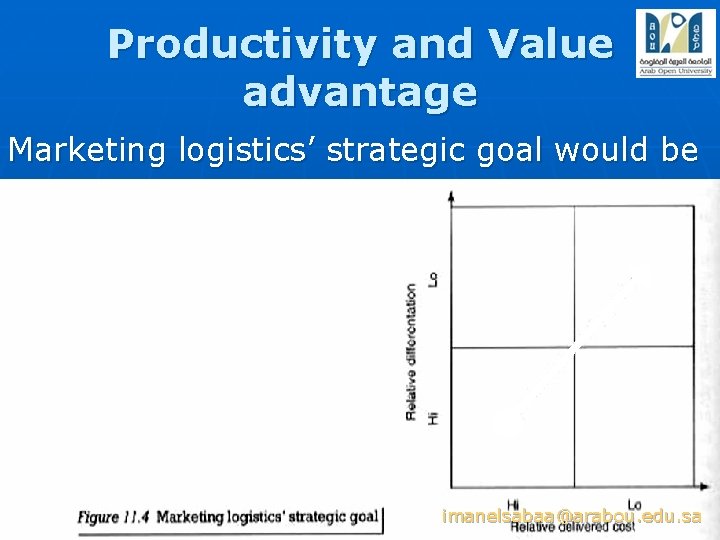
Productivity and Value advantage Marketing logistics’ strategic goal would be imanelsabaa@arabou. edu. sa
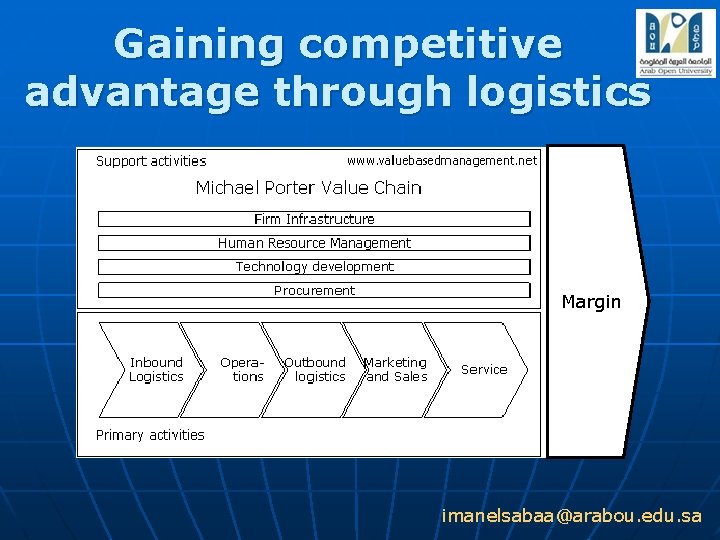
Gaining competitive advantage through logistics n n Competitive advantage cannot be understood by looking at a firm as a whole. It stems from the many discrete activities a firm performs. In this regard; we can use the value chain analysis to disaggregates a firm in to its strategically relevant activities imanelsabaa@arabou. edu. sa
Gaining competitive advantage through logistics Margin imanelsabaa@arabou. edu. sa
Gaining competitive advantage through logistics n Competitive advantage grows out of the way in which firms organize and perform these discrete activities within the value chain. (More cheaply or better than its competitors) imanelsabaa@arabou. edu. sa
Gaining competitive advantage through logistics Productivity advantage: Capacity utilization, inventory reduction, closer integration with suppliers. Value advantage: Superior customer services imanelsabaa@arabou. edu. sa
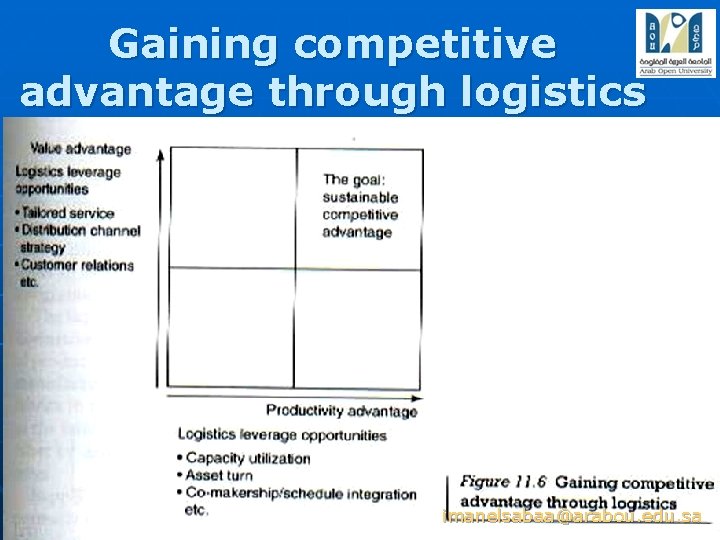
Gaining competitive advantage through logistics imanelsabaa@arabou. edu. sa
The mission of logistics management n n It is to plan and co-ordinate all activities necessary to achieve the desired levels of delivered service and quality at the lowest possible cost. Logistics must therefore be seen as the link between the market place and the operating activity of the business. imanelsabaa@arabou. edu. sa
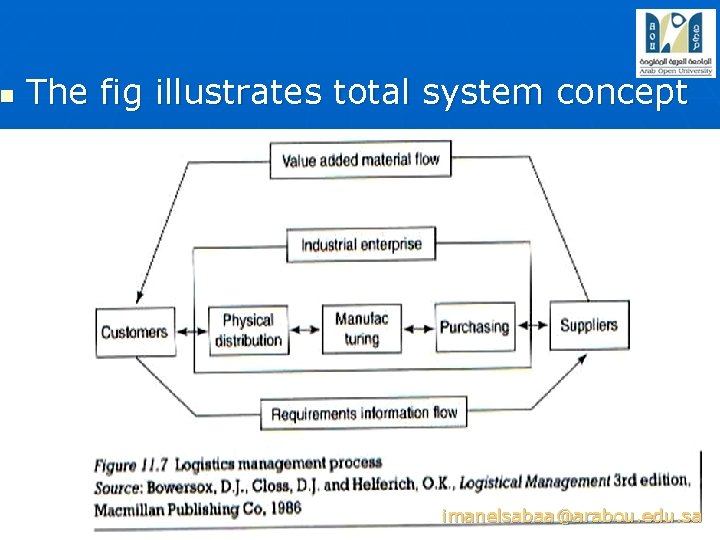
n The fig illustrates total system concept imanelsabaa@arabou. edu. sa
The mission of logistics management n The previous fig suggests that the needs of customers are satisfied through: The co-ordination of the materials and information flows that extend from the market place, through the firm and its operations and beyond that to supplier. imanelsabaa@arabou. edu. sa
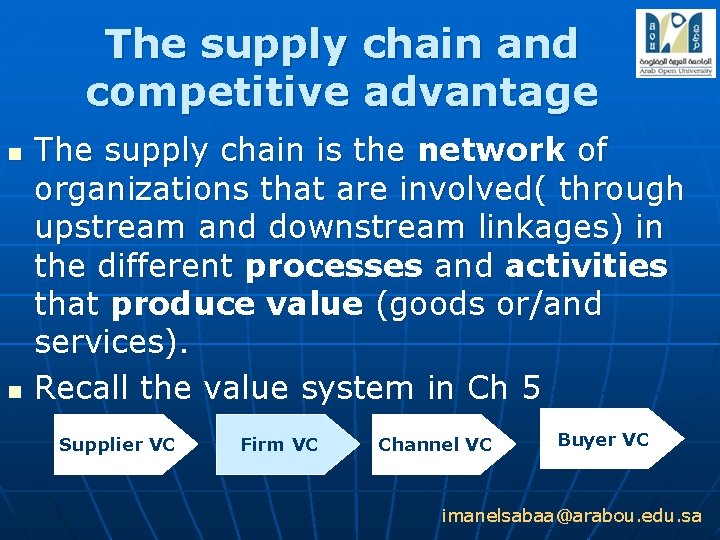
The supply chain and competitive advantage n n The supply chain is the network of organizations that are involved( through upstream and downstream linkages) in the different processes and activities that produce value (goods or/and services). Recall the value system in Ch 5 Supplier VC Firm VC Channel VC Buyer VC imanelsabaa@arabou. edu. sa
The supply chain and competitive advantage n Supply chain management in this regard should be after integrating outside boundaries of the firm to include both suppliers and consumers imanelsabaa@arabou. edu. sa
The supply chain and competitive advantage n The main challenge would be: Integrating and coordinating the flow of materials from suppliers (often off shore) and managing the distribution of final products through multiple intermediaries and in many geographical markets. imanelsabaa@arabou. edu. sa
The supply chain and competitive advantage n n n The difference between logistics and supply chain management p 157 Achieving an integrating supply chain p 158 -159 fig 11. 9 Scope of supply chain management fig 11. 8 p 158 Very important imanelsabaa@arabou. edu. sa
Fundamentals of supply chain management 1. 2. 3. 4. Views the supply chain as a single entity It calls for strategic decision making because of its impact on overall costs and market share provides a different perspective on inventories which are used as a balancing mechanism of last not first resort. Requires high level of integration imanelsabaa@arabou. edu. sa
The changing logistics environment n n The customer service explosion (Services excellence, appropriate delivery systems, committed employees) Time compression (logistics lead time) ORDER CASH Globalization of industry (offshore) Organizational integration (Material, production, and marketing managers) imanelsabaa@arabou. edu. sa
The challenge of logistics management n n To achieve the goal of competitive advantage through both cost reduction and service enhancement. Organizations need to accelerate the movement through the supply chain and to have more flexible Logistics systems and this could be achieved through: imanelsabaa@arabou. edu. sa
The challenge of logistics management - Cutting short the pipeline (Unneeded inventory) - Improve the pipeline visibility (Organizational barriers removals, better coordination) - Managing logistics as a system imanelsabaa@arabou. edu. sa
We covered so far n n n n Definition of logistics Logistics and competitive advantage (Productivity and Value advantage) Competitive advantage and value chain management The mission of logistics management The supply chain and competitive advantage The changing logistics environment The challenge of logistics management imanelsabaa@arabou. edu. sa
Activities 1. 2. 3. Identify the fundamentals of supply chain management, and how they do function. Explain the characteristics of the most challenging factors, in the area of logistics. How can we use logistics to add value and obtain competitive advantage imanelsabaa@arabou. edu. sa
End of chapter Eleven imanelsabaa@arabou. edu. sa
Reverse Logistics Chapter Twelve By Richard A. Lancioni imanelsabaa@arabou. edu. sa
Introduction n 1. 2. Why organizations might need to organize the flow of materials back from customers? A requirement to reclaim material for recycling (Waste management) Recall the defected product. imanelsabaa@arabou. edu. sa
Introduction n 1. 2. The trend will continue for the following reasons: Fast-changing technology necessitating frequent changes in product design. New laws being enacted worldwide, requiring the recall of defective products and the recycling of solid imanelsabaa@arabou. edu. sa waste.
The concept of backward distribution n n 1. 2. 3. What is backward distribution? What are its major obstacles? The lack of an orderly reverse distribution system Absence of needed information The high cost of collection and transportation. imanelsabaa@arabou. edu. sa
Urgency, scope and effectiveness of the recall process Urgency Classes of recalls could be: n Imminently hazardous(100% recall) n n Dangerous nature, possible of causing illness and possible be life-threatening Conscious or unconscious violation of regulations (Mislabeled or misbranded) imanelsabaa@arabou. edu. sa or Quality failures
Urgency, scope and effectiveness of the recall process Scope and Effectiveness of recalls depends on: n The nature of the product and the level of penetration in the distribution system. n Number of units manufactured and length of the product life. n The ability to locate and notify consumers. imanelsabaa@arabou. edu. sa
Locating the product n 1. 2. 3. n Where we can find the product in the distribution system? Manufacturer’s or Primary distributor's warehouse Middlemen (wholesalers Retailers) Hand of consumers Note the Level of complications and imanelsabaa@arabou. edu. sa
Mechanism for locating products n 1. 2. There are different ways of locating the products: Durable products (invoices, bills or warranty cards) Nondurable products ( Record keeping- Recall advertisement) imanelsabaa@arabou. edu. sa
Retrieval of products 1. Process of retrieving could be through: The company’s field salesforce. 2. The retailer or other middlemen. 3. Outside collection specialists. n imanelsabaa@arabou. edu. sa
Retrieval of products n 1. 2. Effective retrievals require: Motivated customer (Incentives, education, legislations) Good relationships with participants in the distribution process (needed information and guidelines) imanelsabaa@arabou. edu. sa
Read Pages 169 -170 n n n Reverse distribution as a part of logistics strategy Facility network Communications and order processing Transportation and traffic management Logistics costing imanelsabaa@arabou. edu. sa
A reverse distribution model P 171 -172 Transportation n Warehousing n Inventory control n Material handling n Order processing See fig 12. 2 p 172 n imanelsabaa@arabou. edu. sa
We covered so far The need for it? n The concept of backward distribution n Urgency, scope and effectiveness of the recall process n Mechanism for locating products n Retrieval of products n A reverse distribution model n imanelsabaa@arabou. edu. sa
Activities n n n Discuss the major elements which are involved in a product recall Explain why the concept of Reverse Logistics is important for the firms in the future Solve activity 15 in your study guide p 52 imanelsabaa@arabou. edu. sa
End of Chapter Twelve imanelsabaa@arabou. edu. sa
Staple yourself to an order Chapter fourteen By Benson P. Shapiro, V. Kasturi Rangan and John. Sviokla imanelsabaa@arabou. edu. sa
What is its importance § Focusing on the OMC allow managers to look at their company through a customer’s eyes and hence to improve overall operations and create new competitive advantages. imanelsabaa@arabou. edu. sa
Introduction n n The typical OMC includes 10 activities (or stages) that sometimes overlap or interact. While OMCs vary from industry to industry and are different for product and services, almost every business has these same stages. imanelsabaa@arabou. edu. sa
Lessons to be learned 1. 2. 3. The risk of falling between the cracks The likelihood of vertical gaps in knowledge. The importance of order selection and prioritization. imanelsabaa@arabou. edu. sa
Lessons to be learned Problems usually occur in the way an order is dealt with between departments rather than within a particular department. imanelsabaa@arabou. edu. sa
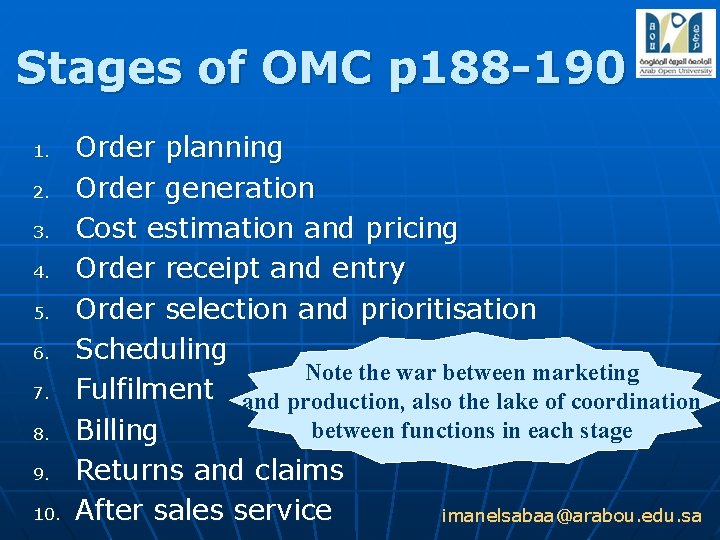
Stages of OMC p 188 -190 1. 2. 3. 4. 5. 6. 7. 8. 9. 10. Order planning Order generation Cost estimation and pricing Order receipt and entry Order selection and prioritisation Scheduling Note the war between marketing Fulfilment and production, also the lake of coordination between functions in each stage Billing Returns and claims After sales service imanelsabaa@arabou. edu. sa
Problems with the OMC 1. 2. 3. 4. Most companies never view the OMC as a whole system. Each step in the OMC requires a mix of overlapping functional responsibilities and then disasters occur. To top management, the details of the OMC are invisible. The customer remains as remote from imanelsabaa@arabou. edu. sa the OMC. Out of the picture
How to fix an OMC n 1. 2. 3. It takes a lot of hard work to improve a company’s order management cycle (OMC). Most successful efforts involve three basic elements: Analysis – Draw your OMC and chart the gaps, note the customer prespective. System Focus – Put the pieces together, move across boundaries Political Strategy – Staple yourself to an order imanelsabaa@arabou. edu. sa
Benefits of Fixing OMC n n n They will experience improved customer satisfaction. Interdepartmental problems will decrease. Companies will improve their financial performance. imanelsabaa@arabou. edu. sa
We covered so far What is its importance? n Lessons to be learned n Stages of OMC n Problems with the OMC n How to fix an OMC? n Benefits of Fixing OMC n imanelsabaa@arabou. edu. sa
Activities n n n Discuss the main problems with Order Management Cycles Recommend Ways of improving Order Management Cycles Solve activity 17 in your study guide on p 58 ( e. g. AOU) imanelsabaa@arabou. edu. sa
End of Chapter fourteen and the end of Processes Module imanelsabaa@arabou. edu. sa
- Slides: 59