
B 120 An Introduction to Business Studies Tutorial
B 120: An Introduction to Business Studies Tutorial 1 12 th October 2009
Hello and Welcome to B 120 ! A little bit about me. . .

Tutorial Learning Outcomes A ‘learning outcome’ is what I want you to have achieved by the end of the tutorial – we will come back to check this at the end. § To meet fellow students and tutor face to face. § Explain how the components of B 120 fit together. § Think about how we can define what a business is, including Morgan’s Metaphors. § Understand the limitations of a stakeholder model approach. § Carry out a STEEP analysis and understand the importance of using business models. § Understand the relevance of culture. § Understand how you will be assessed in B 120.
Agenda • • • Introduction to B 120 Course Structure, Assessment, etc. Introduction to Book 1 Activities Review Questions & Close
Relationships –tutor/students Tutor’s Role: • To be supportive of your learning and encourage you to succeed in B 120. • Help you to understand the course materials. • To provide you with timely feedback on your TMAs • To use the virtual learning tools to help in your learning. Student’s Role: • Participate as fully as possible – bring your experience and understanding to the tutorials. • Submit TMAs on time. • Acknowledge and respect input and views of others
Relationships – tutor/students/groups Ø Contacting your tutor – via e-mail sjames@arabou. edu. sa Ø Contacting each other – hoping to have a TGF set up. Ø Confidentiality – we need to be careful about what we discuss in a TGF – we can’t give answers to the TMAs!
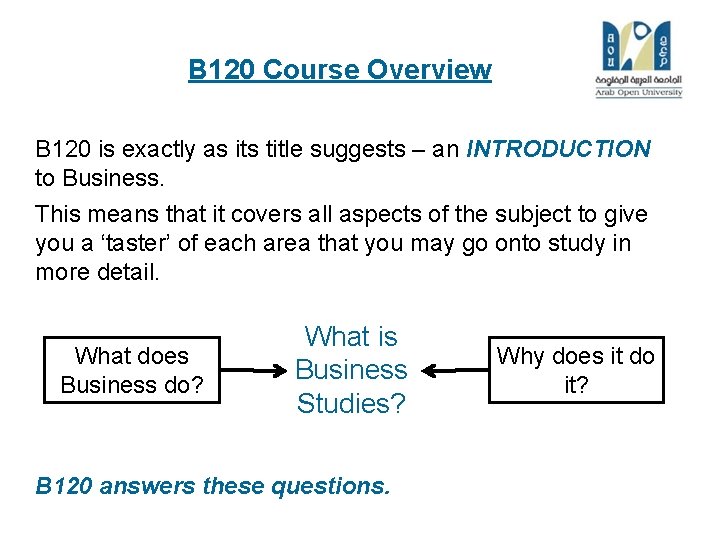
B 120 Course Overview B 120 is exactly as its title suggests – an INTRODUCTION to Business. This means that it covers all aspects of the subject to give you a ‘taster’ of each area that you may go onto study in more detail. What does Business do? What is Business Studies? B 120 answers these questions. Why does it do it?
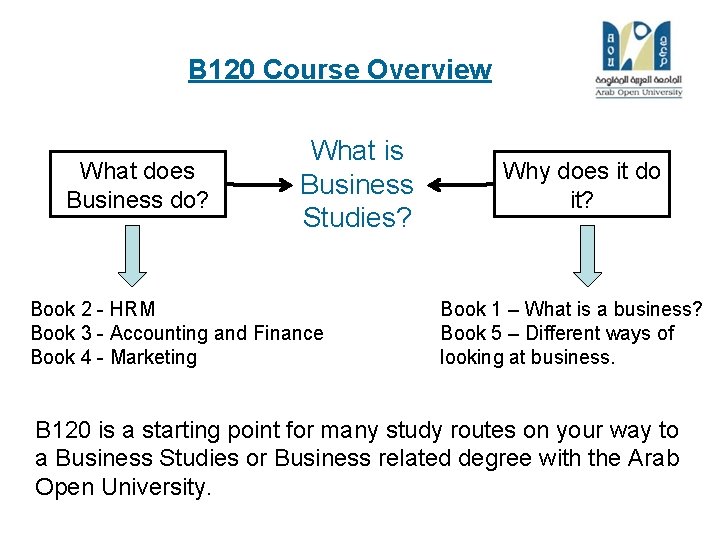
B 120 Course Overview What does Business do? What is Business Studies? Book 2 - HRM Book 3 - Accounting and Finance Book 4 - Marketing Why does it do it? Book 1 – What is a business? Book 5 – Different ways of looking at business. B 120 is a starting point for many study routes on your way to a Business Studies or Business related degree with the Arab Open University.
B 120 Course Overview – The Materials The 5 study books support the key aspects of Business Studies: Book 1 – What is a Business? Businesses do not operate within a vacuum – they are part of a complex ‘environment’ with which they need to interact and cooperate to succeed. Book 2 – An introduction to HRM in Business It is now accepted that a successful business understands the importance of recognising the needs of their employees. Book 3 – An introduction to Accounting and Finance in Business All businesses need money - to pay day to day expenses but also for investment – a well managed accounting system tries to ensure this.
B 120 Course Overview – The Materials Book 4 – An introduction to Marketing in Business The best products in the world can fail if they are not made available to the target market – this is the aim of any marketing campaign. Book 5 – Different way of looking at Business As mentioned business does not operate in a vacuum – we live in an increasingly complex world – this module shows the impact of this wider environment and how business tries to respond to this.
B 120 Course Overview – The Materials How are the Books Organised? Aims and Objectives – Each books starts with a list of aims and objectives that the book is aiming to achieve, you should use this as a guide to what you are expected to understand on completion of the book. Sessions – Each book is divided into sessions that break the work into manageable pieces. Each session addresses key concepts or ideas from business studies, using theory to explain these.

Introduction Book 1: Aims & Objectives • Describe some common characteristics of businesses • Explore what makes businesses different from each other • Understand the main Sociological, Technological, Economic, Environmental & Political forces that impact on business • Explain how organisational cultures emerge within businesses • Outline different types of structures and how they might impact on how work is organised within a business • Identify the importance of business ethics • Provide an introduction to business functions
Book 1: Sessions 1. 2. 3. 4. 5. 6. 7. What is a business? The external environment Business structures Business cultures Business ethics An introduction to business functions Small business and entrepreneurship
Book 1: Key Concepts & Ideas • Businesses come in all shapes and sizes • A business cannot operate without being influenced by and impacting upon its external environment • The shape and identity of a business is closely linked to its structure and culture • Business ethics is an important part of business and of B 120 • Small businesses, while often overlooked, provide a large proportion of employment and are an important part of the business world

Book 1: Key Theories • • • Business Types (Public / Private, Profit / Not for Profit) Morgan’s Metaphors (Morgan) STEEP & SWOT Analysis Business Structures (Pugh & Hickman) National Cultures (Hofstede) Organisational Culture (Trice & Beyer / Drennan) The Role of Ethics in Business (CSR) Stakeholder Analysis (Johnson & Scholes) Introduction to other Business Functions
Activity: Exploring Business In this first activity we are going to think about what we understand the word ‘business’ to mean. Think of a business or organisation that you are familiar with. Make brief notes about everything you know about this business, you may find it useful to use the course materials to do this. Activity 1
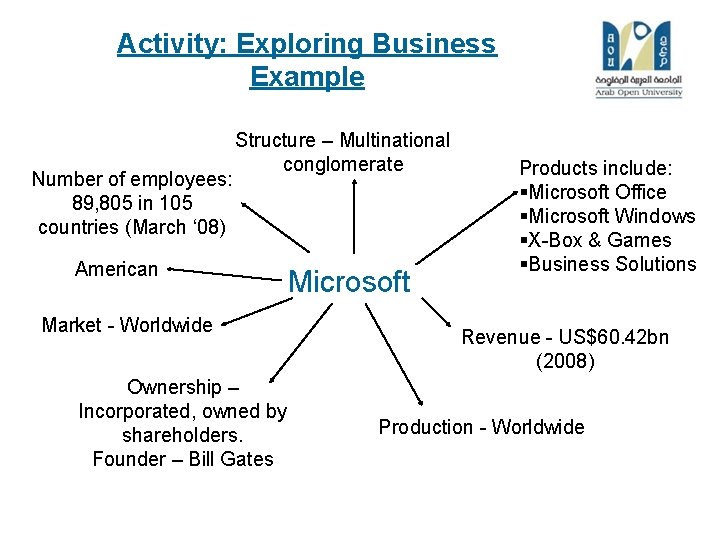
Activity: Exploring Business Example Number of employees: 89, 805 in 105 countries (March ‘ 08) Structure – Multinational conglomerate American Market - Worldwide Ownership – Incorporated, owned by shareholders. Founder – Bill Gates Microsoft Products include: §Microsoft Office §Microsoft Windows §X-Box & Games §Business Solutions Revenue - US$60. 42 bn (2008) Production - Worldwide
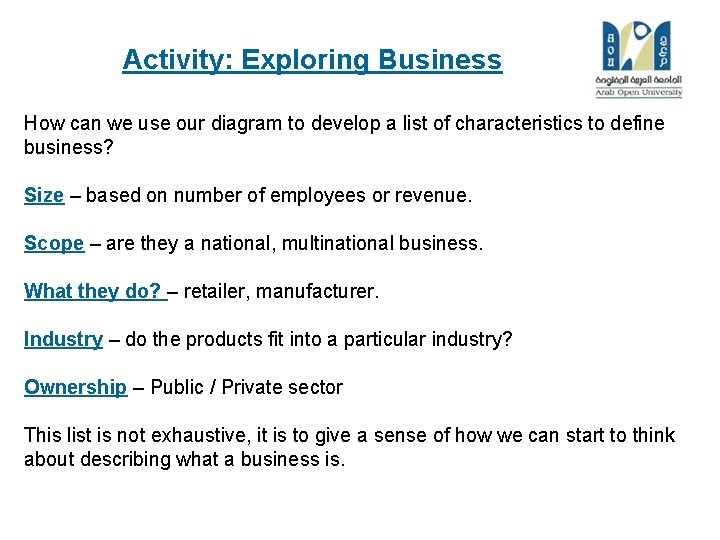
Activity: Exploring Business How can we use our diagram to develop a list of characteristics to define business? Size – based on number of employees or revenue. Scope – are they a national, multinational business. What they do? – retailer, manufacturer. Industry – do the products fit into a particular industry? Ownership – Public / Private sector This list is not exhaustive, it is to give a sense of how we can start to think about describing what a business is.
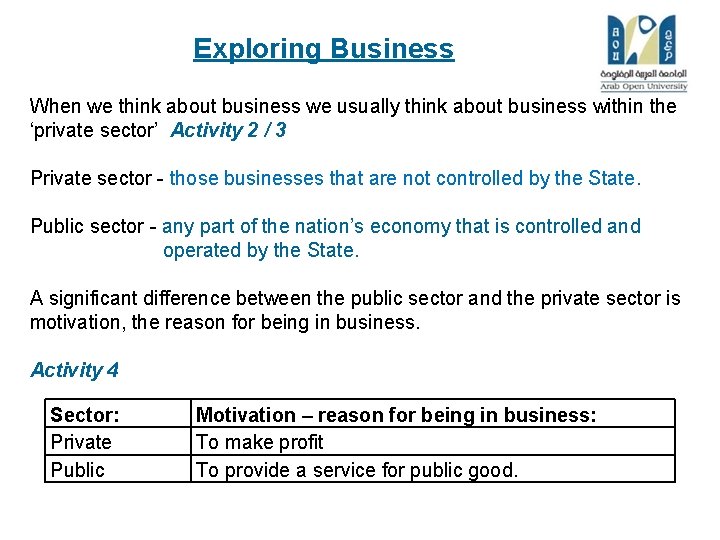
Exploring Business When we think about business we usually think about business within the ‘private sector’ Activity 2 / 3 Private sector - those businesses that are not controlled by the State. Public sector - any part of the nation’s economy that is controlled and operated by the State. A significant difference between the public sector and the private sector is motivation, the reason for being in business. Activity 4 Sector: Private Public Motivation – reason for being in business: To make profit To provide a service for public good.
Stakeholders What are stakeholders? Individuals and organisations with an interest in the activities of a company. A business that uses a stakeholder model is one that tries to balance the interests of their different stakeholders. This is a very different approach to the way that business has been done in the past. Firms used to aim for maximum profits to keep shareholders happy. This was often against interests of groups outside organisation.
Activity - Stakeholders Who are Microsoft’s Stakeholders? • Internal Stakeholders • External Stakeholders What do you think Microsoft’s stakeholders expect from the business? Activity 5
Why do we use Business Theories and Models? B 120 introduces a lot of business theory – why? Take the STEEP model as an example. This provides a framework for analysing business What does this mean? It is a model we can apply to any business to describe its external environment. Why do we need a framework? ü To give our work structure ü To allow for easy comparison between businesses

STEEP A useful structure to help analyse / understand their external environment relating to a business: Ø Sociological factors Ø Technological factors Ø Economic factors Ø Environmental factors Ø Political factors
STEEP Sociological: Demographics, age & structure of populations, patterns of work, gender roles. Technological: Information and communications technology, scale and rate of change, internet, etc. Economical: Rate of economic growth, interest rates, inflation, energy prices, exchange rates, etc. Environmental: Legislation, environmental reporting, shareholders, pressure groups, customers, etc. Political: Legislation, WTO / EU trade regulations, government, public services, taxes.
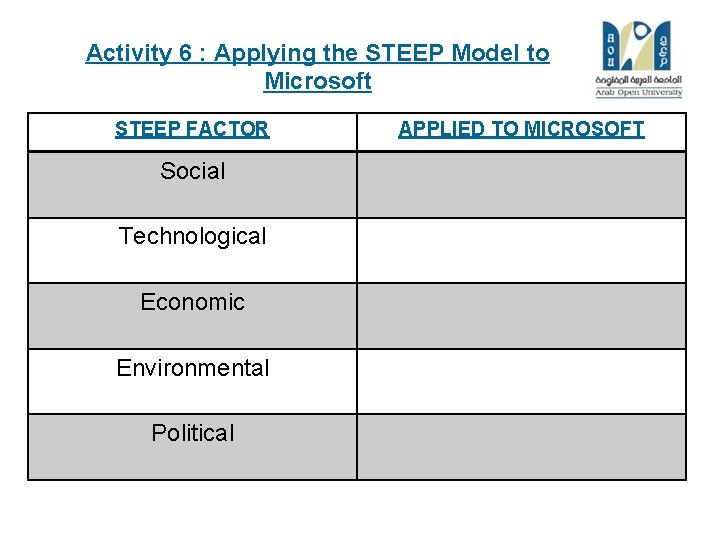
Activity 6 : Applying the STEEP Model to Microsoft STEEP FACTOR Social Technological Economic Environmental Political APPLIED TO MICROSOFT

Using Models We can use the STEEP model to consider some of the problems associated with using business models. Look at how we have presented our analysis of the eternal business environment for Microsoft – does the layout suggest any problems? Ø Businesses are messy and the boundaries are not clear cut. Ø We can not always apply each element of the model to every business, theory and practice are not always the same! The point? Be brave – learn to be critical of business theory.
Progress Check Look back at the learning outcomes to see how we are doing: § To meet fellow students and tutor face to face. § Explain how the components of B 120 fit together. § Think about how we can define what a business is, including Morgan’s Metaphors. § Understand the limitations of a stakeholder model approach. § Carry out a STEEP analysis and understand the importance of using business models. § Understand the relevance of culture. § Understand how you will be assessed in B 120.
Organisational Culture ‘Culture is a pattern of beliefs and expectations shared organisational members. These beliefs and expectations produce norms that shape the behaviour of individuals and groups within the organisation. ’ ‘The way that we do things around here…. ’ Geert Hofstede: The cultural values of a country are reflected in the way it does business.
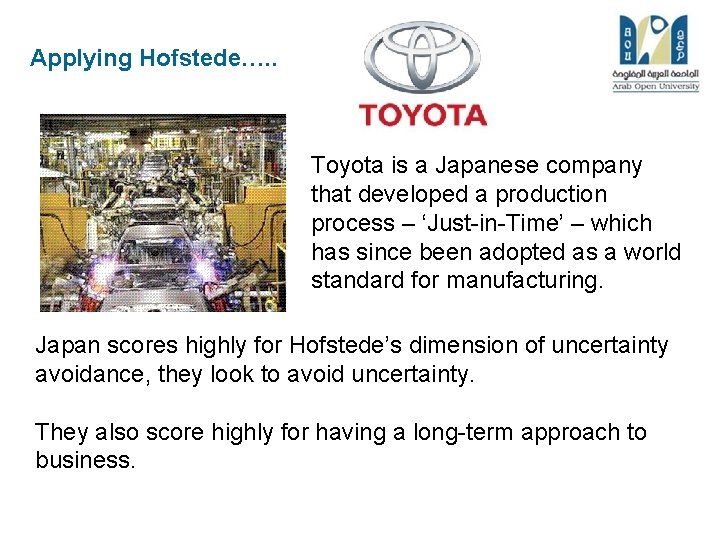
Applying Hofstede…. . Toyota is a Japanese company that developed a production process – ‘Just-in-Time’ – which has since been adopted as a world standard for manufacturing. Japan scores highly for Hofstede’s dimension of uncertainty avoidance, they look to avoid uncertainty. They also score highly for having a long-term approach to business.
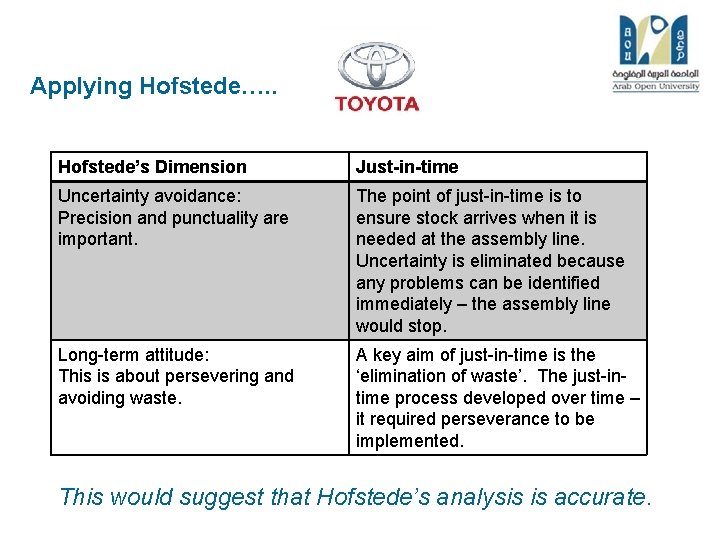
Applying Hofstede…. . Hofstede’s Dimension Just-in-time Uncertainty avoidance: Precision and punctuality are important. The point of just-in-time is to ensure stock arrives when it is needed at the assembly line. Uncertainty is eliminated because any problems can be identified immediately – the assembly line would stop. Long-term attitude: This is about persevering and avoiding waste. A key aim of just-in-time is the ‘elimination of waste’. The just-intime process developed over time – it required perseverance to be implemented. This would suggest that Hofstede’s analysis is accurate.
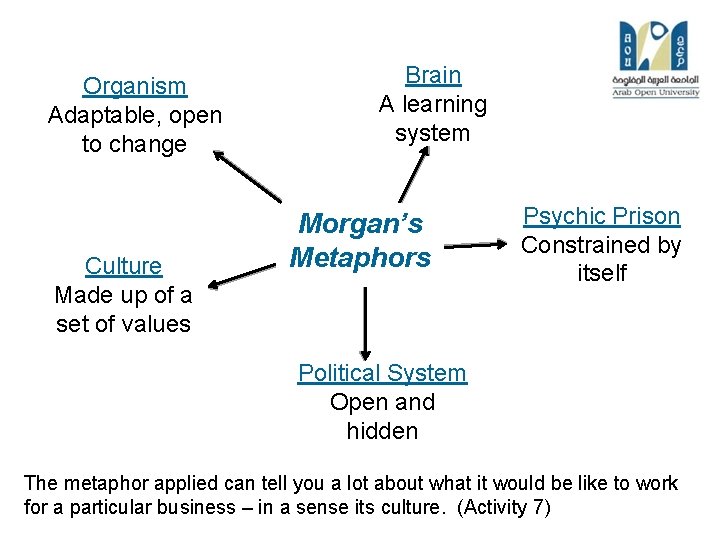
Organism Adaptable, open to change Culture Made up of a set of values Brain A learning system Morgan’s Metaphors Psychic Prison Constrained by itself Political System Open and hidden The metaphor applied can tell you a lot about what it would be like to work for a particular business – in a sense its culture. (Activity 7)
Extension Activity – Corporate culture at Microsoft What factors influence the culture of a business? Hofstede shows that the culture of the nation can influence the culture of the business. Use the list on page 47 of Book 1 to decide what factors may influence the culture at Microsoft.
B 120 Assessment Tutor Marked Assessments (TMAs) There are 2 TMA’s in B 120…. . ü TMA 01: A mini case studies based on Book 2 - 25 th October 2009 – EXTENSION 1 WEEK ü TMA 02: Report based on Book 4 - 12 th December 2009 Each TMA is worth 15% of the Total Assessment mark.
B 120 Assessment Tutor Marked Assessments (continued) Ø If you think you might miss the deadline - please do contact me Ø Under certain circumstances - an extension can be agreed Ø You do need to have a valid, plausible reason Ø Any extension must be agreed before the due date Ø Late TMAs – without authorisation - will not count towards your final mark
B 120 Assessment Quizzes There are 2 Quizzes in B 120…. . ü Quiz 1: 45 minutes. Will cover Book 3. ü Quiz 2: 45 minutes. Will cover Book 5 Each quiz is worth 10% of the total assessment mark.
B 120 Assessment End of Course Examination • Final written assessment • It will cover all 5 books More to come on this nearer the time
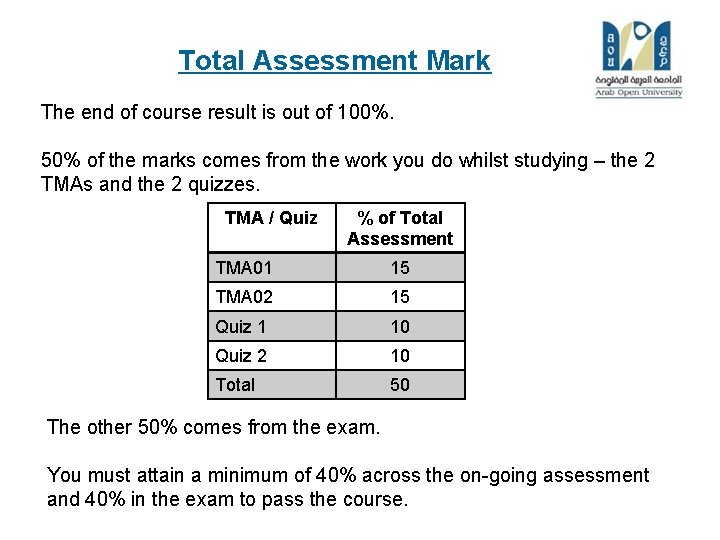
Total Assessment Mark The end of course result is out of 100%. 50% of the marks comes from the work you do whilst studying – the 2 TMAs and the 2 quizzes. TMA / Quiz % of Total Assessment TMA 01 15 TMA 02 15 Quiz 1 10 Quiz 2 10 Total 50 The other 50% comes from the exam. You must attain a minimum of 40% across the on-going assessment and 40% in the exam to pass the course.
Questions Please do e-mail if something occurs to you after the tutorial.
Review of Today § To meet fellow students and tutor face to face. § Explain how the components of B 120 fit together. § Think about how we can define what a business is, including Morgan’s Metaphors. § Understand the limitations of a stakeholder model approach. § Carry out a STEEP analysis and understand the importance of using business models. § Understand how you will be assessed in B 120.
Review of Today – Your thoughts please…. Ø How far did the day school meet my expectations or needs? Ø What have I learned? How has the day school improved my understanding? Ø Has it highlighted any issues or skills that I need to explore or develop? If so, give further details. It is really important that these tutorials meet your needs so please do think about these questions and email me some feedback. I would also welcome any suggestions for tutorial content.
- Slides: 40