
AZ EU Jogrendszere INITB 134 Dr Mikls Szirbik

AZ EU Jogrendszere INITB 134 Dr. Miklós Szirbik, LL. M. 16. 09. 2019 INTRODUCTION
Szirbik, Az EU Jogrendszere Dr. Szirbik Miklós LL. M. IBS, NKE Goethe University 2005, Frankfurt am Main 2005 FPS, Frankfurt am Main Europan Law Andrássy University Budapest 2011 – GIZ Prime Minister’s Office State Aid Monitoring Office 2012 -2016

Miklós Szirbik, Az EU Jogrendszere Ismétlés: Mit értünk az alatt, hogy az EU jog sui generis jellegű?
Miklós Szirbik, Az EU Jogrendszere Mit értünk az alatt, hogy az EU jog sui generis jellegű? AZ EU-t nemzetközi szerződés alapján hozták létre, ugyanakkor saját jogalkotási kompetenciákkal rendelkezik a rá átruházot hatáskör keretében, és az általa elfogadott jogszabályok a tagállamok számára is kötelező erővel bírnak. Ehhez képest például az ENSZ, illetve más nemzetközi szervezetek jogalkotásra vonatkozó hatásköre nagyon korlátozott. Az Egyesült Nemzetek Szervezetének Alapokmányában foglalt 10. és 14. cikkek alapján az ENSZ Kozgyűlés által elfogadott határozatok ajánlásoknak minősülnek (recommendations), ugyanakkor a gyakorlatban közvetetten kihatásuk van a nemzetközi jogforrásainak értelmezésére.
Miklós Szirbik, Az EU Jogrendszere 1. EU jog forrásai Kérdések: A) Hogyan definiálná a jogforrás kifejezést? B) Milyen jogforrásokat ismer a belső jogban? C) Milyen jogforrásokat ismerünk a nemzetközi jogban? D) A fentiek alapján: melyek az EU jogforrásai?

Miklós Szirbik, Az EU Jogrendszere 1. Jogforrások Az EU két fő jogforrása az elsődleges és a másodlagos jog. Az elsődleges jog alatt elsősorban az alapszerződéseket, és azok mellékleteit értjük, továbbá az általános jogi elveket. Másodlagos jognak (származtatott jog) az EU Intézményei illetve az Európai Központi Bank által a Szerződések alapján alkotott jogi aktusokat nevezzük. Ezenfelül az Európai Bíróság joggyakorlata is jogforrásnak számít (páldául a jogforrások konkretizálása, illetve az általános jogi elvek elismerése során).
Miklós Szirbik, Az EU Jogrendszere TFEU CHAPTER 2 LEGAL ACTS OF THE UNION, ADOPTION PROCEDURES AND OTHER PROVISIONS SECTION 1 THE LEGAL ACTS OF THE UNION Article 288
Miklós Szirbik, Az EU Jogrendszere Az alábbi jogi aktusok mely belső jogi aktusokra emlékeztetik Önt? Art. 288 TFEU To exercise the Union's competences, the institutions shall adopt regulations, directives, decisions, recommendations and opinions. A regulation shall have general application. It shall be binding in its entirety and directly applicable in all Member States. A directive shall be binding, as to the result to be achieved, upon each Member State to which it is addressed, but shall leave to the national authorities the choice of form and methods. A decision shall be binding in its entirety. A decision which specifies those to whom it is addressed shall be binding only on them. Recommendations and opinions shall have no binding force.
Miklós Szirbik, Az EU Jogrendszere Példa: Regulations - Regulation (EU) 2016/679 of the European Parliament and of the Council of 27 April 2016 on the protection of natural persons with regard to the processing of personal data and on the free movement of such data, and repealing Directive 95/46/EC (General Data Protection Regulation) (Text with EEA relevance) https: //eur-lex. europa. eu/legal-content/EN/TXT/? uri=celex%3 A 32016 R 0679
Miklós Szirbik, Az EU Jogrendszere Példa: Directives - Directive 2014/24/EU of the European Parliament and of the Council of 26 February 2014 on public procurement and repealing Directive 2004/18/EC Text with EEA relevance https: //eur-lex. europa. eu/legal-content/EN/TXT/? uri=celex%3 A 32014 L 0024
Miklós Szirbik, Az EU Jogrendszere Példák: Decisions – (1) Greece Aluminum Case, (2) Poland- Aid scheme for compensation of damage caused by the floods in Poland http: //ec. europa. eu/competition/state_aid/cases/234935_1079057_10_1. p df http: //ec. europa. eu/competition/state_aid/cases/237314_1142520_25_2. p df
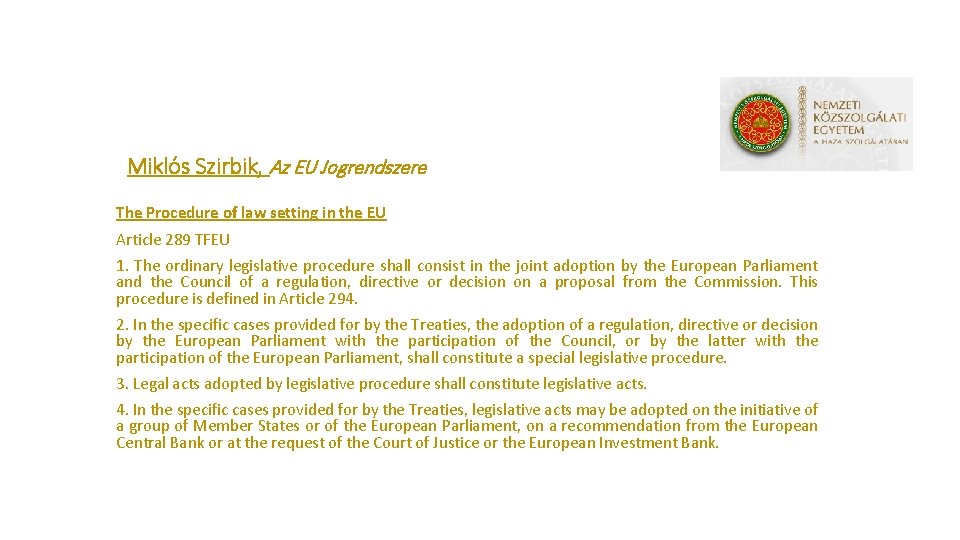
Miklós Szirbik, Az EU Jogrendszere The Procedure of law setting in the EU Article 289 TFEU 1. The ordinary legislative procedure shall consist in the joint adoption by the European Parliament and the Council of a regulation, directive or decision on a proposal from the Commission. This procedure is defined in Article 294. 2. In the specific cases provided for by the Treaties, the adoption of a regulation, directive or decision by the European Parliament with the participation of the Council, or by the latter with the participation of the European Parliament, shall constitute a special legislative procedure. 3. Legal acts adopted by legislative procedure shall constitute legislative acts. 4. In the specific cases provided for by the Treaties, legislative acts may be adopted on the initiative of a group of Member States or of the European Parliament, on a recommendation from the European Central Bank or at the request of the Court of Justice or the European Investment Bank.
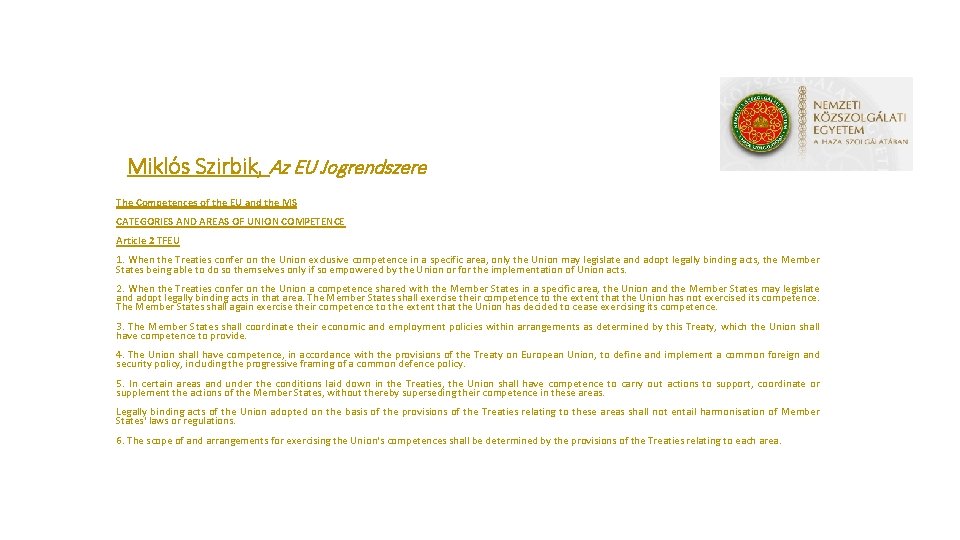
Miklós Szirbik, Az EU Jogrendszere The Competences of the EU and the MS CATEGORIES AND AREAS OF UNION COMPETENCE Article 2 TFEU 1. When the Treaties confer on the Union exclusive competence in a specific area, only the Union may legislate and adopt legally binding acts, the Member States being able to do so themselves only if so empowered by the Union or for the implementation of Union acts. 2. When the Treaties confer on the Union a competence shared with the Member States in a specific area, the Union and the Member States may legislate and adopt legally binding acts in that area. The Member States shall exercise their competence to the extent that the Union has not exercised its competence. The Member States shall again exercise their competence to the extent that the Union has decided to cease exercising its competence. 3. The Member States shall coordinate their economic and employment policies within arrangements as determined by this Treaty, which the Union shall have competence to provide. 4. The Union shall have competence, in accordance with the provisions of the Treaty on European Union, to define and implement a common foreign and security policy, including the progressive framing of a common defence policy. 5. In certain areas and under the conditions laid down in the Treaties, the Union shall have competence to carry out actions to support, coordinate or supplement the actions of the Member States, without thereby superseding their competence in these areas. Legally binding acts of the Union adopted on the basis of the provisions of the Treaties relating to these areas shall not entail harmonisation of Member States' laws or regulations. 6. The scope of and arrangements for exercising the Union's competences shall be determined by the provisions of the Treaties relating to each area.
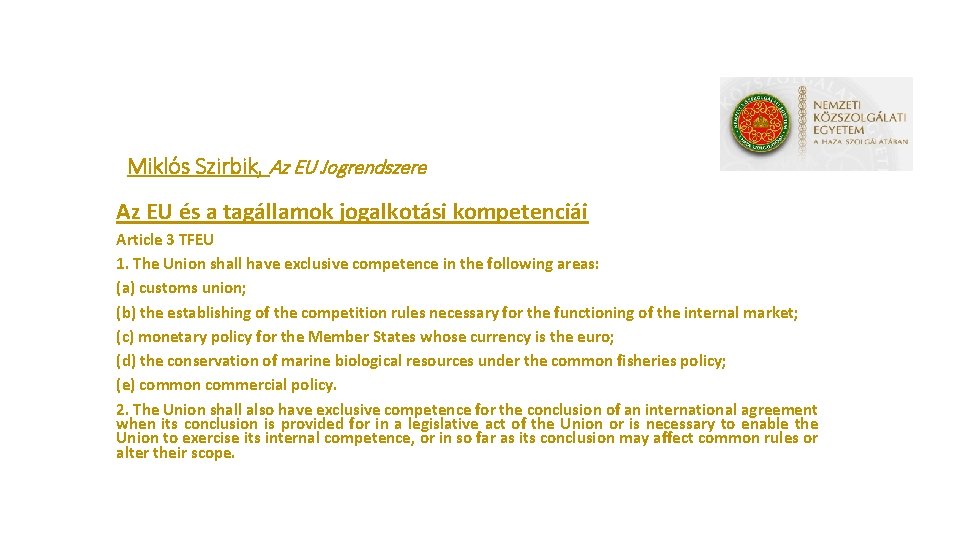
Miklós Szirbik, Az EU Jogrendszere Az EU és a tagállamok jogalkotási kompetenciái Article 3 TFEU 1. The Union shall have exclusive competence in the following areas: (a) customs union; (b) the establishing of the competition rules necessary for the functioning of the internal market; (c) monetary policy for the Member States whose currency is the euro; (d) the conservation of marine biological resources under the common fisheries policy; (e) common commercial policy. 2. The Union shall also have exclusive competence for the conclusion of an international agreement when its conclusion is provided for in a legislative act of the Union or is necessary to enable the Union to exercise its internal competence, or in so far as its conclusion may affect common rules or alter their scope.
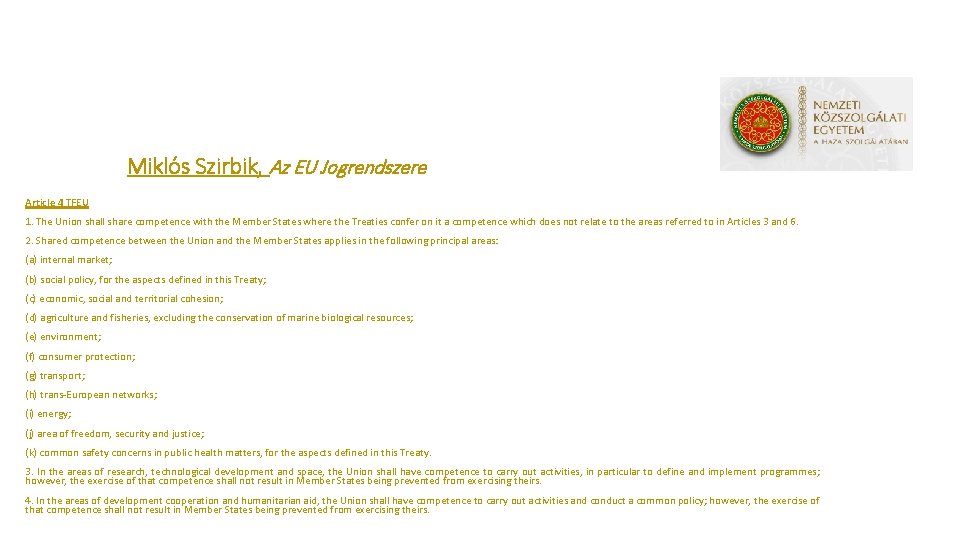
Miklós Szirbik, Az EU Jogrendszere Article 4 TFEU 1. The Union shall share competence with the Member States where the Treaties confer on it a competence which does not relate to the areas referred to in Articles 3 and 6. 2. Shared competence between the Union and the Member States applies in the following principal areas: (a) internal market; (b) social policy, for the aspects defined in this Treaty; (c) economic, social and territorial cohesion; (d) agriculture and fisheries, excluding the conservation of marine biological resources; (e) environment; (f) consumer protection; (g) transport; (h) trans-European networks; (i) energy; (j) area of freedom, security and justice; (k) common safety concerns in public health matters, for the aspects defined in this Treaty. 3. In the areas of research, technological development and space, the Union shall have competence to carry out activities, in particular to define and implement programmes; however, the exercise of that competence shall not result in Member States being prevented from exercising theirs. 4. In the areas of development cooperation and humanitarian aid, the Union shall have competence to carry out activities and conduct a common policy; however, the exercise of that competence shall not result in Member States being prevented from exercising theirs.
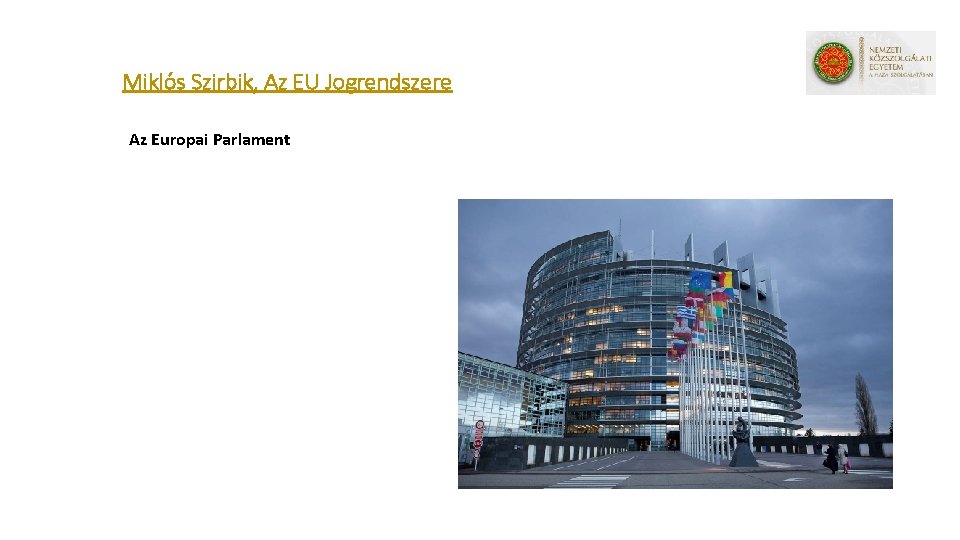
Miklós Szirbik, Az EU Jogrendszere Az Europai Parlament
Miklós Szirbik, Az EU Jogrendszere History of EP 1952 -1957: Consultative Assembly Its members were elected by the national parliaments of the MS. As indicated in the name, it had to be heard by the Council while lawsetting but it did not create itself the European legal sources. In 1979 shortly after the 1957 Treaties the EP was elected directly for the first time and it broadened its importance continuously. Today it is a co-legislative organ.

Miklós Szirbik, Az EU Jogrendszere David Sassoli, EPP since 17 January 2017
Miklós Szirbik, Az EU Jogrendszere Az Európai Bíróság döntése az Európai Parlament javára a C-124/13 sz. ügyben. https: //eur-lex. europa. eu/legalcontent/EN/TXT/? uri=uriserv: OJ. C_. 2013. 156. 01. 0021. 01. ENG http: //ebcd. org/european-court-of-justice-decides-in-favor-ofeuropean-parliament-in-cod-case/
Miklós Szirbik, Az EU Jogrendszere European Court of Justice decides in favor of European Parliament in Case C‑ 73/17 (France v. EP)

Köszönöm a figyelmüket!
- Slides: 21