
Ayers Emotivism Metaethics Cognitivist Realist Naturalism moral facts

- Slides: 9
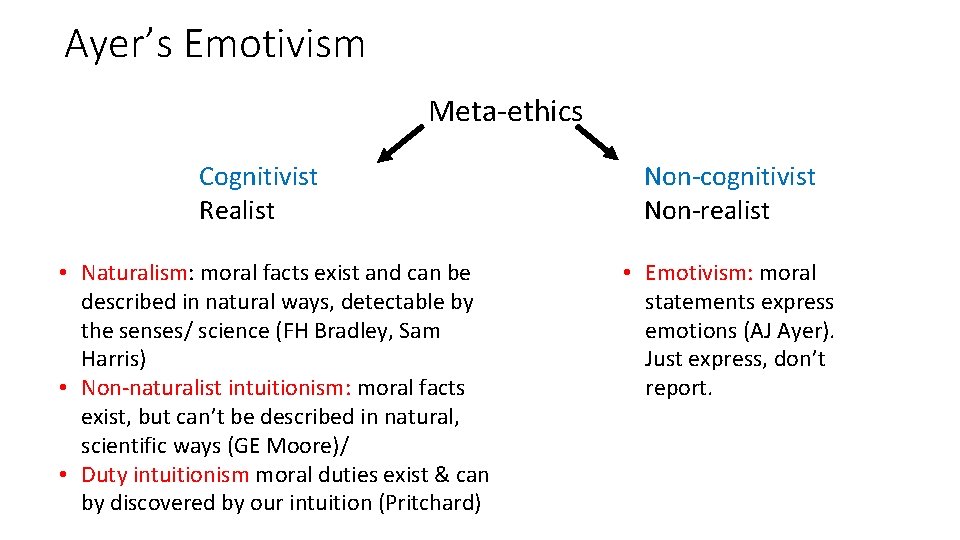
Ayer’s Emotivism Meta-ethics Cognitivist Realist • Naturalism: moral facts exist and can be described in natural ways, detectable by the senses/ science (FH Bradley, Sam Harris) • Non-naturalist intuitionism: moral facts exist, but can’t be described in natural, scientific ways (GE Moore)/ • Duty intuitionism moral duties exist & can by discovered by our intuition (Pritchard) Non-cognitivist Non-realist • Emotivism: moral statements express emotions (AJ Ayer). Just express, don’t report.
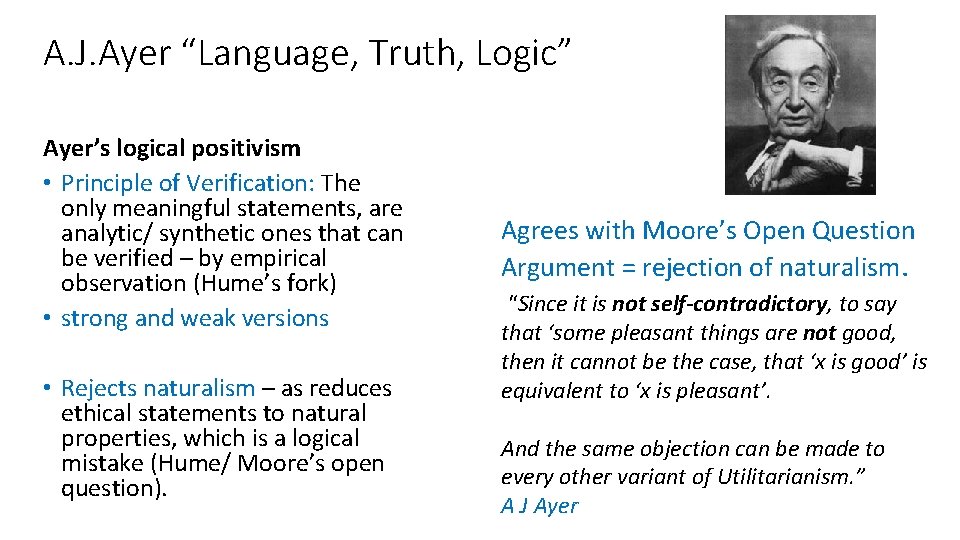
A. J. Ayer “Language, Truth, Logic” Ayer’s logical positivism • Principle of Verification: The only meaningful statements, are analytic/ synthetic ones that can be verified – by empirical observation (Hume’s fork) • strong and weak versions • Rejects naturalism – as reduces ethical statements to natural properties, which is a logical mistake (Hume/ Moore’s open question). Agrees with Moore’s Open Question Argument = rejection of naturalism. “Since it is not self-contradictory, to say that ‘some pleasant things are not good, then it cannot be the case, that ‘x is good’ is equivalent to ‘x is pleasant’. And the same objection can be made to every other variant of Utilitarianism. ” A J Ayer
“Smoking dope gives you pleasure, but is it good? ”. Ayer.
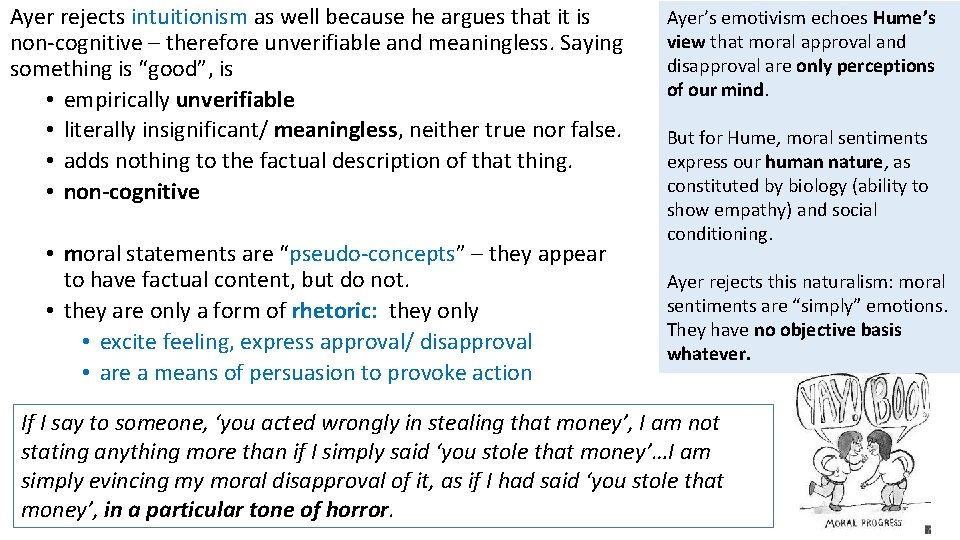
Ayer rejects intuitionism as well because he argues that it is non-cognitive – therefore unverifiable and meaningless. Saying something is “good”, is • empirically unverifiable • literally insignificant/ meaningless, neither true nor false. • adds nothing to the factual description of that thing. • non-cognitive • moral statements are “pseudo-concepts” – they appear to have factual content, but do not. • they are only a form of rhetoric: they only • excite feeling, express approval/ disapproval • are a means of persuasion to provoke action Ayer’s emotivism echoes Hume’s view that moral approval and disapproval are only perceptions of our mind. But for Hume, moral sentiments express our human nature, as constituted by biology (ability to show empathy) and social conditioning. Ayer rejects this naturalism: moral sentiments are “simply” emotions. They have no objective basis whatever. If I say to someone, ‘you acted wrongly in stealing that money’, I am not stating anything more than if I simply said ‘you stole that money’…I am simply evincing my moral disapproval of it, as if I had said ‘you stole that money’, in a particular tone of horror.
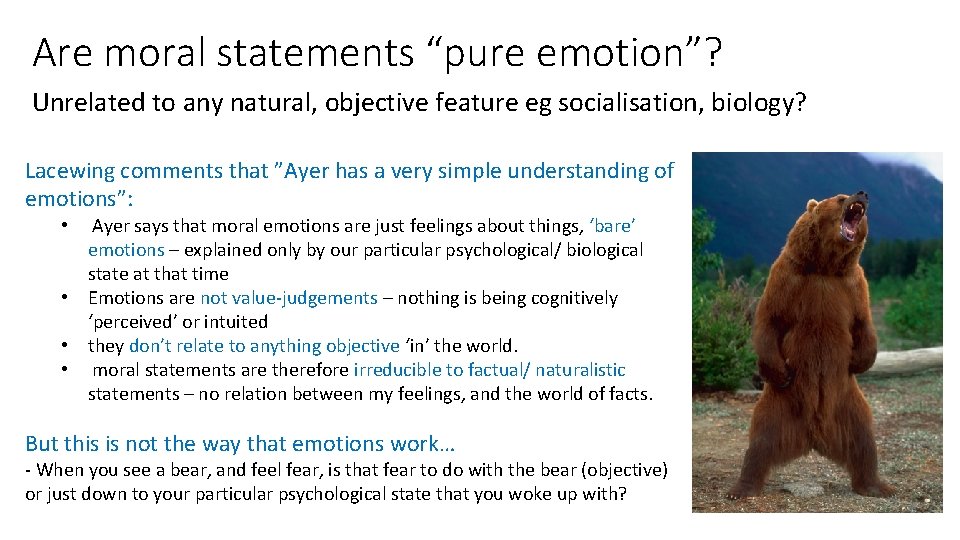
Are moral statements “pure emotion”? Unrelated to any natural, objective feature eg socialisation, biology? Lacewing comments that ”Ayer has a very simple understanding of emotions”: Ayer says that moral emotions are just feelings about things, ‘bare’ emotions – explained only by our particular psychological/ biological state at that time • Emotions are not value-judgements – nothing is being cognitively ‘perceived’ or intuited • they don’t relate to anything objective ‘in’ the world. • moral statements are therefore irreducible to factual/ naturalistic statements – no relation between my feelings, and the world of facts. • But this is not the way that emotions work… - When you see a bear, and feel fear, is that fear to do with the bear (objective) or just down to your particular psychological state that you woke up with?
Explain Ayer’s emotivism • What is the role of emotions in emotivism? • How do they relate to morality? • What arguments does Ayer offer for this point of view?
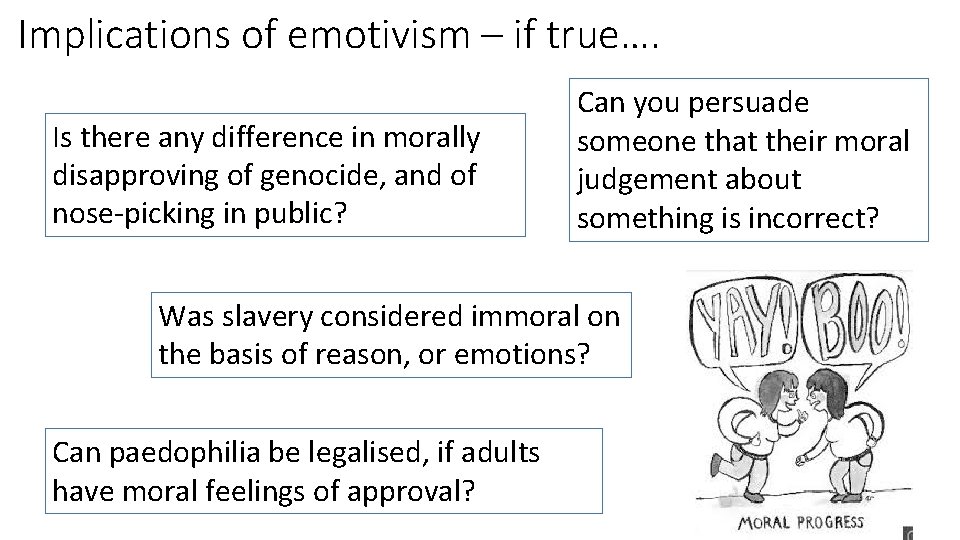
Implications of emotivism – if true…. Is there any difference in morally disapproving of genocide, and of nose-picking in public? Can you persuade someone that their moral judgement about something is incorrect? Was slavery considered immoral on the basis of reason, or emotions? Can paedophilia be legalised, if adults have moral feelings of approval?
Moral debate is impossible. • Morality has no external, objective content – moral statements cannot be verified. No criteria exist by which a moral opinion may be rejected. • The only thing we might rationally debate, is the facts of the situation, but not moral statement, “just as you cannot verify a cry of pain”. We must abandon the effort to convince them. “Another man, if he were to disagree with me, cannot, strictly speaking, contradict me…for I am not making any factual statement, nor an assertion, not even a statement about my own state of mind…I am merely expressing moral sentiments. ” “But I am not saying that morals are trivial or unimportant, or that people ought not to bother with them…” Ayer Moral theories are useless: • They only report people’s psychological state when they express a moral judgment. • They do not provide any independent, verifiable criteria to determine morality, because this does not exist. • They cannot therefore provide guidance for actual conduct. They are useless. • Only meta-ethics has value, as it offers an analysis of how ethical language works. • relates it to psychology • Shows its functions - to persuade/ command, motivate.
What are the key problems of emotivism? • Moral statements are meaningless • Just boils morality down to ‘bare’ emotion – simplistic view of emotions • Moral debate is impossible - can never come to agreement / disagreement • Moral theories become useless – no verifiable criteria for morality, mean no guidance possible