
Axisymetric Inlet Design for CombinedCycle Engines Jesse R
Axisymetric Inlet Design for Combined-Cycle Engines Jesse R. Colville, Ryan P. Starkey, and Mark J. Lewis University of Maryland, College Park, Maryland Presented by: Andrew Mac. Krell AME 50531 – Intermediate Thermodynamics University of Notre Dame April 30, 2008
Abstract Examined a new strategy for designing inlets for Turbine-based combined-cycle (TBCC) engines p Starting characteristics are examined compared with of the Kantrowitz limit p Widened shoulder centerbody and variable cone with reextension designs have the ability to remain started into the Mach 6 -7 range p

TBCC Engines Low speed Turbojets merged with high speed Ramjets and Scramjets p Challenge: Integration of the TBCC cycle modes into a single system p n n Each requires unique flow properties to operate properly Inlet must provide efficient compression for all components across a wide Mach spectrum
Inlet Performance Imposes a significant constraint on overall operation of engine p Needs to: p n n n diffuse required amount of air and maximize pressure recovery while minimizing shockwave Supply air with tolerable flow distortions Minimize amount of added external drag Minimize added mass Provide self-starting capability
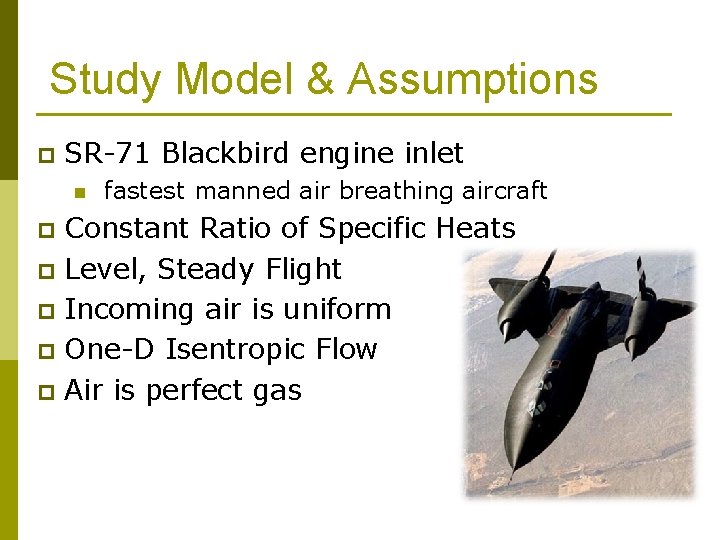
Study Model & Assumptions p SR-71 Blackbird engine inlet n fastest manned air breathing aircraft Constant Ratio of Specific Heats p Level, Steady Flight p Incoming air is uniform p One-D Isentropic Flow p Air is perfect gas p
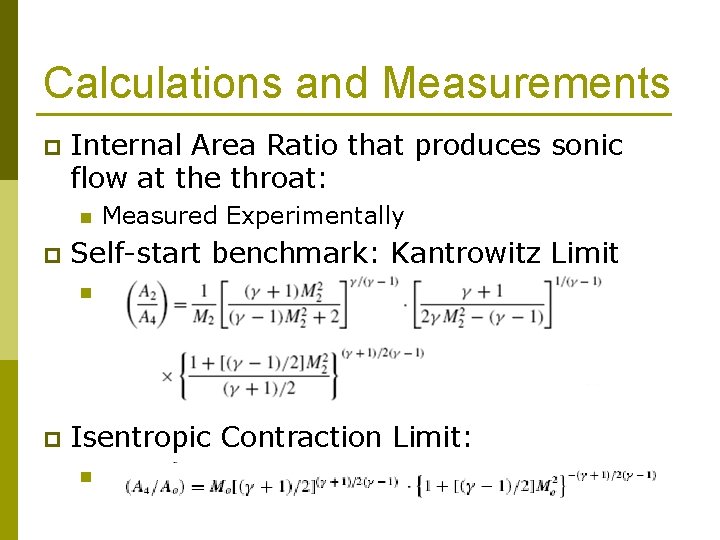
Calculations and Measurements p Internal Area Ratio that produces sonic flow at the throat: n p Measured Experimentally Self-start benchmark: Kantrowitz Limit n a a p Isentropic Contraction Limit: n A

Inlet Modifications Variable Cowl Leading Edge p Variable Cone Centerbody p Reextended Spike p Widened Shoulder Centerbody p Variable Cone With Reextension p
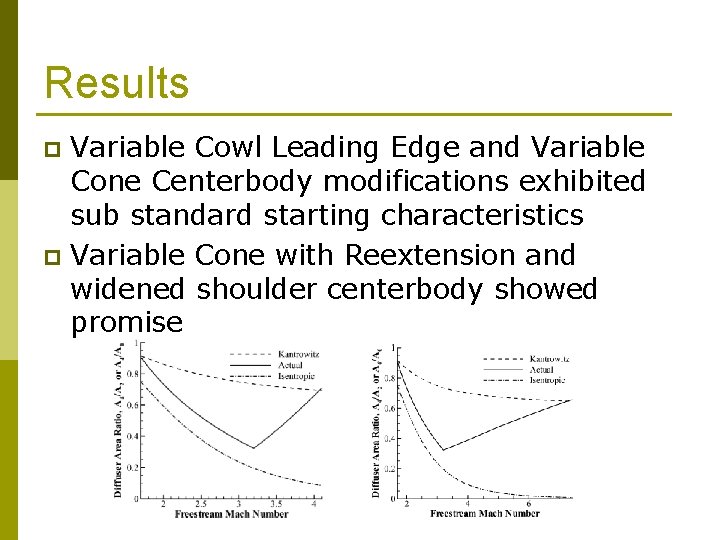
Results Variable Cowl Leading Edge and Variable Cone Centerbody modifications exhibited sub standard starting characteristics p Variable Cone with Reextension and widened shoulder centerbody showed promise p
Conclusions Complex variable geometry is needed to design inlets for high speed aircrafts p Numerical simulation was not entirely accurate p Mechanical complexity associated with the complex variable geometry is the main obstacle that would need to be overcome to realize these design schemes p
- Slides: 9