
AXIAL SKELETON SKULL MANDIBLE n VERTEBRAL COLUMN n
AXIAL SKELETON SKULL & MANDIBLE. n VERTEBRAL COLUMN. n STERNUM. n RIBS. n
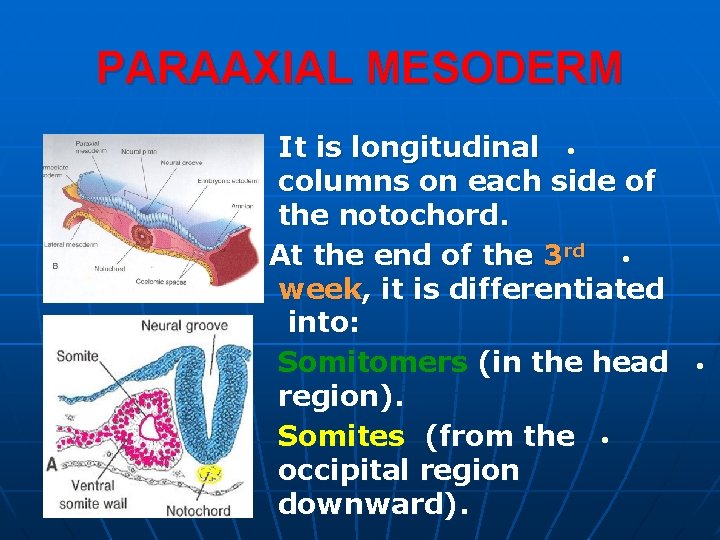
PARAAXIAL MESODERM It is longitudinal • columns on each side of the notochord. At the end of the 3 rd • week, it is differentiated into: Somitomers (in the head region). Somites (from the • occipital region downward). •
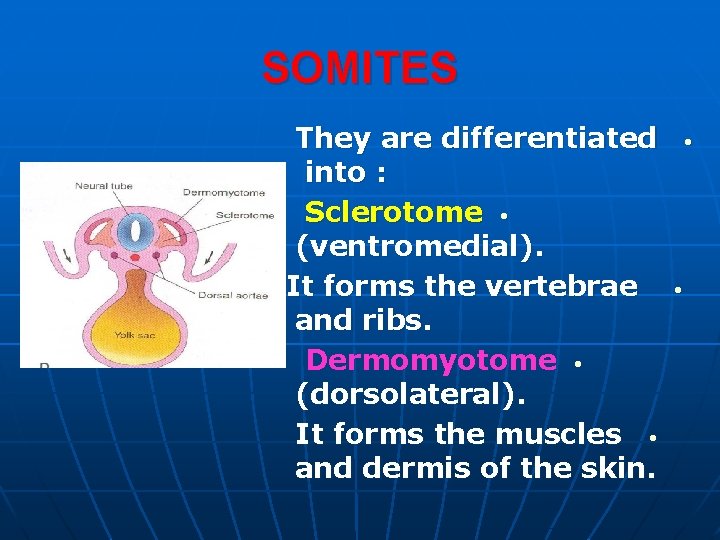
SOMITES They are differentiated into : Sclerotome • (ventromedial). It forms the vertebrae and ribs. Dermomyotome • (dorsolateral). It forms the muscles • and dermis of the skin. • •
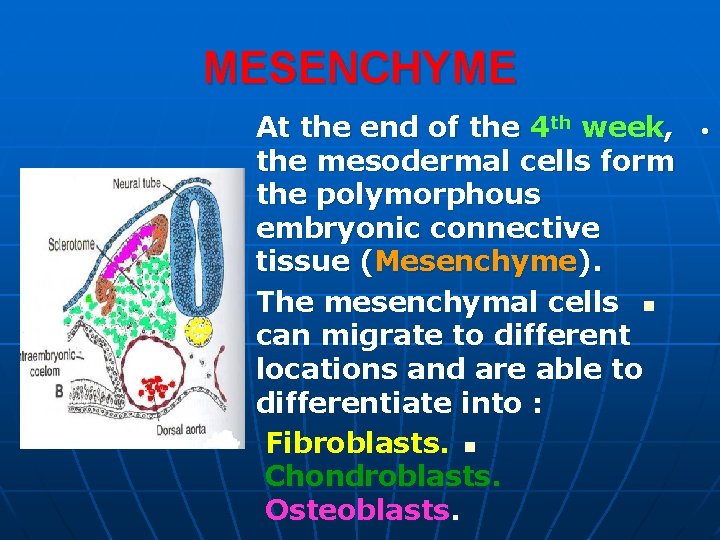
MESENCHYME At the end of the 4 th week, the mesodermal cells form the polymorphous embryonic connective tissue (Mesenchyme). The mesenchymal cells n can migrate to different locations and are able to differentiate into : Fibroblasts. n Chondroblasts. Osteoblasts. •
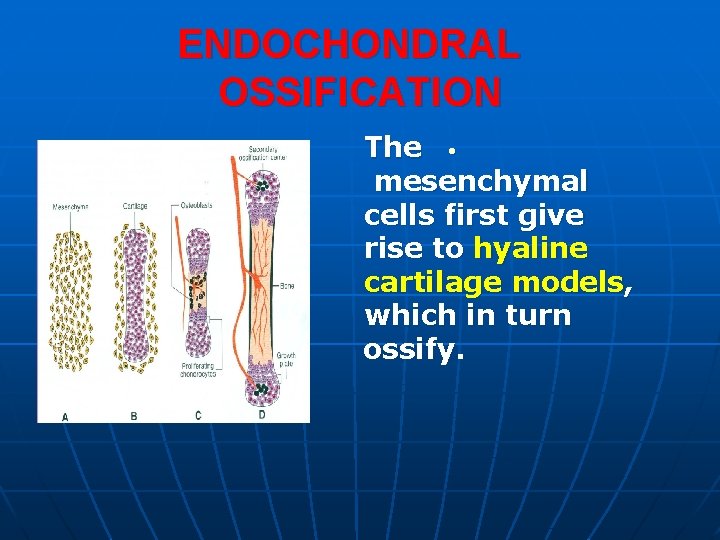
ENDOCHONDRAL OSSIFICATION The • mesenchymal cells first give rise to hyaline cartilage models, which in turn ossify.
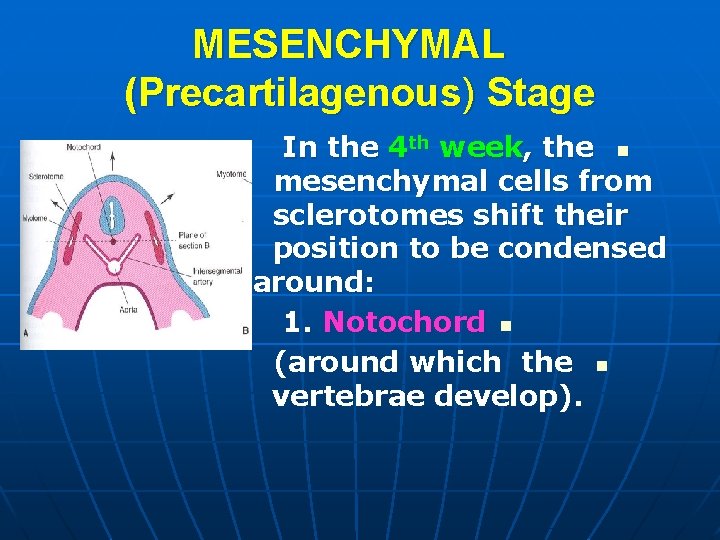
MESENCHYMAL (Precartilagenous) Stage In the 4 th week, the n mesenchymal cells from sclerotomes shift their position to be condensed around: 1. Notochord n (around which the n vertebrae develop).
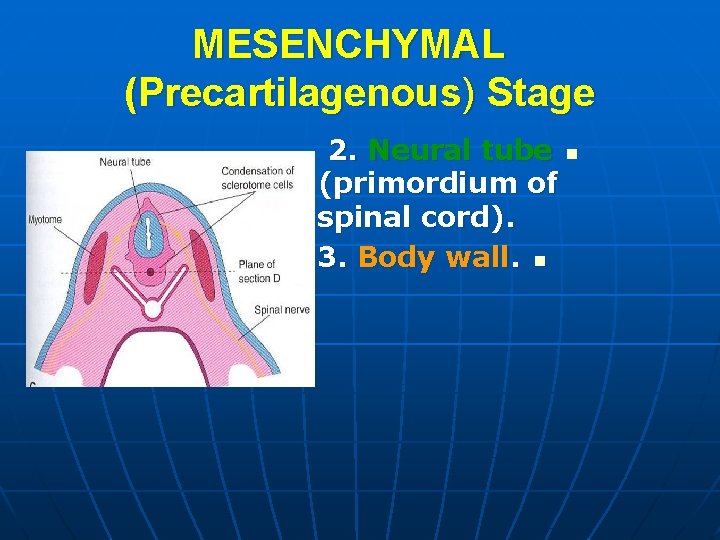
MESENCHYMAL (Precartilagenous) Stage 2. Neural tube n (primordium of spinal cord). 3. Body wall. n
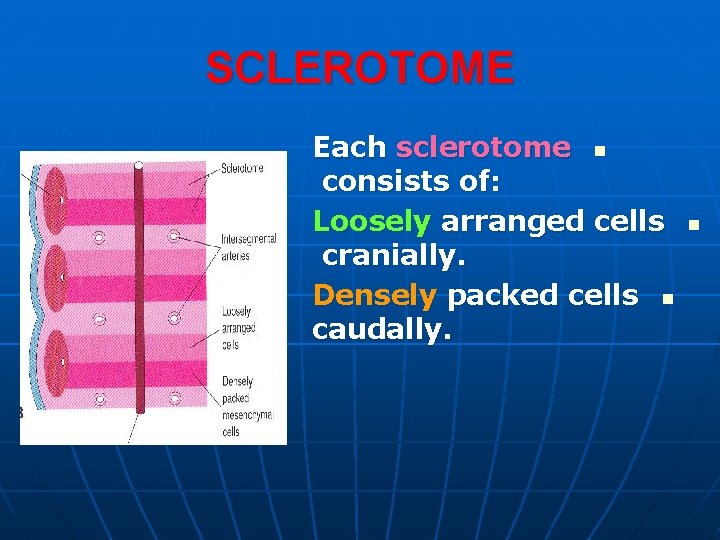
SCLEROTOME Each sclerotome n consists of: Loosely arranged cells cranially. Densely packed cells n caudally. n
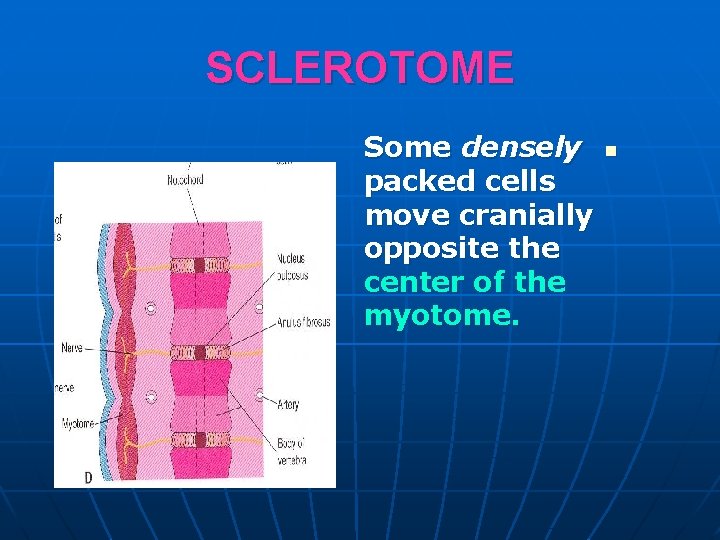
SCLEROTOME Some densely packed cells move cranially opposite the center of the myotome. n
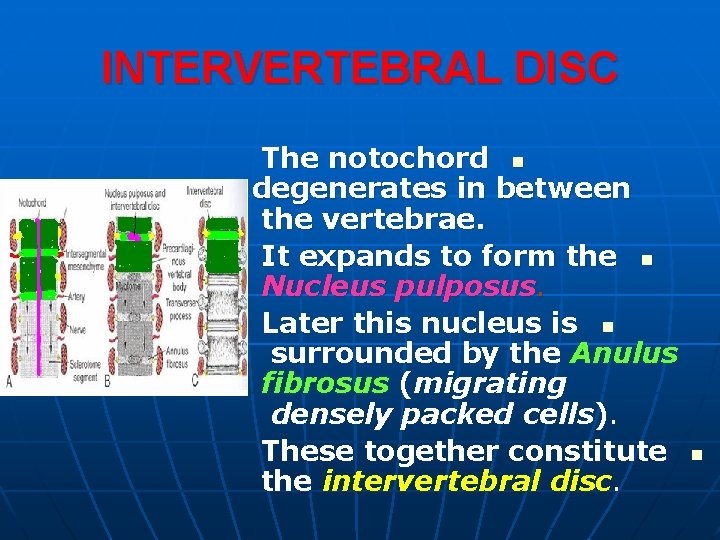
INTERVERTEBRAL DISC The notochord n degenerates in between the vertebrae. It expands to form the n Nucleus pulposus. Later this nucleus is n surrounded by the Anulus fibrosus (migrating densely packed cells). These together constitute the intervertebral disc. n
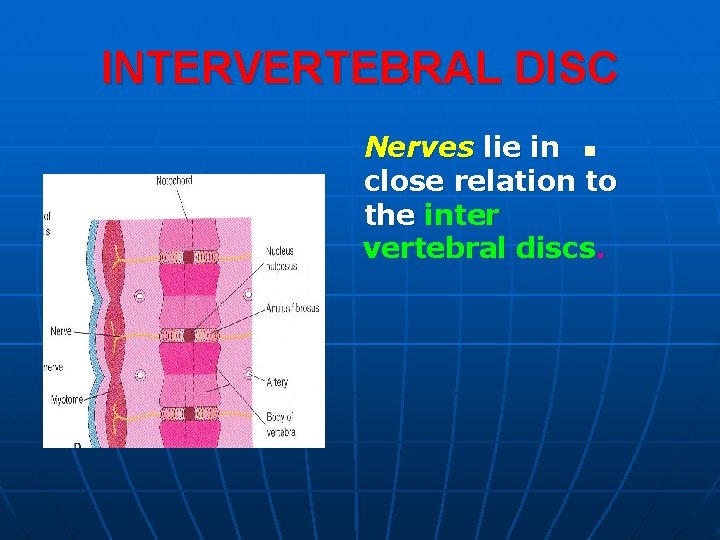
INTERVERTEBRAL DISC Nerves lie in n close relation to the inter vertebral discs.
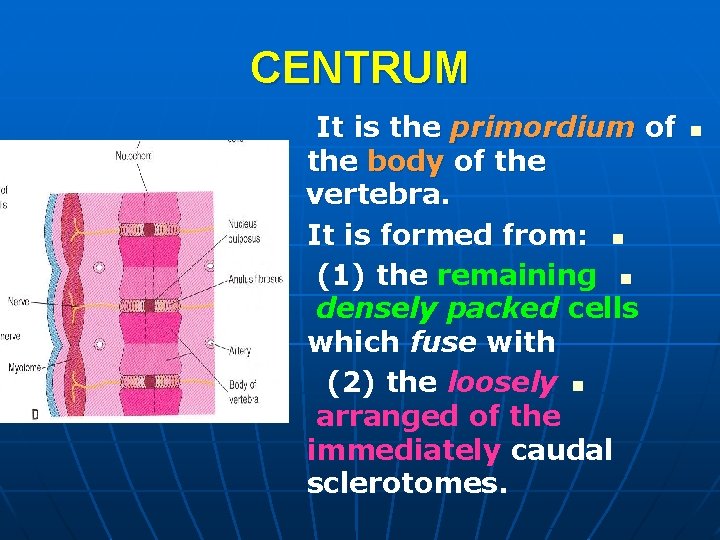
CENTRUM It is the primordium of the body of the vertebra. It is formed from: n (1) the remaining n densely packed cells which fuse with (2) the loosely n arranged of the immediately caudal sclerotomes. n
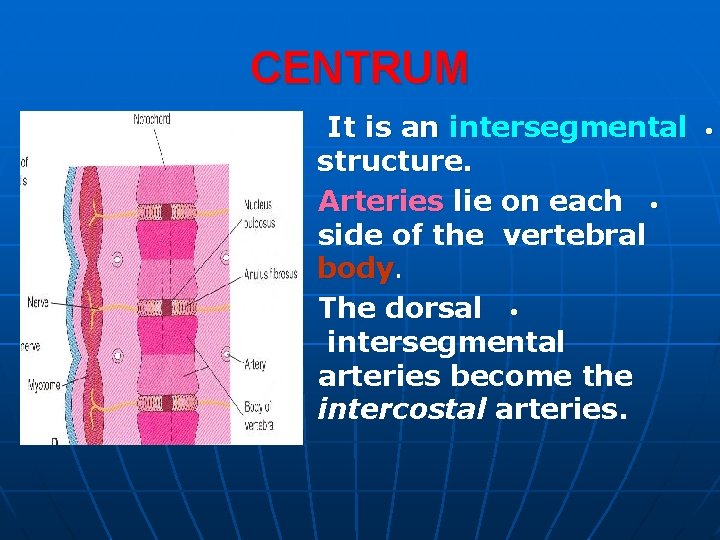
CENTRUM It is an intersegmental structure. Arteries lie on each • side of the vertebral body. The dorsal • intersegmental arteries become the intercostal arteries. •
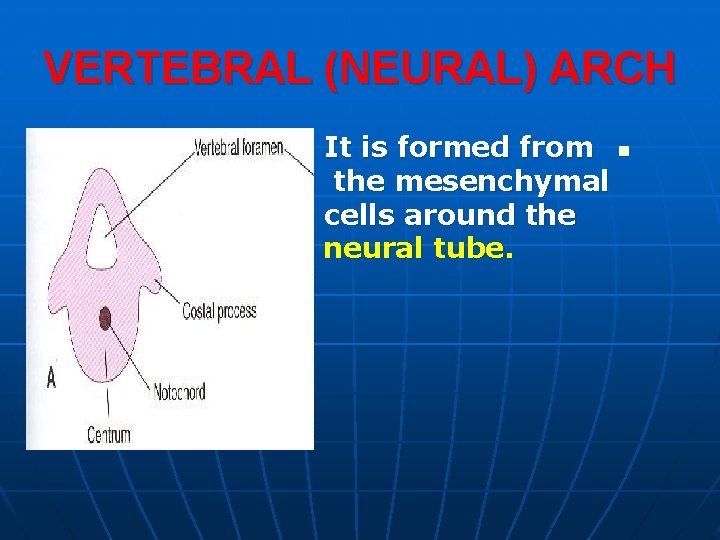
VERTEBRAL (NEURAL) ARCH It is formed from n the mesenchymal cells around the neural tube.
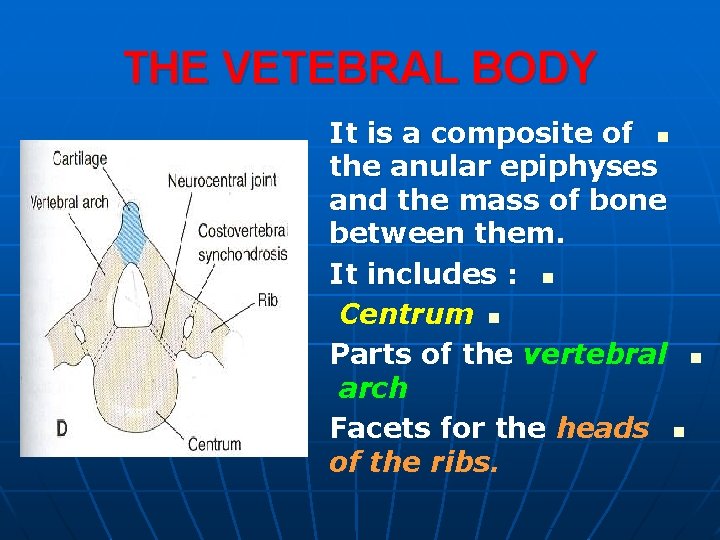
THE VETEBRAL BODY It is a composite of n the anular epiphyses and the mass of bone between them. It includes : n Centrum n Parts of the vertebral n arch Facets for the heads n of the ribs.
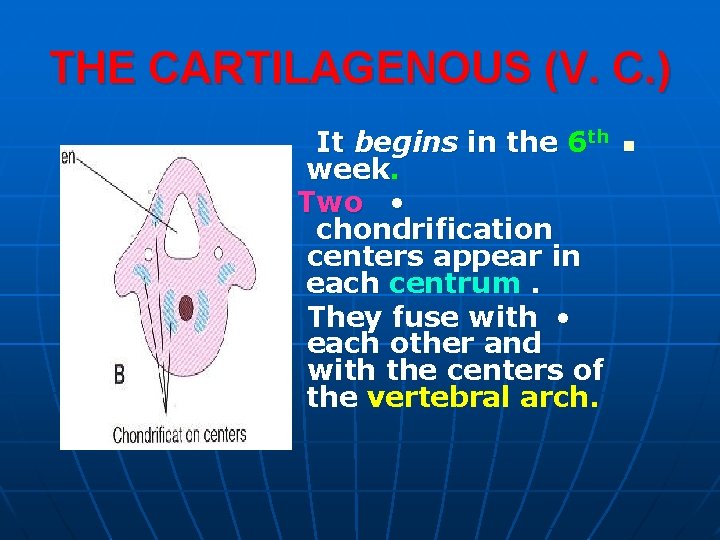
THE CARTILAGENOUS (V. C. ) It begins in the 6 th week. Two • chondrification centers appear in each centrum. They fuse with • each other and with the centers of the vertebral arch. n
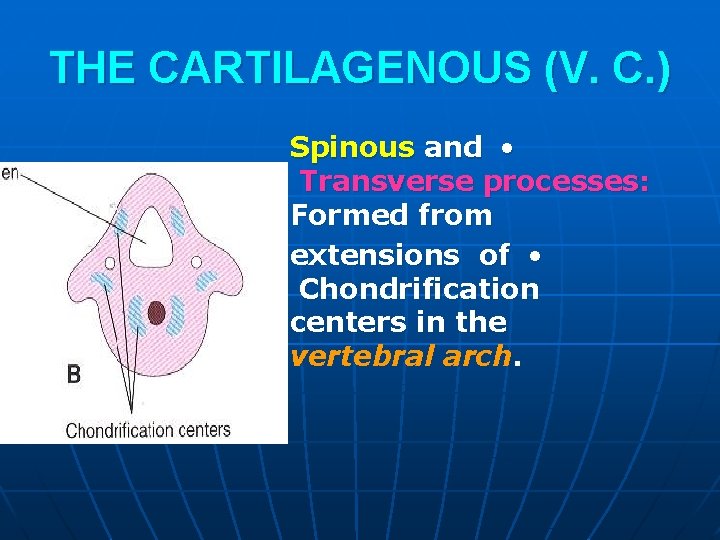
THE CARTILAGENOUS (V. C. ) Spinous and • Transverse processes: Formed from extensions of • Chondrification centers in the vertebral arch.
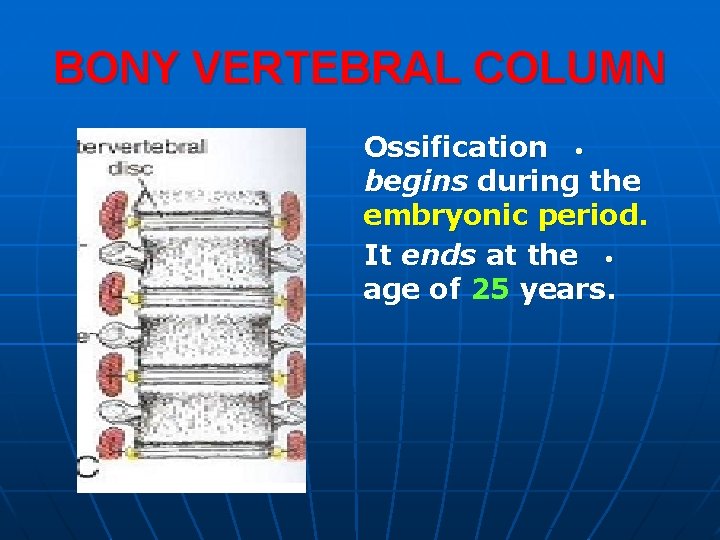
BONY VERTEBRAL COLUMN Ossification • begins during the embryonic period. It ends at the • age of 25 years.
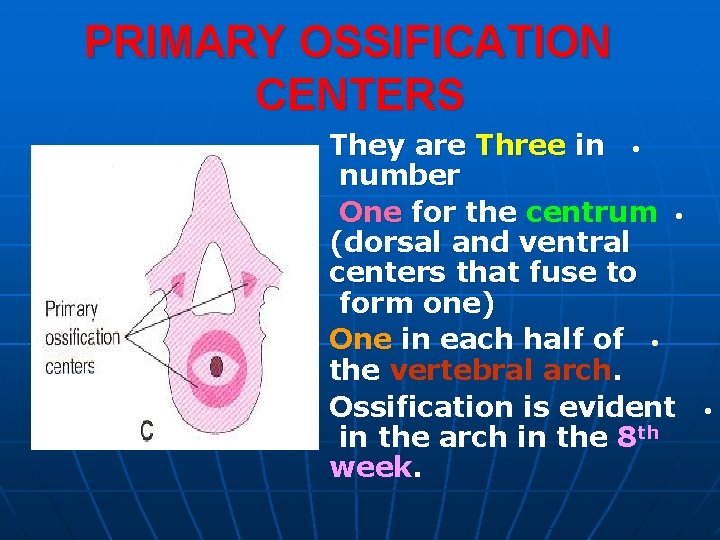
PRIMARY OSSIFICATION CENTERS They are Three in • number One for the centrum • (dorsal and ventral centers that fuse to form one) One in each half of • the vertebral arch. Ossification is evident in the arch in the 8 th week. •
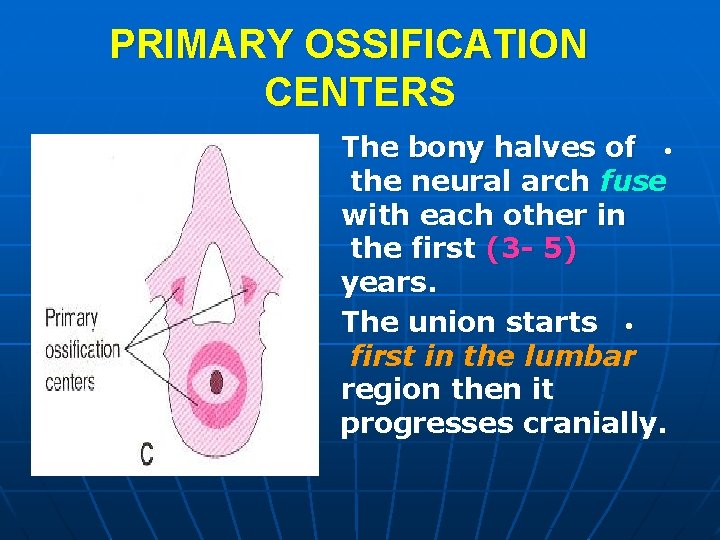
PRIMARY OSSIFICATION CENTERS The bony halves of • the neural arch fuse with each other in the first (3 - 5) years. The union starts • first in the lumbar region then it progresses cranially.
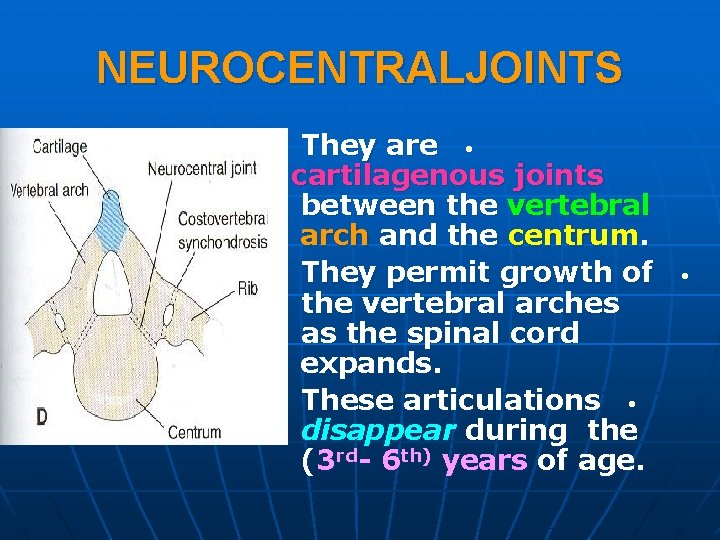
NEUROCENTRALJOINTS They are • cartilagenous joints between the vertebral arch and the centrum. They permit growth of the vertebral arches as the spinal cord expands. These articulations • disappear during the (3 rd- 6 th) years of age. •
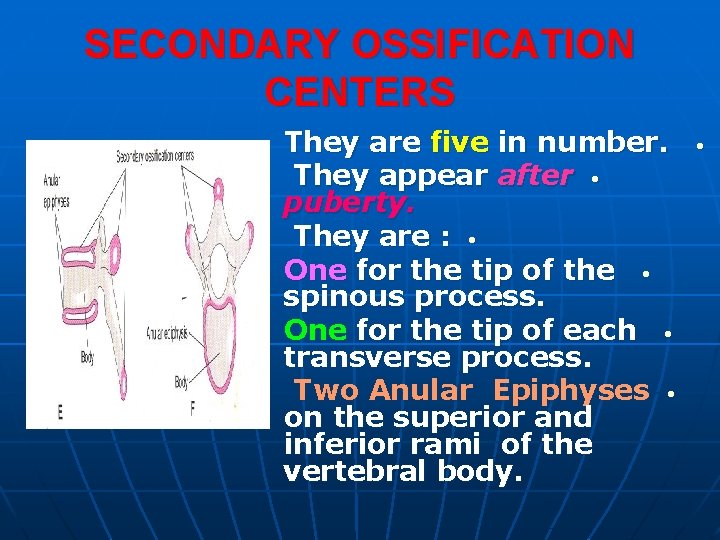
SECONDARY OSSIFICATION CENTERS They are five in number. They appear after • puberty. They are : • One for the tip of the • spinous process. One for the tip of each • transverse process. Two Anular Epiphyses • on the superior and inferior rami of the vertebral body. •
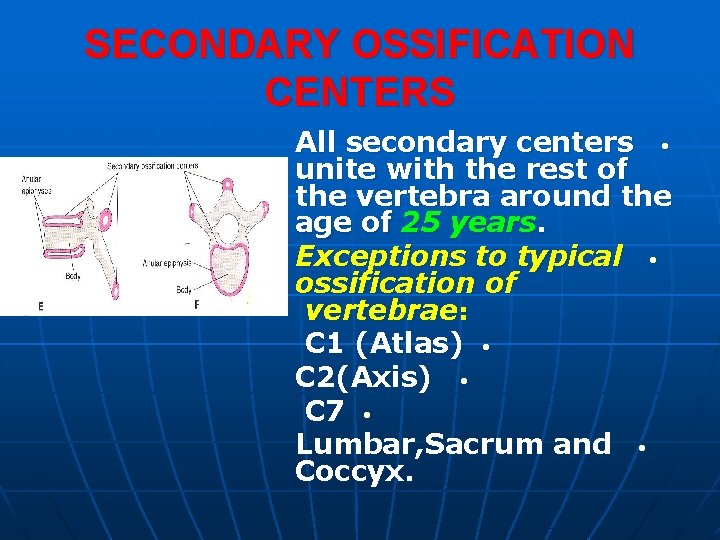
SECONDARY OSSIFICATION CENTERS All secondary centers • unite with the rest of the vertebra around the age of 25 years. Exceptions to typical • ossification of vertebrae: C 1 (Atlas) • C 2(Axis) • C 7 • Lumbar, Sacrum and • Coccyx.
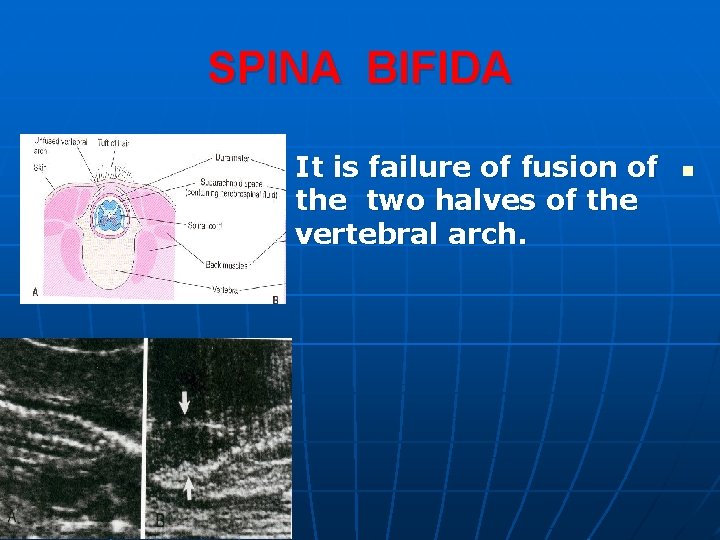
SPINA BIFIDA It is failure of fusion of the two halves of the vertebral arch. n
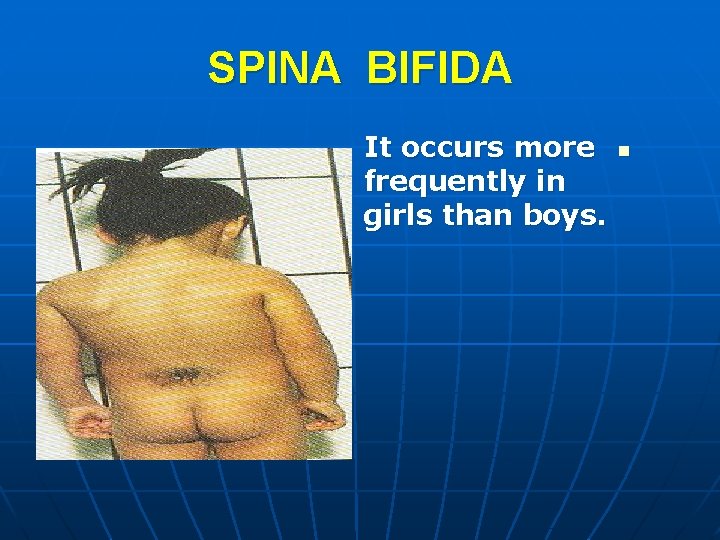
SPINA BIFIDA It occurs more frequently in girls than boys. n
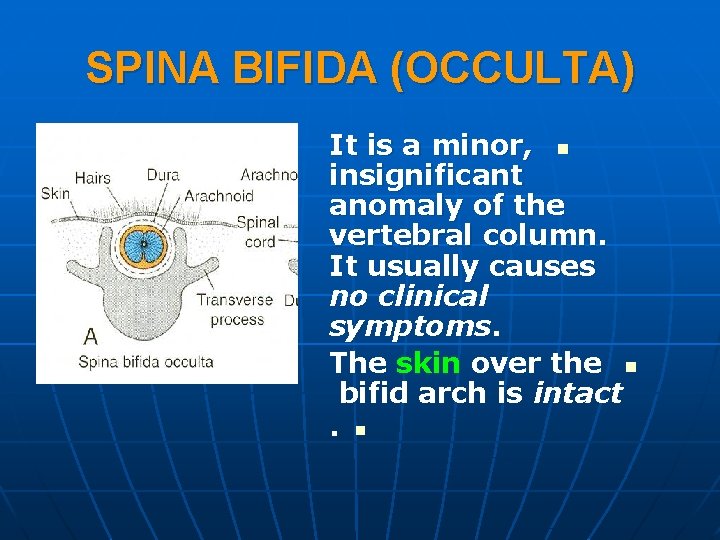
SPINA BIFIDA (OCCULTA) It is a minor, n insignificant anomaly of the vertebral column. It usually causes no clinical symptoms. The skin over the n bifid arch is intact. n
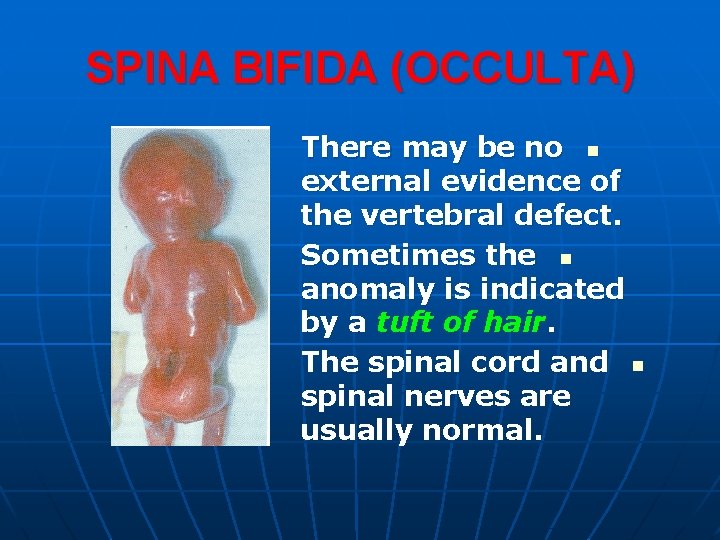
SPINA BIFIDA (OCCULTA) There may be no n external evidence of the vertebral defect. Sometimes the n anomaly is indicated by a tuft of hair. The spinal cord and n spinal nerves are usually normal.
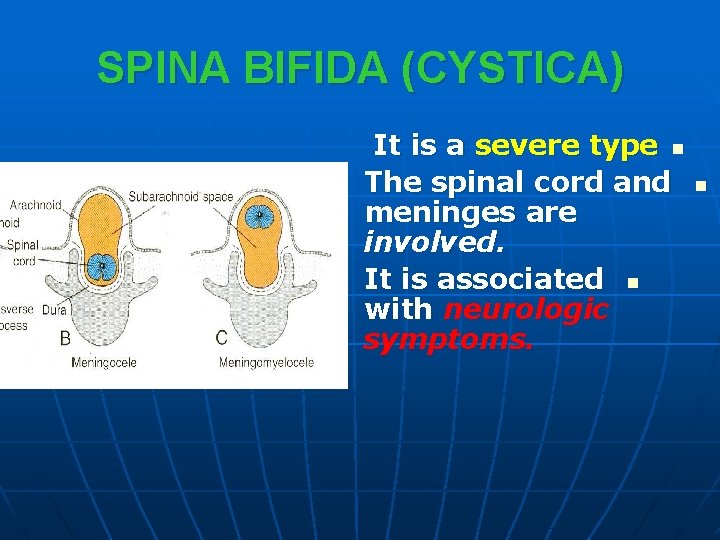
SPINA BIFIDA (CYSTICA) It is a severe type n The spinal cord and meninges are involved. It is associated n with neurologic symptoms. n
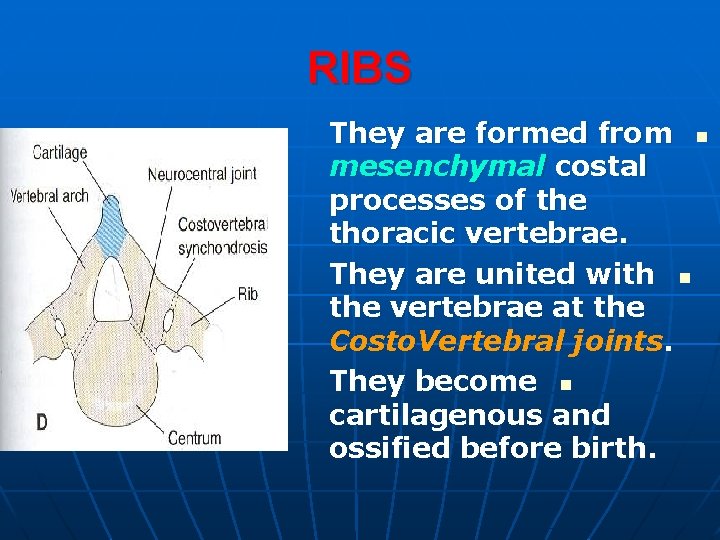
RIBS They are formed from n mesenchymal costal processes of the thoracic vertebrae. They are united with n the vertebrae at the Costo. Vertebral joints. They become n cartilagenous and ossified before birth.
- Slides: 29