
Awareness of Cultural Issues While Advising Presented by
Awareness of Cultural Issues While Advising Presented by: Sheema K. Majiduddin, Ed. M. Counseling and Career Services Edison Hall 100
History n n Founded in 1966 by NJ Dept of High Ed From the beginning to the mid-late 70 s -95% of the student body were primarily… q n White The rest of the student population 5 -10% of the student body was… q 90 African American Approx

A Changing Nation
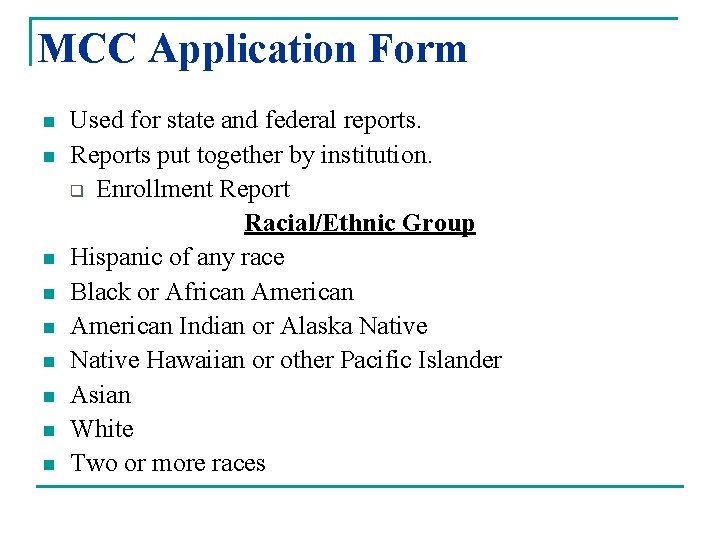
MCC Application Form n n n n n Used for state and federal reports. Reports put together by institution. q Enrollment Report Racial/Ethnic Group Hispanic of any race Black or African American Indian or Alaska Native Hawaiian or other Pacific Islander Asian White Two or more races
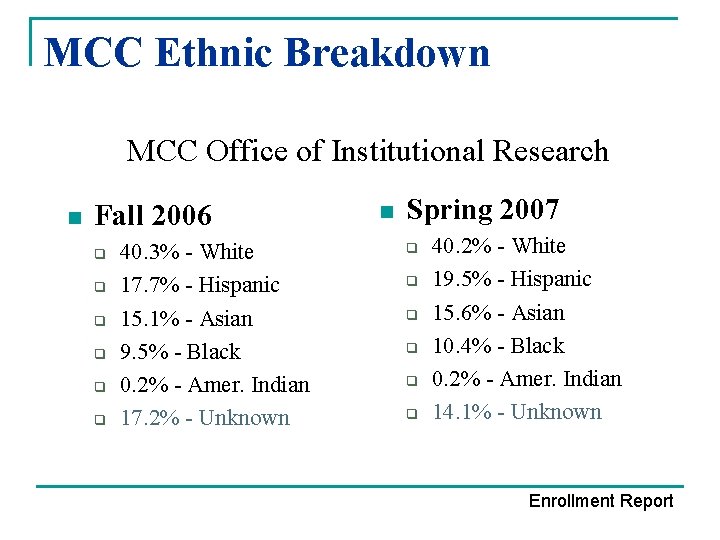
MCC Ethnic Breakdown MCC Office of Institutional Research n Fall 2006 q q q 40. 3% - White 17. 7% - Hispanic 15. 1% - Asian 9. 5% - Black 0. 2% - Amer. Indian 17. 2% - Unknown n Spring 2007 q q q 40. 2% - White 19. 5% - Hispanic 15. 6% - Asian 10. 4% - Black 0. 2% - Amer. Indian 14. 1% - Unknown Enrollment Report
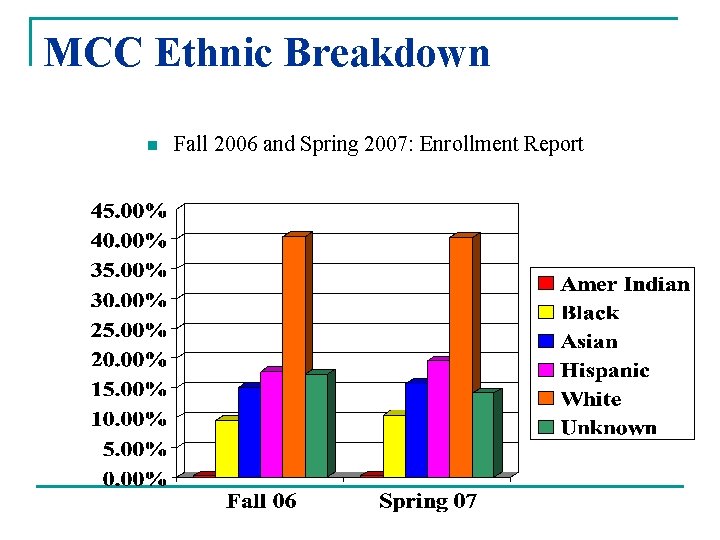
MCC Ethnic Breakdown n Fall 2006 and Spring 2007: Enrollment Report
Ethnic Beings n How students identify themselves n The role it has on advising Blaine Harding, Colorado State University
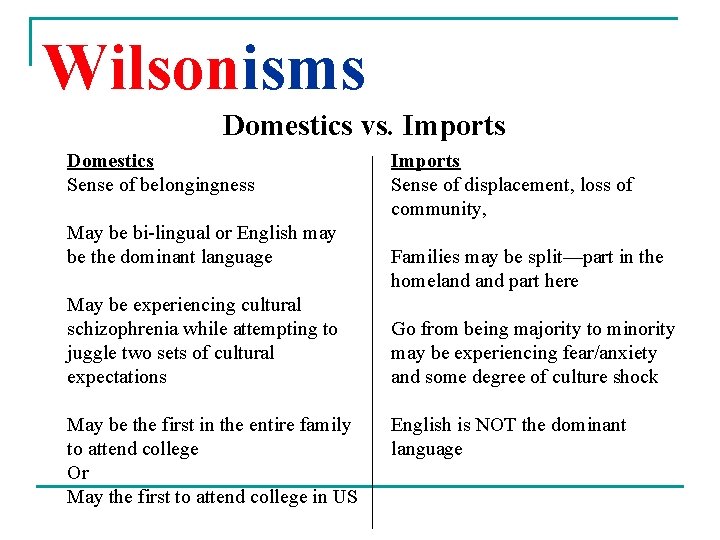
Wilsonisms Domestics vs. Imports Domestics Sense of belongingness May be bi-lingual or English may be the dominant language May be experiencing cultural schizophrenia while attempting to juggle two sets of cultural expectations May be the first in the entire family to attend college Or May the first to attend college in US Imports Sense of displacement, loss of community, Families may be split—part in the homeland part here Go from being majority to minority may be experiencing fear/anxiety and some degree of culture shock English is NOT the dominant language
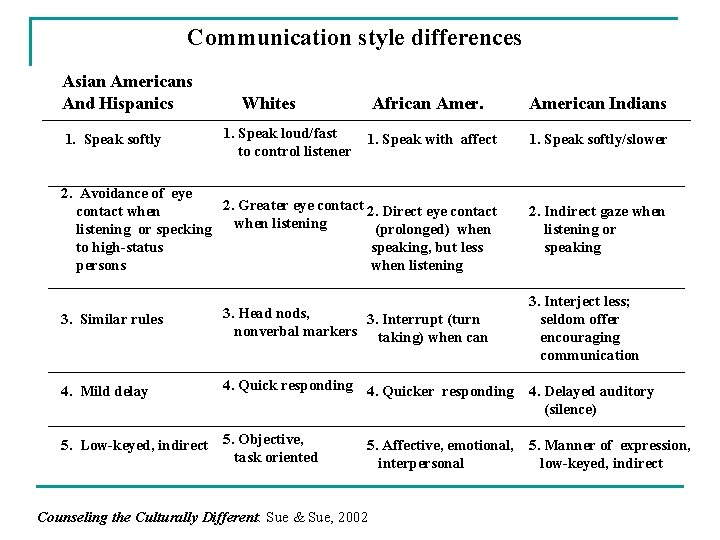
Communication style differences Asian Americans And Hispanics African American Indians 1. Speak with affect 1. Speak softly/slower 2. Avoidance of eye 2. Greater eye contact 2. Direct eye contact when listening or specking (prolonged) when to high-status speaking, but less persons when listening 2. Indirect gaze when listening or speaking 1. Speak softly Whites 1. Speak loud/fast to control listener 3. Interject less; seldom offer encouraging communication 3. Similar rules 3. Head nods, 3. Interrupt (turn nonverbal markers taking) when can 4. Mild delay 4. Quick responding 4. Quicker responding 4. Delayed auditory (silence) 5. Low-keyed, indirect 5. Objective, task oriented 5. Manner of expression, low-keyed, indirect 5. Affective, emotional, interpersonal Counseling the Culturally Different: Sue & Sue, 2002

Communication Styles of Cultural Groups Category 1: High Context Cultures (i. e. , Latinos, Native Americans & African Americans) Category 2: Low Context Cultures (most White European American groups) Strong cohesive group identity Weaker group identity Strong human collective support network More individualistic approach Individuals gain identity through group association Gain identity based on individual efforts and accomplishments Closed society with clear distinctions between insiders and outsiders Open society with weaker distinctions between insiders and outsiders Behavior is regulated by rigid code Greater personal freedom Tendency to be bureaucratic More individual choice Rosado, Luis A. (2005) Cross-cultural Communications: A Latino Perspective. AE-Extra. January. Available online. [URL: <http: //asstudents. unco. edu/students/AE-Extra/2005/1/Art-1. html>. Created: 8 December 2004. Updated: 28 January 2005. Accessed: 9 July 2007. ]
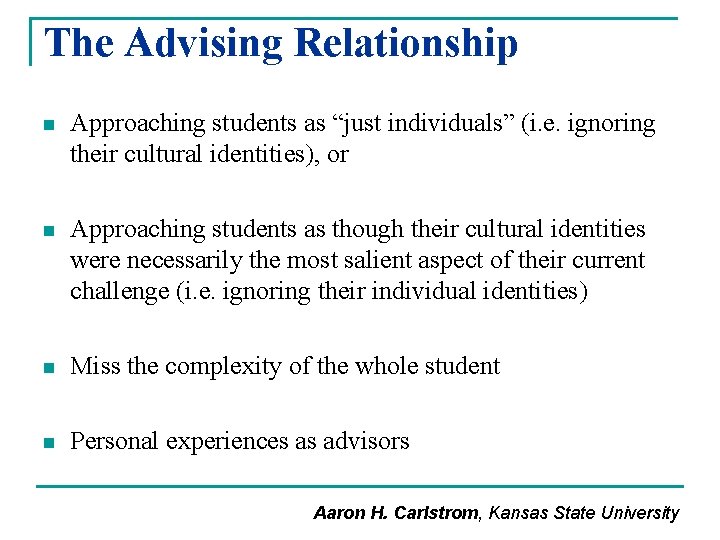
The Advising Relationship n Approaching students as “just individuals” (i. e. ignoring their cultural identities), or n Approaching students as though their cultural identities were necessarily the most salient aspect of their current challenge (i. e. ignoring their individual identities) n Miss the complexity of the whole student n Personal experiences as advisors Aaron H. Carlstrom, Kansas State University
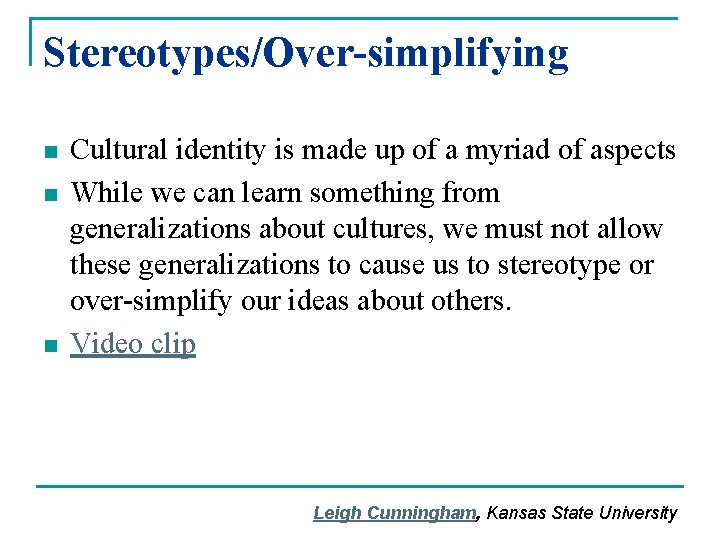
Stereotypes/Over-simplifying n n n Cultural identity is made up of a myriad of aspects While we can learn something from generalizations about cultures, we must not allow these generalizations to cause us to stereotype or over-simplify our ideas about others. Video clip Leigh Cunningham, Kansas State University
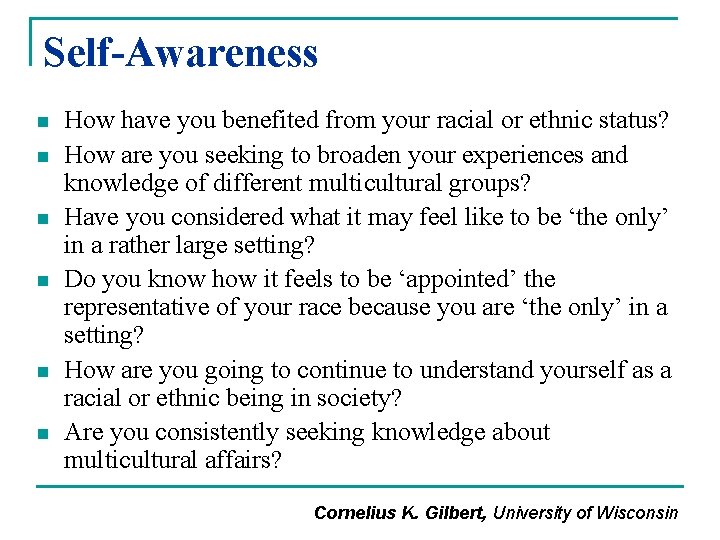
Self-Awareness n n n How have you benefited from your racial or ethnic status? How are you seeking to broaden your experiences and knowledge of different multicultural groups? Have you considered what it may feel like to be ‘the only’ in a rather large setting? Do you know how it feels to be ‘appointed’ the representative of your race because you are ‘the only’ in a setting? How are you going to continue to understand yourself as a racial or ethnic being in society? Are you consistently seeking knowledge about multicultural affairs? Cornelius K. Gilbert, University of Wisconsin
Listening Empathically n Assuming differences allows us to hear from the other’s point of view Aaron H. Carlstrom, Kansas State University
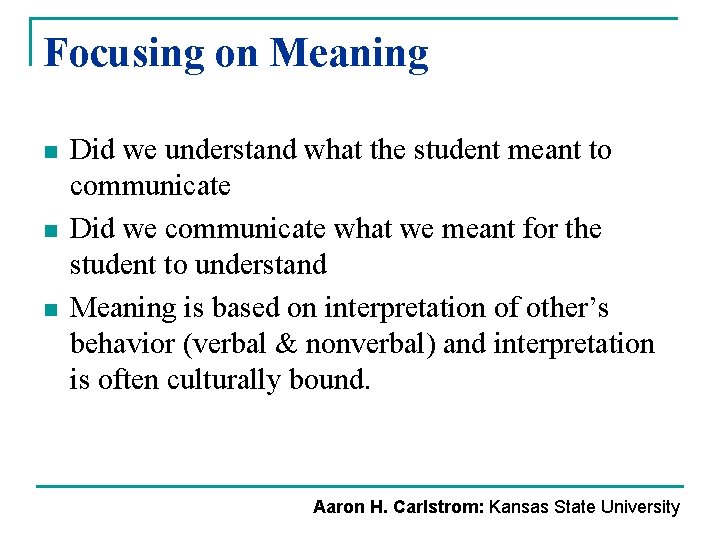
Focusing on Meaning n n n Did we understand what the student meant to communicate Did we communicate what we meant for the student to understand Meaning is based on interpretation of other’s behavior (verbal & nonverbal) and interpretation is often culturally bound. Aaron H. Carlstrom: Kansas State University
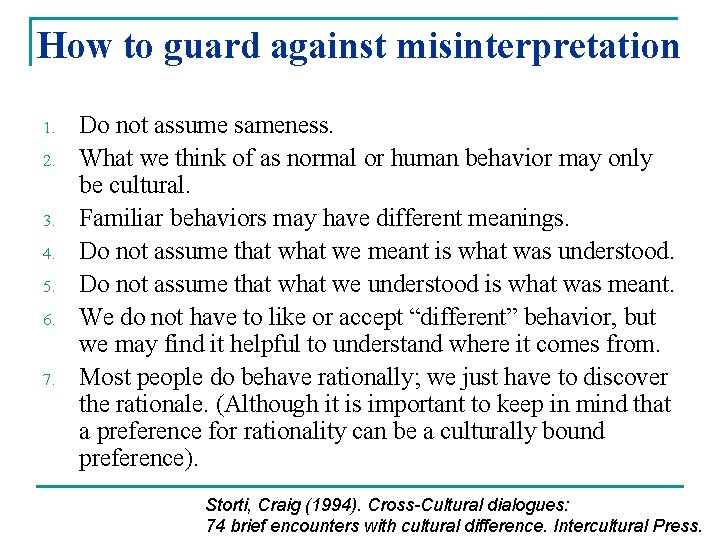
How to guard against misinterpretation 1. 2. 3. 4. 5. 6. 7. Do not assume sameness. What we think of as normal or human behavior may only be cultural. Familiar behaviors may have different meanings. Do not assume that we meant is what was understood. Do not assume that we understood is what was meant. We do not have to like or accept “different” behavior, but we may find it helpful to understand where it comes from. Most people do behave rationally; we just have to discover the rationale. (Although it is important to keep in mind that a preference for rationality can be a culturally bound preference). Storti, Craig (1994). Cross-Cultural dialogues: 74 brief encounters with cultural difference. Intercultural Press.
Exploring Competence n Exploring one’s own competence is an ongoing process n Questions to ask yourself Aaron H. Carlstrom: Kansas State University
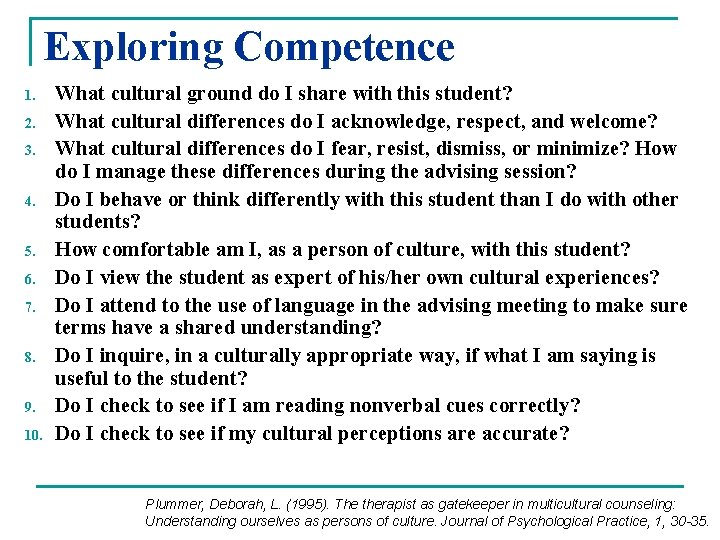
Exploring Competence 1. 2. 3. 4. 5. 6. 7. 8. 9. 10. What cultural ground do I share with this student? What cultural differences do I acknowledge, respect, and welcome? What cultural differences do I fear, resist, dismiss, or minimize? How do I manage these differences during the advising session? Do I behave or think differently with this student than I do with other students? How comfortable am I, as a person of culture, with this student? Do I view the student as expert of his/her own cultural experiences? Do I attend to the use of language in the advising meeting to make sure terms have a shared understanding? Do I inquire, in a culturally appropriate way, if what I am saying is useful to the student? Do I check to see if I am reading nonverbal cues correctly? Do I check to see if my cultural perceptions are accurate? Plummer, Deborah, L. (1995). The therapist as gatekeeper in multicultural counseling: Understanding ourselves as persons of culture. Journal of Psychological Practice, 1, 30 -35.
- Slides: 18