
Award Fee Evaluation Update to Guidance Best Practices
Award Fee Evaluation Update to Guidance & Best Practices Industry Briefing October 26, 2011 1
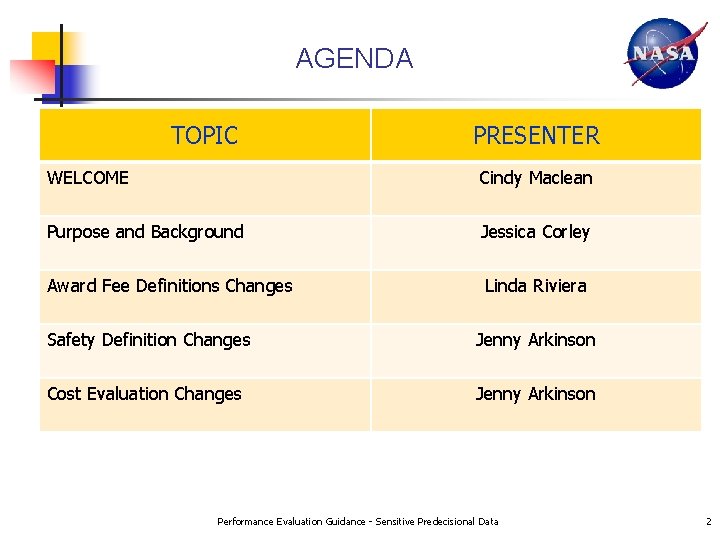
AGENDA TOPIC PRESENTER WELCOME Cindy Maclean Purpose and Background Jessica Corley Award Fee Definitions Changes Linda Riviera Safety Definition Changes Jenny Arkinson Cost Evaluation Changes Jenny Arkinson Performance Evaluation Guidance - Sensitive Predecisional Data 2
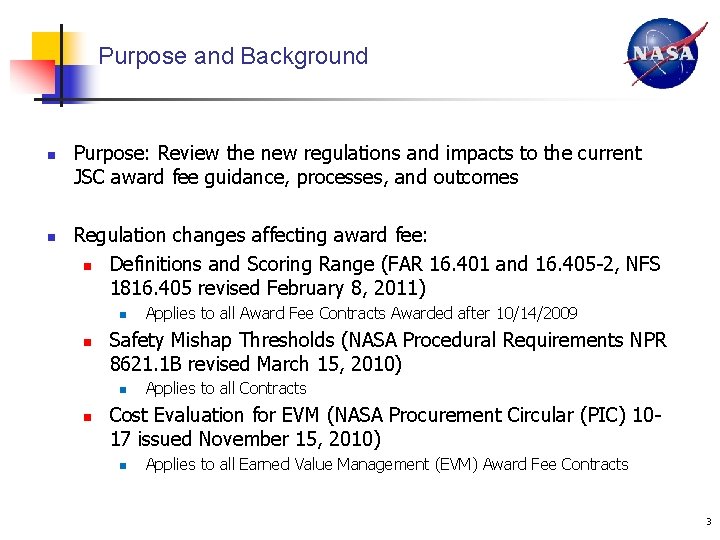
Purpose and Background n n Purpose: Review the new regulations and impacts to the current JSC award fee guidance, processes, and outcomes Regulation changes affecting award fee: n Definitions and Scoring Range (FAR 16. 401 and 16. 405 -2, NFS 1816. 405 revised February 8, 2011) n n Safety Mishap Thresholds (NASA Procedural Requirements NPR 8621. 1 B revised March 15, 2010) n n Applies to all Award Fee Contracts Awarded after 10/14/2009 Applies to all Contracts Cost Evaluation for EVM (NASA Procurement Circular (PIC) 1017 issued November 15, 2010) n Applies to all Earned Value Management (EVM) Award Fee Contracts 3
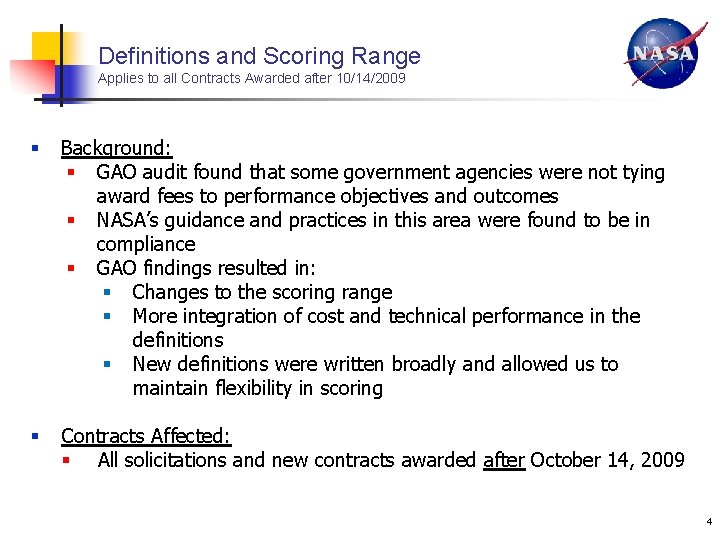
Definitions and Scoring Range Applies to all Contracts Awarded after 10/14/2009 § Background: § GAO audit found that some government agencies were not tying award fees to performance objectives and outcomes § NASA’s guidance and practices in this area were found to be in compliance § GAO findings resulted in: § Changes to the scoring range § More integration of cost and technical performance in the definitions § New definitions were written broadly and allowed us to maintain flexibility in scoring § Contracts Affected: § All solicitations and new contracts awarded after October 14, 2009 4

Evaluation Definitions Applies to all new Award Fee Contracts Awarded after 10/14/2009 Adjective Grade Range Definition Excellent 91 - 100 Contractor has exceeded almost all of the significant award-fee criteria and has met overall cost, schedule and technical performance requirements of the contract in the aggregate as defined and measured against the criteria in the award-fee plan for the award-fee evaluation period. Very Good 76 - 90 Contractor has exceeded many of the significant award-fee criteria and has met overall cost, schedule, and technical performance requirements of the contract in the aggregate as defined and measured against the criteria in the award-fee plan for the award-fee evaluation period. Good Satisfactory Unsatisfactory 51 -75 50 Below 50 Contractor has exceeded some of the significant award-fee and has met overall cost, schedule, and technical performance requirements of the contract in the aggregate as defined and measured against the criteria in the award-fee plan for the award-fee evaluation period. Contractor has failed to meet overall cost, schedule, and technical performance requirements of the contract in the aggregate as defined and measured against the criteria in the award-fee plan for the award-fee evaluation period. 5
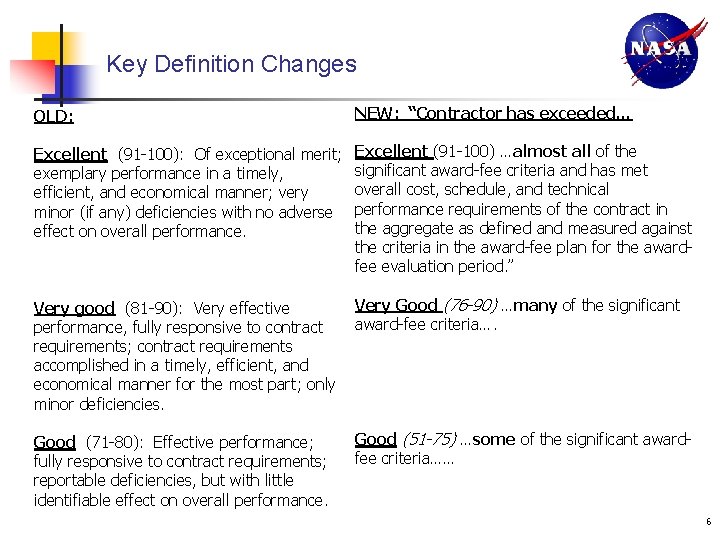
Key Definition Changes OLD: NEW: “Contractor has exceeded… Excellent (91 -100): Of exceptional merit; exemplary performance in a timely, efficient, and economical manner; very minor (if any) deficiencies with no adverse effect on overall performance. Excellent (91 -100) …almost all of the significant award-fee criteria and has met overall cost, schedule, and technical performance requirements of the contract in the aggregate as defined and measured against the criteria in the award-fee plan for the awardfee evaluation period. ” Very good (81 -90): Very effective performance, fully responsive to contract requirements; contract requirements accomplished in a timely, efficient, and economical manner for the most part; only minor deficiencies. Very Good (76 -90) …many of the significant award-fee criteria…. Good (71 -80): Effective performance; fully responsive to contract requirements; reportable deficiencies, but with little identifiable effect on overall performance. Good (51 -75) …some of the significant awardfee criteria…… 6
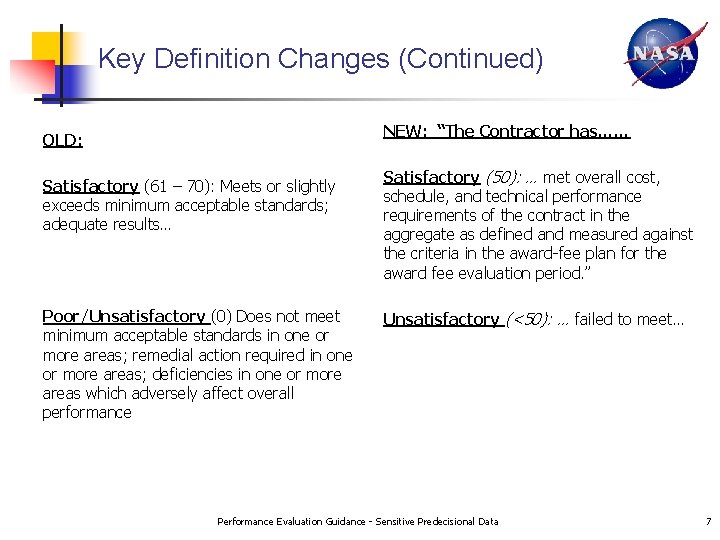
Key Definition Changes (Continued) NEW: “The Contractor has…… OLD: Satisfactory (61 – 70): Meets or slightly exceeds minimum acceptable standards; adequate results… Poor/Unsatisfactory (0) Does not meet minimum acceptable standards in one or more areas; remedial action required in one or more areas; deficiencies in one or more areas which adversely affect overall performance Satisfactory (50): … met overall cost, schedule, and technical performance requirements of the contract in the aggregate as defined and measured against the criteria in the award-fee plan for the award fee evaluation period. ” Unsatisfactory (<50): … failed to meet… Performance Evaluation Guidance - Sensitive Predecisional Data 7

Safety Mishap Definition Changes Applies to all Contracts n This update is a result of a revision to NPR 8621. 1 B effective April 1, 2010 n Increase in Property Damage Thresholds for Mishaps n Mishap Definitions n Type A: Fatality or permanent total disability or hospitalization of 3 or more employees and property damage >$2 M Type B: Permanent partial disability or hospitalization of 2 or less employees and n Type C: Days Away Cases, Restricted Duty Case and property damage of <$500 K n Incident: Medical treatments and property damage of <$50 K but >$1 K n property damage <$2 M but >$500 K but >$50 K 8
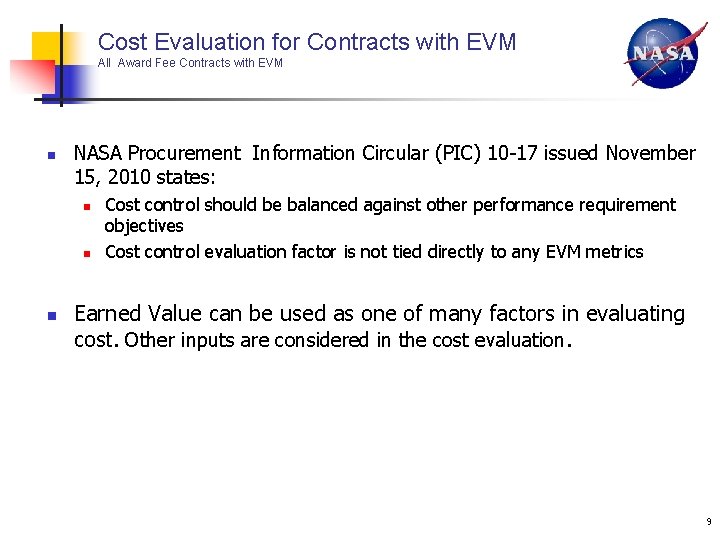
Cost Evaluation for Contracts with EVM All Award Fee Contracts with EVM n NASA Procurement Information Circular (PIC) 10 -17 issued November 15, 2010 states: n n n Cost control should be balanced against other performance requirement objectives Cost control evaluation factor is not tied directly to any EVM metrics Earned Value can be used as one of many factors in evaluating cost. Other inputs are considered in the cost evaluation. 9
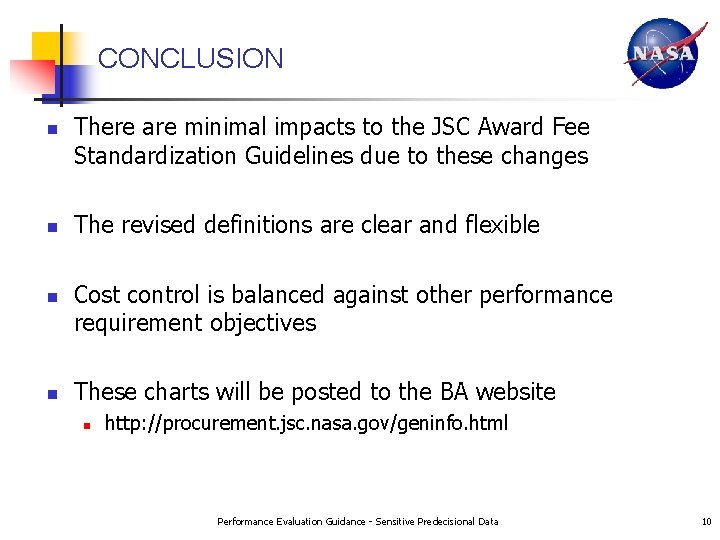
CONCLUSION n n There are minimal impacts to the JSC Award Fee Standardization Guidelines due to these changes The revised definitions are clear and flexible Cost control is balanced against other performance requirement objectives These charts will be posted to the BA website n http: //procurement. jsc. nasa. gov/geninfo. html Performance Evaluation Guidance - Sensitive Predecisional Data 10
- Slides: 10