
AWAKE Vacuum system Friederike Salveter Jan Hansen Frederic

- Slides: 22
AWAKE Vacuum system Friederike Salveter Jan Hansen, Frederic Daligault CERN (TE-VSC-DLM)
Outline • • Concept - What is AWAKE? Location AWAKE experimental area Shedule • • • The AWAKE vacuum system • • • To. Do Procurement Pressure simulation • • • Phase 1 Phase 2 Proton beam line – 1 Proton beam line – 2 Laser beam line Electron beam line Present status 10/7/2020 FS 2
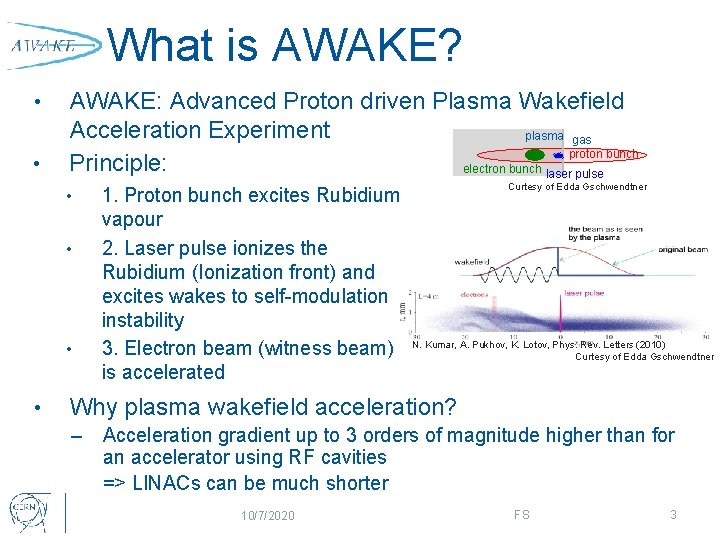
What is AWAKE? • • AWAKE: Advanced Proton driven Plasma Wakefield Acceleration Experiment plasma gas proton bunch Principle: electron bunch laser pulse • • 1. Proton bunch excites Rubidium vapour 2. Laser pulse ionizes the Rubidium (Ionization front) and excites wakes to self-modulation instability 3. Electron beam (witness beam) is accelerated Curtesy of Edda Gschwendtner N. Kumar, A. Pukhov, K. Lotov, Phys. Rev. Letters (2010) Curtesy of Edda Gschwendtner Why plasma wakefield acceleration? – Acceleration gradient up to 3 orders of magnitude higher than for an accelerator using RF cavities => LINACs can be much shorter 10/7/2020 FS 3
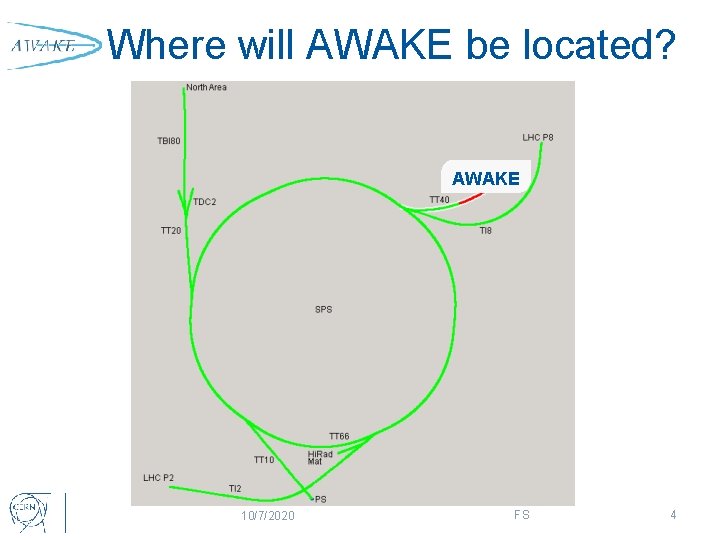
Where will AWAKE be located? AWAKE 10/7/2020 FS 4
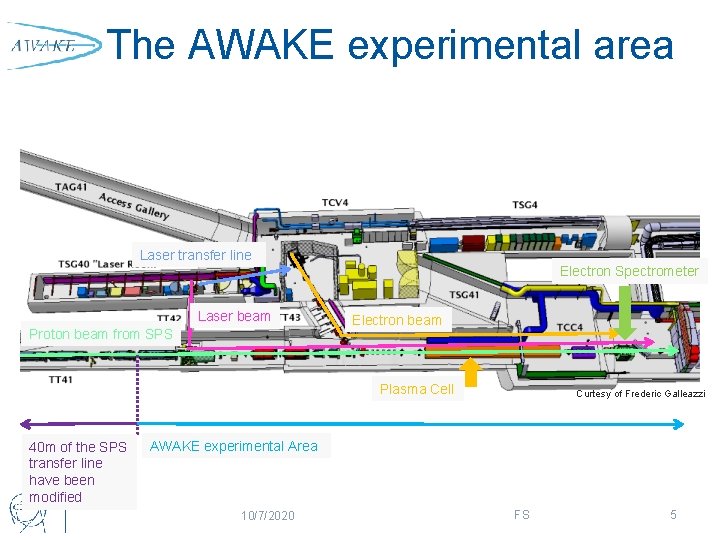
The AWAKE experimental area Laser transfer line Electron Spectrometer Laser beam Proton beam from SPS Electron beam Plasma Cell 40 m of the SPS transfer line have been modified Curtesy of Frederic Galleazzi AWAKE experimental Area 10/7/2020 FS 5
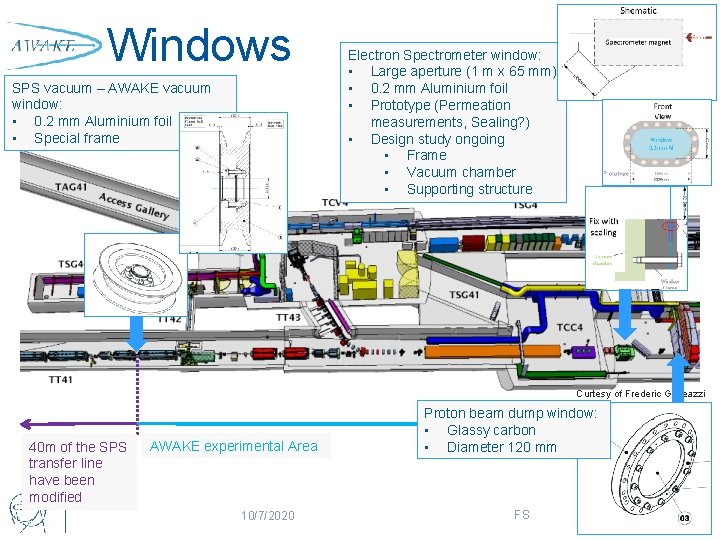
Windows SPS vacuum – AWAKE vacuum window: • 0. 2 mm Aluminium foil • Special frame Electron Spectrometer window: • Large aperture (1 m x 65 mm) • 0. 2 mm Aluminium foil • Prototype (Permeation measurements, Sealing? ) • Design study ongoing • Frame • Vacuum chamber • Supporting structure Curtesy of Frederic Galleazzi 40 m of the SPS transfer line have been modified AWAKE experimental Area 10/7/2020 Proton beam dump window: • Glassy carbon • Diameter 120 mm FS 6
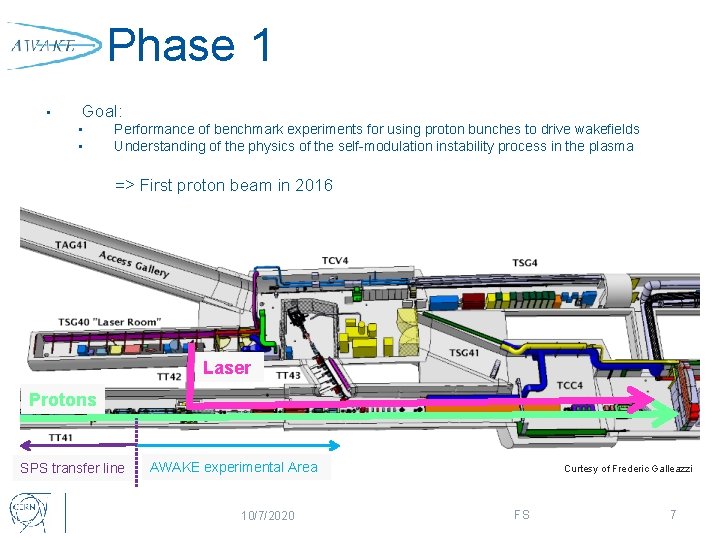
Phase 1 • Goal: • • Performance of benchmark experiments for using proton bunches to drive wakefields Understanding of the physics of the self-modulation instability process in the plasma => First proton beam in 2016 Laser Protons SPS transfer line AWAKE experimental Area 10/7/2020 Curtesy of Frederic Galleazzi FS 7
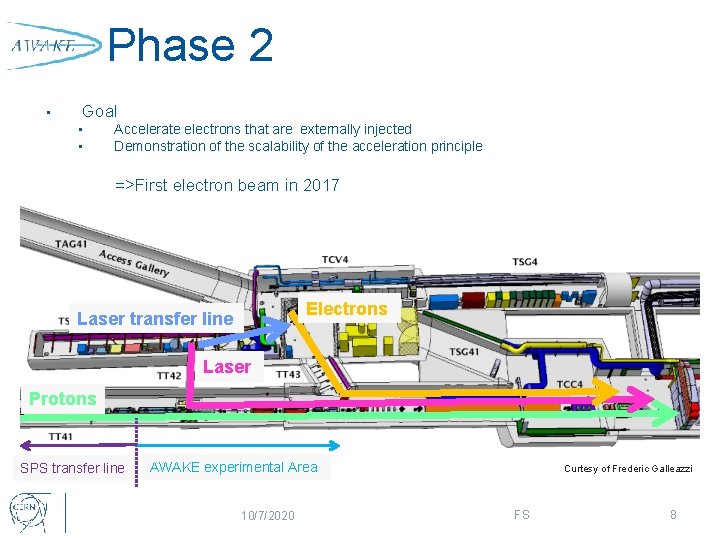
Phase 2 • Goal • • Accelerate electrons that are externally injected Demonstration of the scalability of the acceleration principle =>First electron beam in 2017 Electrons Laser transfer line Laser Protons SPS transfer line AWAKE experimental Area 10/7/2020 Curtesy of Frederic Galleazzi FS 8
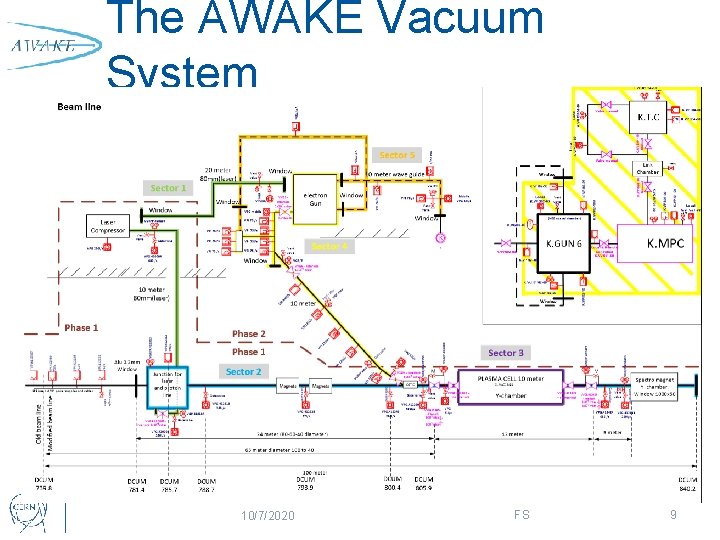
The AWAKE Vacuum System 10/7/2020 FS 9
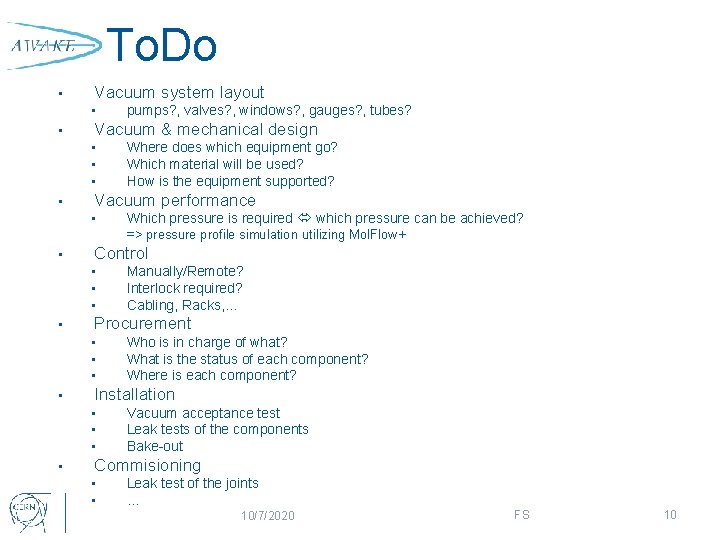
To. Do • Vacuum system layout • • Vacuum & mechanical design • • pumps? , valves? , windows? , gauges? , tubes? Where does which equipment go? Which material will be used? How is the equipment supported? Vacuum performance • Which pressure is required which pressure can be achieved? => pressure profile simulation utilizing Mol. Flow+ • Control • • Procurement • • Who is in charge of what? What is the status of each component? Where is each component? Installation • • Manually/Remote? Interlock required? Cabling, Racks, … Vacuum acceptance test Leak tests of the components Bake-out Commisioning • • Leak test of the joints … 10/7/2020 FS 10
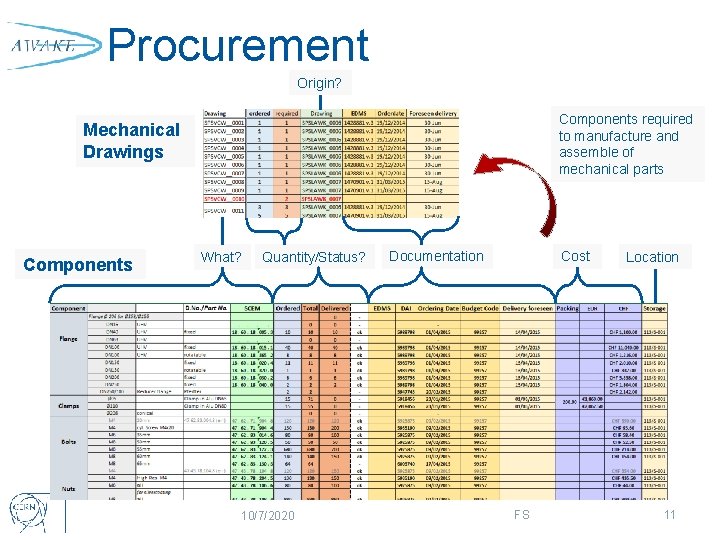
Procurement Origin? Components required to manufacture and assemble of mechanical parts Mechanical Drawings Components What? Quantity/Status? 10/7/2020 Cost Documentation FS Location 11
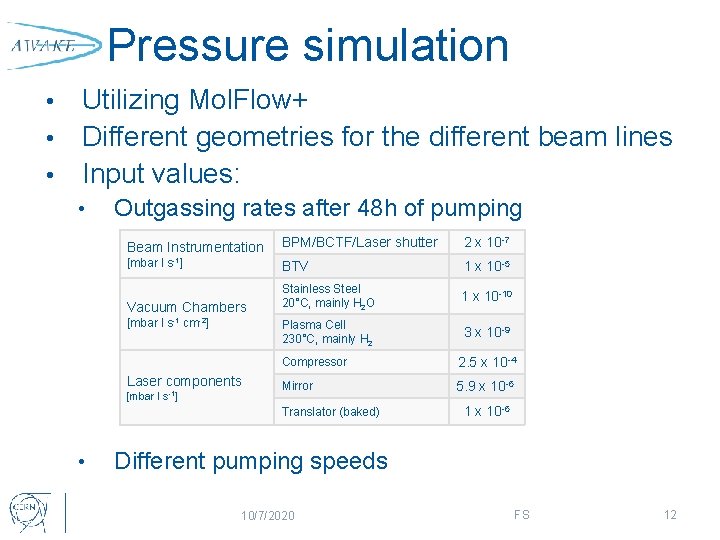
Pressure simulation Utilizing Mol. Flow+ • Different geometries for the different beam lines • Input values: • • Outgassing rates after 48 h of pumping Beam Instrumentation BPM/BCTF/Laser shutter 2 x 10 -7 [mbar l s-1] BTV 1 x 10 -5 Vacuum Chambers Stainless Steel 20°C, mainly H 2 O 1 x 10 -10 Plasma Cell 230°C, mainly H 2 3 x 10 -9 [mbar l s-1 cm-2] Laser components [mbar l s-1] Compressor 2. 5 x 10 -4 Mirror 5. 9 x 10 -6 Translator (baked) • 1 x 10 -6 Different pumping speeds 10/7/2020 FS 12
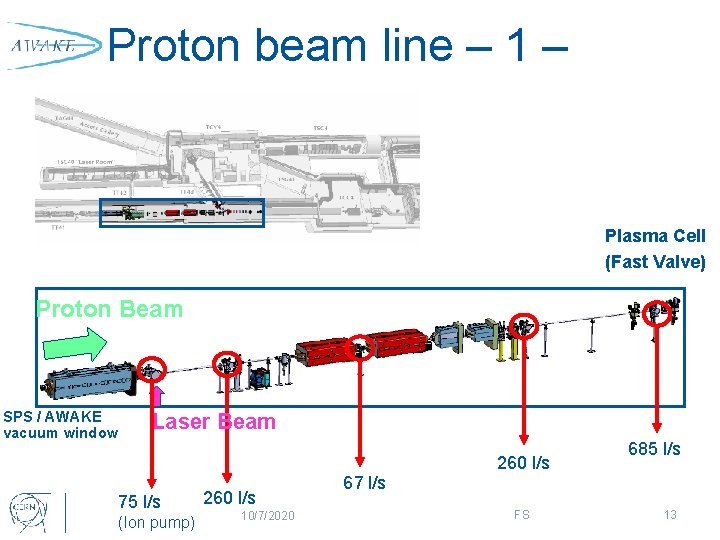
Proton beam line – 1 – Plasma Cell (Fast Valve) Proton Beam SPS / AWAKE vacuum window Laser Beam 75 l/s (Ion pump) 260 l/s 10/7/2020 67 l/s 260 l/s FS 685 l/s 13
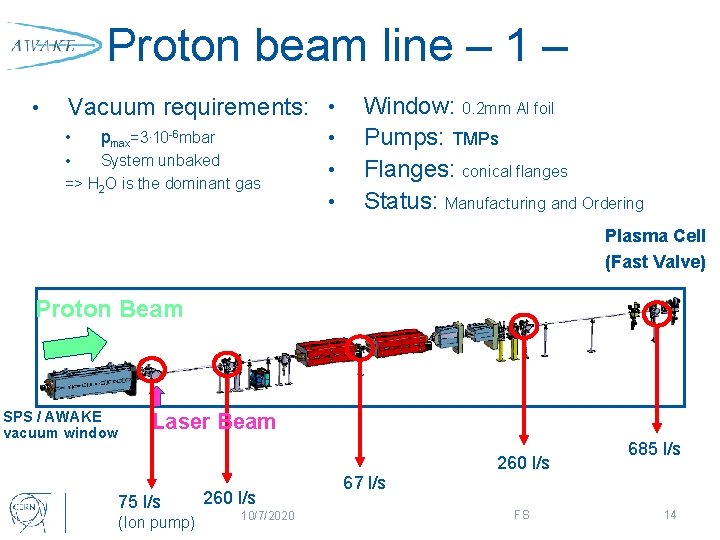
Proton beam line – 1 – • Vacuum requirements: • pmax=3. 10 -6 mbar • System unbaked => H 2 O is the dominant gas • • Window: 0. 2 mm Al foil Pumps: TMPs Flanges: conical flanges Status: Manufacturing and Ordering Plasma Cell (Fast Valve) Proton Beam SPS / AWAKE vacuum window Laser Beam 75 l/s (Ion pump) 260 l/s 10/7/2020 67 l/s 260 l/s FS 685 l/s 14
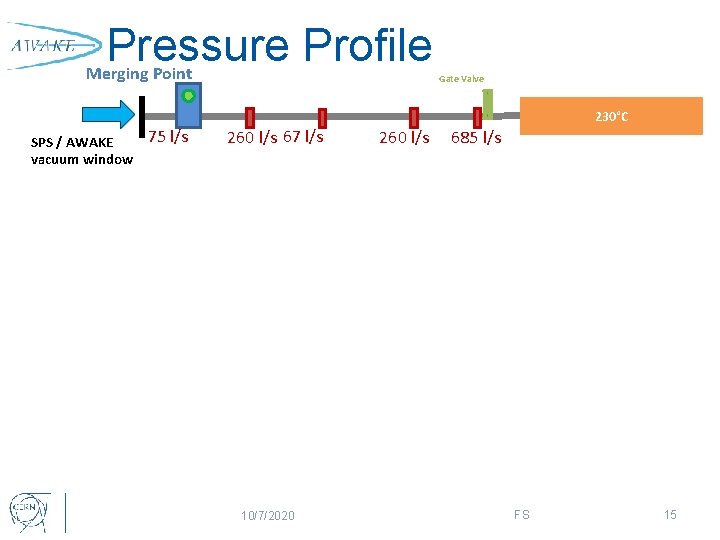
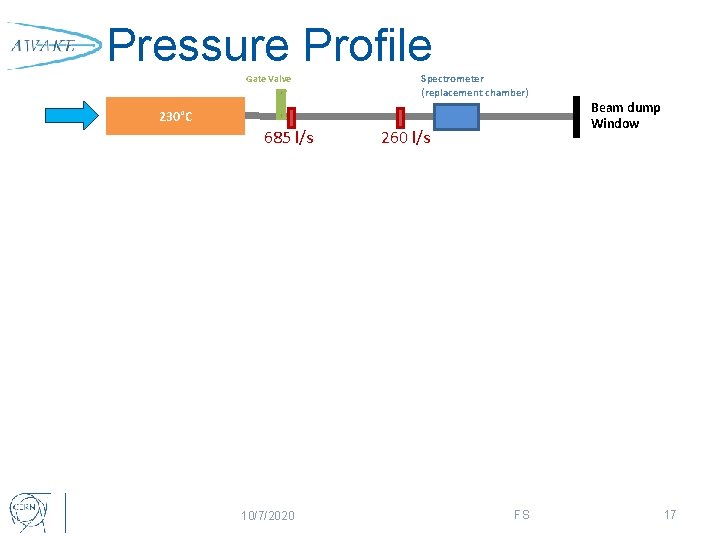
Pressure Profile Merging Point Gate Valve 230°C SPS / AWAKE vacuum window 75 l/s 260 l/s 67 l/s 10/7/2020 260 l/s 685 l/s FS 15
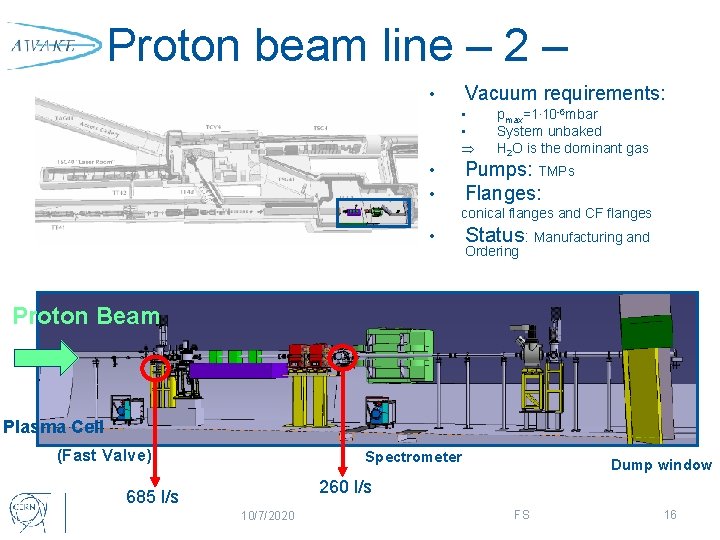
Proton beam line – 2 – Vacuum requirements: • • • Þ pmax=1. 10 -6 mbar System unbaked H 2 O is the dominant gas Pumps: TMPs Flanges: • • conical flanges and CF flanges • Status: Manufacturing and Ordering Proton Beam Plasma Cell (Fast Valve) Spectrometer Dump window 260 l/s 685 l/s 10/7/2020 FS 16
Pressure Profile Gate Valve Spectrometer (replacement chamber) 230°C 685 l/s 10/7/2020 260 l/s FS Beam dump Window 17
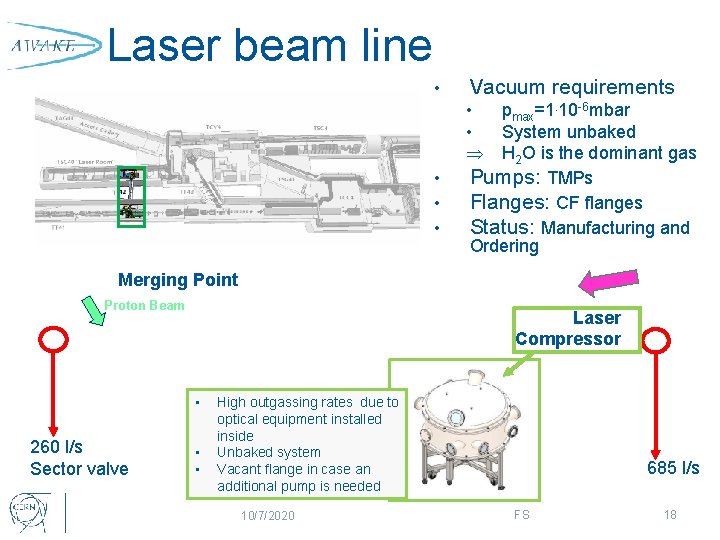
Laser beam line • Vacuum requirements pmax=1. 10 -6 mbar System unbaked H 2 O is the dominant gas Pumps: TMPs Flanges: CF flanges Status: Manufacturing and Ordering • • Þ • • • Merging Point Proton Beam Laser Compressor • 260 l/s Sector valve • • High outgassing rates due to optical equipment installed inside Unbaked system Vacant flange in case an additional pump is needed 10/7/2020 685 l/s FS 18
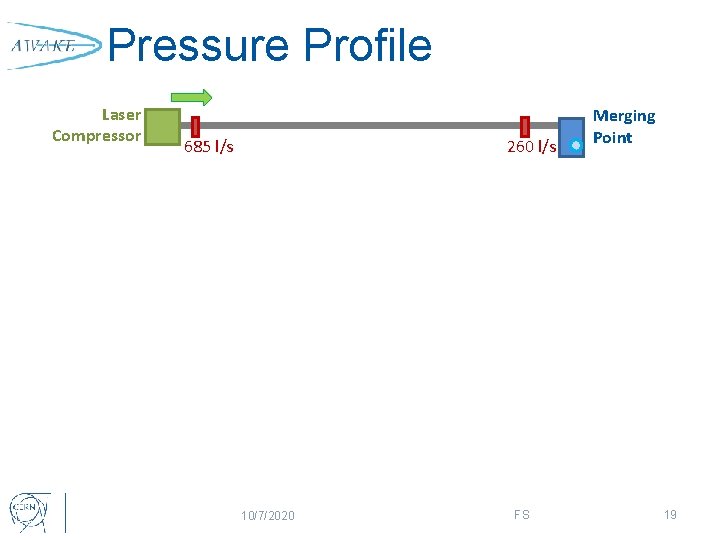
Pressure Profile Laser Compressor 260 l/s 685 l/s 10/7/2020 FS Merging Point 19
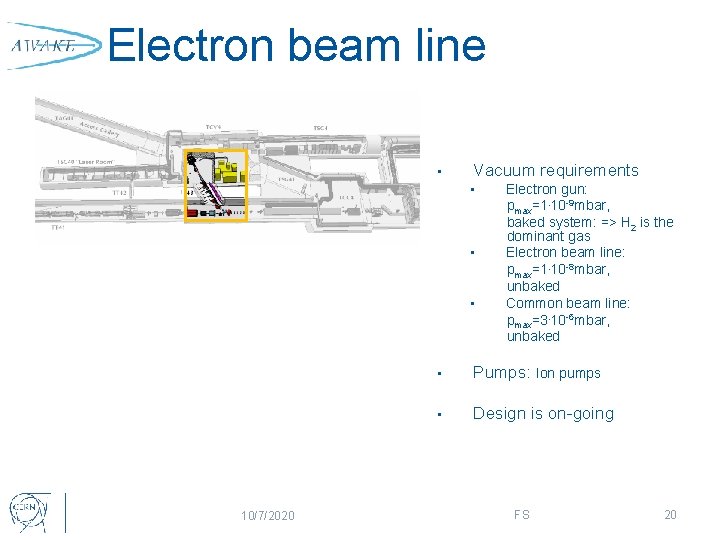
Electron beam line • Vacuum requirements • • • 10/7/2020 Electron gun: pmax=1. 10 -9 mbar, baked system: => H 2 is the dominant gas Electron beam line: pmax=1. 10 -8 mbar, unbaked Common beam line: pmax=3. 10 -6 mbar, unbaked • Pumps: Ion pumps • Design is on-going FS 20
Present status • Phase 1: • • Design of the Laser beam line and the Proton beam lines finished Procurement and Manufacturing of the components is in progress Installation in the tunnel starting in September 2015 Phase 2: • Design has started 10/7/2020 FS 21
Thank you! 10/7/2020 22