
AVRT ATRIAL VENTRICULAR REENTRANT TACHYCARDIA JAZMINE BOLOOR PATIENT
AVRT ATRIAL VENTRICULAR REENTRANT TACHYCARDIA JAZMINE BOLOOR

PATIENT IN AVRT: EKG • DELTA WAVE: • SA node triggers, sends signal to AV node and accessory pathway • AV node has a safeguard to slow the signal down so the ventricles can fill. Accessory pathway doesn’t have safeguard, meaning the signal can very quickly travel from the atria down, depolarizing the ventricles. This creates a slurred upstroke, as the P wave is closely coupled with the QRS. Once the signal gets through the AV node, it travels very quickly through the circuit of the heart and up the accessory pathway, creating a sharp downwards wave as the ventricles depolarize.

PATIENT IN AVRT: EKG (CONT) Circuit: • • Orthodromic: from atria, down AV node to ventricles, up accessory pathway • Antegrade • Manifest pathway or concealed pathway Antidromic: from atria, down accessory pathway to ventricles, up AV Node • Retrograde • Delta wave • Manifest pathway

PATIENT IN AVRT: EMG Usually induced by programmed stimulation Wenckebach, effective refractory periods If not already in tachycardia We would probably see that the AV node is decrementing; if not the signal is probably taking an accessory path Mapping: Pace the ventricles, map the atrium for earliest signal Manifest or concealed pathway Pace the atria, map the ventricles for earliest signal Manifest pathway - Antidromic

DIAGNOSING THE PATIENT Going through some scenarios: If there is a delta wave (pre – excitation) – probably antidromic AVRT, manifest pathway If no delta wave and patient is only going into tachycardia when pacing in the ventricles – probably orthodromic AVRT, concealed pathway If there is no delta wave and the patient is going into tachycardia both when pacing in the ventricles and when pacing in the atria – probably orthodromic AVRT, manifest pathway FINAL DIAGNOSIS FOR ABLATION: The patient goes into tachycardia when pacing both the atria and the ventricles; eccentric activation seen on the CS catheter. This patient is in orthodromic AVRT and has a manifest pathway on the left side of the heart near where CS 1, 2 are.
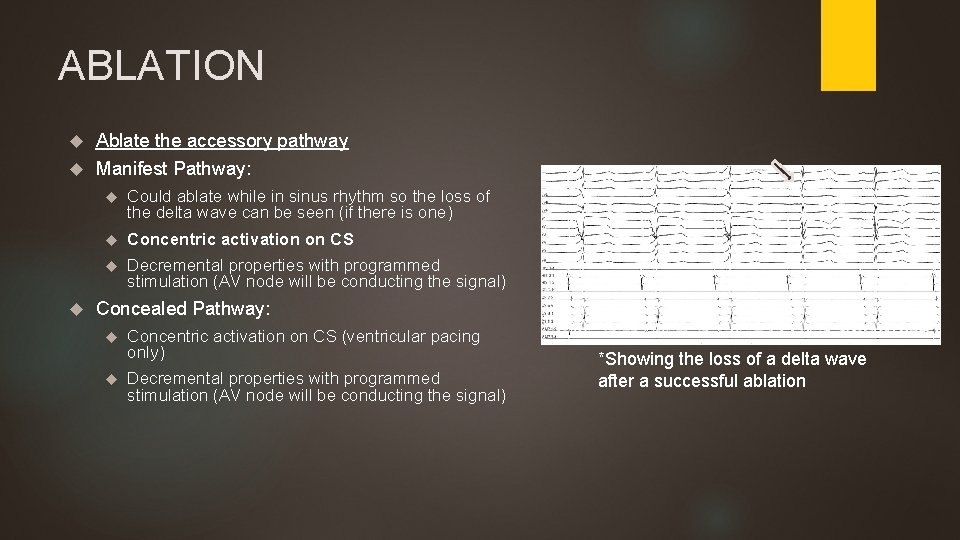
ABLATION Ablate the accessory pathway Manifest Pathway: Could ablate while in sinus rhythm so the loss of the delta wave can be seen (if there is one) Concentric activation on CS Decremental properties with programmed stimulation (AV node will be conducting the signal) Concealed Pathway: Concentric activation on CS (ventricular pacing only) Decremental properties with programmed stimulation (AV node will be conducting the signal) *Showing the loss of a delta wave after a successful ablation

Thank you!
- Slides: 7