
AVPF vs AVP RTCP Intevals AVP and AVPF

- Slides: 13
AVPF vs AVP RTCP Intevals
AVP and AVPF Interop • Whe AVP and AVPF is interoperating one must choose certain parameters correctly. • In trying to determine the most suitable based on the timing rules a AVPF timing issue was found that is problematic for interop. • Based on simulations of the algorithm – There might be bugs in the simulation
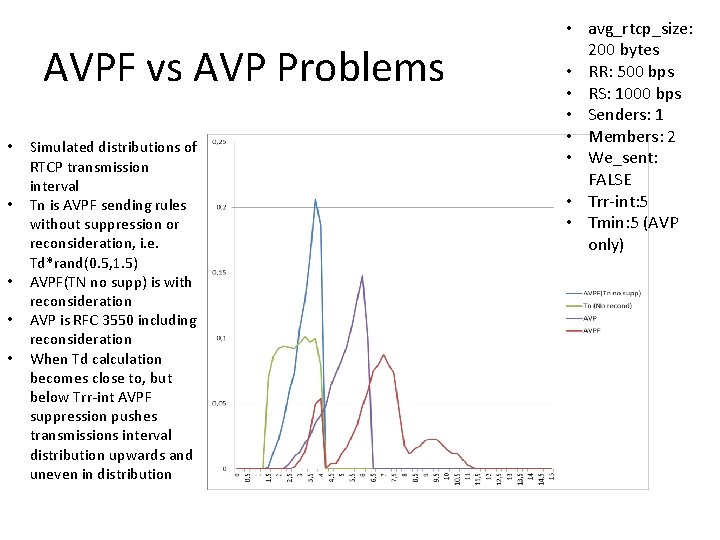
AVPF vs AVP Problems • • • Simulated distributions of RTCP transmission interval Tn is AVPF sending rules without suppression or reconsideration, i. e. Td*rand(0. 5, 1. 5) AVPF(TN no supp) is with reconsideration AVP is RFC 3550 including reconsideration When Td calculation becomes close to, but below Trr-int AVPF suppression pushes transmissions interval distribution upwards and uneven in distribution • avg_rtcp_size: 200 bytes • RR: 500 bps • RS: 1000 bps • Senders: 1 • Members: 2 • We_sent: FALSE • Trr-int: 5 • Tmin: 5 (AVP only)
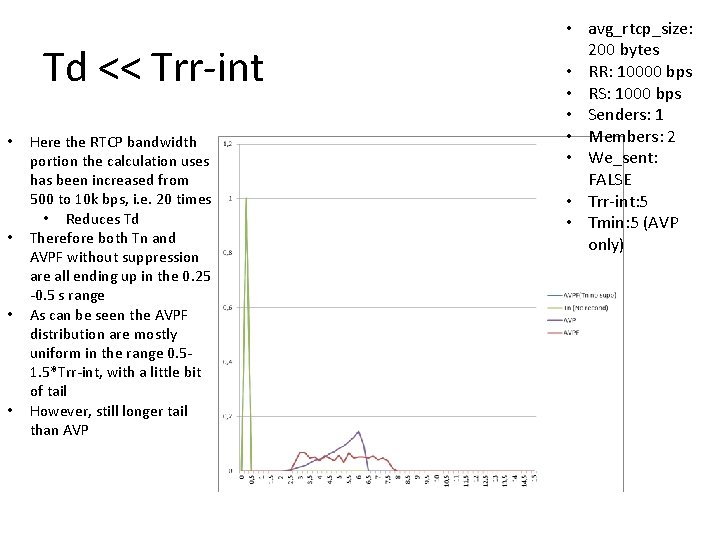
Td << Trr-int • • Here the RTCP bandwidth portion the calculation uses has been increased from 500 to 10 k bps, i. e. 20 times • Reduces Td Therefore both Tn and AVPF without suppression are all ending up in the 0. 25 -0. 5 s range As can be seen the AVPF distribution are mostly uniform in the range 0. 51. 5*Trr-int, with a little bit of tail However, still longer tail than AVP • avg_rtcp_size: 200 bytes • RR: 10000 bps • RS: 1000 bps • Senders: 1 • Members: 2 • We_sent: FALSE • Trr-int: 5 • Tmin: 5 (AVP only)
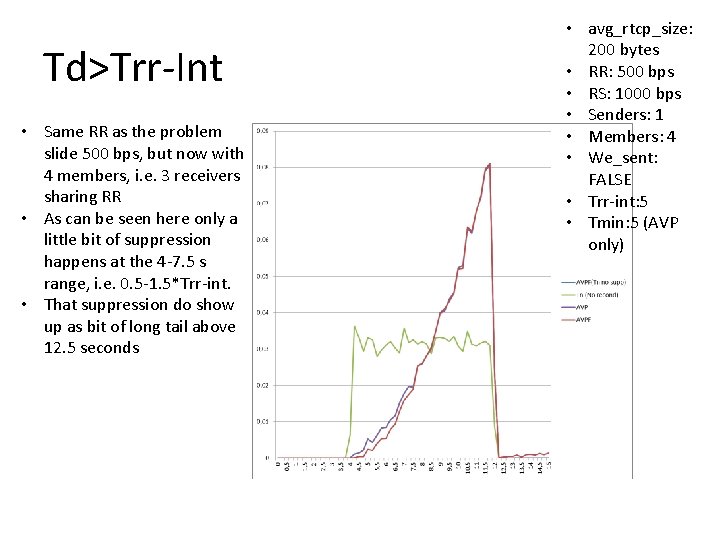
Td>Trr-Int • Same RR as the problem slide 500 bps, but now with 4 members, i. e. 3 receivers sharing RR • As can be seen here only a little bit of suppression happens at the 4 -7. 5 s range, i. e. 0. 5 -1. 5*Trr-int. • That suppression do show up as bit of long tail above 12. 5 seconds • avg_rtcp_size: 200 bytes • RR: 500 bps • RS: 1000 bps • Senders: 1 • Members: 4 • We_sent: FALSE • Trr-int: 5 • Tmin: 5 (AVP only)
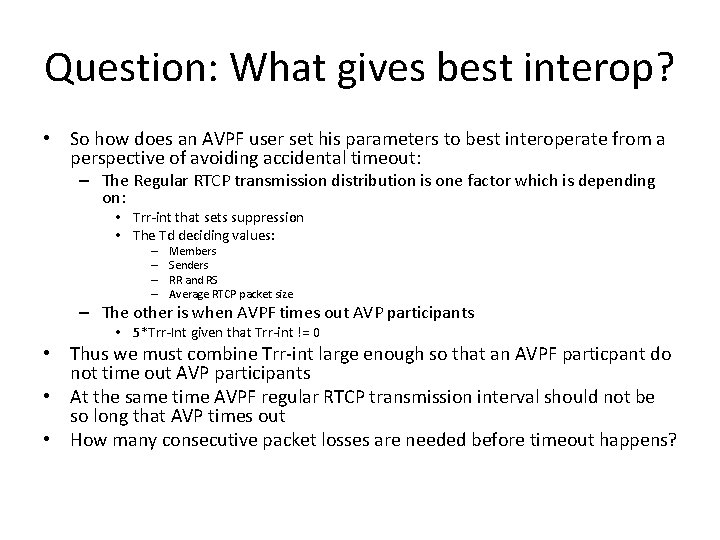
Question: What gives best interop? • So how does an AVPF user set his parameters to best interoperate from a perspective of avoiding accidental timeout: – The Regular RTCP transmission distribution is one factor which is depending on: • Trr-int that sets suppression • The Td deciding values: – – Members Senders RR and RS Average RTCP packet size – The other is when AVPF times out AVP participants • 5*Trr-Int given that Trr-int != 0 • Thus we must combine Trr-int large enough so that an AVPF particpant do not time out AVP participants • At the same time AVPF regular RTCP transmission interval should not be so long that AVP times out • How many consecutive packet losses are needed before timeout happens?
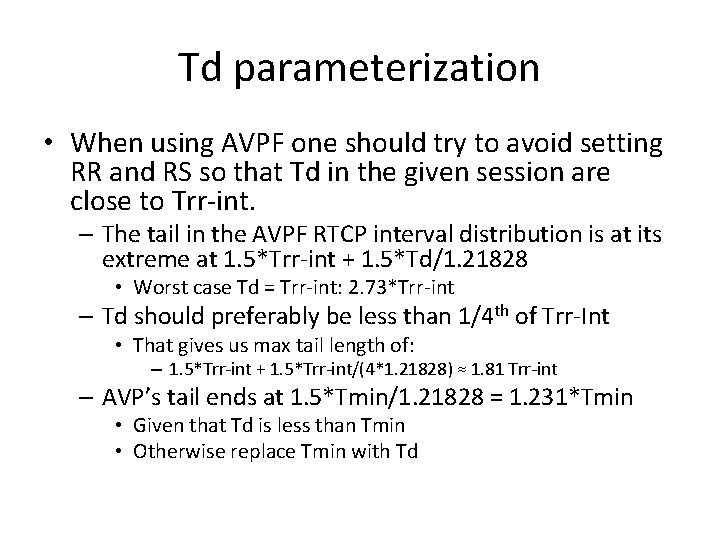
Td parameterization • When using AVPF one should try to avoid setting RR and RS so that Td in the given session are close to Trr-int. – The tail in the AVPF RTCP interval distribution is at its extreme at 1. 5*Trr-int + 1. 5*Td/1. 21828 • Worst case Td = Trr-int: 2. 73*Trr-int – Td should preferably be less than 1/4 th of Trr-Int • That gives us max tail length of: – 1. 5*Trr-int + 1. 5*Trr-int/(4*1. 21828) ≈ 1. 81 Trr-int – AVP’s tail ends at 1. 5*Tmin/1. 21828 = 1. 231*Tmin • Given that Td is less than Tmin • Otherwise replace Tmin with Td
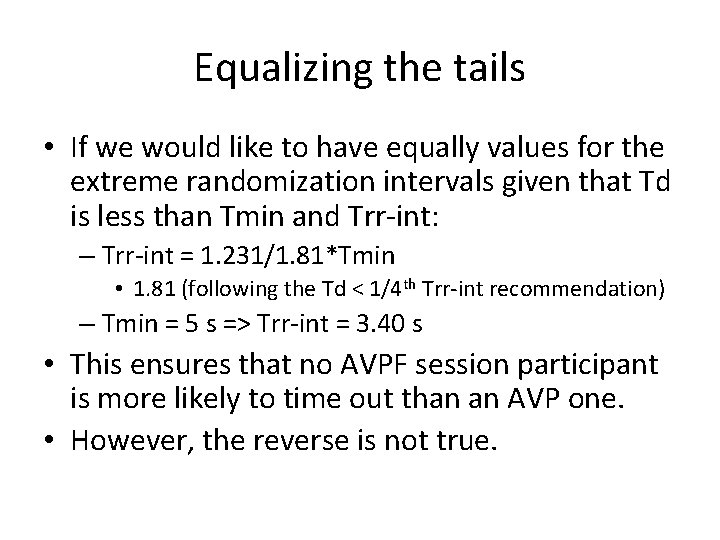
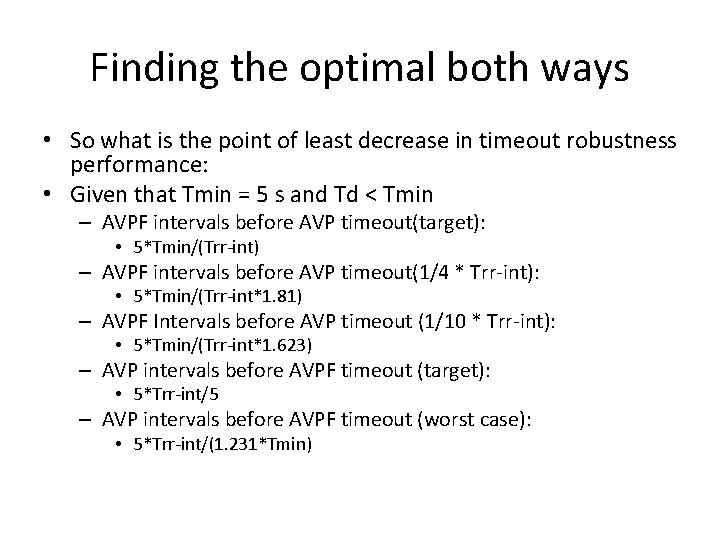
Equalizing the tails • If we would like to have equally values for the extreme randomization intervals given that Td is less than Tmin and Trr-int: – Trr-int = 1. 231/1. 81*Tmin • 1. 81 (following the Td < 1/4 th Trr-int recommendation) – Tmin = 5 s => Trr-int = 3. 40 s • This ensures that no AVPF session participant is more likely to time out than an AVP one. • However, the reverse is not true.
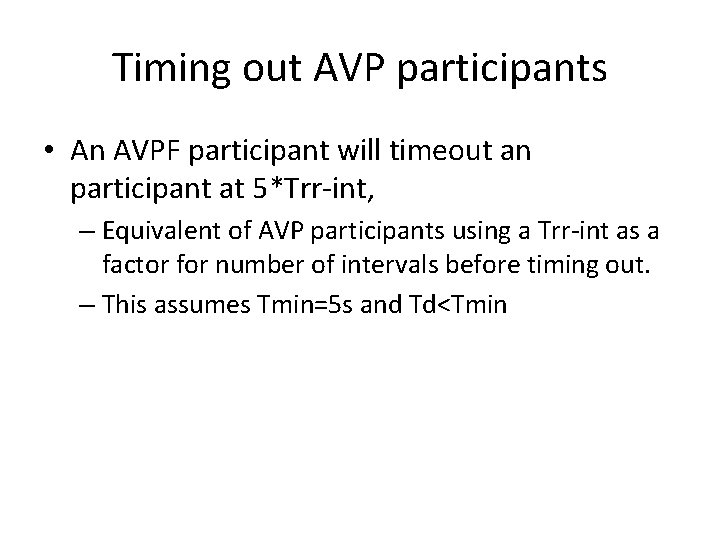
Timing out AVP participants • An AVPF participant will timeout an participant at 5*Trr-int, – Equivalent of AVP participants using a Trr-int as a factor for number of intervals before timing out. – This assumes Tmin=5 s and Td<Tmin
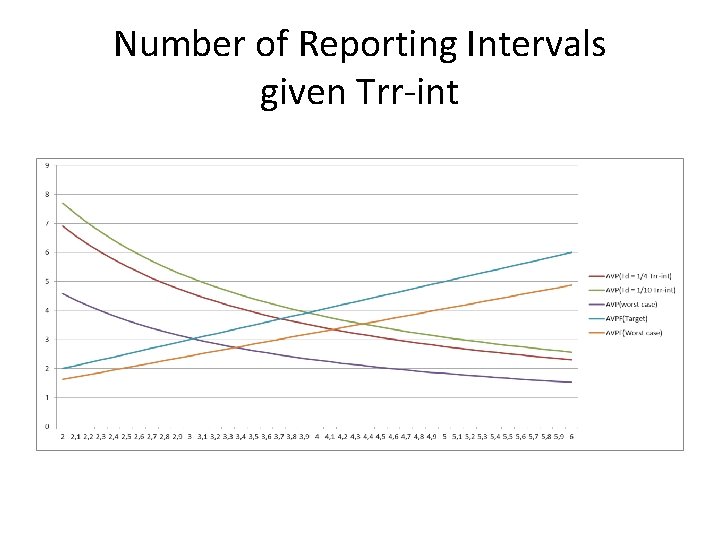
Finding the optimal both ways • So what is the point of least decrease in timeout robustness performance: • Given that Tmin = 5 s and Td < Tmin – AVPF intervals before AVP timeout(target): • 5*Tmin/(Trr-int) – AVPF intervals before AVP timeout(1/4 * Trr-int): • 5*Tmin/(Trr-int*1. 81) – AVPF Intervals before AVP timeout (1/10 * Trr-int): • 5*Tmin/(Trr-int*1. 623) – AVP intervals before AVPF timeout (target): • 5*Trr-int/5 – AVP intervals before AVPF timeout (worst case): • 5*Trr-int/(1. 231*Tmin)
Number of Reporting Intervals given Trr-int
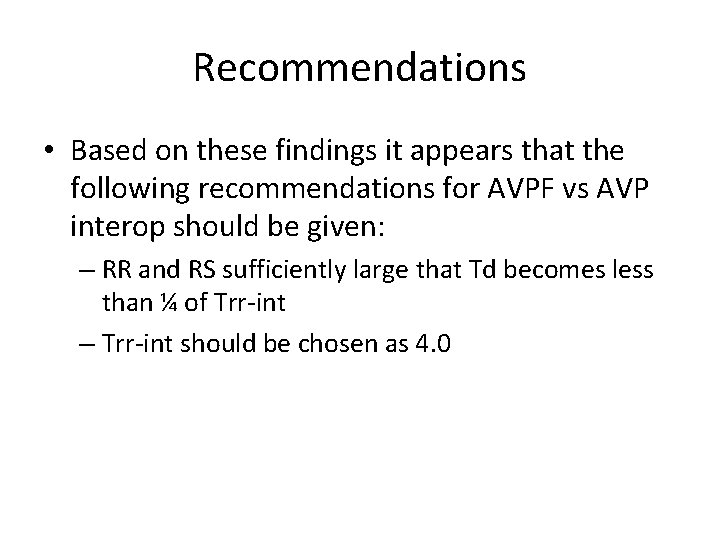
Recommendations • Based on these findings it appears that the following recommendations for AVPF vs AVP interop should be given: – RR and RS sufficiently large that Td becomes less than ¼ of Trr-int – Trr-int should be chosen as 4. 0
Future Work? • Do the Suppression algorithms bad behavior needs to be addressed?