
Avoiding the Corporate Death Spiral Recognizing Eliminating the
![Drucker on Purpose & Profit • “[The statement that] the purpose of an organization](https://slidetodoc.com/presentation_image_h/ee598e56b5c4c96c47ac85d778423462/image-17.jpg "Drucker on Purpose & Profit • “[The statement that] the purpose of an organization")
- Slides: 39
Avoiding the Corporate Death Spiral Recognizing & Eliminating the Signs of Decline Gregg Stocker Houston, Texas USA © 2010 Gregg Stocker
The U. S. Today. . . • Americans happiness has declined over the last 30 years – Longer working hours – Deterioration in quality of relationships – More than ½ of workers are dissatisfied with their jobs www. greggstocker. com gstocker@greggstocker. com © 2010 Gregg Stocker
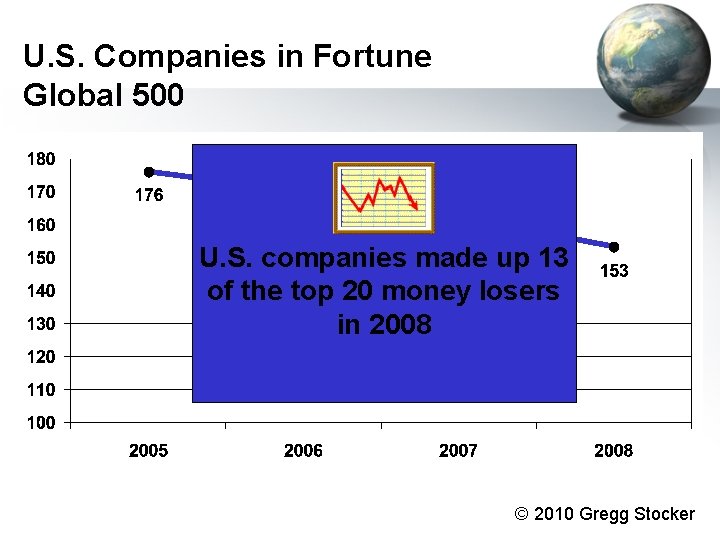
U. S. Companies in Fortune Global 500 U. S. companies made up 13 of the top 20 money losers in 2008 www. greggstocker. com gstocker@greggstocker. com © 2010 Gregg Stocker
Words of Advice “The one thing the U. S. should never do is export its management techniques. . . at least to friendly countries. ” W. Edwards Deming (1900 – 1993) www. greggstocker. com gstocker@greggstocker. com © 2010 Gregg Stocker
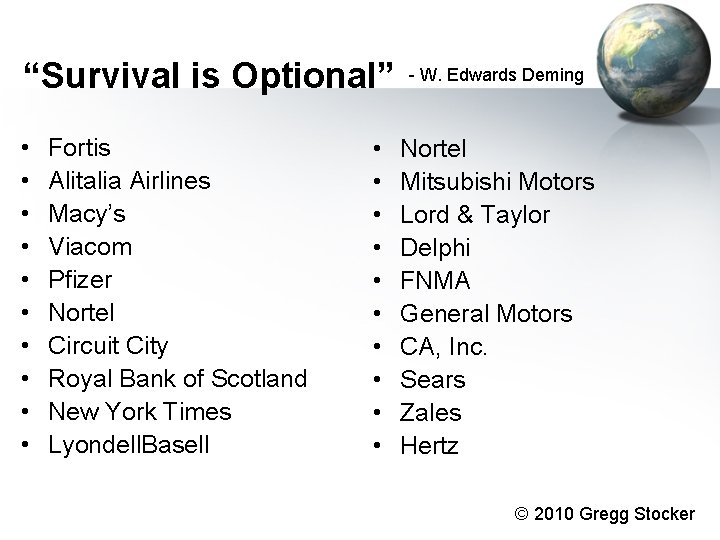
“Survival is Optional” • • • Fortis Alitalia Airlines Macy’s Viacom Pfizer Nortel Circuit City Royal Bank of Scotland New York Times Lyondell. Basell www. greggstocker. com • • • - W. Edwards Deming Nortel Mitsubishi Motors Lord & Taylor Delphi FNMA General Motors CA, Inc. Sears Zales Hertz gstocker@greggstocker. com © 2010 Gregg Stocker
What Affects Company Performance & Survival? • • Economy? Political Situation? Investor/Stockholder Pressures? Terrorism? Health Care Costs? Energy Prices? Natural Disasters? • Are companies at the mercy of external factors? www. greggstocker. com gstocker@greggstocker. com © 2010 Gregg Stocker
The Problem “. . . management has walked off the job of managing, striving instead for [bonuses, ] dividends and good performance of the company’s stock. ” W. Edwards Deming (1900 – 1993) www. greggstocker. com gstocker@greggstocker. com © 2010 Gregg Stocker
What is the Job of Managing? • Continually build the health of the organization – Setting direction and maintaining the course – Inspiring people to improve and excel – Optimizing the organization for the benefit of all stakeholders • Strengthening the organization’s immune system improves chances of surviving negative external events www. greggstocker. com gstocker@greggstocker. com © 2010 Gregg Stocker
Declining Organizational Health • Obvious signs – Declining profits – Falling sales – Shrinking market share • Damage is done – Management usually enters crisis-mode • Death spiral is evident www. greggstocker. com gstocker@greggstocker. com © 2010 Gregg Stocker
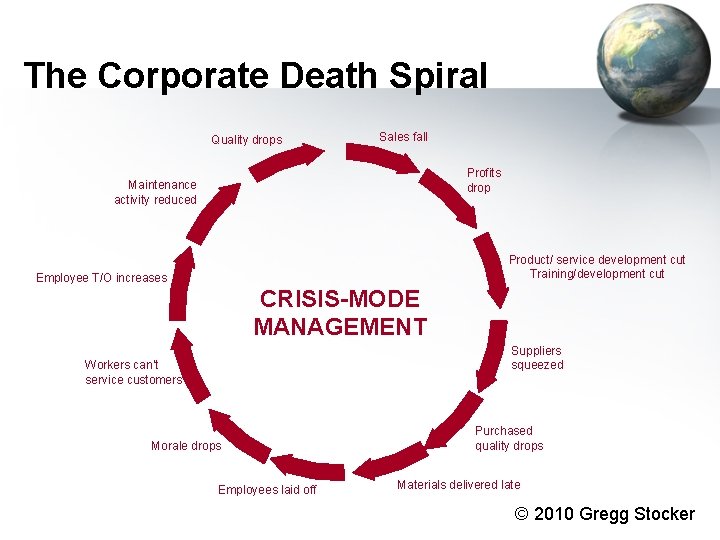
The Corporate Death Spiral Quality drops Sales fall Profits drop Maintenance activity reduced Product/ service development cut Training/development cut Employee T/O increases CRISIS-MODE MANAGEMENT Suppliers squeezed Workers can’t service customers Purchased quality drops Morale drops Employees laid off www. greggstocker. com Materials delivered late gstocker@greggstocker. com © 2010 Gregg Stocker
Can a Successful Company have Health Problems? “There is nothing more vulnerable than entrenched success. ” George Romney www. greggstocker. com gstocker@greggstocker. com © 2010 Gregg Stocker
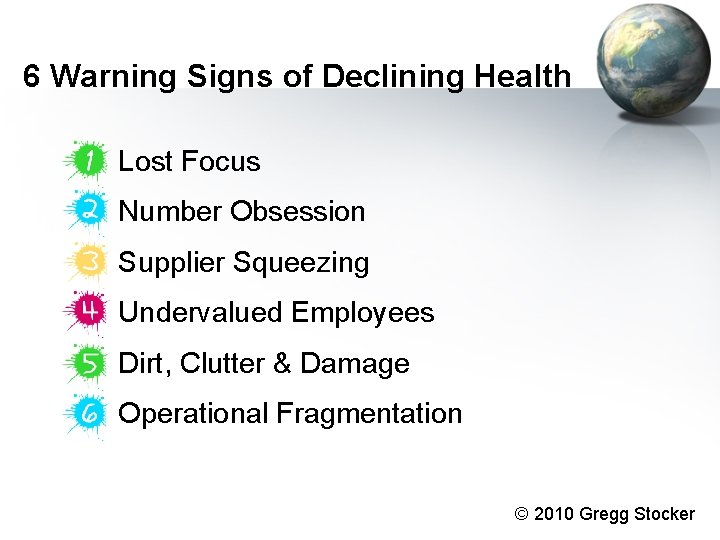
6 Warning Signs of Declining Health Lost Focus Number Obsession Supplier Squeezing Undervalued Employees Dirt, Clutter & Damage Operational Fragmentation www. greggstocker. com gstocker@greggstocker. com © 2010 Gregg Stocker
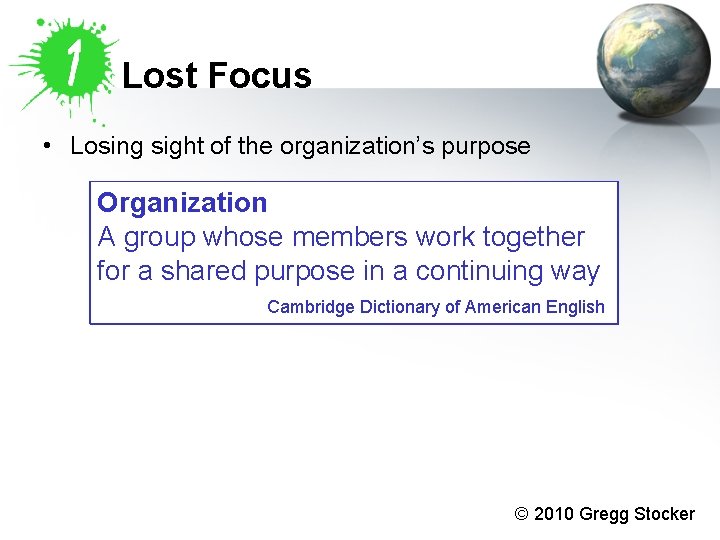
Lost Focus • Losing sight of the organization’s purpose Organization A group whose members work together for a shared purpose in a continuing way Cambridge Dictionary of American English www. greggstocker. com gstocker@greggstocker. com © 2010 Gregg Stocker
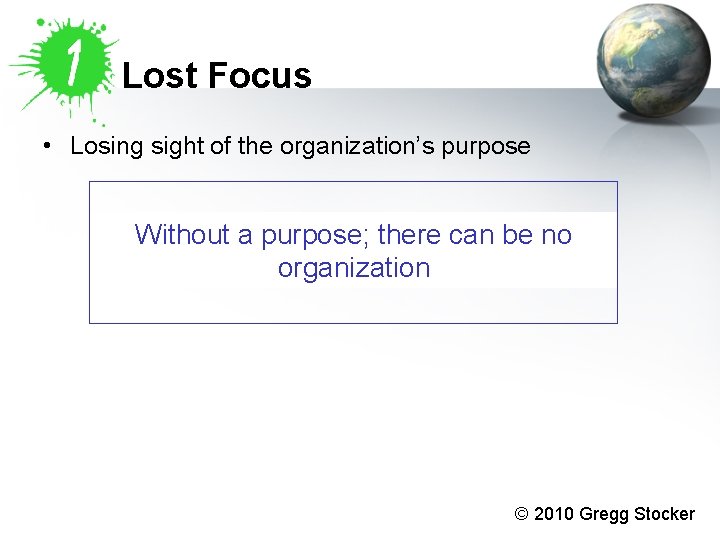
Lost Focus • Losing sight of the organization’s purpose Without a purpose; there can be no organization www. greggstocker. com gstocker@greggstocker. com © 2010 Gregg Stocker
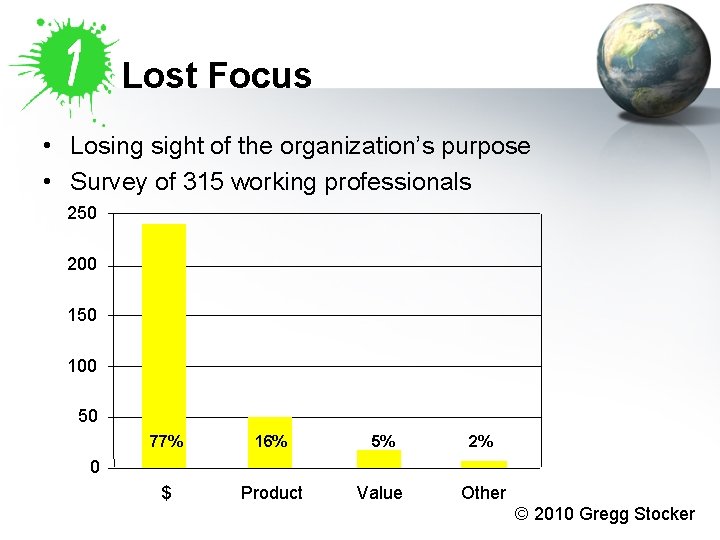
Lost Focus • Losing sight of the organization’s purpose • Survey of 315 working professionals 250 200 150 100 50 77% 16% 5% 2% 0 $ www. greggstocker. com Product Value Other gstocker@greggstocker. com © 2010 Gregg Stocker
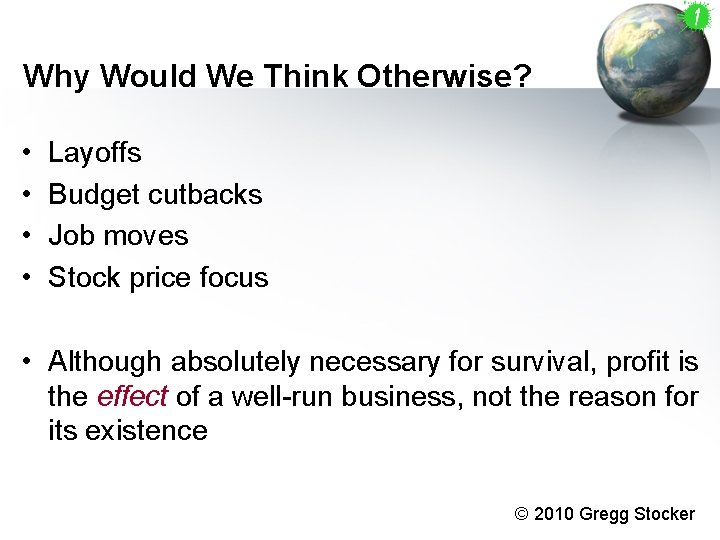
Why Would We Think Otherwise? • • Layoffs Budget cutbacks Job moves Stock price focus • Although absolutely necessary for survival, profit is the effect of a well-run business, not the reason for its existence www. greggstocker. com gstocker@greggstocker. com © 2010 Gregg Stocker
Drucker on Purpose & Profit • “[The statement that] the purpose of an organization is to make a profit is not only false, but is totally irrelevant. ” • “. . . In fact, the concept is worse than irrelevant. It does harm. ” www. greggstocker. com gstocker@greggstocker. com © 2010 Gregg Stocker
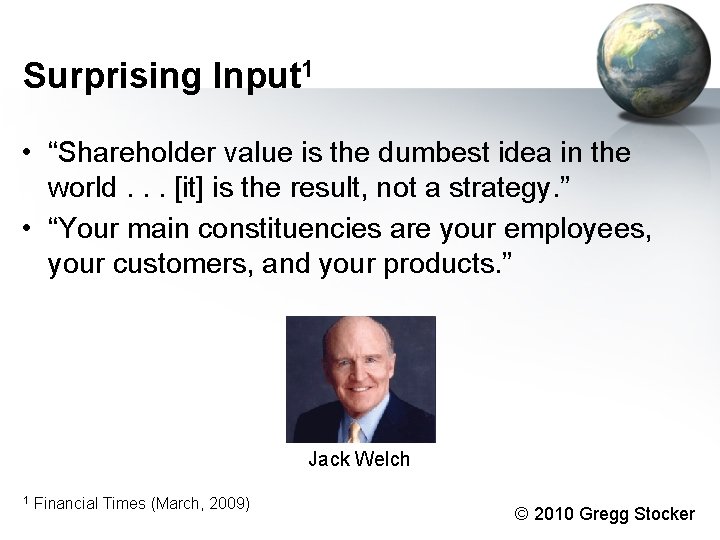
Surprising Input 1 • “Shareholder value is the dumbest idea in the world. . . [it] is the result, not a strategy. ” • “Your main constituencies are your employees, your customers, and your products. ” Jack Welch 1 Financial Times (March, 2009) www. greggstocker. com gstocker@greggstocker. com © 2010 Gregg Stocker
Focus on Profit vs Value • Concern horizon is shorter • Investment decisions/actions delayed because of potential effect on share price • Layoffs/cutbacks implemented quickly & often • Conflict develops between employees and shareholders www. greggstocker. com gstocker@greggstocker. com © 2010 Gregg Stocker
“Shrinking Your Way Into Prosperity” • 18 -year study of S&P 500 companies • Deepest cuts vs industry peers during recession: – Smaller profits – Weaker stock returns – Up to nine years after cutbacks • 42% of executives feel recent cutbacks could hurt their long-term growth 2 1 Dr. Wayne Mascio, University of Colorado-Denver 2 Duke University/CFO Magazine gstocker@greggstocker. com www. greggstocker. com © 2010 Gregg Stocker
Number-Obsession • • Running the organization from a spreadsheet Spending more time with numbers than people Lack of balance among KPIs Believing that “if you can’t measure it, you can’t improve it” applies to everything www. greggstocker. com gstocker@greggstocker. com © 2010 Gregg Stocker
Advice from Experts • “Not everything that counts can be counted, and not everything that can be counted, counts. ” Albert Einstein www. greggstocker. com gstocker@greggstocker. com © 2010 Gregg Stocker
What Can’t be Measured. . . • Costs associated with: – – – – Low employee morale Fear in the workplace Dissatisfied customers Lack of teamwork Poor strategic planning Employee turnover Poor supplier relations Etc. www. greggstocker. com gstocker@greggstocker. com © 2010 Gregg Stocker
Numbers are Important • Feedback – Company performance – Cash flow – Budgeting • Process/system improvement • The KEY is to understand. . . – Numbers don’t tell the whole story – How to gain knowledge from numbers and use to guide improvement www. greggstocker. com gstocker@greggstocker. com © 2010 Gregg Stocker
Supplier Squeezing • Supplier relationships based on price & payment terms • Continual pressure placed on suppliers to reduce price • Multiple suppliers for each product/service purchased www. greggstocker. com gstocker@greggstocker. com © 2010 Gregg Stocker
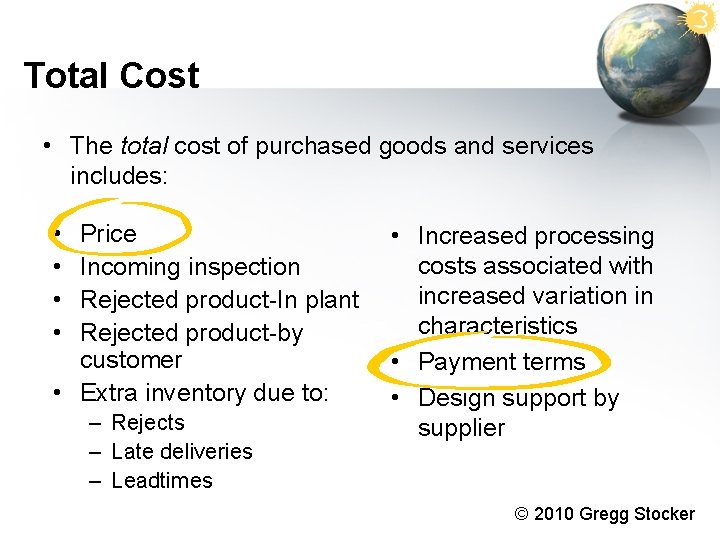
Total Cost • The total cost of purchased goods and services includes: • • Price Incoming inspection Rejected product-In plant Rejected product-by customer • Extra inventory due to: – Rejects – Late deliveries – Leadtimes www. greggstocker. com • Increased processing costs associated with increased variation in characteristics • Payment terms • Design support by supplier gstocker@greggstocker. com © 2010 Gregg Stocker
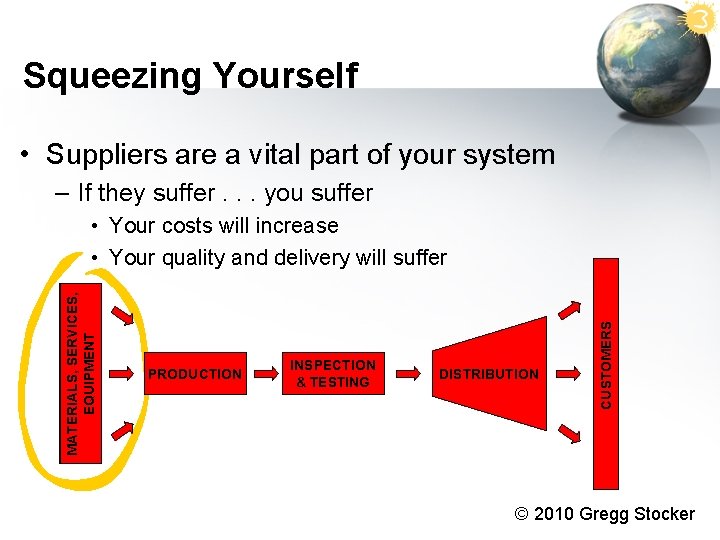
Squeezing Yourself • Suppliers are a vital part of your system – If they suffer. . . you suffer PRODUCTION www. greggstocker. com INSPECTION & TESTING DISTRIBUTION gstocker@greggstocker. com CUSTOMERS MATERIALS, SERVICES, EQUIPMENT • Your costs will increase • Your quality and delivery will suffer © 2010 Gregg Stocker
Undervalued Employees • Employees treated as an expense – Layoffs are among the initial cost-cutting moves – Value employees only on measurable results • Little pride of association with organization • Leaders hired – not developed www. greggstocker. com gstocker@greggstocker. com © 2010 Gregg Stocker
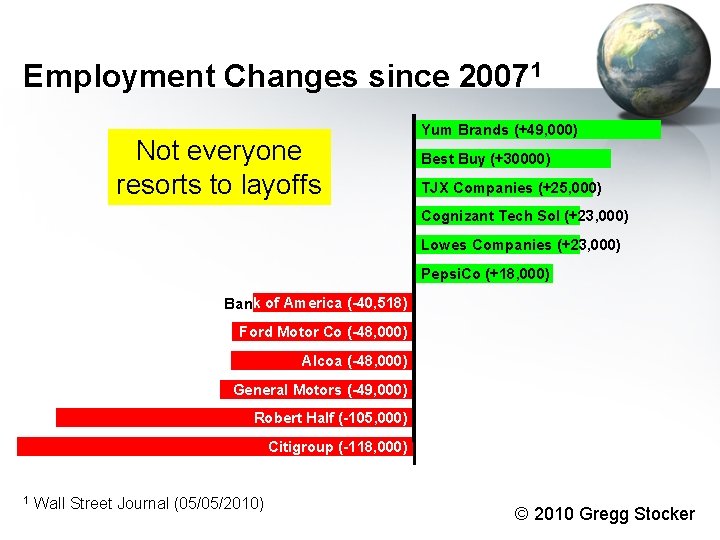
The True Cost of Layoffs • Easy to measure – Severance – Unemployment taxes/social costs • Difficult to measure – – – – Morale drops / teamwork falls apart Talented employees look for other jobs Loss of trained & experienced employees when business returns Fear is increased among remaining employees Focus becomes survival instead of serving the customer Dedication to the company among remaining employees is lost Stress level of remaining employees increases www. greggstocker. com gstocker@greggstocker. com © 2010 Gregg Stocker
Employment Changes since 20071 Not everyone resorts to layoffs Yum Brands (+49, 000) Best Buy (+30000) TJX Companies (+25, 000) Cognizant Tech Sol (+23, 000) Lowes Companies (+23, 000) Pepsi. Co (+18, 000) k of America (-40, 518) Bank Ford Motor Co (-48, 000) Alcoa (-48, 000) General Motors (-49, 000) Robert Half (-105, 000) Citigroup (-118, 000) 1 Wall Street Journal (05/05/2010) www. greggstocker. com gstocker@greggstocker. com © 2010 Gregg Stocker
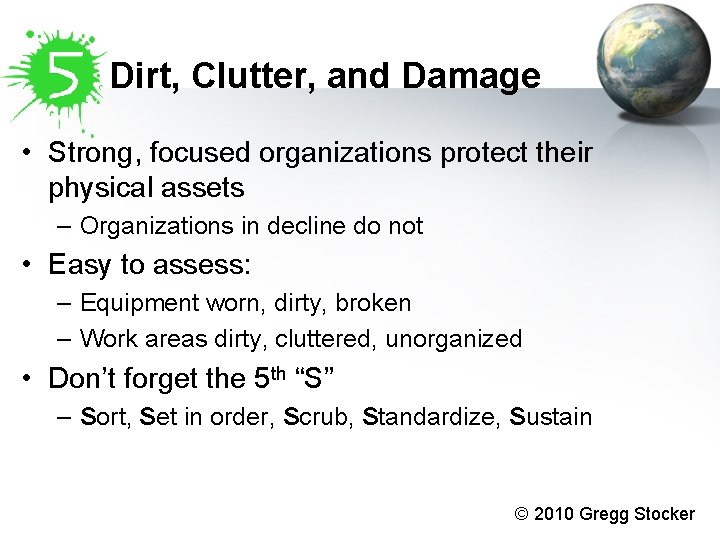
Dirt, Clutter, and Damage • Strong, focused organizations protect their physical assets – Organizations in decline do not • Easy to assess: – Equipment worn, dirty, broken – Work areas dirty, cluttered, unorganized • Don’t forget the 5 th “S” – Sort, Set in order, Scrub, Standardize, Sustain www. greggstocker. com gstocker@greggstocker. com © 2010 Gregg Stocker
The Preventive Maintenance Paradox • When business is good – No time for preventive maintenance • When business is bad – No money for preventive maintenance www. greggstocker. com gstocker@greggstocker. com © 2010 Gregg Stocker
Operational Fragmentation • Attempting to manage the organization by focusing on the individual components • Reductionistic or atomistic approach versus a holistic approach to management • Setting fragmented goals that help one area but hurt the company, as a whole • Creates & strengthens silos www. greggstocker. com gstocker@greggstocker. com © 2010 Gregg Stocker
Putting it in Perspective • “If you try to take a cat apart to see how it works, the first thing you have in your hands is a nonworking cat. ” Douglas Adams Salmon of Doubt-Hitchhiking the Galaxy One More Time www. greggstocker. com gstocker@greggstocker. com © 2010 Gregg Stocker
Effects of Fragmented Goals • Sales objective: – Meet sales forecasts • Effects: – – – Forecasts set low Selling more than the customer needs Price cuts & profits drop Promising delivery dates that cannot be met Decreased customer satisfaction www. greggstocker. com gstocker@greggstocker. com © 2010 Gregg Stocker
Why Do We Fragment? • It’s easier to understand implement • Lack of trust – Fragmentation is a natural result of micromanagement • It’s what we were taught – Misapplication of MBO www. greggstocker. com gstocker@greggstocker. com © 2010 Gregg Stocker
Barriers to De-Fragmenting • Goals & rewards that are component-focused rather than company-wide • Layoffs • Systems that drive focus on pleasing the boss instead of the customer (internal and external) • Functionally-focused leaders www. greggstocker. com gstocker@greggstocker. com © 2010 Gregg Stocker
Escaping the Death Spiral • It’s easier to avoid than escape • Assess organization for warning signs – Discuss & debate • Prioritize areas to address • Build into strategic plan • Apply change management principles – Heavy people focus • Get back to basics – Reaffirm and recommit to purpose www. greggstocker. com gstocker@greggstocker. com © 2010 Gregg Stocker
For More Information • Book – Avoiding the Corporate Death Spiral: Recognizing & Eliminating the Signs of Decline – Available from Amazon or Quality Press • Blog – corporatedeathspiral. blogspot. com • Email – gstocker@greggstocker. com www. greggstocker. com gstocker@greggstocker. com © 2010 Gregg Stocker