
Avoiding Social LockIn with Crosscloud Sandro Hawke W

- Slides: 41
Avoiding Social Lock-In with Crosscloud Sandro Hawke, W 3 C / MIT, sandro@hawke. org W 3 C Tech Talk 5 Jun 2014 http: //www. w 3. org/2014/Talks/0605 -sandro
Overview ● The Problem o Social Lock-In ● The Solution o Crosscloud = Blogs + RDF + Auth +. . . ● The Plan o o Research Community Standards Business
Product Lock-In Once you start using a product, there can be a high cost to switch. This is old news. Most common: Data Format Lock-In ●. doc files (“proprietary formats”) ● ever switch accounting systems? Mitigated by standards, non-binary formats
Social (Multi-User) Software You’re interacting with people via computer ● chat ● auction ● meeting scheduling ● dating ● video sharing ● … many more The value is largely in other people using it.
Social Lock-In If you switch, you find yourself in a ghost town, unless you can get your primary contacts to move at the same time. Re diaspora (facebook competitor): “It’s cool, but the sad fact is most people will still go to Facebook simply because that's where all their friends are. " -- Newsweek It’s not insurmountable (cf snapchat, g+) but it is very strong.
Examples Imagine these without other users: e. Bay, airbnb, yelp, foursquare, kickstarter, evite, meetup, doodle, e. Harmony, okcupid, digg, reddit, facebook, linkedin, twitter, tumblr, instagram, pinterest, flickr, wikipedia, Stack. Overflow, Words with Friends, Github, . . . Very high barrier to entry for competition
Results? Other developers (innovation) are locked out. Little “serious” (enterprise) use. Exclusion. Not everyone’s on every system. No real options for privacy. The systems change when they want.
So what is Crosscloud? A system (under construction) that doesn’t have these problems. You can switch apps, still working with the same people and data Healthy competition: ● vi/emacs ● firefox/chrome ● elm/pine/thunderbird
Great for Free/Open Source Software As a coder, even if github’s software were 100% free, I couldn’t effectively fork it (social lockin, all the other users) With Crosscloud I could. Don’t like the latest change? Just keep running the older version of the code. Share your own changes with the world
Of course it’s Decentralized We’re building it, but once it’s out there, no one will be able to control it. ● Like the Web ● Like email People can join & participate without asking anyone’s permission or paying anyone (beyond various service providers, which could be adsubsidized). ● Good for weekend hackers and for enterprise
Problem Summary Social Lock-in comes naturally with Social Software (where the value is the people) It locks out innovation, business applications, government applications It forces people to accept random site changes, privacy invasion, ads, questionable security We imagine Crosscloud as a platform without Lockin.
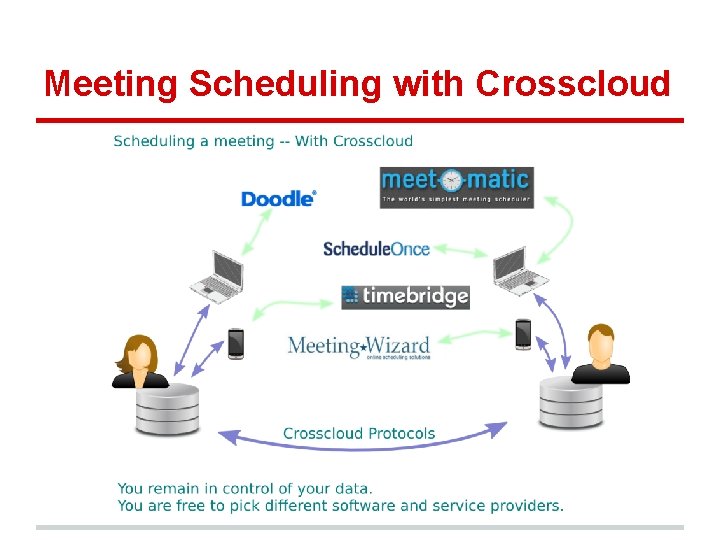
So how could this possibly work? It’s about the data.
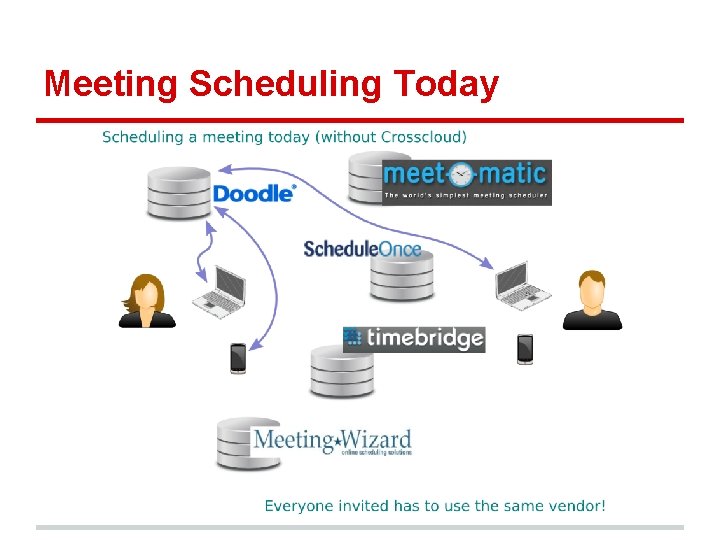
Meeting Scheduling Today
Meeting Scheduling with Crosscloud
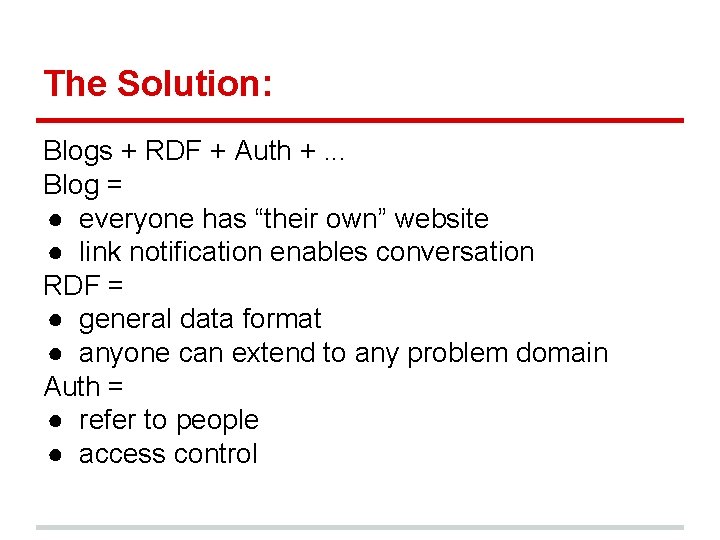
The Solution: Blogs + RDF + Auth +. . . Blog = ● everyone has “their own” website ● link notification enables conversation RDF = ● general data format ● anyone can extend to any problem domain Auth = ● refer to people ● access control
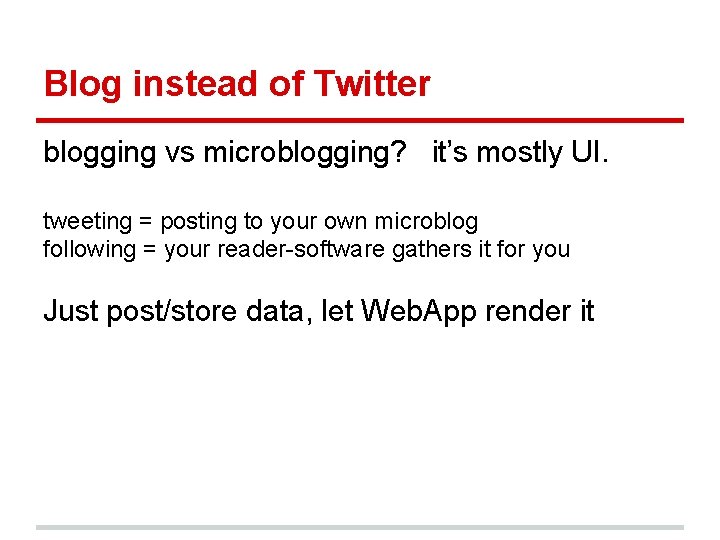
Blog instead of Twitter blogging vs microblogging? it’s mostly UI. tweeting = posting to your own microblog following = your reader-software gathers it for you Just post/store data, let Web. App render it
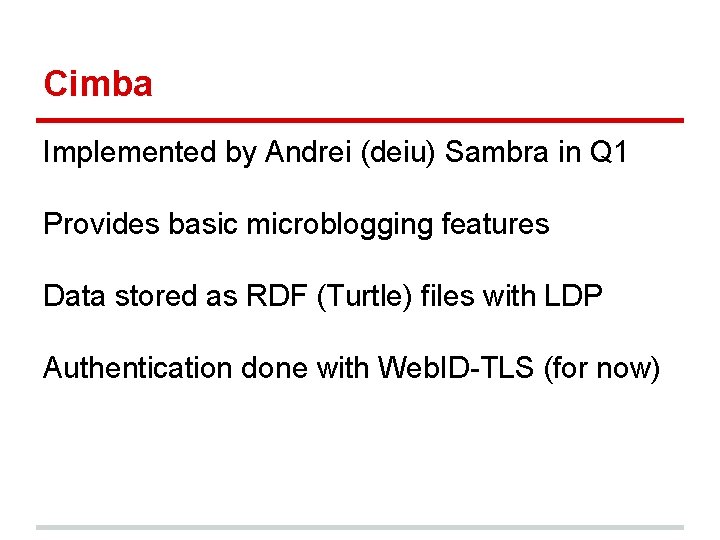
Cimba Implemented by Andrei (deiu) Sambra in Q 1 Provides basic microblogging features Data stored as RDF (Turtle) files with LDP Authentication done with Web. ID-TLS (for now)
Cimba Demo Watch at: https: //www. youtube. com/watch? v=z 0_Xa. J 97 r. F 0 Try it at: http: //cimba. co
Play Chess via Blogs 1. 2. 3. 4. 5. Alice posts she’s playing a game with Bob posts he’s playing that game Alice posts her move (optionally) Bob posts a copy of that move Bob posts his move … etc ● A client can render this like any chess app ● URLs linking all over the place ● Polling is slow; notification is good
Auction a textbook via Blogs 1. Alice posts her Chem textbook for auction 2. Alice notifies many auction index services 3. Bob finds it, posts a bid 4. Alice links to his bid as the new high bid … n. Alice closes the auction ● Again: UI can make this look like e. Bay, etc ● Note that e. Bay is more than software ● ISSUE: does Bob POST to his own blog and notify Alice, or does he POST to Alice’s server? )
Machine Readable Blogs These “POSTS” are RDF triples, not HTML They are created and viewed through Web. Apps (or desktop or mobile apps) They link to each other heavily, using Linked Data principles, much like Blog posts do.
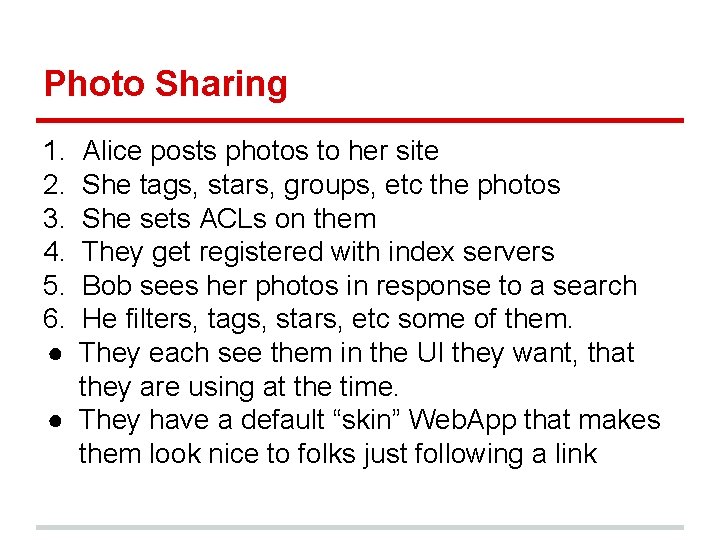
Photo Sharing 1. 2. 3. 4. 5. 6. ● Alice posts photos to her site She tags, stars, groups, etc the photos She sets ACLs on them They get registered with index servers Bob sees her photos in response to a search He filters, tags, stars, etc some of them. They each see them in the UI they want, that they are using at the time. ● They have a default “skin” Web. App that makes them look nice to folks just following a link
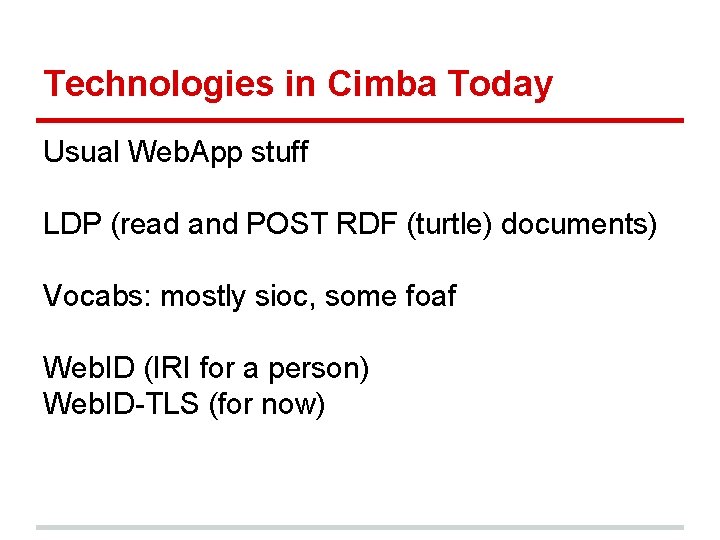
Technologies in Cimba Today Usual Web. App stuff LDP (read and POST RDF (turtle) documents) Vocabs: mostly sioc, some foaf Web. ID (IRI for a person) Web. ID-TLS (for now)
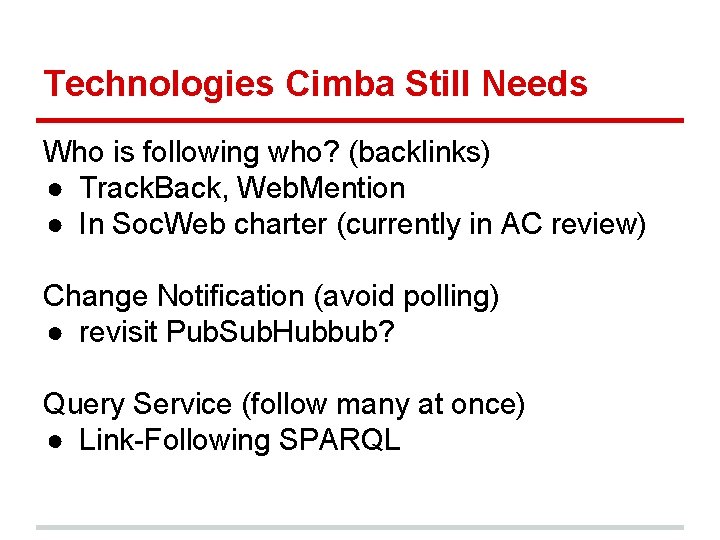
Technologies Cimba Still Needs Who is following who? (backlinks) ● Track. Back, Web. Mention ● In Soc. Web charter (currently in AC review) Change Notification (avoid polling) ● revisit Pub. Sub. Hubbub? Query Service (follow many at once) ● Link-Following SPARQL
Still needs. . . Better UX than Web. ID-TLS Maybe a p 2 p CDN
Technology Summary blogs ● people have their own sites ● their apps can post/edit their content ● backlinks ● change notification + semweb stack ● linked data platform (read/write RDF FS) ● link following sparql ● vocabulary conversion (owl? , rif? ) ● indexing + identity = Crosscloud protocols
Is this just going to happen on its own? Probably not.
The Plan Build an ecosystem ● users + apps + data servers, standards Start small ● cimba, rww. io, Viral growth (easy, right? )
Perspective 1987 - Started to worry about this problem 1991 - My first startup in this space 2000 - Eric. P told me Tim. BL was on same track 2009 - RIF done, revisiting Social Lock-In 2010 - spare time=hacking on MVP 2012 - spare time=applying for grants 2013 - grants begin to arrive, WGs wrap up 2014 - assembling team
Grants Very grateful to: ● John S. and James L. Knight Foundation ● QCRI ● National Science Foundation ● John D. and Catherine T. Mac. Arthur Foundation
Research Several Interesting Comp Sci Questions - rdf patch - link-following sparql - efficient notifications - scaling to many consumers (cf Akamai) - scaling to many producers (cf Google) - practical vocab conversion (RIF? )
Community App Developers ● Start with MIT Students (UROP) ● Need to build a nice toolkit, docs, etc Data Service Providers ● Partners? Own. Cloud? ● Show it’s a viable business Indie. Web? Fed. Soc. Web? tent. io?
Standards Linked Data Platform (LDP) ● Going to CR now ● Crosscloud needs several other bits ● Hopefully re-charter in 6 -12 mos ● … but they’re not about social lock-in Soc. Web WG ● Hopefully launching in July ● … to soon to see their focus
Business Ultimately, we need commercial participation ● In app development o o but it won't be the folks that want to mine your data it’ll be the folks that want to provide value to users ● In cloud data hosting o intense market out there; this might catch on ● In data interoperability o o apps written to be compatible with existing apps written separately, integrated by another ● Branded and sold for end users ● Participating in standards
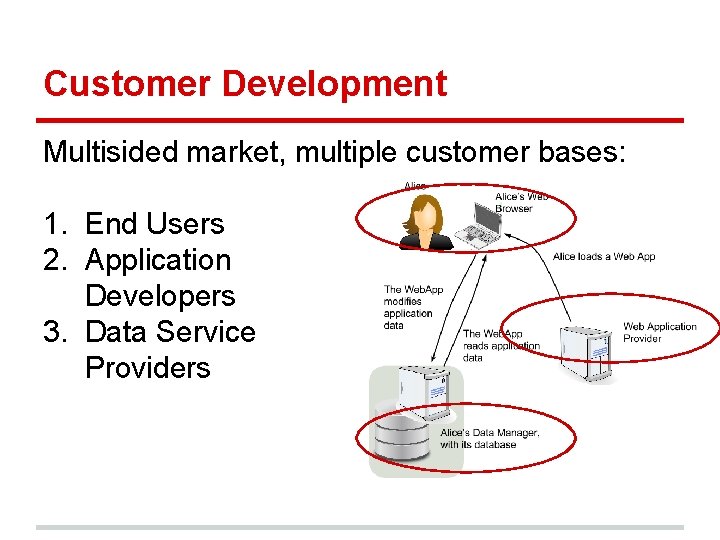
Customer Development Multisided market, multiple customer bases: 1. End Users 2. Application Developers 3. Data Service Providers
End Users Possible benefits: ● Sense of control, actual control ● Sense of privacy, actual privacy ● No ads (if you pay) ● Integrated interface to multiple systems ● Ability to include everyone ● Custom support for your group/enterprise Issues: ● Need apps ● Need data service providers ● Need other users
Application Developers Possible benefits: ● Doing right by the users ● Easier critical mass of users ● No need for backend operations o scaling, security, expertise, 24 hr staff ● Ecosystem of collaboration Issues: ● Need to hide RDF? ● Web. Apps only for now? ● Platform is still evolving rapidly
Data Service Providers Possible benefits: ● Money o o Different market from file storage Not much harder ● Supporting your enterprise / people Issues: ● Will be highly competitive market ● Platform is still evolving rapidly
Short Term Focus on cimba MVP ● microblogging plus ● access control groups and revise as needed … While documenting protocols, feeding them into LDP and Soc. Web WGs … And doing necessary Comp Sci
Summary ● Social lock-in hobbles social software ● Crosscloud will solve social lock-in by o o o putting data under user control in a standard format (RDF) with lots of links notification indexes vocab mapping shims ● Protocol/standards work needed ● Comp Sci research needed ● App developers needed
Next Steps ● Look at the app area lists and email me your favorites (and edits) https: //github. com/sandhawke/crosscloud/blob/ master/apps. md ● Join the announcements mailing list: crosscloud -announce@csail. mit. edu subscribe ● Let us know how your technologies/groups might fit in or use this ● Suggest more funding sources ● Suggest people to hire (especially postdoc, MIT UROP)