
Avoiding Rejections John Morris KRIS King Mongkuts Institute





- Slides: 61
Avoiding Rejections John Morris KRIS, King Mongkut’s Institute of Technology Ladkrabang previously Engineering, Mahasarakham University Electrical and Computer Engineering, The University of Auckland Iolanthe II leaves the Hauraki Gulf under full sail – Auckland-Tauranga Race, 2007
����� working in a Thai university sees this fairly often …. I have a problem with this paper. . . The editor wants …
Usually. . • After an editor has sent an initial rejection. . I regret to advise you that, following the referees’ comments, we are unable to accept your paper in its present form. However … • Do not be disheartened Aim in this talk: help you avoid the final rejection! i. e. turn that first rejection into an acceptance • Everybody gets a letter like this! – Elsevier notes that most papers require some revision
Understanding rejections • Types of rejections – – Out of scope Minor revisions Major revisions Reject
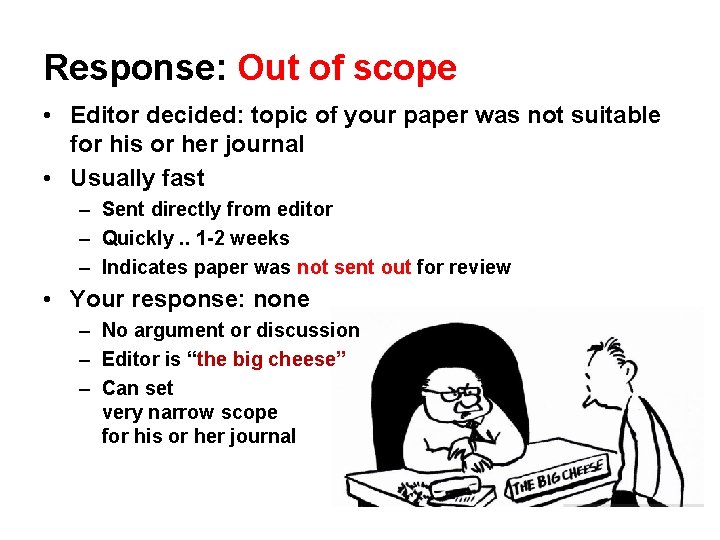
Response: Out of scope • Editor decided: topic of your paper was not suitable for his or her journal • Usually fast – Sent directly from editor – Quickly. . 1 -2 weeks – Indicates paper was not sent out for review • Your response: none – No argument or discussion – Editor is “the big cheese” – Can set very narrow scope for his or her journal
Response: Out of scope • Your action: – Simply send to another journal • Before choosing another journal – Study topics for the current journal – Can you understand why editor considered it ‘out of scope’ ? J Helps you to read ‘Call for Papers’ for next journal
Avoiding ‘out of scope’ rejection • Read Call for Papers for the journal – Carefully • Look at recent papers in the journal – Can you find similar papers? • Reality L Editors sometimes do not set out aims clearly – Do not worry. . – There are many journals now!!
Rejection: Minor revisions needed • Everyone get minor revisions • Elsevier – Only papers from large groups (20+ authors) get accepted without change – These are small communities • Everyone has already seen the paper • All the rest of us – At least one reviewer will find something that needs change!! – Editor will simply tell you ‘minor revisions’ needed and – invite you to send a revision Minor Revisions are normal! Everyone gets them!
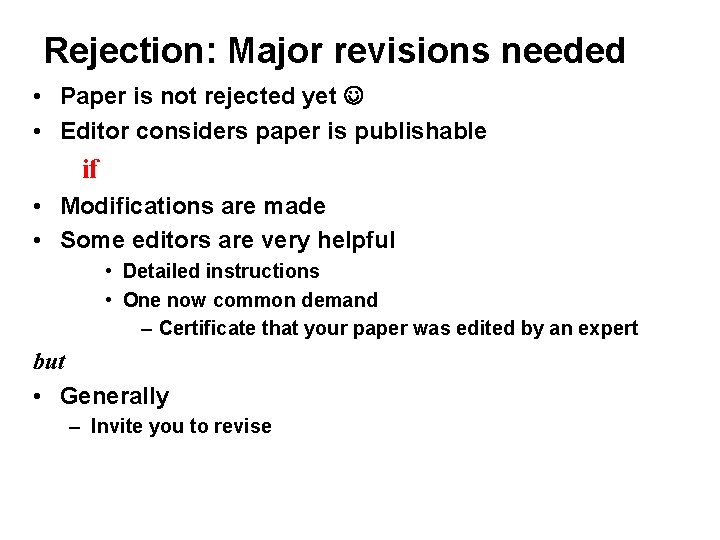
Rejection: Major revisions needed • Paper is not rejected yet • Editor considers paper is publishable if • Modifications are made • Some editors are very helpful • Detailed instructions • One now common demand – Certificate that your paper was edited by an expert but • Generally – Invite you to revise
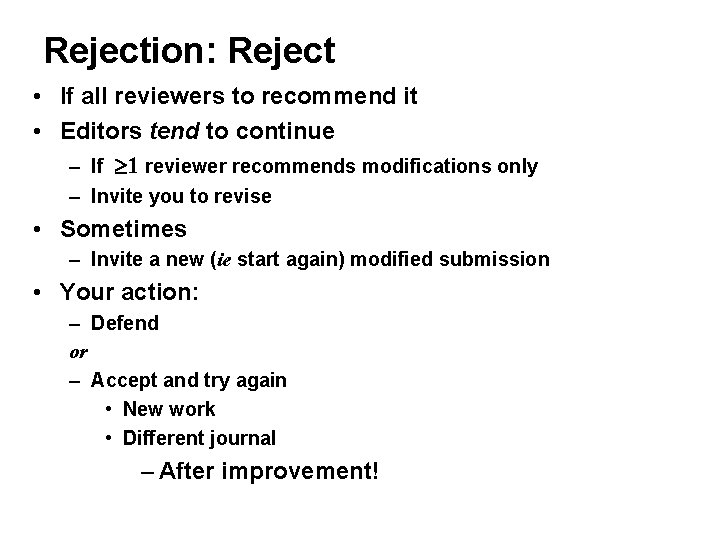
Rejection: Reject • If all reviewers to recommend it • Editors tend to continue – If 1 reviewer recommends modifications only – Invite you to revise • Sometimes – Invite a new (ie start again) modified submission • Your action: – Defend or – Accept and try again • New work • Different journal – After improvement!
AVOIDING REJECTIONS
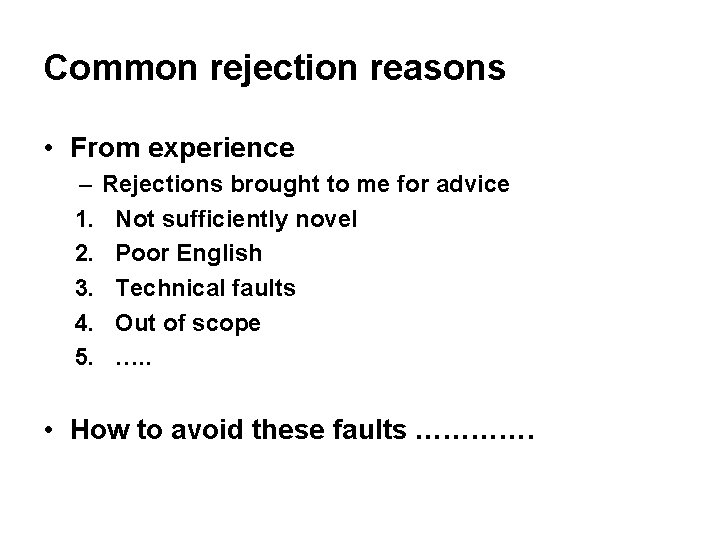
Common rejection reasons • From experience – Rejections brought to me for advice 1. Not sufficiently novel 2. Poor English 3. Technical faults 4. Out of scope 5. …. . • How to avoid these faults ………….
Avoiding Rejection Reasons NOT SUFFICIENTLY NOVEL
Not sufficiently novel • Very common rejection reason! • Need to read literature thoroughly L Very hard in 2019 – 100 s of papers on every topic – Many papers on ‘hot’ topics – Accept this! – Plan to spend many hours in library or – Google searches – <1 day / week on reading literature Þ ‘Not sufficiently novel’ rejections
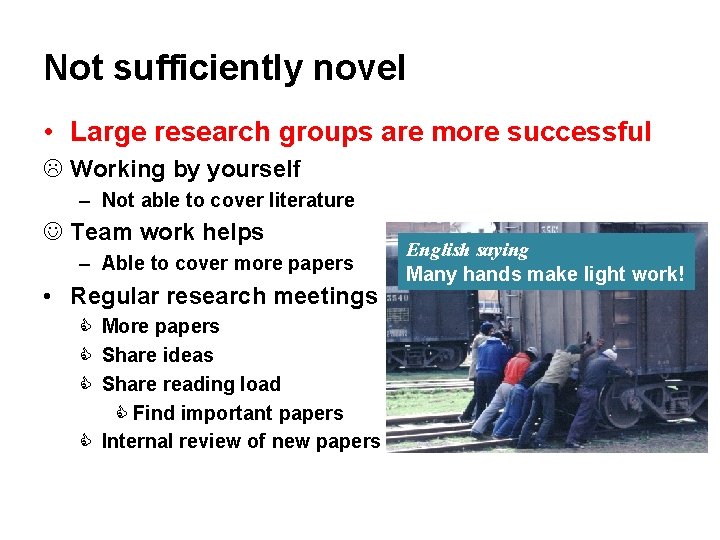
Not sufficiently novel • Large research groups are more successful L Working by yourself – Not able to cover literature J Team work helps – Able to cover more papers • Regular research meetings C More papers C Share ideas C Share reading load C Find important papers C Internal review of new papers English saying Many hands make light work!
Avoiding Rejection Reasons ENGLISH WEAK
English problems • Have your text checked! • Find a native speaker! or European • Languages with similar complex grammar • Bad English can lead to long delays – Checking before submission takes days • or less for short papers • Rejections take weeks or months
English weak • Rule #1 • Rule #2 • Rule #3 KEEP IT SIMPLE Do not add any unneeded words Make sure every sentence has <subject> <verb> <object> • Rule #4 • Rule #5 Read KISS before starting • Rule #6 Find some good model papers * Look in high impact factor journals * Native speaker authors * If you can’t read the paper, probably others can’t read it either Make sure somebody checks it carefully Preferably a native speaker
English weak • Rule #5 • Rule #6 KEEP IT SIMPLE (in case you forgot Rule #1) – Make sure somebody checks it carefully – Preferably a native speaker • Rule #7 – Find some good model papers – Look in high impact factor journals • Native speaker authors • But some of them write badly too!! • If you can’t read the paper, probably others can’t read it either – Apply John’s 24 hour rule
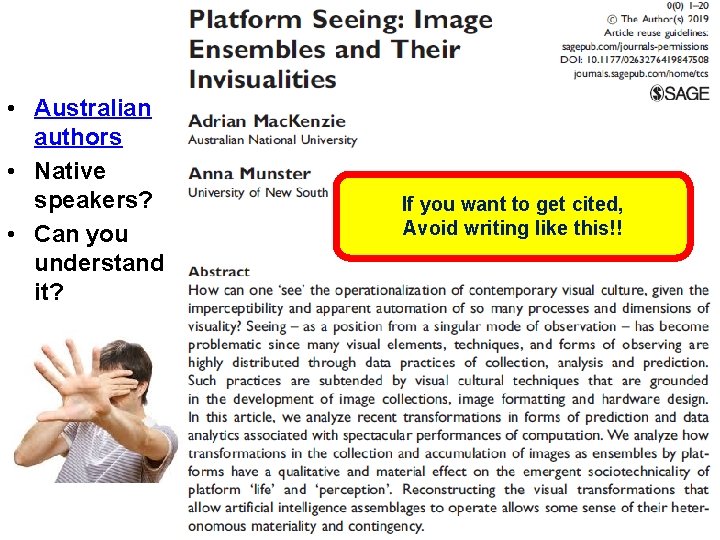
• Australian authors • Native speakers? • Can you understand it? If you want to get cited, Avoid writing like this!!
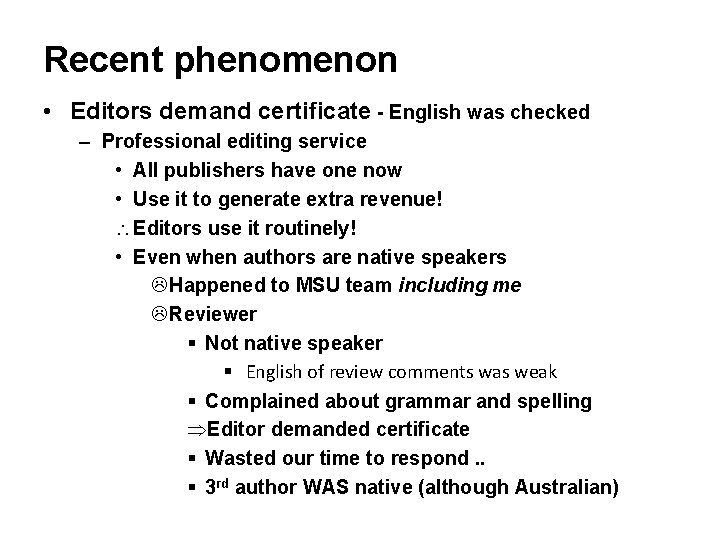
Recent phenomenon • Editors demand certificate - English was checked – Professional editing service • All publishers have one now • Use it to generate extra revenue! Editors use it routinely! • Even when authors are native speakers L Happened to MSU team including me L Reviewer § Not native speaker § English of review comments was weak § Complained about grammar and spelling ÞEditor demanded certificate § Wasted our time to respond. . § 3 rd author WAS native (although Australian)
Avoiding Rejection Reasons NOT ENOUGH DATA
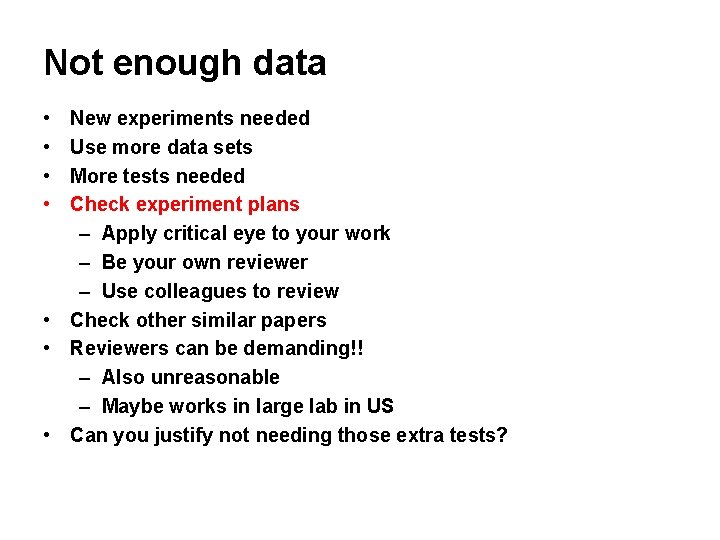
Not enough data • • New experiments needed Use more data sets More tests needed Check experiment plans – Apply critical eye to your work – Be your own reviewer – Use colleagues to review • Check other similar papers • Reviewers can be demanding!! – Also unreasonable – Maybe works in large lab in US • Can you justify not needing those extra tests?
Responding to the editor REVISION REQUIRED
Minor or Major Revisions Actions • Read and study review carefully • Ask colleagues to comment – Make sure you understood criticism – Review comments are often cryptic – Reviewers are under pressure to complete quickly
Minor or Major Revisions Actions • Prepare a response for the editor • Copy every comment by the editor or reviewers – Start with comments from the editor • Good idea – Reviewers comments in italics – Your response in normal text or – Use colours to distinguish • reviewer complaints vs your answers • Insert your answer
Responding to the editor SUMMARY
Actions • Form large research groups – Multiple disciplinary groups are good – Modern communications • Group can cover many countries • Team work the best solution • Use colleagues to review your paper first john. mo@kmitl. ac. th
PLAGIARISM
Plagiarism Checks • Editors routinely run papers through plagiarism checks • Types of plagiarism – Accidental • Using same words to describe some experiment – Everybody writes the same (or similar) things • Copying phrases used by others in introduction – When you are writing about their work and – Reference it – Self plagiarism • Copying your own already published work
Real Plagiarism ý Claiming other people’s work as your own ý Theft of their work or ideas • If detected – Your paper and – your thesis too – Will be rejected • Avoid this – Good institutions and good journals • Will not accept your work again • Google serious plagiarism is detected easily now
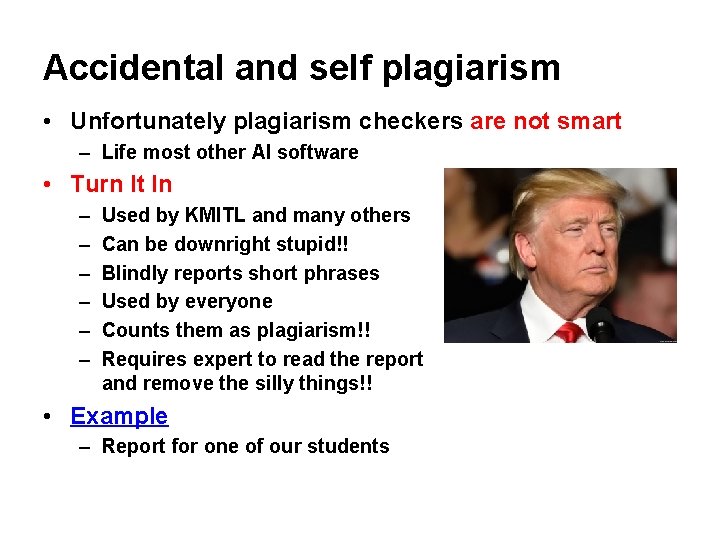
Accidental and self plagiarism • Unfortunately plagiarism checkers are not smart – Life most other AI software • Turn It In – – – Used by KMITL and many others Can be downright stupid!! Blindly reports short phrases Used by everyone Counts them as plagiarism!! Requires expert to read the report and remove the silly things!! • Example – Report for one of our students
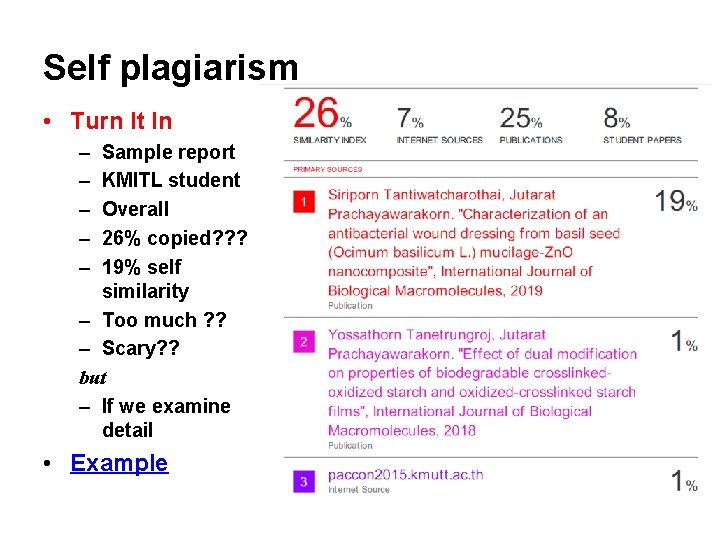
Self plagiarism • Turn It In – – – Sample report KMITL student Overall 26% copied? ? ? 19% self similarity – Too much ? ? – Scary? ? but – If we examine detail • Example
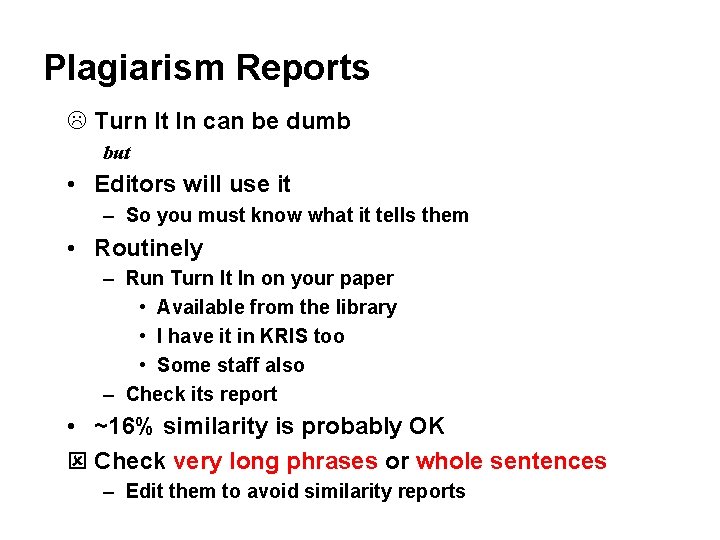
Plagiarism Reports L Turn It In can be dumb but • Editors will use it – So you must know what it tells them • Routinely – Run Turn It In on your paper • Available from the library • I have it in KRIS too • Some staff also – Check its report • ~16% similarity is probably OK ý Check very long phrases or whole sentences – Edit them to avoid similarity reports
Negotiating with editors REJECTIONS
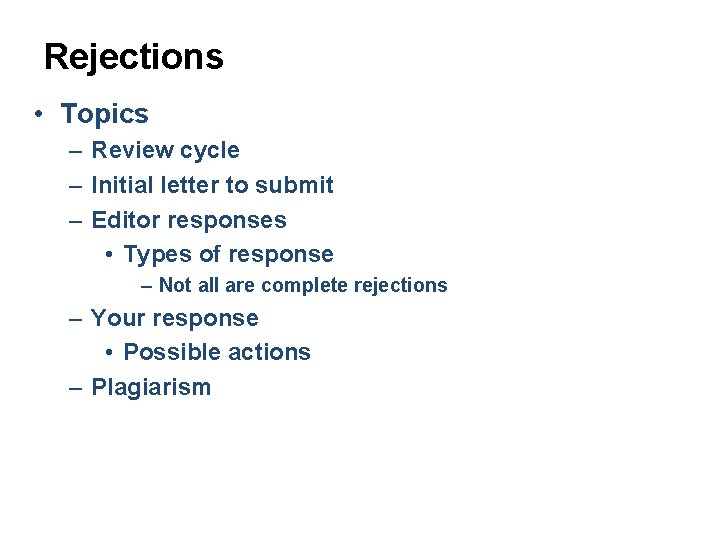
Rejections • Topics – Review cycle – Initial letter to submit – Editor responses • Types of response – Not all are complete rejections – Your response • Possible actions – Plagiarism
Procedures REVIEWS
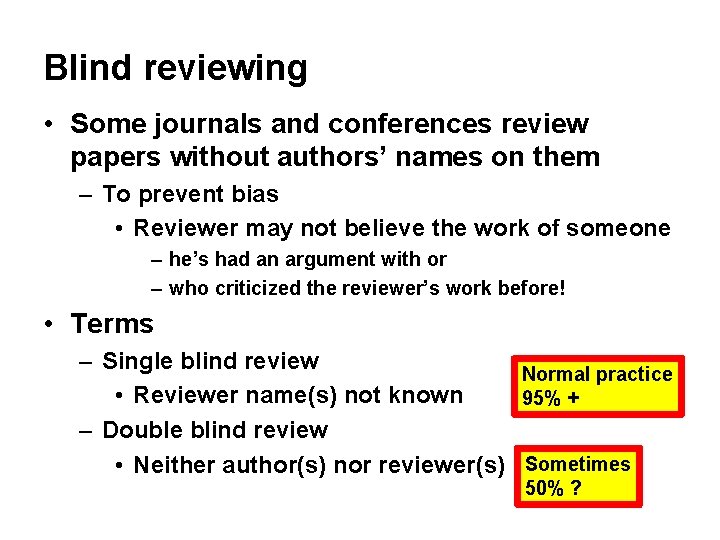
Blind reviewing • Some journals and conferences review papers without authors’ names on them – To prevent bias • Reviewer may not believe the work of someone – he’s had an argument with or – who criticized the reviewer’s work before! • Terms – Single blind review Normal practice • Reviewer name(s) not known 95% + – Double blind review Sometimes • Neither author(s) nor reviewer(s) known 50% ?
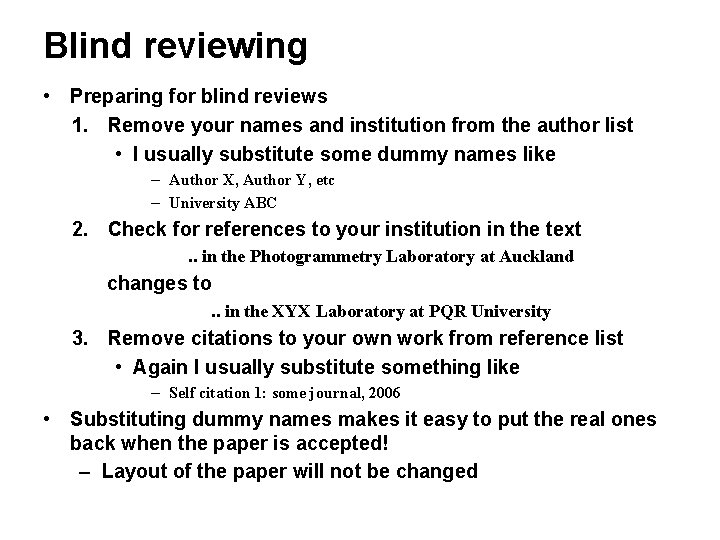
Blind reviewing • Preparing for blind reviews 1. Remove your names and institution from the author list • I usually substitute some dummy names like – Author X, Author Y, etc – University ABC 2. Check for references to your institution in the text. . in the Photogrammetry Laboratory at Auckland changes to. . in the XYX Laboratory at PQR University 3. Remove citations to your own work from reference list • Again I usually substitute something like – Self citation 1: some journal, 2006 • Substituting dummy names makes it easy to put the real ones back when the paper is accepted! – Layout of the paper will not be changed
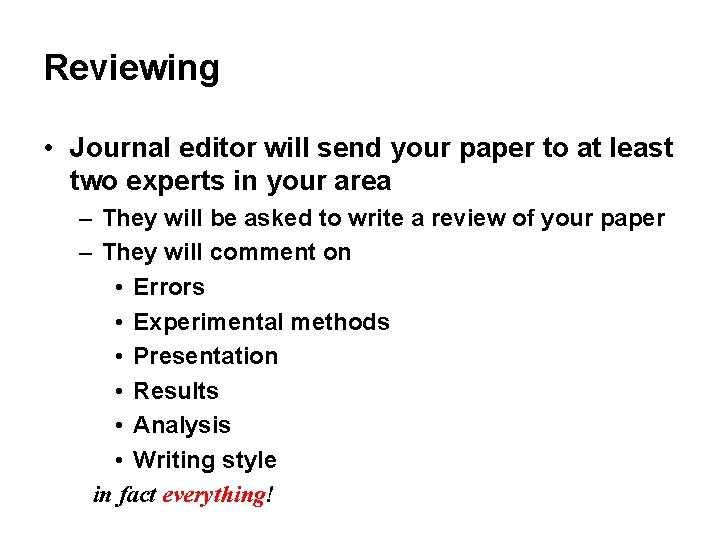
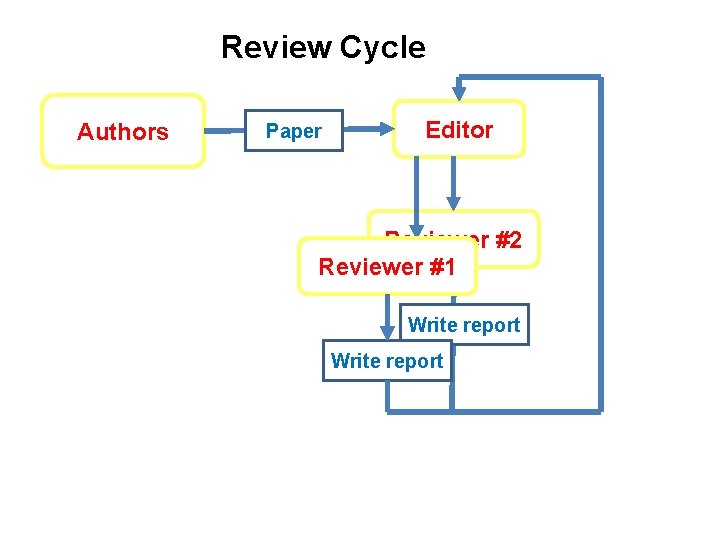
Reviewing • Journal editor will send your paper to at least two experts in your area – They will be asked to write a review of your paper – They will comment on • Errors • Experimental methods • Presentation • Results • Analysis • Writing style in fact everything!
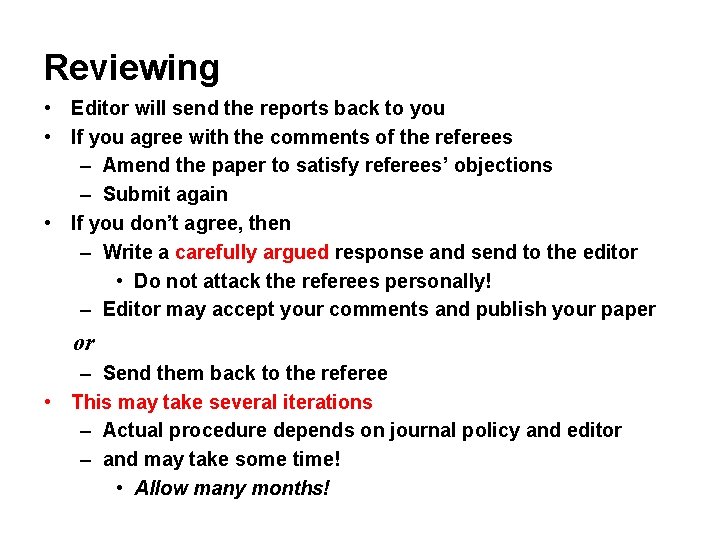
Reviewing • Editor will send the reports back to you • If you agree with the comments of the referees – Amend the paper to satisfy referees’ objections – Submit again • If you don’t agree, then – Write a carefully argued response and send to the editor • Do not attack the referees personally! – Editor may accept your comments and publish your paper or – Send them back to the referee • This may take several iterations – Actual procedure depends on journal policy and editor – and may take some time! • Allow many months!
Review Cycle Authors Paper Editor Reviewer #2 Reviewer #1 Write report
Reviewing • Referees are anonymous – You will not be told who they are – Don’t even ask!! • Big mistake of some authors – argue personally with the referees • Journal editors will not allow it • If you start such an argument, your paper is likely to be rejected immediately – You will be considered unprofessional • You must accept the referees’ comments as reasonable – Even if you don’t agree with them! • Anonymity is important in the reviewing process – Allows the referees to express their opinions freely! – Even a junior lecturer can criticize a senior professor IF he or she can justify the criticism!!
Final preparation • Editor has advised you that your paper is accepted – Make any corrections that the editor or the referees have requested – Prepare a final copy of your paper • Often referred to as the ‘camera ready’ copy – It will be photographed and bound into the journal – Check it carefully!! • Any mistakes will end up in print forever! – Check formatting requirements too • Some journals will ask for original La. Te. X files and separate image files
PREPARING YOUR PAPER
Submission • Check your paper first!! • Spelling – Spell checkers are mostly reliable • Use them!! • Few problems, eg where, wear – Mostly easily recognized • Dictionaries often incomplete – Technical terms missing – Word allows a custom dictionary » File Options Proofing – You can add technical terms to it » Avoids all those squiggly lines under words it thinks you did not type correctly
Submission • Check your paper first!! • Spelling – Spell checkers are mostly reliable • Use them!! • Few problems, eg where, wear – Mostly easily recognized • Dictionaries sometimes incomplete – Technical terms missing
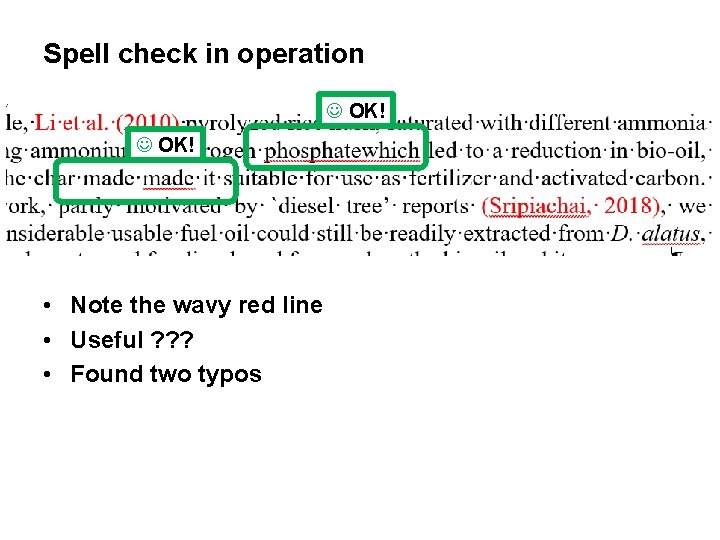
Spell check in operation J OK! • Note the wavy red line • Useful ? ? ? • Found two typos
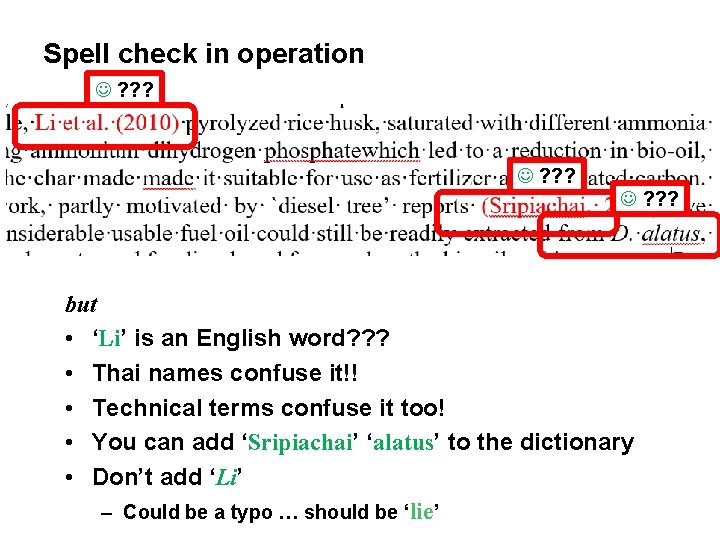
Spell check in operation J ? ? ? but • ‘Li’ is an English word? ? ? • Thai names confuse it!! • Technical terms confuse it too! • You can add ‘Sripiachai’ ‘alatus’ to the dictionary • Don’t add ‘Li’ – Could be a typo … should be ‘lie’
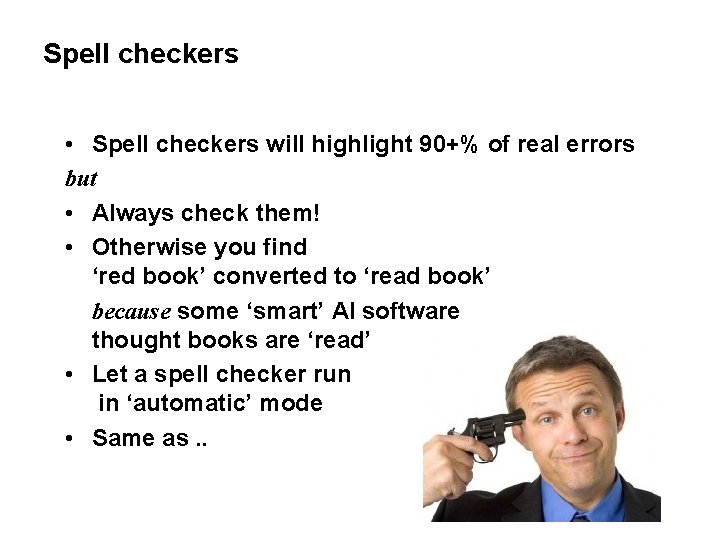
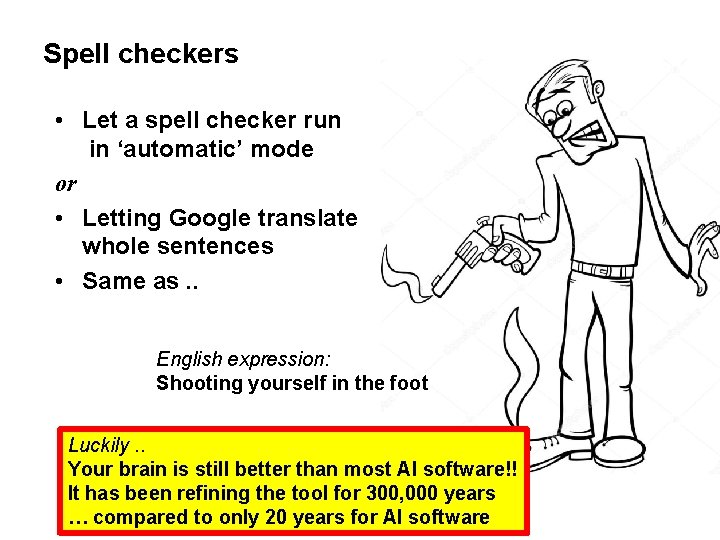
Spell checkers • Spell checkers will highlight 90+% of real errors but • Always check them! • Otherwise you find ‘red book’ converted to ‘read book’ because some ‘smart’ AI software thought books are ‘read’ • Let a spell checker run in ‘automatic’ mode • Same as. .
Spell checkers • Let a spell checker run in ‘automatic’ mode or • Letting Google translate whole sentences • Same as. . English expression: Shooting yourself in the foot Luckily. . Your brain is still better than most AI software!! It has been refining the tool for 300, 000 years … compared to only 20 years for AI software
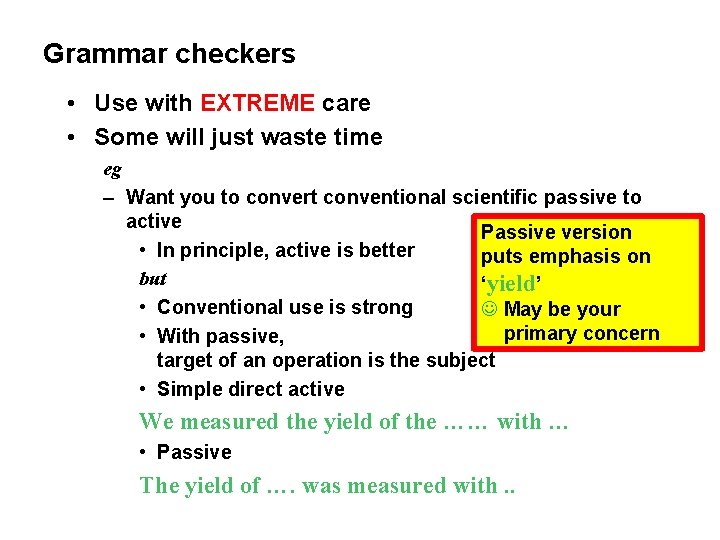
Grammar checkers • Use with EXTREME care • Some will just waste time eg – Want you to convert conventional scientific passive to active Passive version • In principle, active is better puts emphasis on but ‘yield’ • Conventional use is strong J May be your primary concern • With passive, target of an operation is the subject • Simple direct active We measured the yield of the …… with … • Passive The yield of …. was measured with. .
Checking • Spelling, grammar • Journal rules – Words in abstract – Formatting • Numbering sections – Reference format ? Figures and tables in text or at end – Serious differences may cause your paper to be sent back for correction before – Any reviewer has seen it!! ÞLoss of time and slower acceptance • Check plagiarism with Turn It In • More later
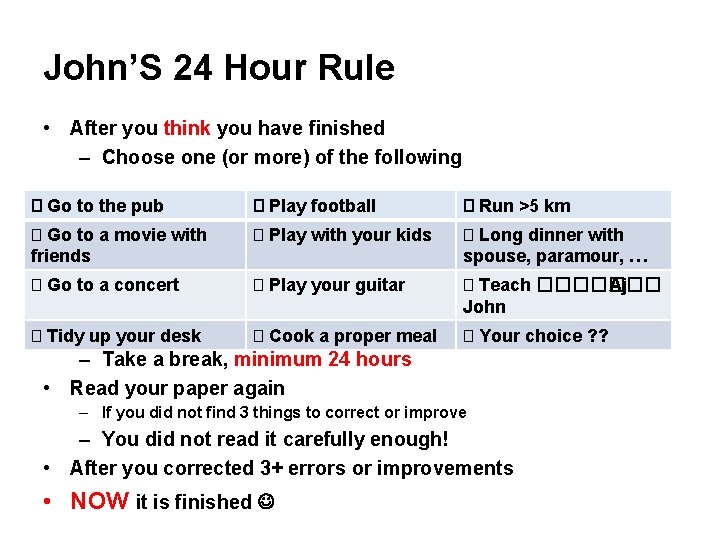
John’S 24 Hour Rule • After you think you have finished – Choose one (or more) of the following � Go to the pub � Play football � Run >5 km � Go to a movie with friends � Play with your kids � Long dinner with spouse, paramour, … � Go to a concert � Play your guitar � Teach ������� Aj John � Tidy up your desk � Cook a proper meal � Your choice ? ? – Take a break, minimum 24 hours • Read your paper again – If you did not find 3 things to correct or improve – You did not read it carefully enough! • After you corrected 3+ errors or improvements • NOW it is finished
Keep it Simple COVER LETTER
Cover Letter • Editors are busy. . Help them • Nice touch • Address the editor(s) by name Dear Sir/Madam L Ouch. . You did not even find out the name of the editor!! L Politer, less ‘business-like’ Dear Prof Watson or Dear Profs Black and White • Can’t find the editor name(s) Dear Editor(s) – Better than Sir/Madam
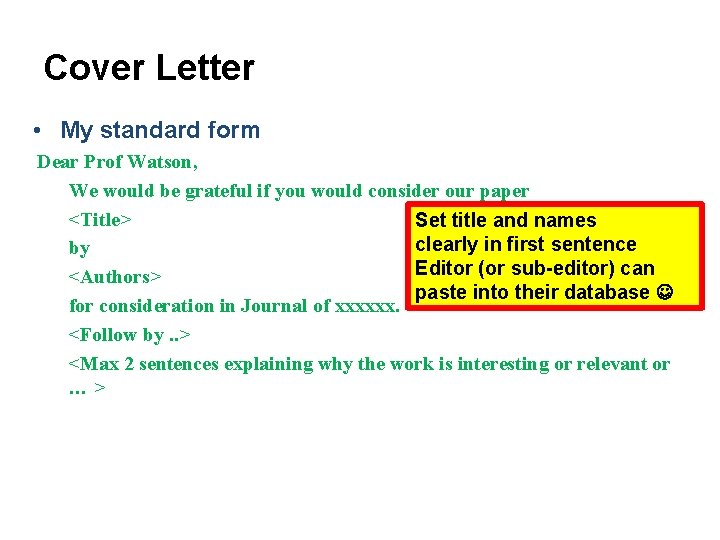
Cover Letter • My standard form Dear Prof Watson, We would be grateful if you would consider our paper <Title> Set title and names clearly in first sentence by Editor (or sub-editor) can <Authors> paste into their database for consideration in Journal of xxxxxx. <Follow by. . > <Max 2 sentences explaining why the work is interesting or relevant or …>
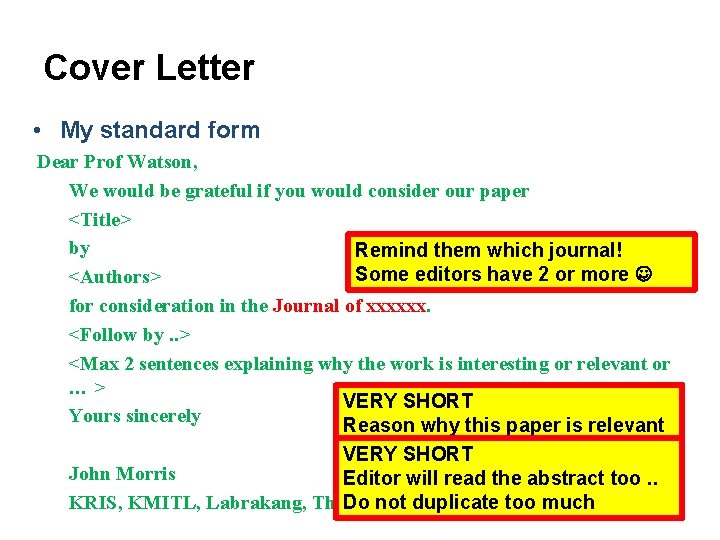
Cover Letter • My standard form Dear Prof Watson, We would be grateful if you would consider our paper <Title> by Remind them which journal! Some editors have 2 or more <Authors> for consideration in the Journal of xxxxxx. <Follow by. . > <Max 2 sentences explaining why the work is interesting or relevant or …> VERY SHORT Yours sincerely Reason why this paper is relevant to this. SHORT journal and important VERY John Morris Editor will read the abstract too. . KRIS, KMITL, Labrakang, Thailaind Do not duplicate too much
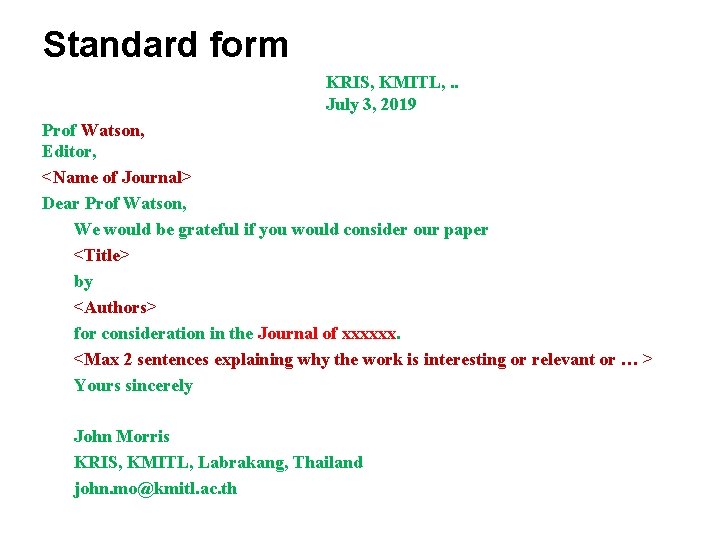
Standard form KRIS, KMITL, . . July 3, 2019 Prof Watson, Editor, <Name of Journal> Dear Prof Watson, We would be grateful if you would consider our paper <Title> by <Authors> for consideration in the Journal of xxxxxx. <Max 2 sentences explaining why the work is interesting or relevant or … > Yours sincerely John Morris KRIS, KMITL, Labrakang, Thailand john. mo@kmitl. ac. th
RESPONSE FROM EDITOR