
Avoiding Plagiarism Dont let this happen to you
- Slides: 11
Avoiding Plagiarism Don’t let this happen to you!
Plagiarism Defined Plagiarism is using someone else’s words or ideas without giving proper credit- or without giving any credit at all- to the writer of the original. Whether plagiarism is intentional or unintentional, it is a serious offense that you can avoid by simply paraphrasing or directly quoting text.
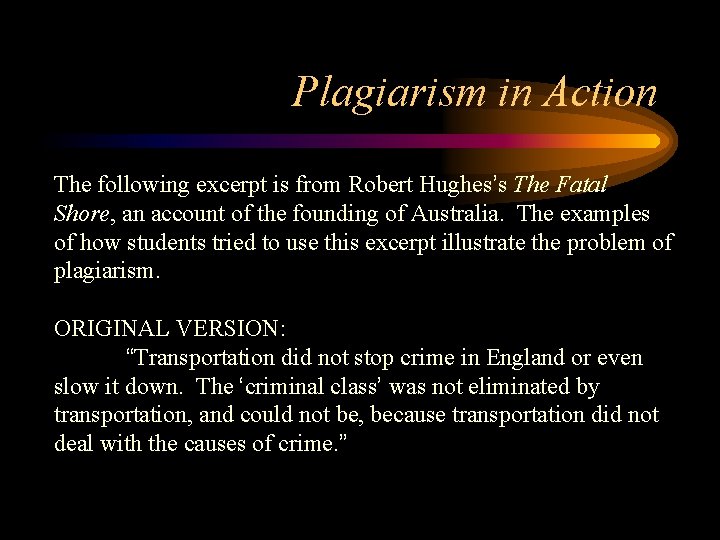
Plagiarism in Action The following excerpt is from Robert Hughes’s The Fatal Shore, an account of the founding of Australia. The examples of how students tried to use this excerpt illustrate the problem of plagiarism. ORIGINAL VERSION: “Transportation did not stop crime in England or even slow it down. The ‘criminal class’ was not eliminated by transportation, and could not be, because transportation did not deal with the causes of crime. ”
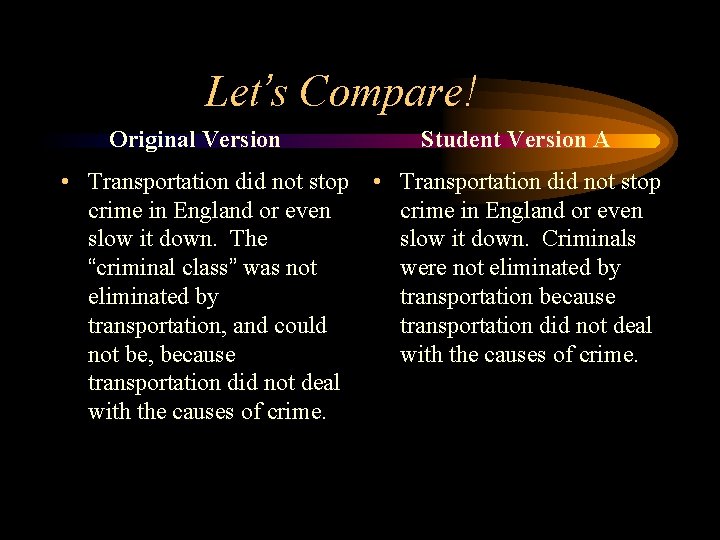
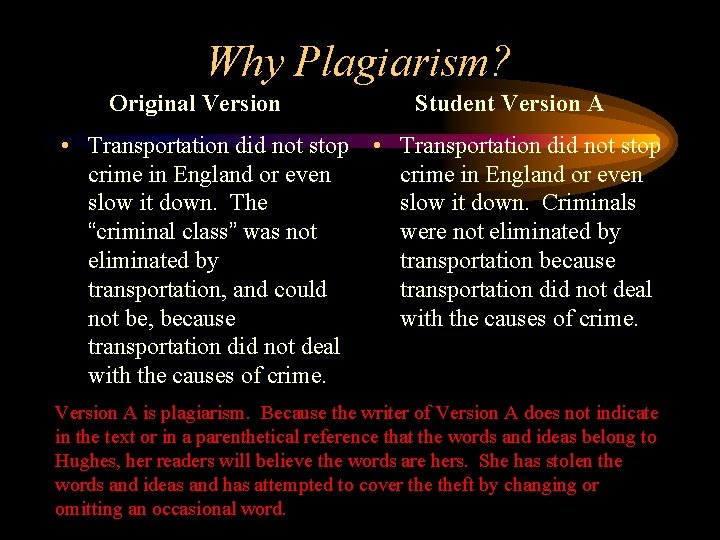
Let’s Compare! Original Version • Transportation did not stop crime in England or even slow it down. The “criminal class” was not eliminated by transportation, and could not be, because transportation did not deal with the causes of crime. Student Version A • Transportation did not stop crime in England or even slow it down. Criminals were not eliminated by transportation because transportation did not deal with the causes of crime.
Why Plagiarism? Original Version • Transportation did not stop crime in England or even slow it down. The “criminal class” was not eliminated by transportation, and could not be, because transportation did not deal with the causes of crime. Student Version A • Transportation did not stop crime in England or even slow it down. Criminals were not eliminated by transportation because transportation did not deal with the causes of crime. Version A is plagiarism. Because the writer of Version A does not indicate in the text or in a parenthetical reference that the words and ideas belong to Hughes, her readers will believe the words are hers. She has stolen the words and ideas and has attempted to cover theft by changing or omitting an occasional word.
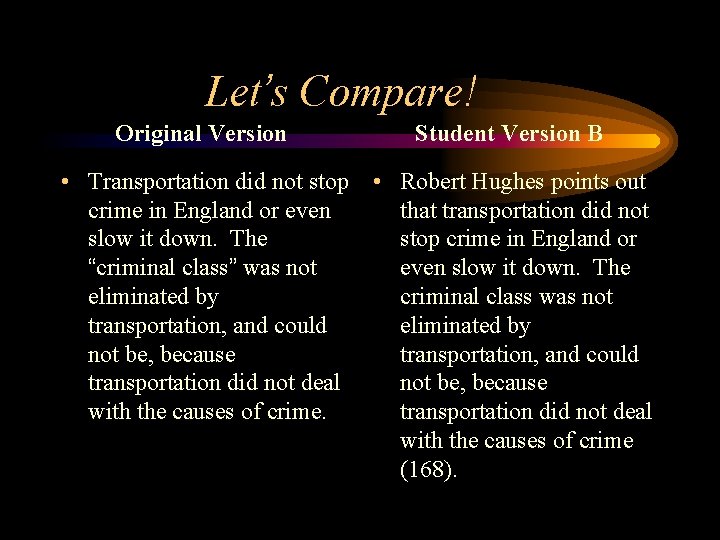
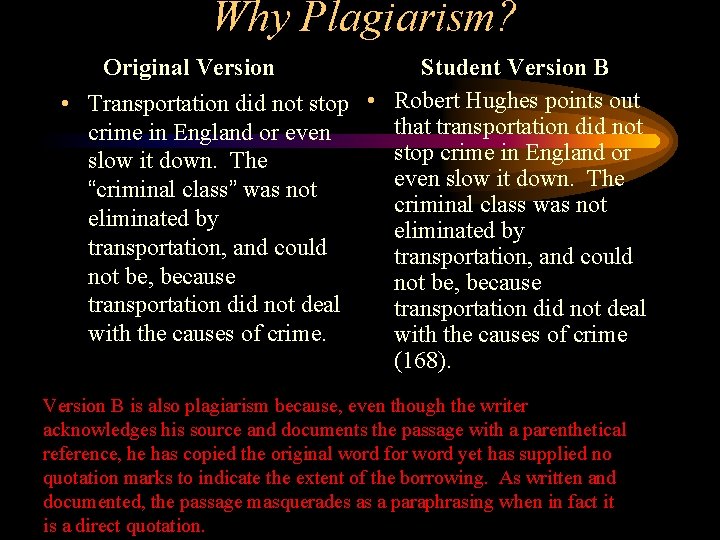
Let’s Compare! Original Version Student Version B • Transportation did not stop crime in England or even slow it down. The “criminal class” was not eliminated by transportation, and could not be, because transportation did not deal with the causes of crime. • Robert Hughes points out that transportation did not stop crime in England or even slow it down. The criminal class was not eliminated by transportation, and could not be, because transportation did not deal with the causes of crime (168).
Why Plagiarism? Original Version Student Version B • Transportation did not stop • Robert Hughes points out that transportation did not crime in England or even stop crime in England or slow it down. The even slow it down. The “criminal class” was not criminal class was not eliminated by transportation, and could not be, because transportation did not deal with the causes of crime (168). Version B is also plagiarism because, even though the writer acknowledges his source and documents the passage with a parenthetical reference, he has copied the original word for word yet has supplied no quotation marks to indicate the extent of the borrowing. As written and documented, the passage masquerades as a paraphrasing when in fact it is a direct quotation.
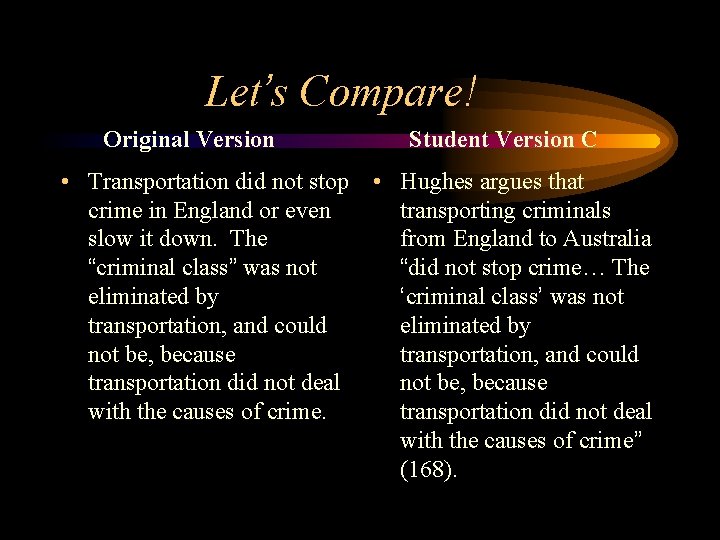
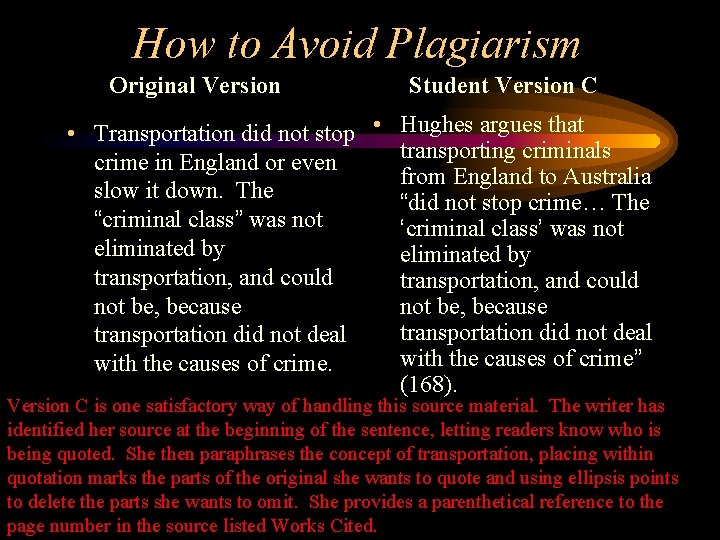
Let’s Compare! Original Version • Transportation did not stop crime in England or even slow it down. The “criminal class” was not eliminated by transportation, and could not be, because transportation did not deal with the causes of crime. Student Version C • Hughes argues that transporting criminals from England to Australia “did not stop crime… The ‘criminal class’ was not eliminated by transportation, and could not be, because transportation did not deal with the causes of crime” (168).
How to Avoid Plagiarism Original Version Student Version C • Transportation did not stop • Hughes argues that transporting criminals crime in England or even from England to Australia slow it down. The “did not stop crime… The “criminal class” was not ‘criminal class’ was not eliminated by transportation, and could not be, because transportation did not deal with the causes of crime” with the causes of crime. (168). Version C is one satisfactory way of handling this source material. The writer has identified her source at the beginning of the sentence, letting readers know who is being quoted. She then paraphrases the concept of transportation, placing within quotation marks the parts of the original she wants to quote and using ellipsis points to delete the parts she wants to omit. She provides a parenthetical reference to the page number in the source listed Works Cited.
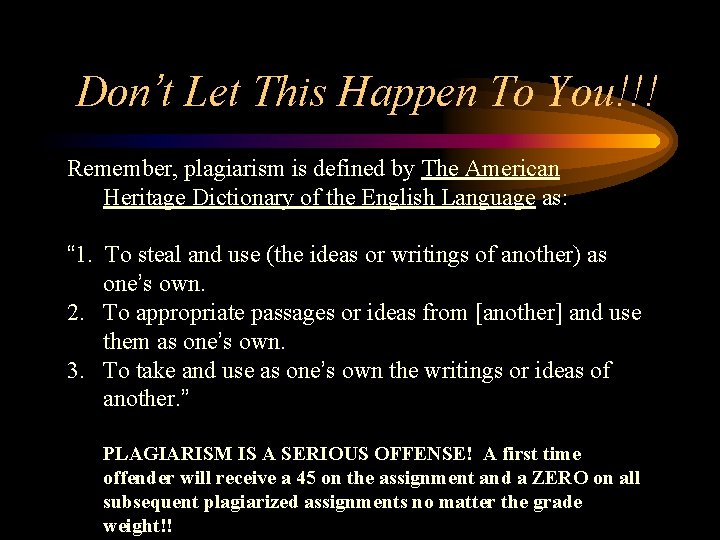
Don’t Let This Happen To You!!! Remember, plagiarism is defined by The American Heritage Dictionary of the English Language as: “ 1. To steal and use (the ideas or writings of another) as one’s own. 2. To appropriate passages or ideas from [another] and use them as one’s own. 3. To take and use as one’s own the writings or ideas of another. ” PLAGIARISM IS A SERIOUS OFFENSE! A first time offender will receive a 45 on the assignment and a ZERO on all subsequent plagiarized assignments no matter the grade weight!!
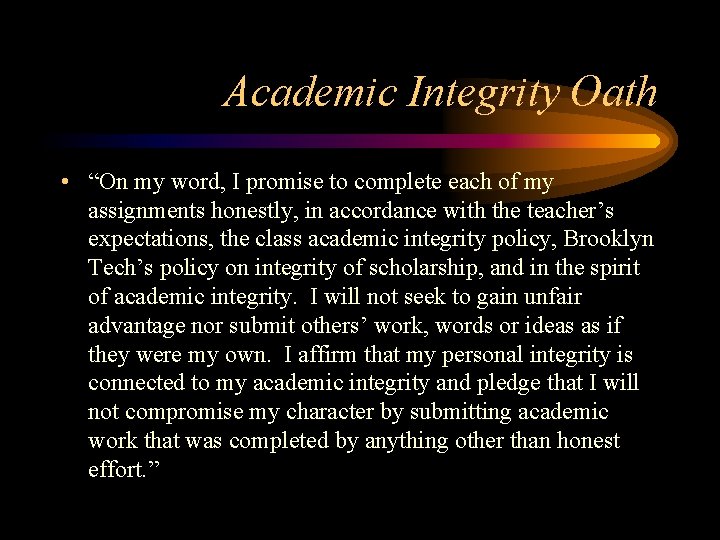
Academic Integrity Oath • “On my word, I promise to complete each of my assignments honestly, in accordance with the teacher’s expectations, the class academic integrity policy, Brooklyn Tech’s policy on integrity of scholarship, and in the spirit of academic integrity. I will not seek to gain unfair advantage nor submit others’ work, words or ideas as if they were my own. I affirm that my personal integrity is connected to my academic integrity and pledge that I will not compromise my character by submitting academic work that was completed by anything other than honest effort. ”