
Avoiding Plagiarism Copying and Pasting from the Internet
- Slides: 26
Avoiding Plagiarism Copying and Pasting from the Internet is PLAGIARISM – even if you change a few words!!! 1. DIRECTIONS: The following slides contain important information on plagiarism. You will use this information to answer several plagiarism questions on your syllabus. 1
What is PLAGIARISM? n Plagiarism - Copying or using some else’s words or ideas and presenting them as your own. It is unethical and illegal. What does THAT mean…. ? ? ? ? There are ELEVEN ways to commit plagiarism…… 2
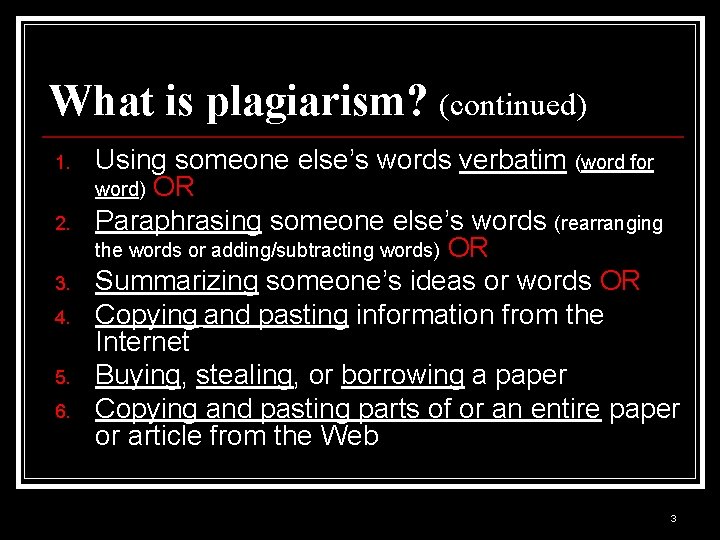
What is plagiarism? (continued) 1. 2. 3. 4. 5. 6. Using someone else’s words verbatim (word for word) OR Paraphrasing someone else’s words (rearranging the words or adding/subtracting words) OR Summarizing someone’s ideas or words OR Copying and pasting information from the Internet Buying, stealing, or borrowing a paper Copying and pasting parts of or an entire paper or article from the Web 3
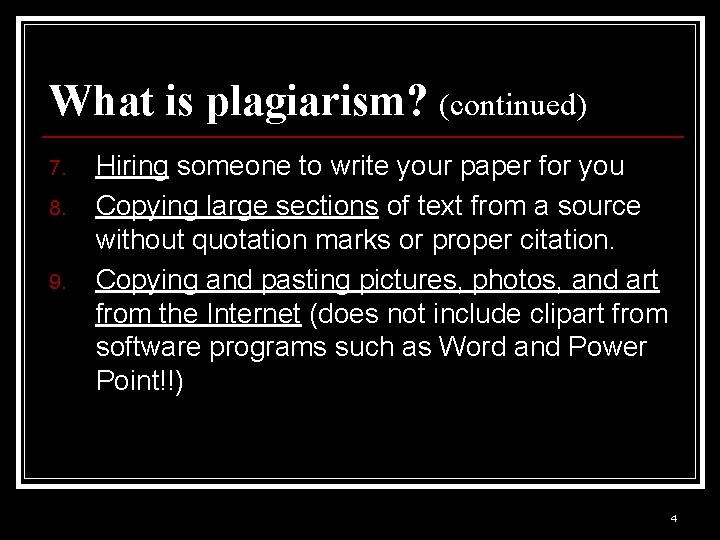
What is plagiarism? (continued) 7. 8. 9. Hiring someone to write your paper for you Copying large sections of text from a source without quotation marks or proper citation. Copying and pasting pictures, photos, and art from the Internet (does not include clipart from software programs such as Word and Power Point!!) 4
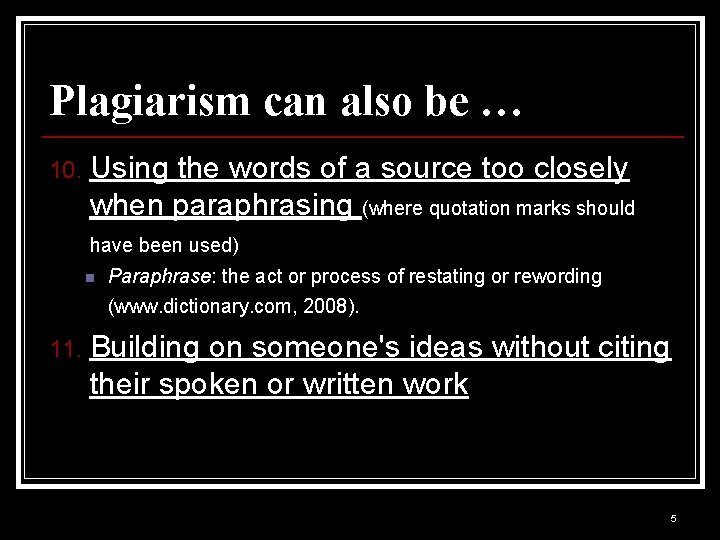
Plagiarism can also be … 10. Using the words of a source too closely when paraphrasing (where quotation marks should have been used) n 11. Paraphrase: the act or process of restating or rewording (www. dictionary. com, 2008). Building on someone's ideas without citing their spoken or written work 5
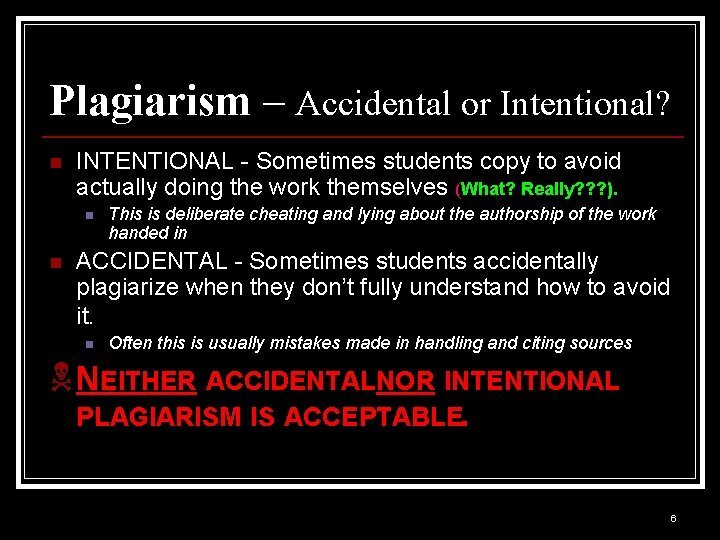
Plagiarism – Accidental or Intentional? n INTENTIONAL - Sometimes students copy to avoid actually doing the work themselves (What? Really? ? ? ). n n This is deliberate cheating and lying about the authorship of the work handed in ACCIDENTAL - Sometimes students accidentally plagiarize when they don’t fully understand how to avoid it. n Often this is usually mistakes made in handling and citing sources N NEITHER ACCIDENTALNOR INTENTIONAL PLAGIARISM IS ACCEPTABLE. 6
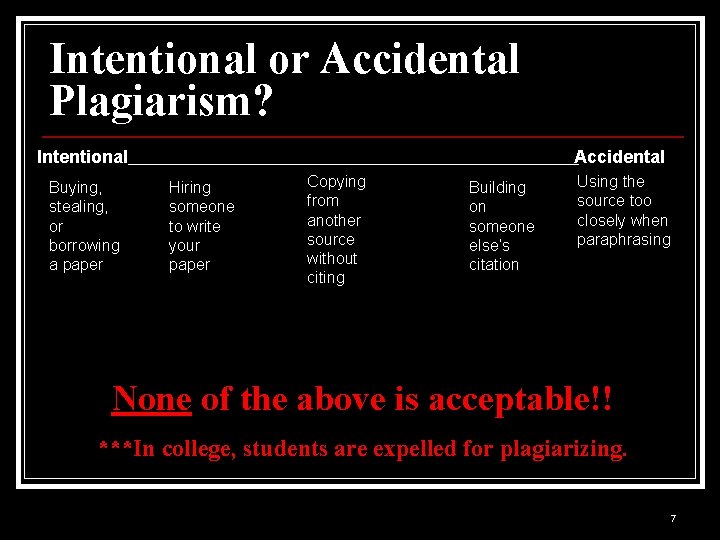
Intentional or Accidental Plagiarism? Intentional_________________________________________Accidental Buying, stealing, or borrowing a paper Hiring someone to write your paper Copying from another source without citing Building on someone else’s citation Using the source too closely when paraphrasing None of the above is acceptable!! ***In college, students are expelled for plagiarizing. 7
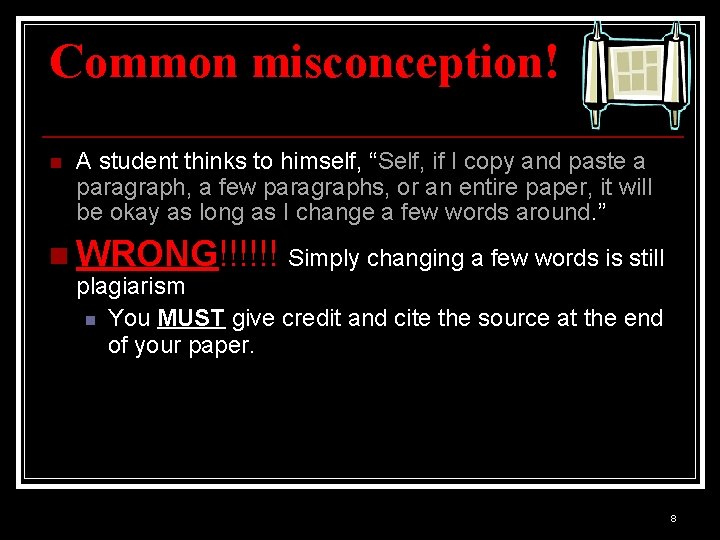
Common misconception! n A student thinks to himself, “Self, if I copy and paste a paragraph, a few paragraphs, or an entire paper, it will be okay as long as I change a few words around. ” n WRONG!!!!!! Simply changing a few words is still plagiarism n You MUST give credit and cite the source at the end of your paper. 8
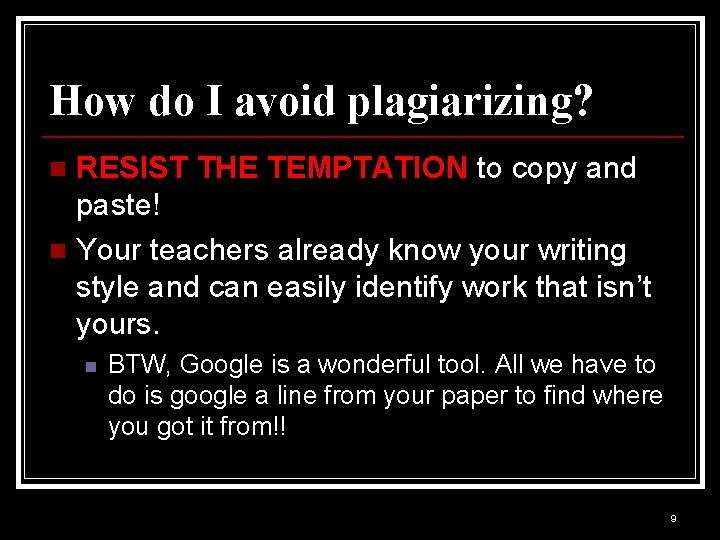
How do I avoid plagiarizing? RESIST THE TEMPTATION to copy and paste! n Your teachers already know your writing style and can easily identify work that isn’t yours. n n BTW, Google is a wonderful tool. All we have to do is google a line from your paper to find where you got it from!! 9
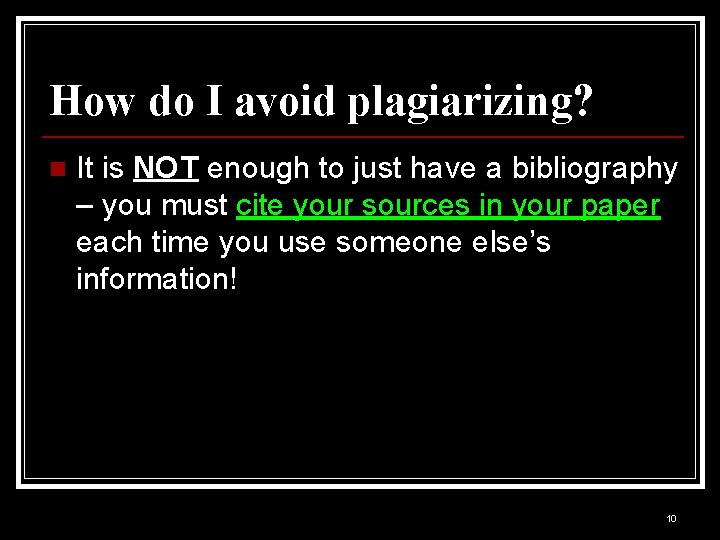
How do I avoid plagiarizing? n It is NOT enough to just have a bibliography – you must cite your sources in your paper each time you use someone else’s information! 10
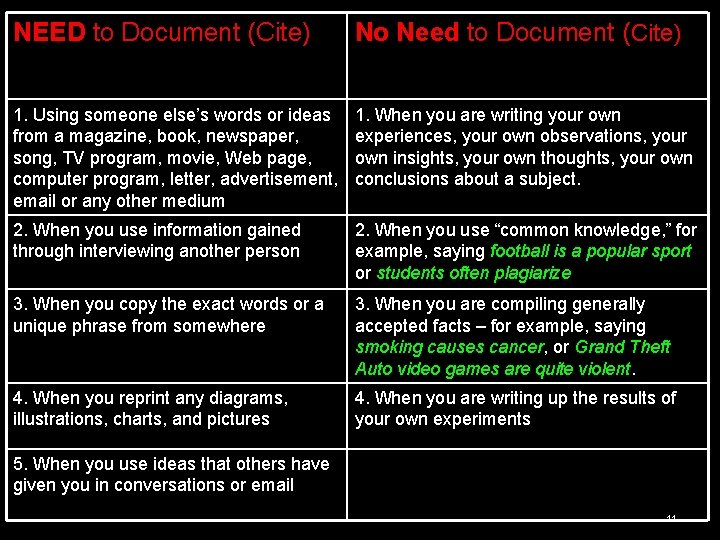
NEED to Document (Cite) No Need to Document (Cite) 1. Using someone else’s words or ideas from a magazine, book, newspaper, song, TV program, movie, Web page, computer program, letter, advertisement, email or any other medium 1. When you are writing your own experiences, your own observations, your own insights, your own thoughts, your own conclusions about a subject. 2. When you use information gained through interviewing another person 2. When you use “common knowledge, ” for example, saying football is a popular sport or students often plagiarize 3. When you copy the exact words or a unique phrase from somewhere 3. When you are compiling generally accepted facts – for example, saying smoking causes cancer, or Grand Theft Auto video games are quite violent. 4. When you reprint any diagrams, illustrations, charts, and pictures 4. When you are writing up the results of your own experiments 5. When you use ideas that others have given you in conversations or email 11
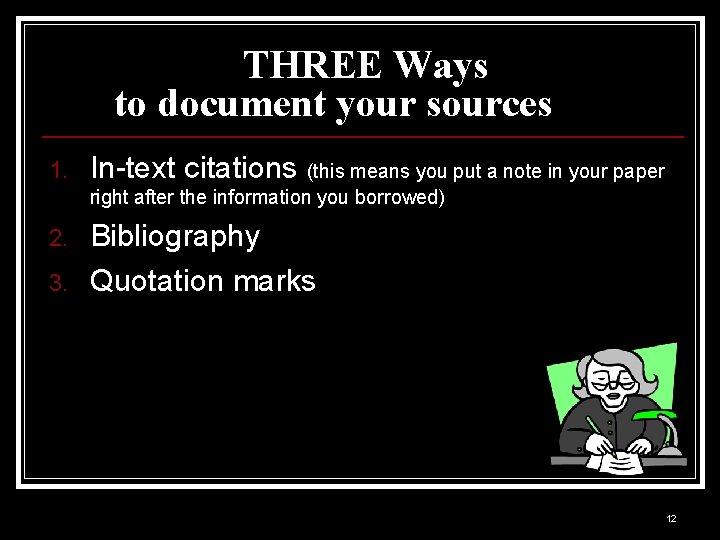
THREE Ways to document your sources 1. In-text citations (this means you put a note in your paper right after the information you borrowed) 2. 3. Bibliography Quotation marks 12
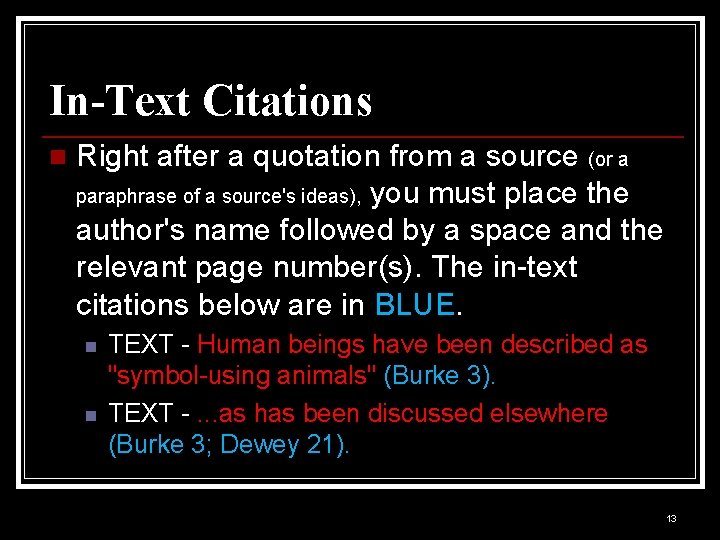
In-Text Citations n Right after a quotation from a source (or a paraphrase of a source's ideas), you must place the author's name followed by a space and the relevant page number(s). The in-text citations below are in BLUE. n n TEXT - Human beings have been described as "symbol-using animals" (Burke 3). TEXT -. . . as has been discussed elsewhere (Burke 3; Dewey 21). 13
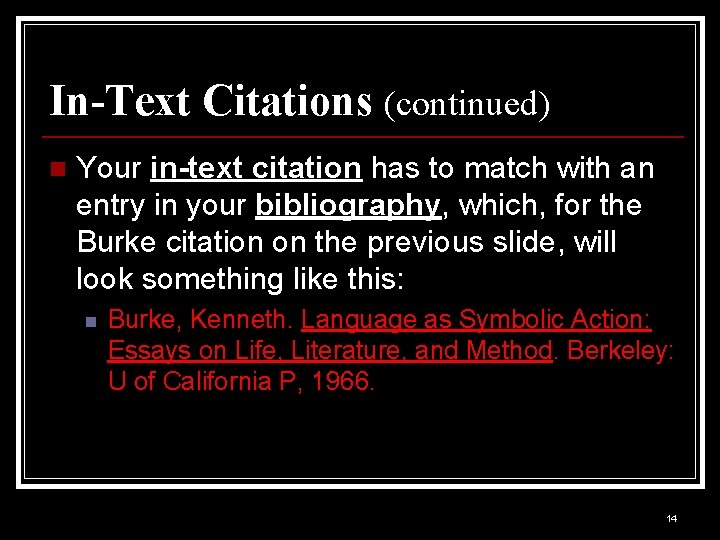
In-Text Citations (continued) n Your in-text citation has to match with an entry in your bibliography, which, for the Burke citation on the previous slide, will look something like this: n Burke, Kenneth. Language as Symbolic Action: Essays on Life, Literature, and Method. Berkeley: U of California P, 1966. 14
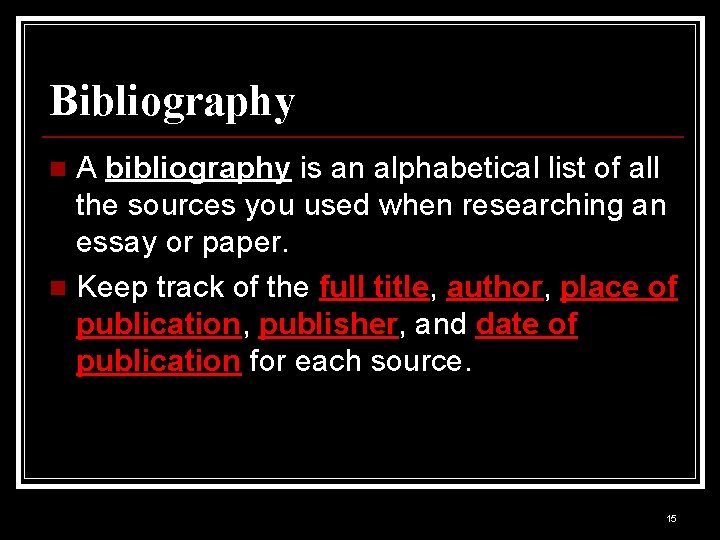
Bibliography A bibliography is an alphabetical list of all the sources you used when researching an essay or paper. n Keep track of the full title, author, place of publication, publisher, and date of publication for each source. n 15
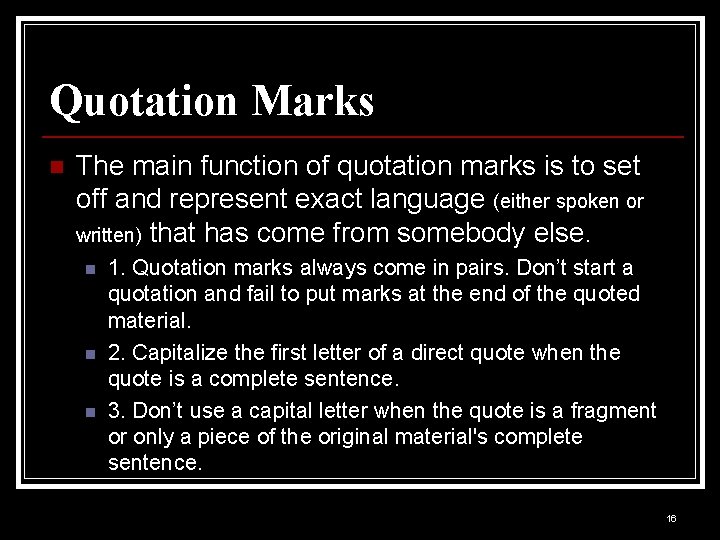
Quotation Marks n The main function of quotation marks is to set off and represent exact language (either spoken or written) that has come from somebody else. n n n 1. Quotation marks always come in pairs. Don’t start a quotation and fail to put marks at the end of the quoted material. 2. Capitalize the first letter of a direct quote when the quote is a complete sentence. 3. Don’t use a capital letter when the quote is a fragment or only a piece of the original material's complete sentence. 16
So How Do I Avoid Plagiarism? 1. For EACH source (book, journal, article, e-mail, conversation, song lyrics, newspaper, webpage, etc) that you use in your research, you need to write some basic information on a note card(ONE note card per source). 2. The following slides show you what information you need for four of the most common sources: book, magazine/journal, newspaper, and online. 17
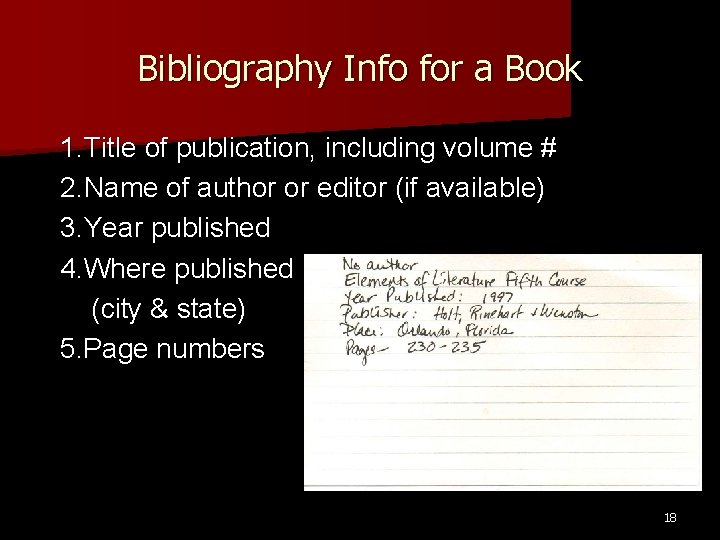
Bibliography Info for a Book 1. Title of publication, including volume # 2. Name of author or editor (if available) 3. Year published 4. Where published (city & state) 5. Page numbers 18
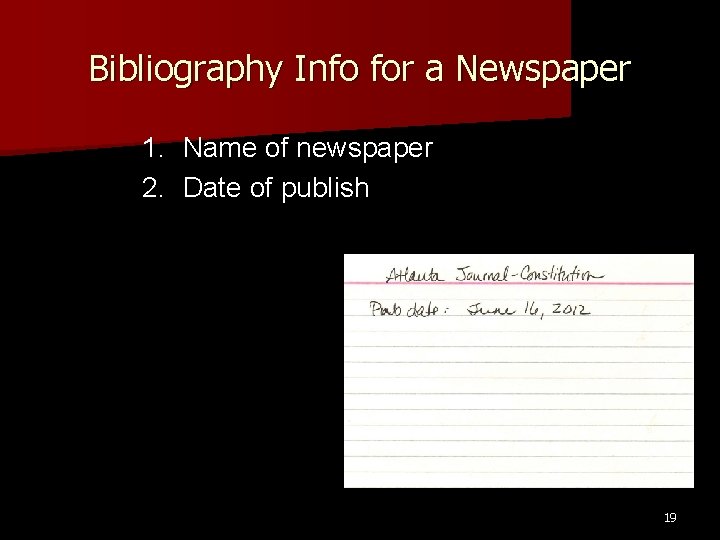
Bibliography Info for a Newspaper 1. Name of newspaper 2. Date of publish 19
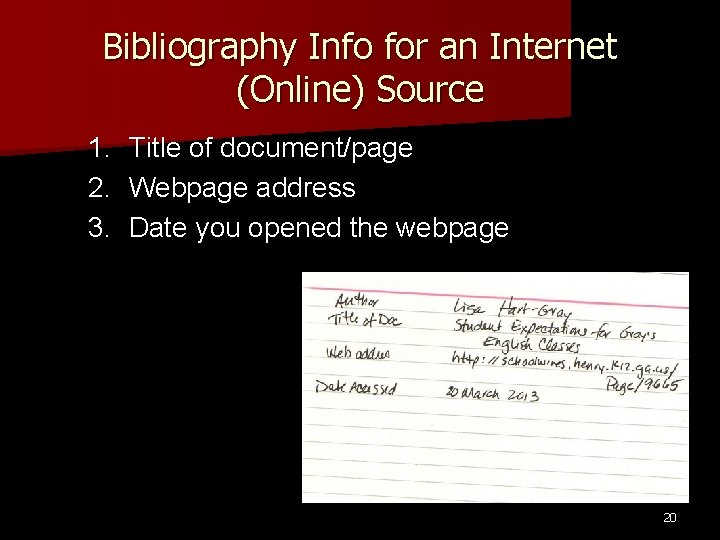
Bibliography Info for an Internet (Online) Source 1. Title of document/page 2. Webpage address 3. Date you opened the webpage 20
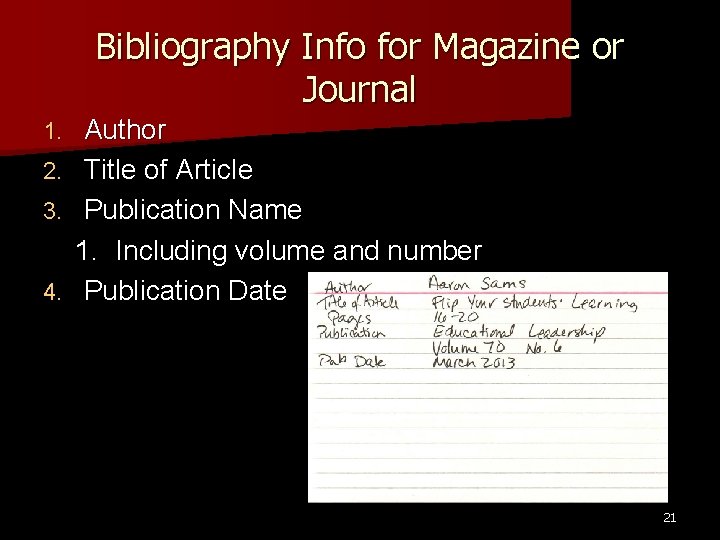
Bibliography Info for Magazine or Journal 1. 2. 3. 4. Author Title of Article Publication Name 1. Including volume and number Publication Date 21
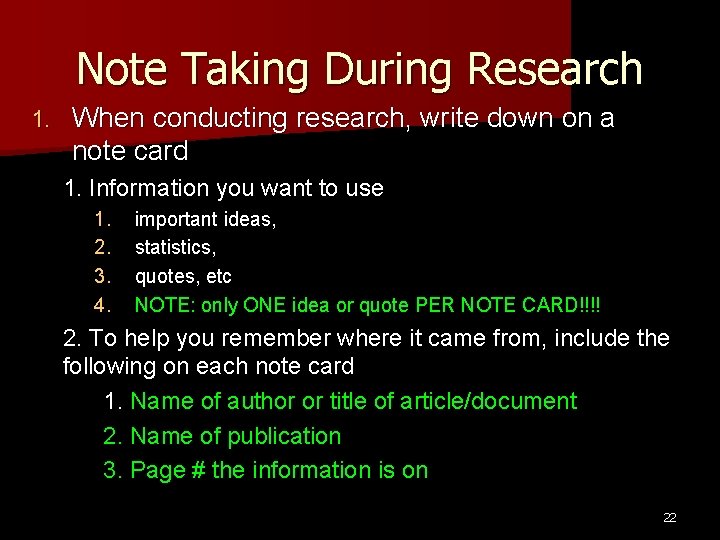
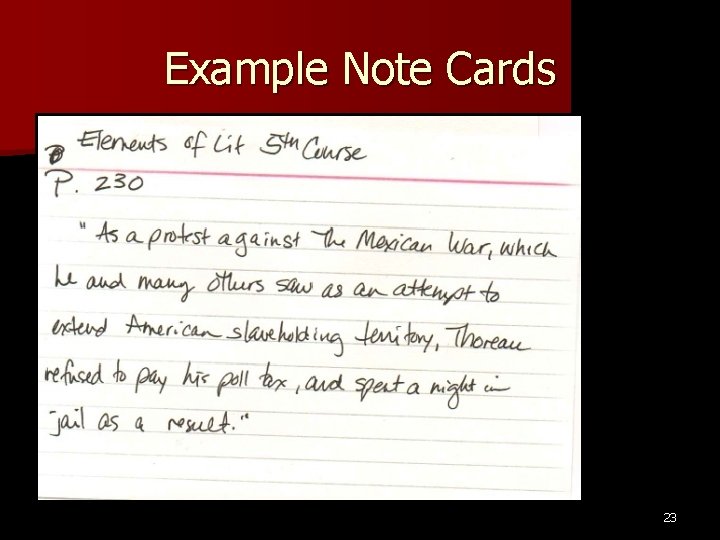
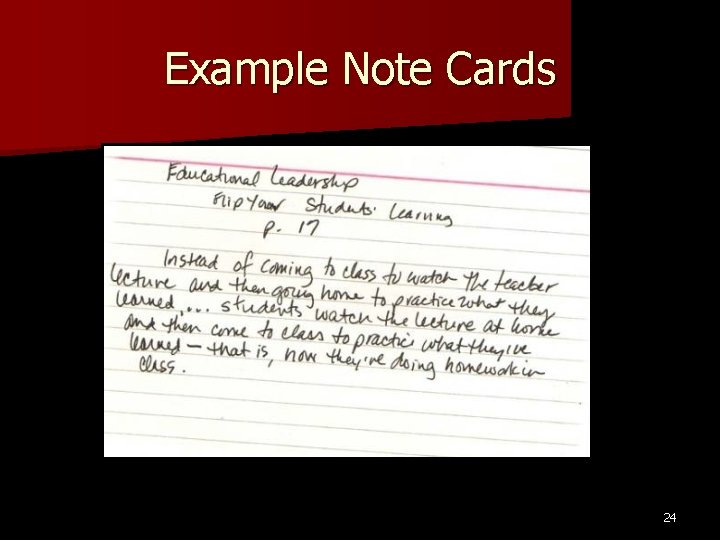
Note Taking During Research 1. When conducting research, write down on a note card 1. Information you want to use 1. 2. 3. 4. important ideas, statistics, quotes, etc NOTE: only ONE idea or quote PER NOTE CARD!!!! 2. To help you remember where it came from, include the following on each note card 1. Name of author or title of article/document 2. Name of publication 3. Page # the information is on 22
Example Note Cards 23
Example Note Cards 24
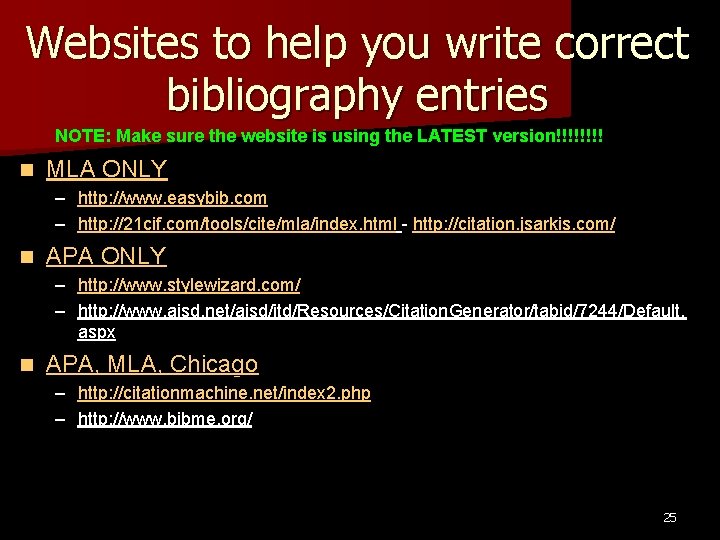
Websites to help you write correct bibliography entries NOTE: Make sure the website is using the LATEST version!!!! n MLA ONLY – http: //www. easybib. com – http: //21 cif. com/tools/cite/mla/index. html - http: //citation. jsarkis. com/ n APA ONLY – http: //www. stylewizard. com/ – http: //www. aisd. net/aisd/itd/Resources/Citation. Generator/tabid/7244/Default. aspx n APA, MLA, Chicago – http: //citationmachine. net/index 2. php – http: //www. bibme. org/ 25
Avoid Plagiarism ALL THE TIME YOU are responsible for correctly citing information that you take from someone else. n You will use this information ALL THE TIME – not just in English class and not just for this particular assignment. n Colleges, Tech Schools, and professionals will not tolerate plagiarism. You could (among other things) n – Lose your job – Be expelled from college/tech school – Be sued by the person you “stole/borrowed” the information from 26