
AVOIDING BIAS AND RANDOM ERROR IN DATA ANALYSIS
AVOIDING BIAS AND RANDOM ERROR IN DATA ANALYSIS Susan Ellenberg, Ph. D. Perelman School of Medicine University of Pennsylvania School of Medicine FDA Clinical Investigator Course Silver Spring, MD November 9, 2016

OVERVIEW • Bias and random error present obstacles to obtaining accurate information from clinical trials • Bias and error can result at all stages of trial ―Design ―Conduct ―Analysis and interpretation 2
OVERVIEW • Bias and random error present obstacles to obtaining accurate information from clinical trials • Bias and error can result at all stages of trial ―Design ―Conduct ―Analysis and interpretation 3
POTENTIAL FOR BIAS AND ERROR • Bias – Missing data • Dropouts • Deliberate exclusions – Handling noncompliance • Error – Multiple comparisons 4
MANY CAUSES OF MISSING DATA • Subject dropped out and refused further follow-up • Subject stopped drug or otherwise did not comply with protocol and investigators ceased follow-up • Subject died or experienced a major medical event that prevented continuation in the study • Subject did not return--lost to follow-up • Subject missed a visit • Subject refused a procedure • Data not recorded 5
MANY CAUSES OF MISSING DATA • Subject dropped out and refused further follow-up • Subject stopped drug or otherwise did not comply with protocol and investigators ceased follow-up • Subject died or experienced a major medical event that prevented continuation in the study • Subject did not return--lost to follow-up • Subject missed a visit • Subject refused a procedure • Data not recorded 6
THE BIG WORRY ABOUT MISSING DATA • Missing-ness may be associated with outcome • We don’t know the form of this association • Nevertheless, if we fail to account for the (true) association, we may bias our results 7
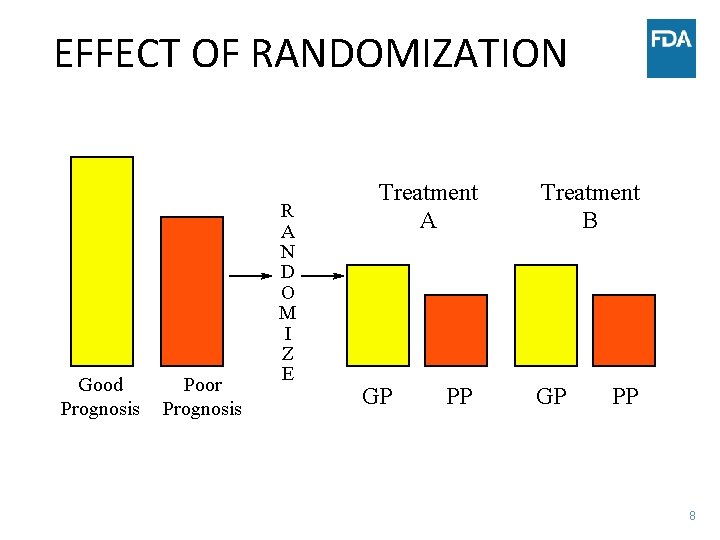
EFFECT OF RANDOMIZATION Good Prognosis Poor Prognosis R A N D O M I Z E Treatment A GP PP Treatment B GP PP 8
EXAMPLE: CANCER STUDY • Test of post-surgery chemotherapy • Subjects randomized to observation only or chemo, following potentially curative surgery • Protocol specified treatment had to begin no later than 6 weeks post-surgery – Assumption: if you don’t start the chemo soon enough you won’t be able to control growth of micro-metastases that might still be there after surgery – Concern that including these subjects would dilute estimate of treatment effect 9
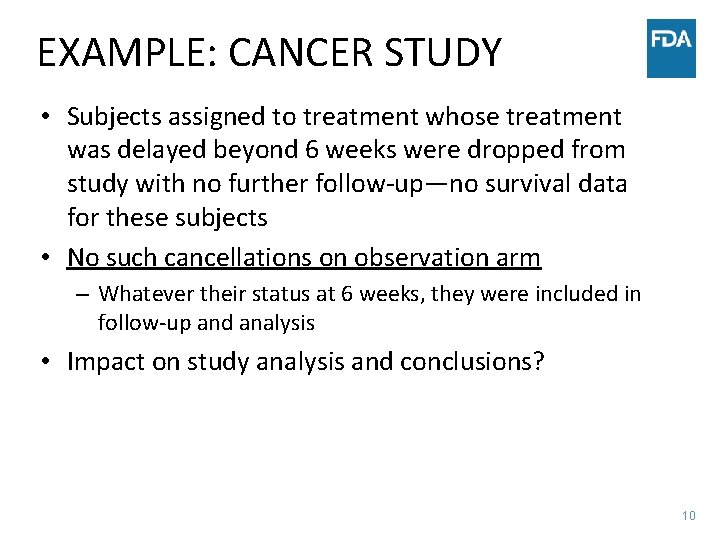
EXAMPLE: CANCER STUDY • Subjects assigned to treatment whose treatment was delayed beyond 6 weeks were dropped from study with no further follow-up—no survival data for these subjects • No such cancellations on observation arm – Whatever their status at 6 weeks, they were included in follow-up and analysis • Impact on study analysis and conclusions? 10
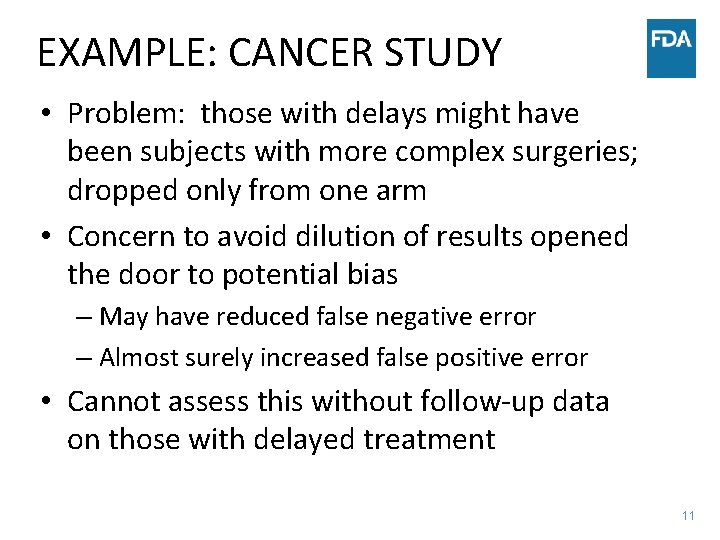
EXAMPLE: CANCER STUDY • Problem: those with delays might have been subjects with more complex surgeries; dropped only from one arm • Concern to avoid dilution of results opened the door to potential bias – May have reduced false negative error – Almost surely increased false positive error • Cannot assess this without follow-up data on those with delayed treatment 11
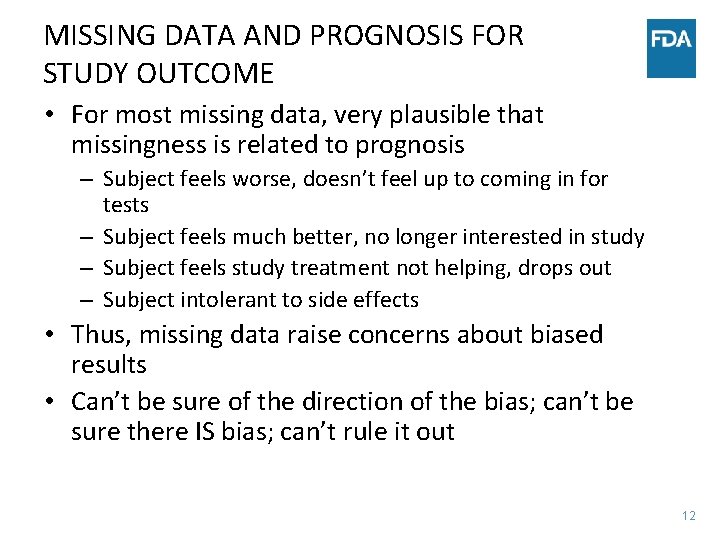
MISSING DATA AND PROGNOSIS FOR STUDY OUTCOME • For most missing data, very plausible that missingness is related to prognosis – Subject feels worse, doesn’t feel up to coming in for tests – Subject feels much better, no longer interested in study – Subject feels study treatment not helping, drops out – Subject intolerant to side effects • Thus, missing data raise concerns about biased results • Can’t be sure of the direction of the bias; can’t be sure there IS bias; can’t rule it out 12
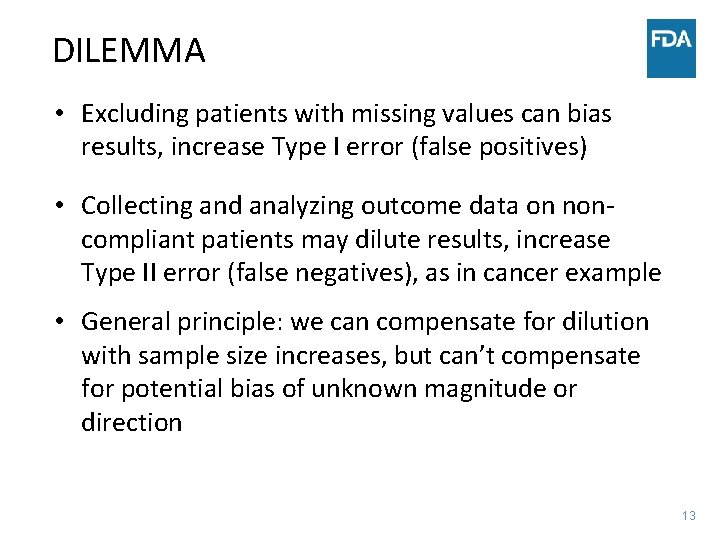
DILEMMA • Excluding patients with missing values can bias results, increase Type I error (false positives) • Collecting and analyzing outcome data on noncompliant patients may dilute results, increase Type II error (false negatives), as in cancer example • General principle: we can compensate for dilution with sample size increases, but can’t compensate for potential bias of unknown magnitude or direction 13
INTENT-TO-TREAT (ITT) PRINCIPLE All randomized patients should be included in the (primary) analysis, in their assigned treatment groups 14
MISSING DATA AND THE INTENTION -TOTREAT (ITT) PRINCIPLE • ITT: Analyze all randomized patients in groups to which randomized • What to do when data are unavailable? • Implication of ITT principle for design: collect all required data on all patients, regardless of compliance with treatment Thus, avoid missing data 15
ROUTINELY PROPOSED MODIFICATIONS OF ITT • All randomized eligible patients. . . • All randomized eligible patients who received any of their assigned treatment. . . • All randomized patients for whom the primary outcome is known. . . 16
MODIFICATION OF ITT (1) • OK to exclude randomized subjects who turn out to be ineligible? 17
MODIFICATION OF ITT (1) • OK to exclude randomized subjects who turn out to be ineligible? – probably won’t bias results--unless level of scrutiny depends on treatment and/or outcome – greater chance of bias if eligibility assessed after data are in and study is unblinded 18
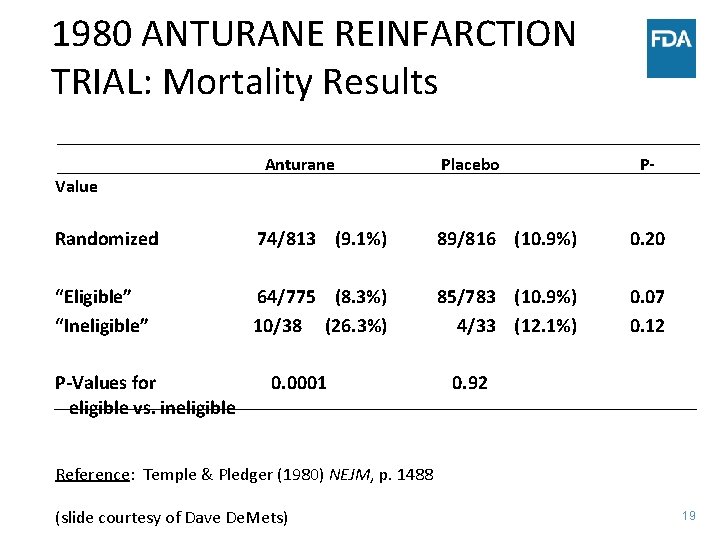
1980 ANTURANE REINFARCTION TRIAL: Mortality Results Value Anturane Placebo P- Randomized 74/813 (9. 1%) 89/816 (10. 9%) 0. 20 “Eligible” “Ineligible” 64/775 (8. 3%) 10/38 (26. 3%) 85/783 (10. 9%) 4/33 (12. 1%) 0. 07 0. 12 P-Values for eligible vs. ineligible 0. 0001 0. 92 Reference: Temple & Pledger (1980) NEJM, p. 1488 (slide courtesy of Dave De. Mets) 19
MODIFICATION OF ITT (2) • OK to exclude randomized subjects who never started assigned treatment? 20
MODIFICATION OF ITT (2) • OK to exclude randomized subjects who never started assigned treatment? – probably won’t bias results if study is doubleblind – in unblinded studies (e. g. , surgery vs drug), refusals of assigned treatment may result in bias if “refusers” excluded 21
MODIFICATION OF ITT (3) • OK to exclude randomized patients who become lost-to-followup so outcome is unknown? 22
MODIFICATION OF ITT (3) • OK to exclude randomized patients who become lost-to-follow-up so outcome is unknown? – Possibility of bias, but can’t analyze what we don’t have – Model-based analyses may be informative if assumptions are reasonable – Sensitivity analysis important, since we can never verify assumptions 23
NONCOMPLIANCE: A PERENNIAL PROBLEM • There will always be people who don’t use medical treatment as prescribed • There will always be noncompliant subjects in clinical trials • How do we evaluate data from a trial in which some subjects do not adhere to their assigned treatment regimen? 24
CLASSIC EXAMPLE • Coronary Drug Project – Large RCT conducted by NIH in 1970’s – Compared several treatments to placebo – Goal: improve survival in patients at high risk of death from heart disease • Results disappointing • Investigators recognized that many subjects did not fully comply with treatment protocol 25
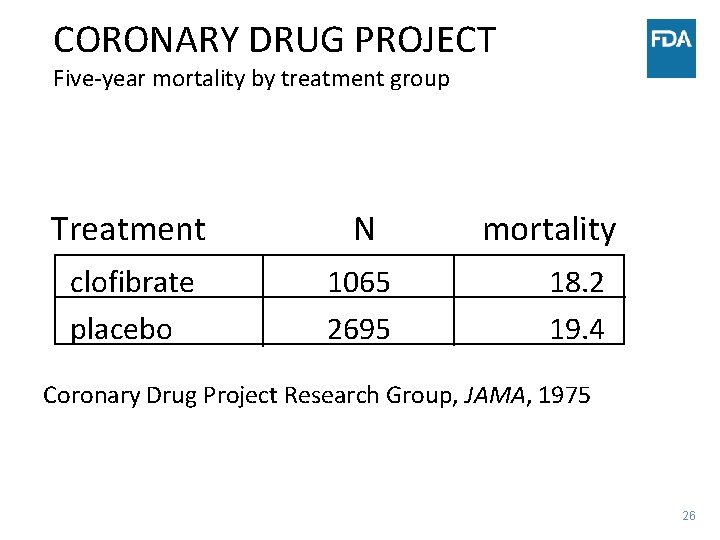
CORONARY DRUG PROJECT Five-year mortality by treatment group Treatment N clofibrate placebo 1065 2695 mortality 18. 2 19. 4 Coronary Drug Project Research Group, JAMA, 1975 26
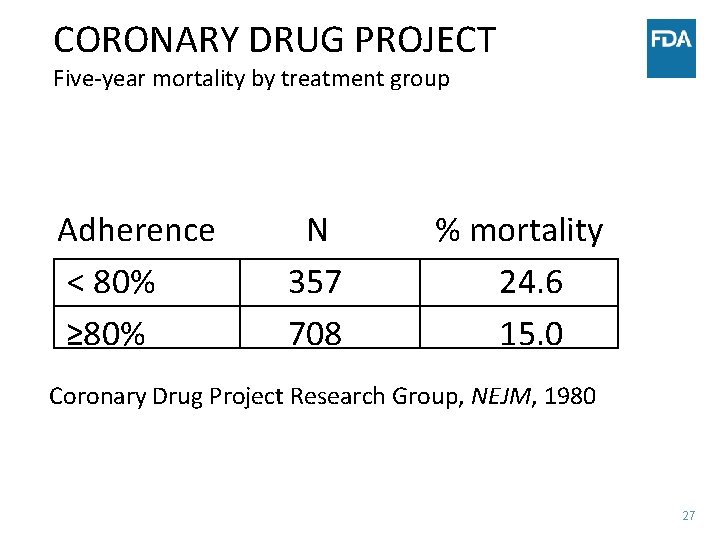
CORONARY DRUG PROJECT Five-year mortality by treatment group Adherence < 80% ≥ 80% N 357 708 % mortality 24. 6 15. 0 Coronary Drug Project Research Group, NEJM, 1980 27
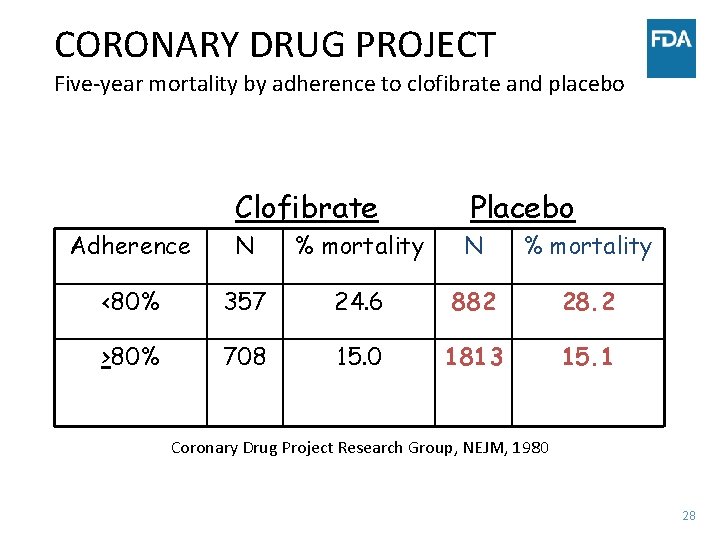
CORONARY DRUG PROJECT Five-year mortality by adherence to clofibrate and placebo Clofibrate Placebo Adherence N % mortality <80% 357 24. 6 882 28. 2 >80% 708 15. 0 1813 15. 1 Coronary Drug Project Research Group, NEJM, 1980 28
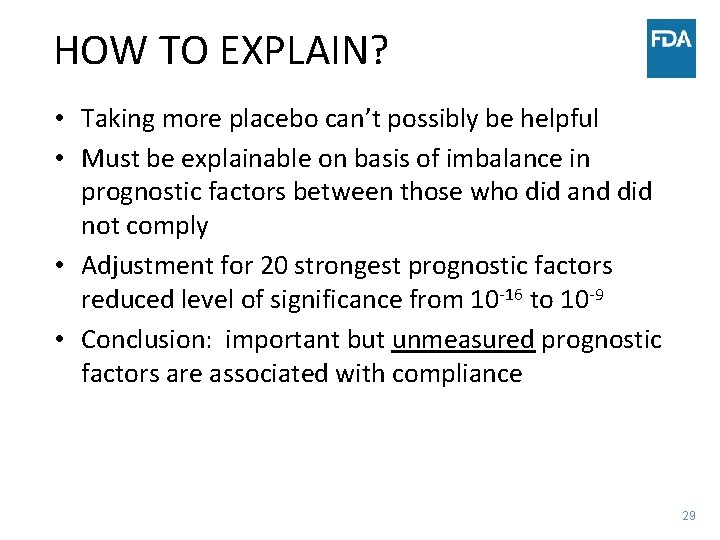
HOW TO EXPLAIN? • Taking more placebo can’t possibly be helpful • Must be explainable on basis of imbalance in prognostic factors between those who did and did not comply • Adjustment for 20 strongest prognostic factors reduced level of significance from 10 -16 to 10 -9 • Conclusion: important but unmeasured prognostic factors are associated with compliance 29
ANALYSIS WITH MISSING DATA • Analysis of data when some are missing requires assumptions • The assumptions are not always obvious • When a substantial proportion of data is missing, different analyses may lead to different conclusions – reliability of findings will be questionable • When few data are missing, approach to analysis probably won’t matter 30
COMMON APPROACHES • Ignore those with missing data; analyze only those who completed study • For those who drop out, analyze as though their last observation was their final observation • For those who drop out, predict what their final observation would be on the basis of outcomes for others with similar characteristics 31
ASSUMPTIONS FOR COMMON ANALYTICAL APPROACHES • Analyze only subjects with complete data – Assumption: those who dropped out would have shown the same effects as those who remained in study • Last observation carried forward – Assumption: those who dropped out would not have improved or worsened • Modeling approaches – Assumption: available data will permit unbiased estimation of missing outcome data 32
ASSUMPTIONS ARE UNVERIFIABLE (AND PROBABLY WRONG) • Completers analysis – Those who drop out are almost surely different from those who remain in study • Last observation carried forward – Dropout may be due to perception of getting worse, or better • Modeling approaches – Can only predict using data that are measured; unmeasured variables may be more important in predicting outcome (CDP example) 33
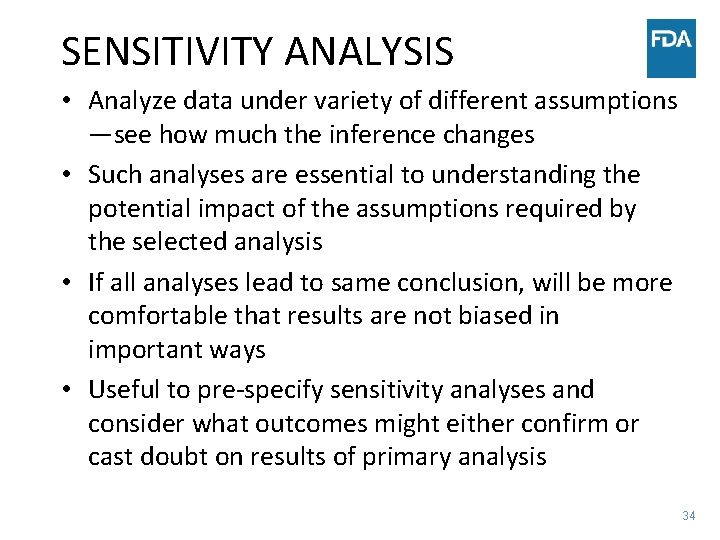
SENSITIVITY ANALYSIS • Analyze data under variety of different assumptions —see how much the inference changes • Such analyses are essential to understanding the potential impact of the assumptions required by the selected analysis • If all analyses lead to same conclusion, will be more comfortable that results are not biased in important ways • Useful to pre-specify sensitivity analyses and consider what outcomes might either confirm or cast doubt on results of primary analysis 34
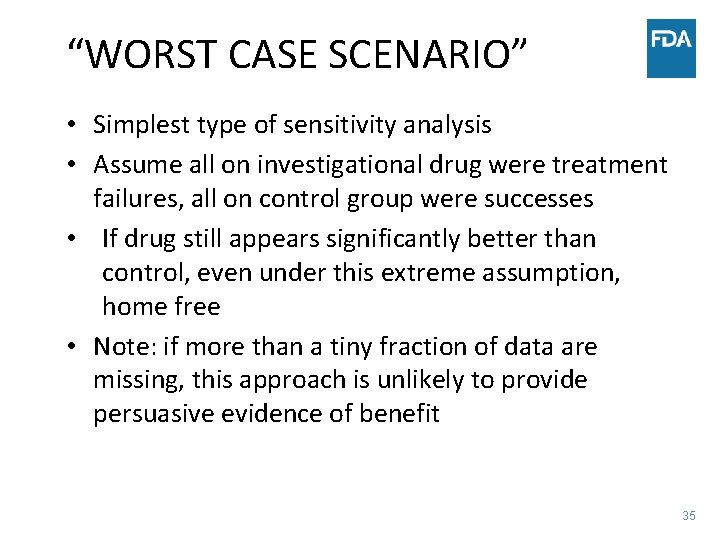
“WORST CASE SCENARIO” • Simplest type of sensitivity analysis • Assume all on investigational drug were treatment failures, all on control group were successes • If drug still appears significantly better than control, even under this extreme assumption, home free • Note: if more than a tiny fraction of data are missing, this approach is unlikely to provide persuasive evidence of benefit 35
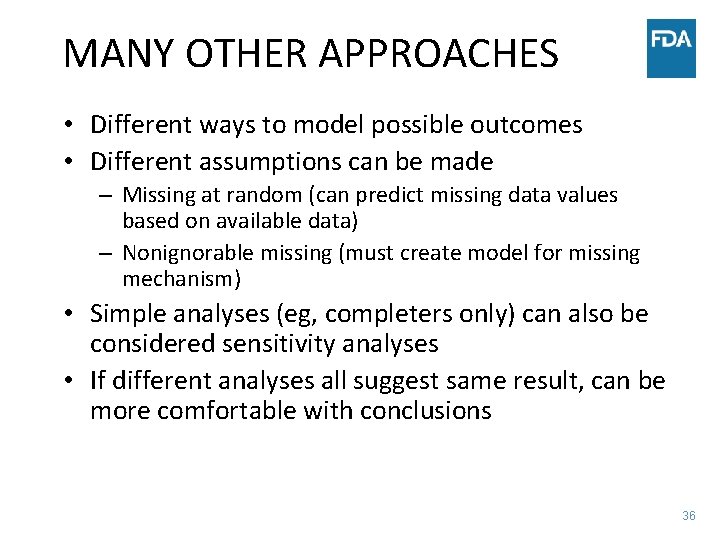
MANY OTHER APPROACHES • Different ways to model possible outcomes • Different assumptions can be made – Missing at random (can predict missing data values based on available data) – Nonignorable missing (must create model for missing mechanism) • Simple analyses (eg, completers only) can also be considered sensitivity analyses • If different analyses all suggest same result, can be more comfortable with conclusions 36
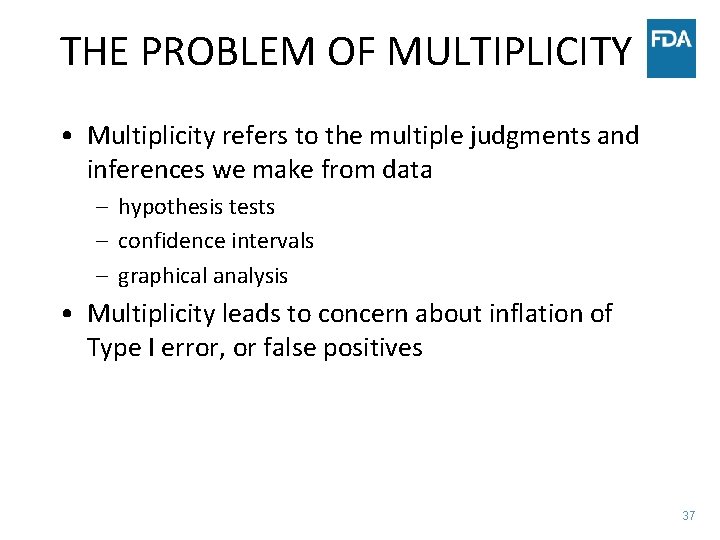
THE PROBLEM OF MULTIPLICITY • Multiplicity refers to the multiple judgments and inferences we make from data – hypothesis tests – confidence intervals – graphical analysis • Multiplicity leads to concern about inflation of Type I error, or false positives 37
EXAMPLE • The chance of drawing the ace of clubs by randomly selecting a card from a complete deck is 1/52 • The chance of drawing the ace of clubs at least once by randomly selecting a card from a complete deck 100 times is…. ? 38
EXAMPLE • The chance of drawing the ace of clubs by randomly selecting a card from a complete deck is 1/52 • The chance of drawing the ace of clubs at least once by randomly selecting a card from a complete deck 100 times is…. ? • And suppose we pick a card at random and it happens to be the ace of clubs—what probability statement can we make? 39
MULTIPLICITY IN CLINICAL TRIALS • There are many types of multiplicity to deal with – Multiple endpoints – Multiple subsets – Multiple analytical approaches – Repeated testing over time 40
MOST LIKELY TO MISLEAD: DATADRIVEN TESTING • • Perform experiment Review data Identify comparisons that look “interesting” Perform significance tests for these results 41
EXAMPLE: OPPORTUNITIES FOR MULTIPLICITY IN AN ONCOLOGY TRIAL • Experiment : regimens A, B and C are compared to standard tx – Intent: cure/control cancer – Eligibility: non-metastatic disease 42
OPPORTUNITIES FOR MULTIPLE TESTING • • • Multiple treatment arms: A, B, C Subsets: gender, age, tumor size, marker levels… Site groupings: country, type of clinic… Covariates accounted for in analysis Repeated testing over time Multiple endpoints – different outcome: mortality, progression, response – different ways of addressing the same outcome: different statistical tests 43
RESULTS IN SUBSETS • Perhaps the most vexing type of multiple comparisons problem • Very natural to explore data to see whether treatment works better in some types of patients than others • Two types of problems – Subset in which the treatment appears beneficial, even though no overall effect – Subset in which the treatment appears ineffective, even though overall effect is positive 44
REAL EXAMPLE • International Study of Infarct Survival (ISIS)2 (Lancet, 1988) – Over 17, 000 subjects randomized to evaluate aspirin and streptokinase post-MI – Both treatments showed highly significant survival benefit in full study population – Subset of subjects born under Gemini or Libra showed slight adverse effect of aspirin 45
REAL EXAMPLE • New drug for sepsis – Overall results negative – Significant drug effect in patients with APACHE score in certain region – Plausible basis for difference – Company planned new study to confirm – FDA requested new study not be limited to favorable subgroup – Results of second study: no effect in either subgroup 46
DIFFICULT SUBSET ISSUES • In multicenter trials there can be concern that results are driven by a single center • Not always implausible – Different patient mix – Better adherence to assigned treatment – Greater skill at administering treatment 47
A PARTICULAR CONCERN IN MULTIREGIONAL TRIALS • Very difficult to standardize approaches in multiregional trials • May not be desirable to standardize too much – Want data within each region to be generalizable within that region • Not implausible that treatment effect will differ by region • How to interpret when treatment effects do seem to differ? 48
REGION AS SUBSET • A not uncommon but difficult problem – Assumption in a multiregional trial is that if treatment is effective, it will be effective in all regions – We understand that looking at results in subsets could yield positive results by chance – Still, it is natural to be uncomfortable about using a treatment that was effective overall but with zero effect where you live – Particularly problematic for regulatory authorities— should treatment be approved in a given region if there was no apparent benefit in that region? 49
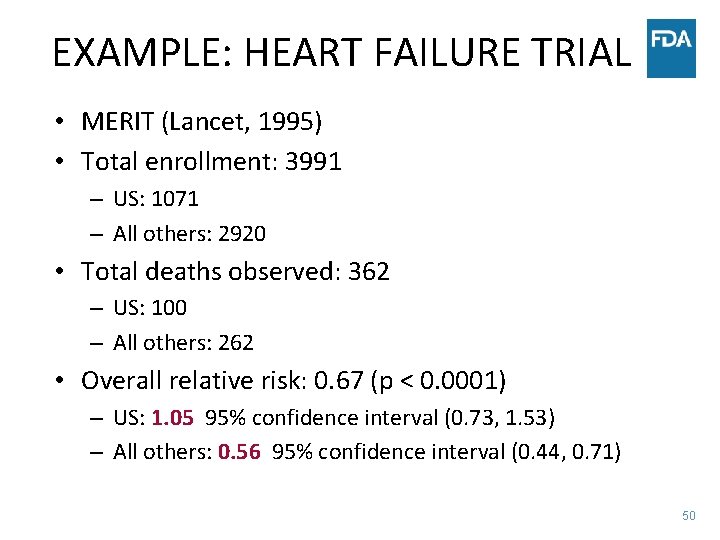
EXAMPLE: HEART FAILURE TRIAL • MERIT (Lancet, 1995) • Total enrollment: 3991 – US: 1071 – All others: 2920 • Total deaths observed: 362 – US: 100 – All others: 262 • Overall relative risk: 0. 67 (p < 0. 0001) – US: 1. 05 95% confidence interval (0. 73, 1. 53) – All others: 0. 56 95% confidence interval (0. 44, 0. 71) 50
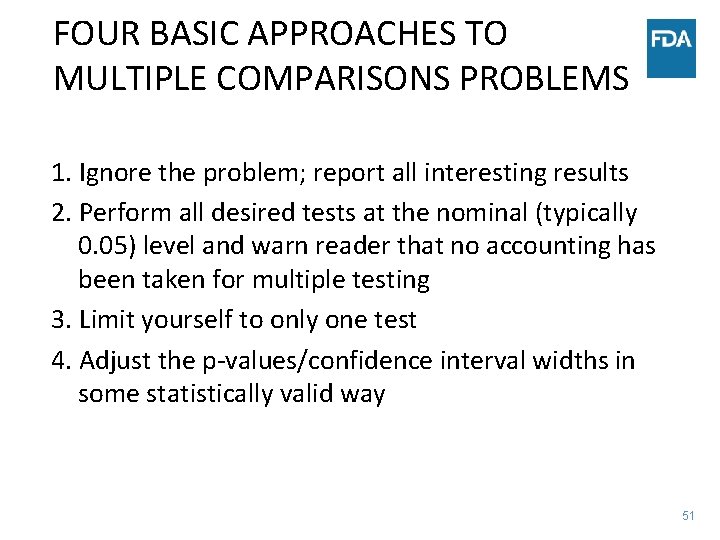
FOUR BASIC APPROACHES TO MULTIPLE COMPARISONS PROBLEMS 1. Ignore the problem; report all interesting results 2. Perform all desired tests at the nominal (typically 0. 05) level and warn reader that no accounting has been taken for multiple testing 3. Limit yourself to only one test 4. Adjust the p-values/confidence interval widths in some statistically valid way 51
IGNORE THE PROBLEM • Probably the most common approach • Less common in the higher-powered journals, or journals where statistical review is standard practice • Even when not completely ignored, often not fully addressed 52
DO ONLY ONE TEST • Single (pre-specified) primary hypothesis • Single (pre-specified) analysis • No consideration of data in subsets • Not really practicable • (Common practice: pre-specify the primary hypothesis and analysis, consider all other analyses “exploratory”) 53
NO ACCOUNTING FOR MULTIPLE TESTING, BUT MAKE THIS CLEAR • Message is that readers should “mentally adjust” • Justification: allows readers to apply their own preferred multiple testing approach • Appealing because you show that you recognize the problem, but you don’t have to decide how to deal with it • May expect too much from statistically unsophisticated audience 54
USE SOME TYPE OF ADJUSTMENT PROCEDURE • Divide desired by the number of comparisons (Bonferroni) • Bonferroni-type stepwise procedures – Less conservative • Control “false discovery” rate – Even less conservative – Allows for a small proportion of false positives, rather than ensuring only small probability of each test producing a false positive conclusion 55
ONE MORE ISSUE: BEFOREAFTER COMPARISONS 56
BEFORE-AFTER COMPARISONS • In order to assess effect of new treatment, must have a comparison group • Changes from baseline could be due to factors other than intervention – Natural variation in disease course – Patient expectations/psychological effects – Regression to the mean • Cannot assume investigational treatment is cause of observed changes without a control group 59
SIDEBAR: REGRESSION TO THE MEAN • “Regression to the mean“ is a phenomenon resulting from using threshold levels of variables to determine study eligibility – Must have blood pressure > X – Must have CD 4 count < Y • In such cases, a second measure will “regress” toward the threshold value – Some qualifying based on the first level will be on a “random high” that day; next measure likely to closer to their true level – Especially true for those whose true level is close to threshold value 60
REAL EXAMPLE • Ongoing study of testosterone supplementation in men over age of 65 with low T levels and functional complaints • Entry criterion: 2 screening T levels required; average needed to be < 275 ng/ml, neither could be > 300 ng/ml • Even so: about 10% of men have baseline T levels >300 61
CONCLUDING REMARKS • There are many pitfalls in the analysis and interpretation of clinical trial data • Awareness of these pitfalls will prevent errors in drawing conclusions • For some issues, no consensus on optimal approach • Statistical rules are best integrated with clinical judgment, and basic common sense 62

- Slides: 63