
Avoid Complaints Angela Harkins BDS MPhil FFFLM Taylor
Avoid Complaints Angela Harkins BDS MPhil FFFLM Taylor Defence Services angela@tdsew. com
Aims and Objectives 1. Value of communication – patients and the dental team 2. Involving the patient in their treatment journey 3. Choose when not to treat Context 1. Law 2. GDC 3. NHS
Why complain ? • Explanations • Assurances • Apologies • Refund of fees



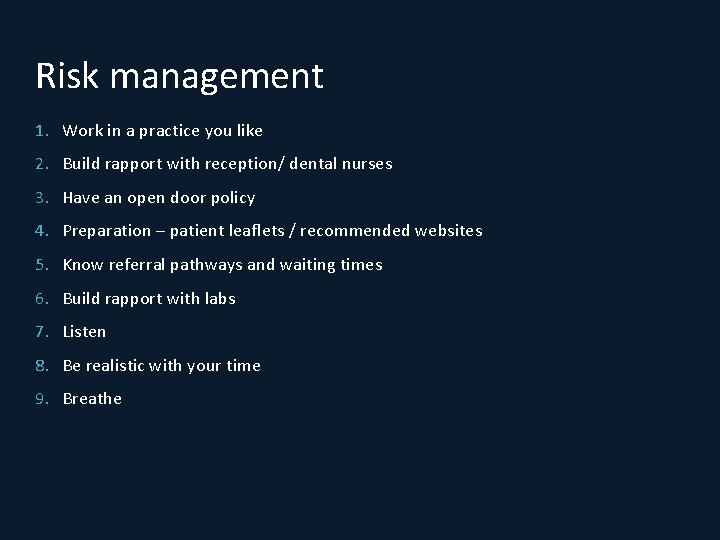
Risk management 1. Work in a practice you like 2. Build rapport with reception/ dental nurses 3. Have an open door policy 4. Preparation – patient leaflets / recommended websites 5. Know referral pathways and waiting times 6. Build rapport with labs 7. Listen 8. Be realistic with your time 9. Breathe

Service Failures • Appointments – incorrect or running late , wrong dentist • Treatment planning • Estimates • Treatment failures • Complications
Complaint A complaint is any expression of dissatisfaction by a patient (or their representative) about a dental service or treatment, whether justified or not.
Principle of clinical negligence For a clinical negligence claim to be successful, the patient (claimant) must prove that it was more likely than not that: a) the defendant dental professional owed them a duty of care b) there was a breach of duty c) The breach of duty caused harm d) avoidable harm resulted Patients lawyer seek reparation of losses , earnings, quality of life , pain and suffering
Patient Interests First • Communicate effectively • Recognise patients rights and responsibilities • Give patients all the necessary information and make sure they understand it • Give clear information on costs
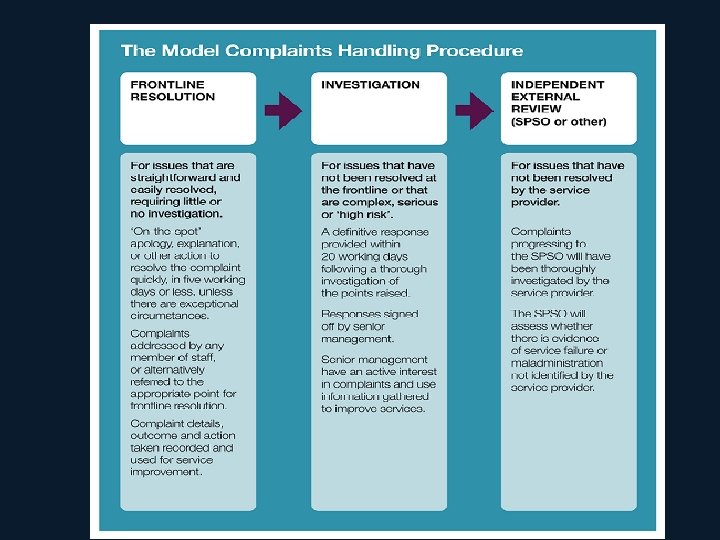
First Stage - SPSO -NHS 1. What exactly is the complaint (or complaints) 2. What does the complainant want to achieve by complaining? 3. Can I achieve this, or explain why not? 4. If I cannot resolve this, who can help with frontline resolution?
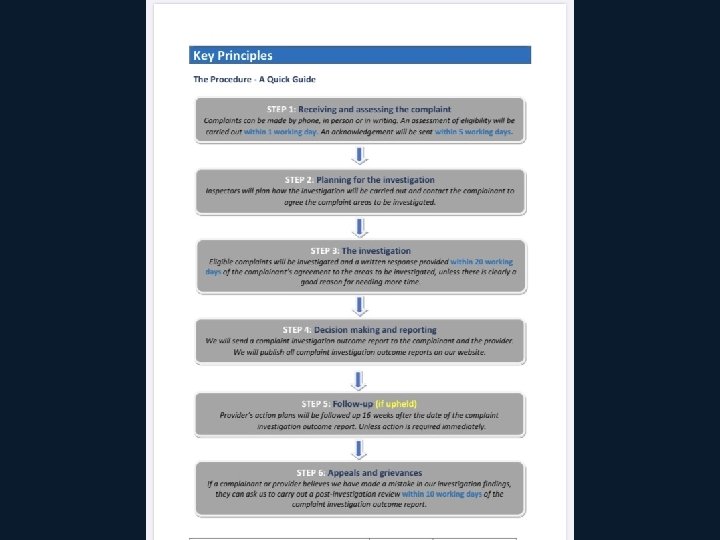
Second Stage - Investigation • frontline resolution has been attempted but the customer remains dissatisfied and requests an investigation. This may happen immediately when the decision at the frontline stage is communicated, or some time later • the customer refuses to take part in frontline resolution • the issues raised are complex and require detailed investigation • the complaint relates to serious, high-risk or high-profile issues.
Law 1. GDPR [2018] 2. Scottish Apology Act [2016] 3. Montgomery v NHS Lanarkshire Health Board [2015] 4. Tooth whitening EU legislation [2013] 5. Patient Rights (Scotland ) Act [2011] 6. Recording of LA European Regulation 726/2004
Recap 1. Importance of good recording keeping 2. Communication is a key clinical tool 3. Feedback or an adverse incident does not need to escalate 4. Seek support from colleagues 5. Dentistry is a combination of art and science

THANKYOU If I can offer any additional information or advise on this or any other topic please email angela@tdsew. com or call 0141 772 0178.

- Slides: 27