
Avogadros Number n One mole of a gas

Avogadro’s Number n One mole of a gas contains Avogadro’s number of molecules n Avogadro’s number is 6. 02 x 1023 or 602, 000, 000, 000
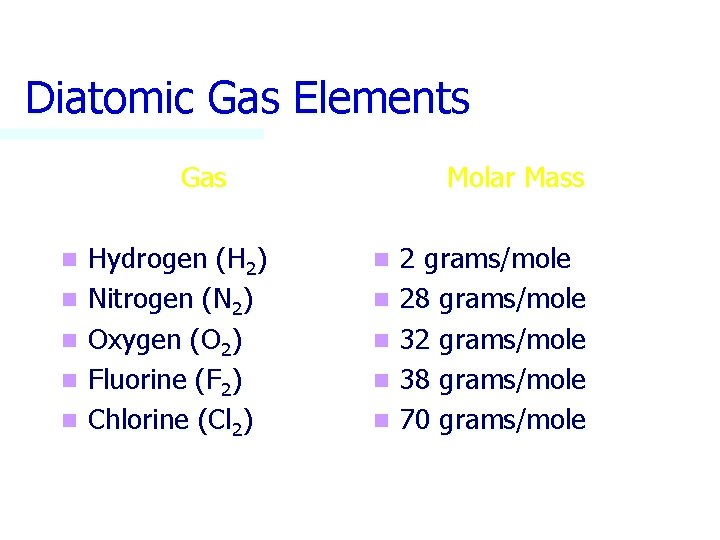
Diatomic Gas Elements Gas n n n Hydrogen (H 2) Nitrogen (N 2) Oxygen (O 2) Fluorine (F 2) Chlorine (Cl 2) Molar Mass n n n 2 grams/mole 28 grams/mole 32 grams/mole 38 grams/mole 70 grams/mole
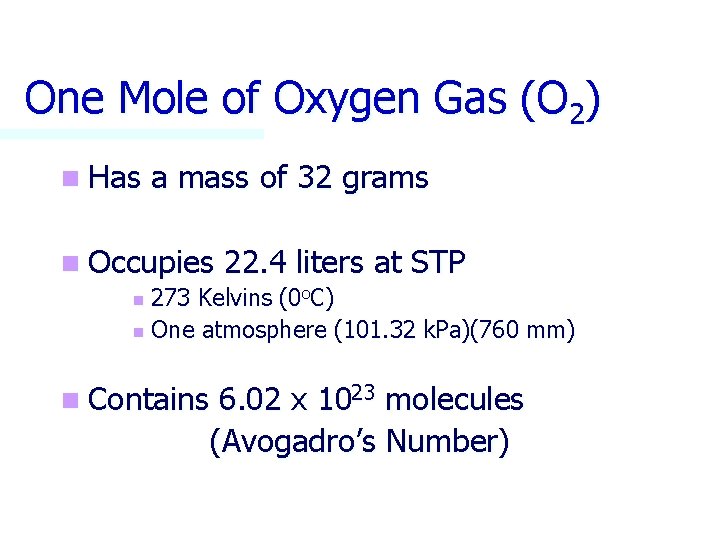
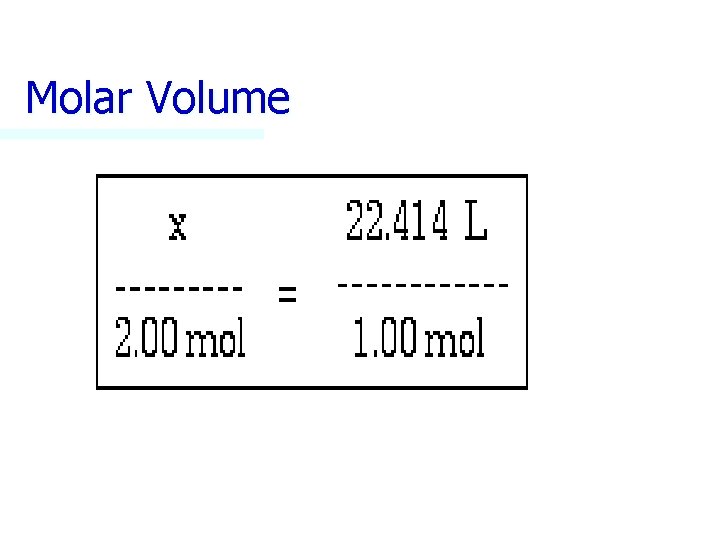
One Mole of Oxygen Gas (O 2) n Has a mass of 32 grams n Occupies 22. 4 liters at STP 273 Kelvins (0 o. C) n One atmosphere (101. 32 k. Pa)(760 mm) n n Contains 6. 02 x 1023 molecules (Avogadro’s Number)
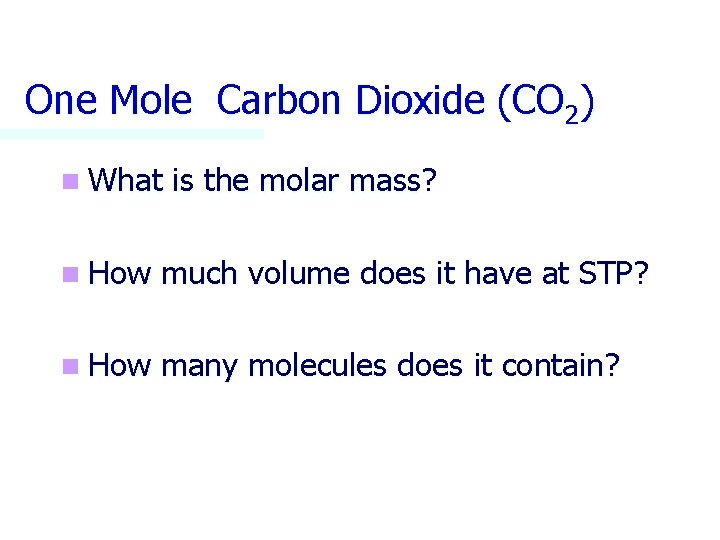
One Mole Carbon Dioxide (CO 2) n What is the molar mass? n How much volume does it have at STP? n How many molecules does it contain?
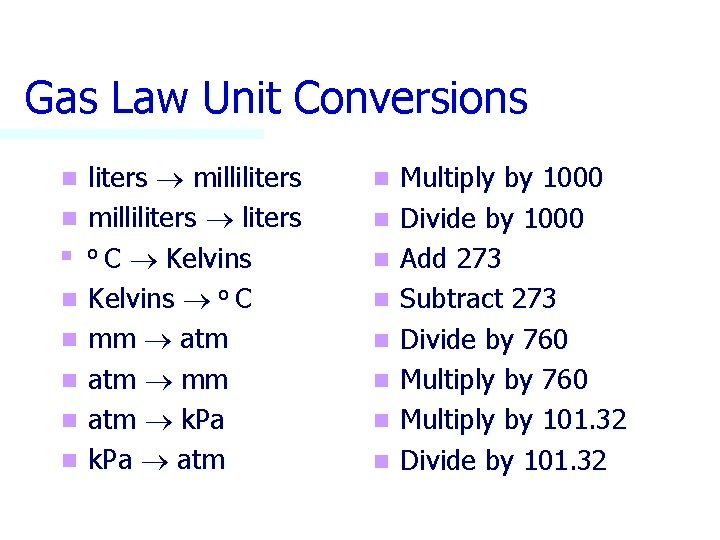
Gas Law Unit Conversions n n n n liters milliliters o C Kelvins o C mm atm mm atm k. Pa atm n n n n Multiply by 1000 Divide by 1000 Add 273 Subtract 273 Divide by 760 Multiply by 101. 32 Divide by 101. 32
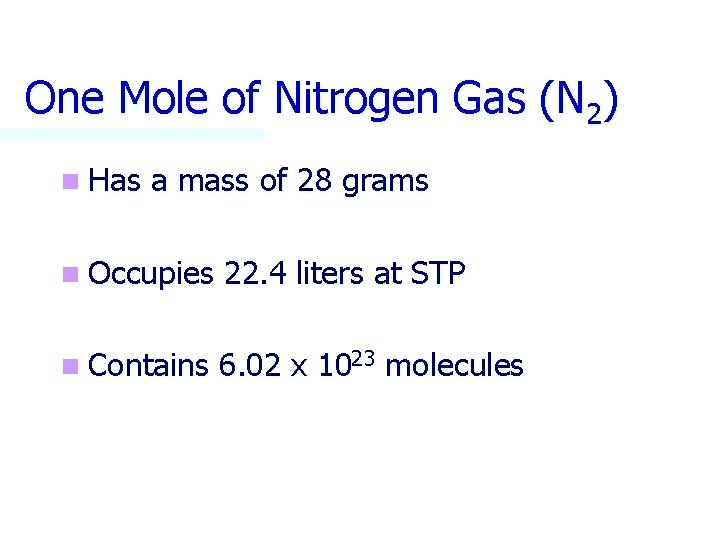
One Mole of Nitrogen Gas (N 2) n Has a mass of 28 grams n Occupies 22. 4 liters at STP n Contains 6. 02 x 1023 molecules
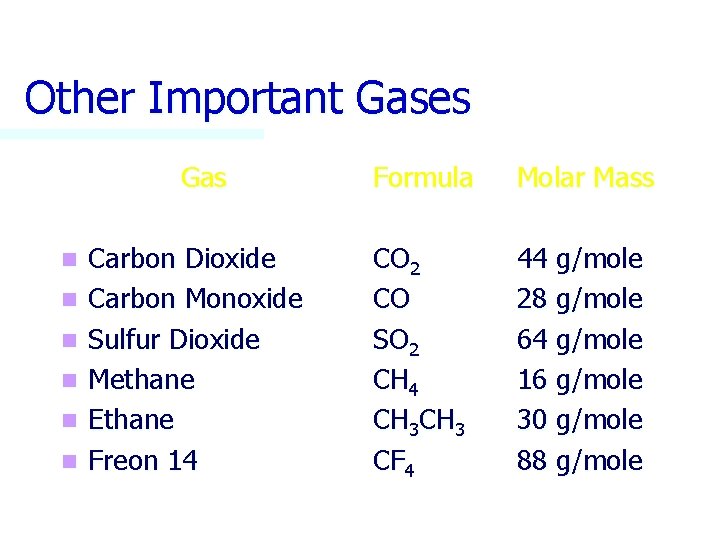
Other Important Gases Gas n n n Carbon Dioxide Carbon Monoxide Sulfur Dioxide Methane Ethane Freon 14 Formula Molar Mass CO 2 CO SO 2 CH 4 CH 3 CF 4 44 g/mole 28 g/mole 64 g/mole 16 g/mole 30 g/mole 88 g/mole
TEST DAY n. Find n. Pick your assigned seat up a response paddle, marker and eraser
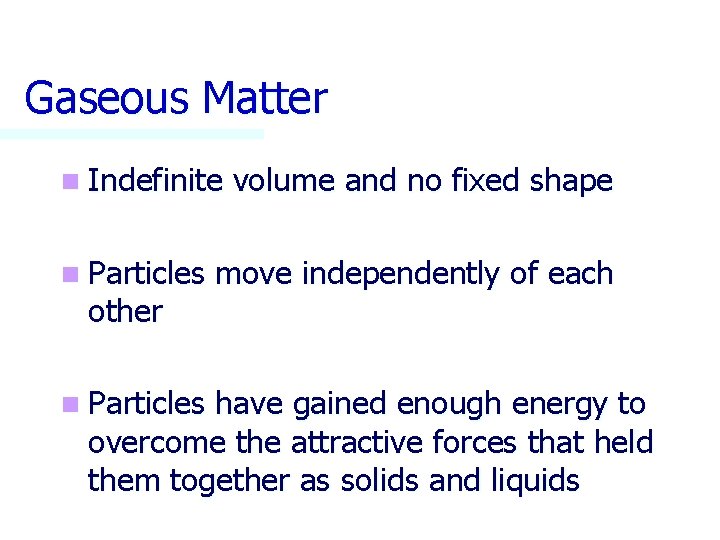
Gaseous Matter n Indefinite n Particles other n Particles volume and no fixed shape move independently of each have gained enough energy to overcome the attractive forces that held them together as solids and liquids
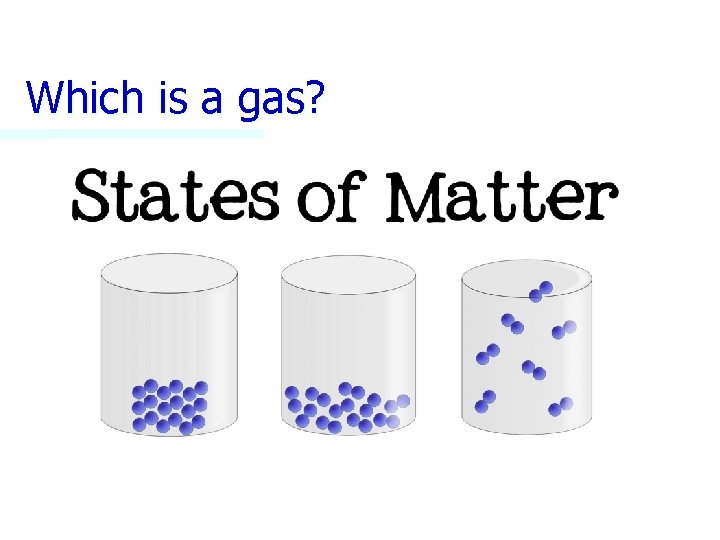
Which is a gas?
Practice n. Draw a graph that represents the relationship between temperature and volume
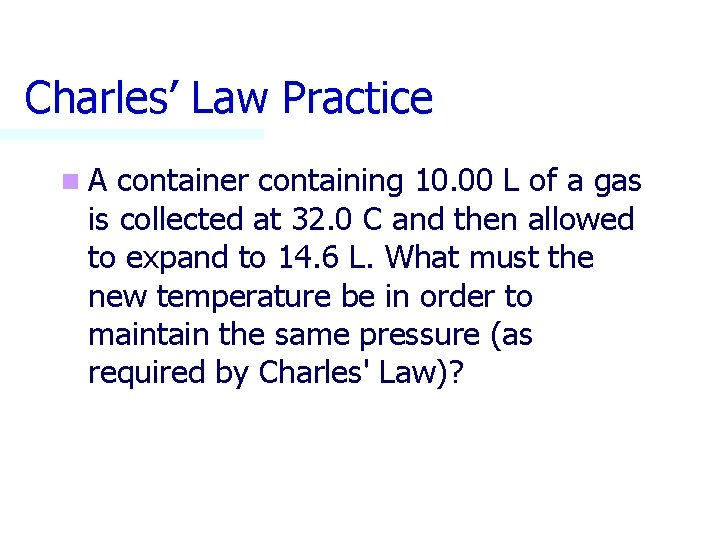
Charles’ Law Practice n. A container containing 10. 00 L of a gas is collected at 32. 0 C and then allowed to expand to 14. 6 L. What must the new temperature be in order to maintain the same pressure (as required by Charles' Law)?
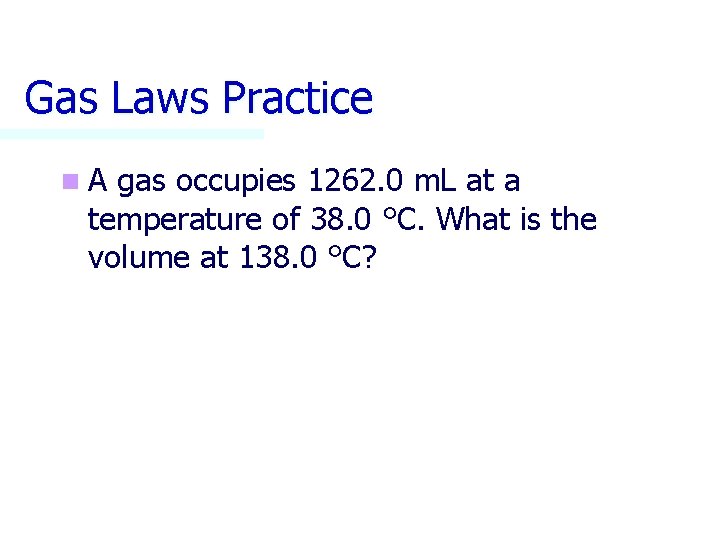
Gas Laws Practice n. A gas occupies 1262. 0 m. L at a temperature of 38. 0 °C. What is the volume at 138. 0 °C?
Gas Laws Practice n If 23. 80 liters of helium at 20. 0 °C is allowed to expand to 51. 98 liters, what must the new temperature be to maintain constant pressure?
Exit Ticket n What happens to the volume of gas as the temperature increases n Explain what is happening in terms of molecular collisions to support your answer
Learning Target n Describe how changing pressure, temperature, and or volume will impact the other variables pertaining to gas laws.
Lab Reminders n Assign n Lab safety: Goggles and Gloves n Work n Use Roles in a quiet and organized manner your check out sheets, everyone is responsible for the middle lab table
Introduction to Gases Lab n Read through background Information n Gather needed equipment and supplies n Perform lab, and answer questions n Complete post lab quiz
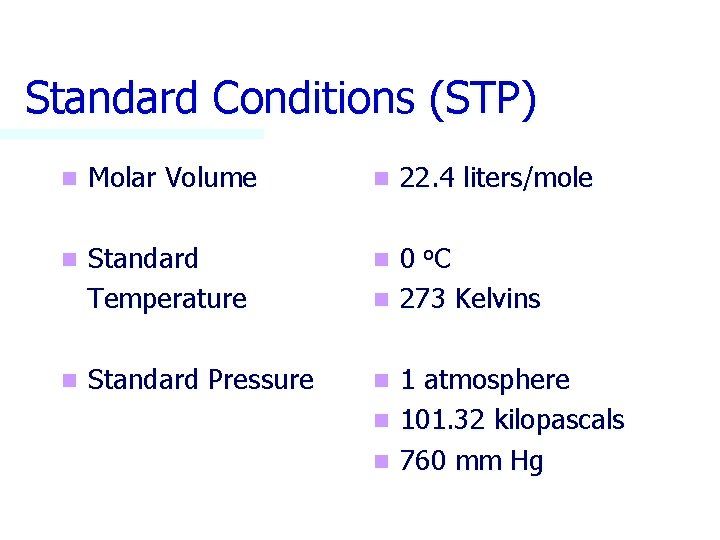
Standard Conditions (STP) n Molar Volume n n Standard Temperature n n Standard Pressure n 22. 4 liters/mole 0 o. C n 273 Kelvins 1 atmosphere n 101. 32 kilopascals n 760 mm Hg
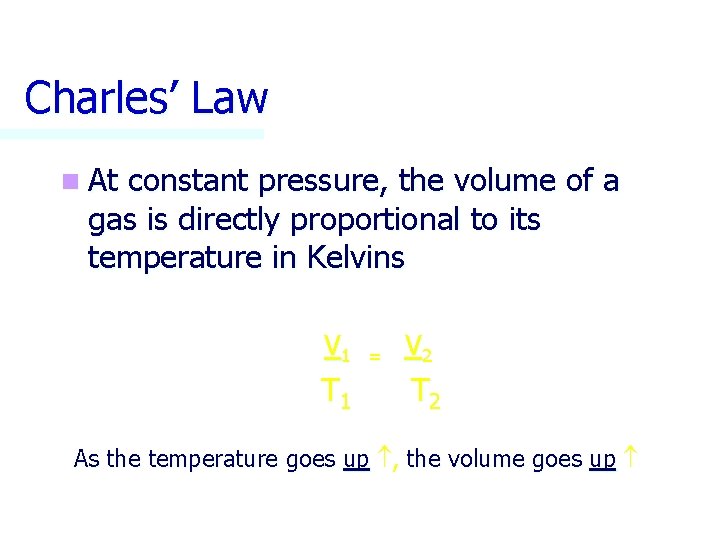
Charles’ Law n At constant pressure, the volume of a gas is directly proportional to its temperature in Kelvins V 1 T 1 = V 2 T 2 As the temperature goes up , the volume goes up
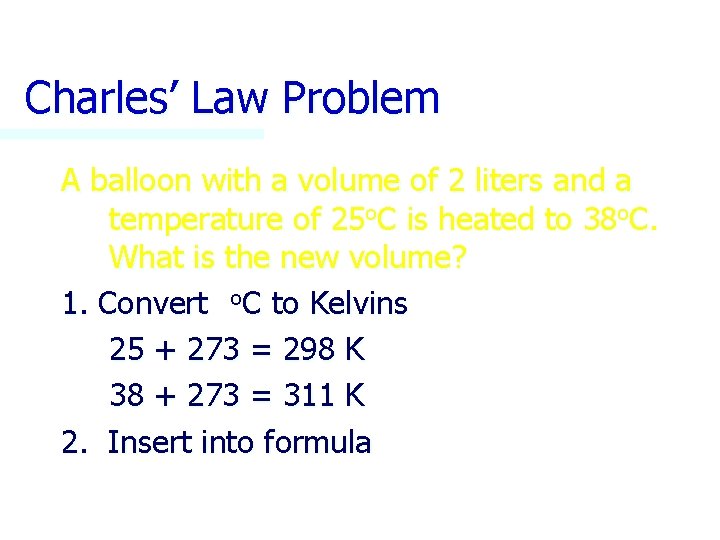
Charles’ Law Problem A balloon with a volume of 2 liters and a temperature of 25 o. C is heated to 38 o. C. What is the new volume? 1. Convert o. C to Kelvins 25 + 273 = 298 K 38 + 273 = 311 K 2. Insert into formula
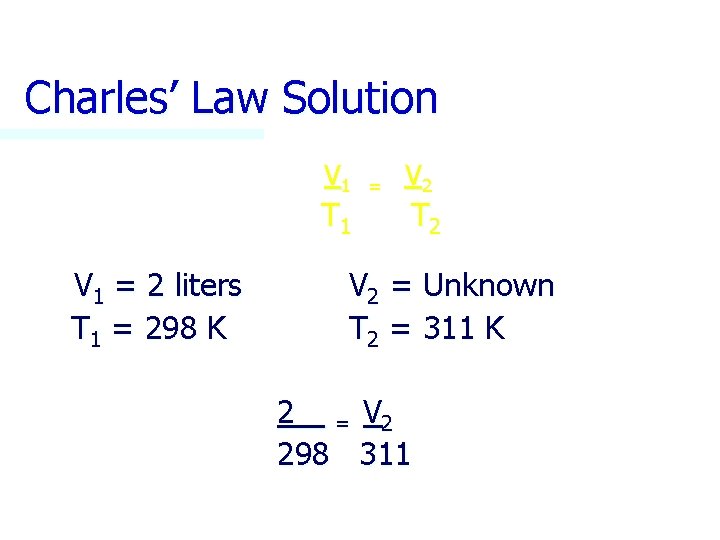
Charles’ Law Solution V 1 T 1 V 1 = 2 liters T 1 = 298 K = V 2 T 2 V 2 = Unknown T 2 = 311 K 2 = V 2 298 311
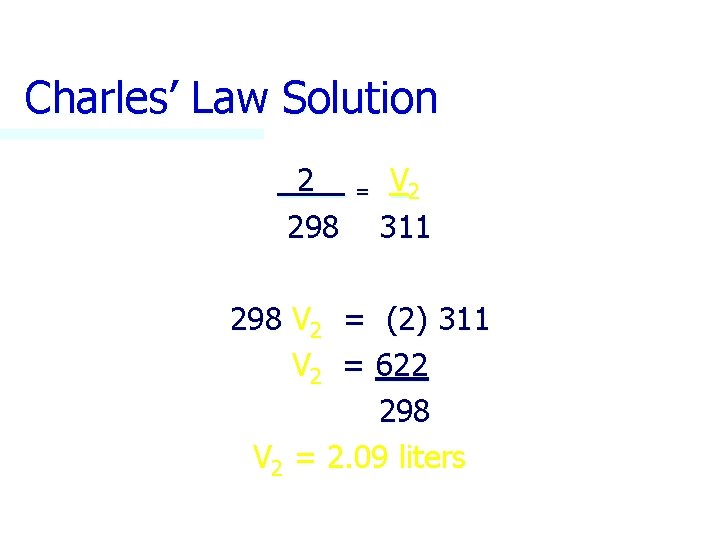
Charles’ Law Solution 2 298 = V 2 311 298 V 2 = (2) 311 V 2 = 622 298 V 2 = 2. 09 liters
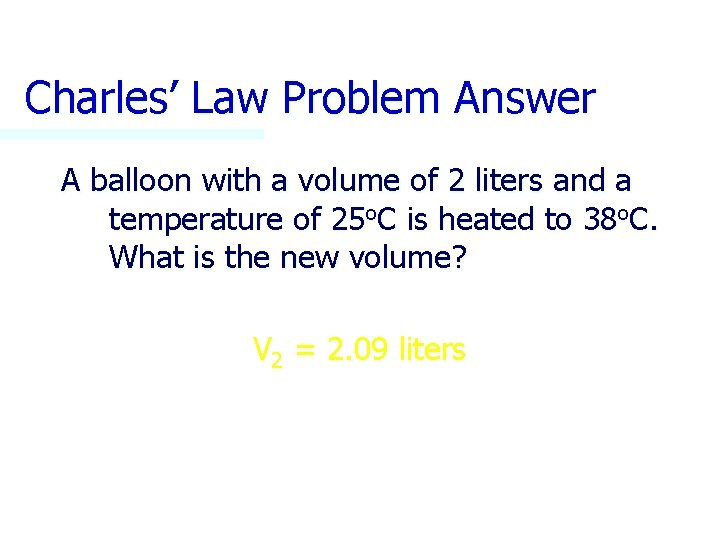
Charles’ Law Problem Answer A balloon with a volume of 2 liters and a temperature of 25 o. C is heated to 38 o. C. What is the new volume? V 2 = 2. 09 liters

While you wait……………. . Pick up paper for entrance ticket n Find your assigned seat n Take out your copy of the PHET simulation outline n Take out your notebook and a pen or pencil n
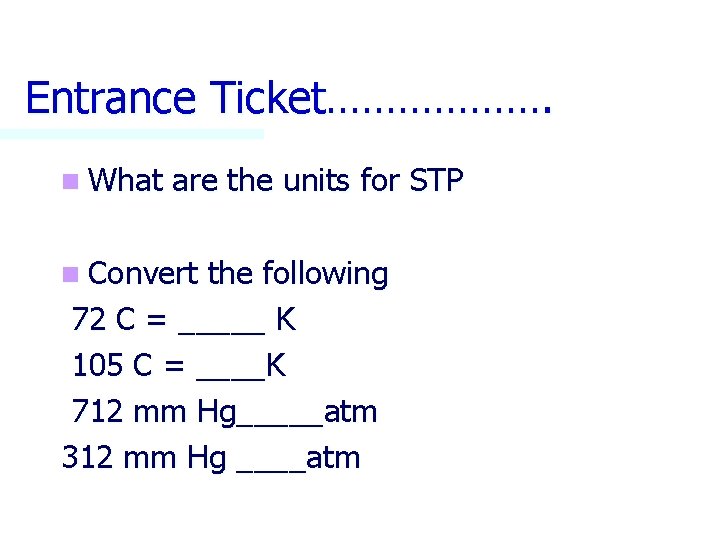
Entrance Ticket………………. n What are the units for STP n Convert the following 72 C = _____ K 105 C = ____K 712 mm Hg_____atm 312 mm Hg ____atm
Learning target n. I can use Boyle’s law to determine the relationship between pressure and volume of gases
Key Concept-Temperature describes the average kinetic energy of molecules within a material or system and is measured in Celsius (°C), Kelvin(K), Fahrenheit (°F n Temperature
Key Concept- Heat describes the transfer of thermal energy between molecules within a system. n Heat
Kinetic Molecular Theory The kinetic theory describes a gas as a large number of submicroscopic particles (atoms or molecules), all of which are in constant rapid motion that has randomness arising from their many collisions with each other and with the walls of the container.
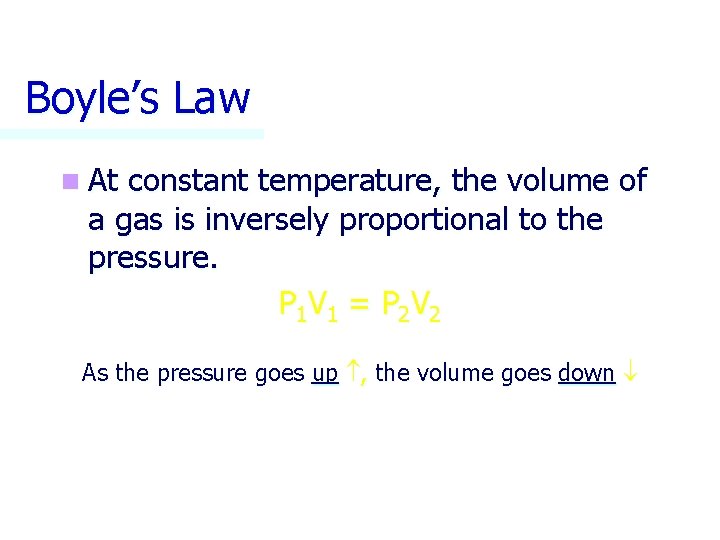
Boyle’s Law n At constant temperature, the volume of a gas is inversely proportional to the pressure. P 1 V 1 = P 2 V 2 As the pressure goes up , the volume goes down
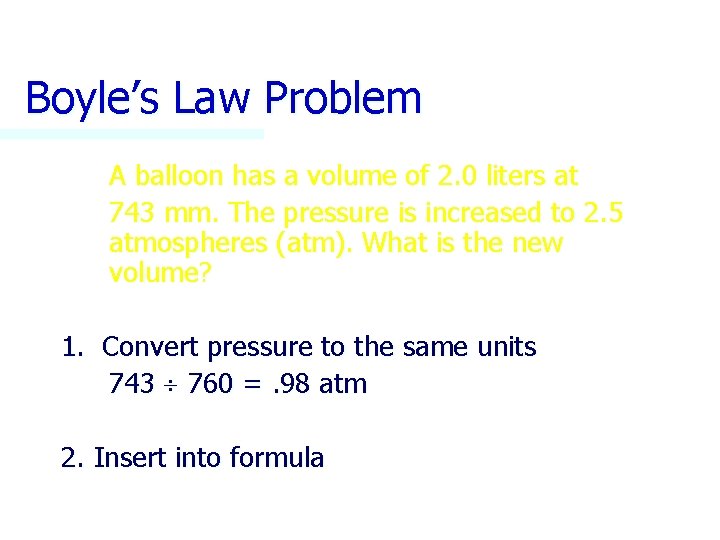
Boyle’s Law Problem A balloon has a volume of 2. 0 liters at 743 mm. The pressure is increased to 2. 5 atmospheres (atm). What is the new volume? 1. Convert pressure to the same units 743 760 =. 98 atm 2. Insert into formula
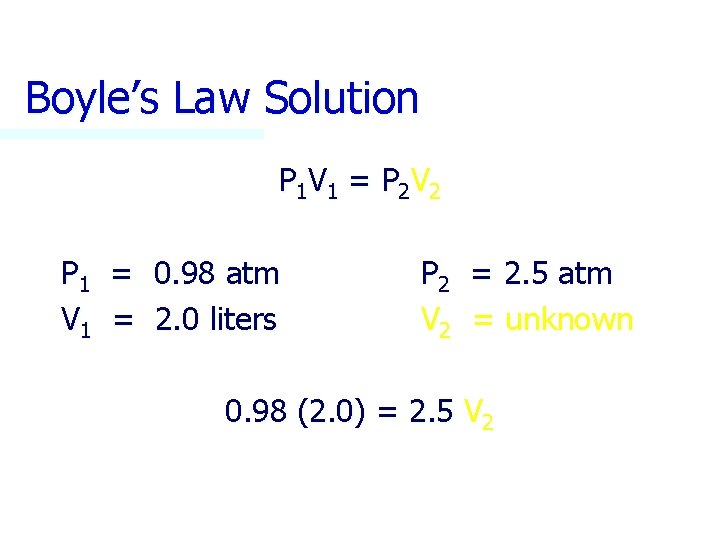
Boyle’s Law Solution P 1 V 1 = P 2 V 2 P 1 = 0. 98 atm V 1 = 2. 0 liters P 2 = 2. 5 atm V 2 = unknown 0. 98 (2. 0) = 2. 5 V 2
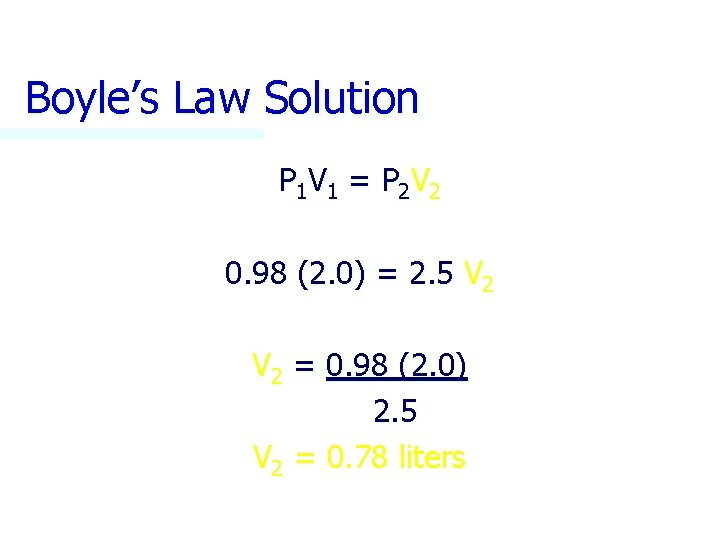
Boyle’s Law Solution P 1 V 1 = P 2 V 2 0. 98 (2. 0) = 2. 5 V 2 = 0. 98 (2. 0) 2. 5 V 2 = 0. 78 liters
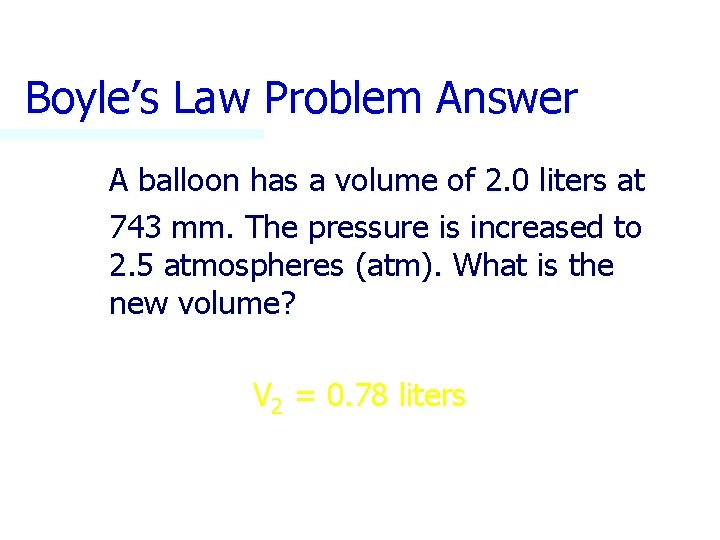
Boyle’s Law Problem Answer A balloon has a volume of 2. 0 liters at 743 mm. The pressure is increased to 2. 5 atmospheres (atm). What is the new volume? V 2 = 0. 78 liters
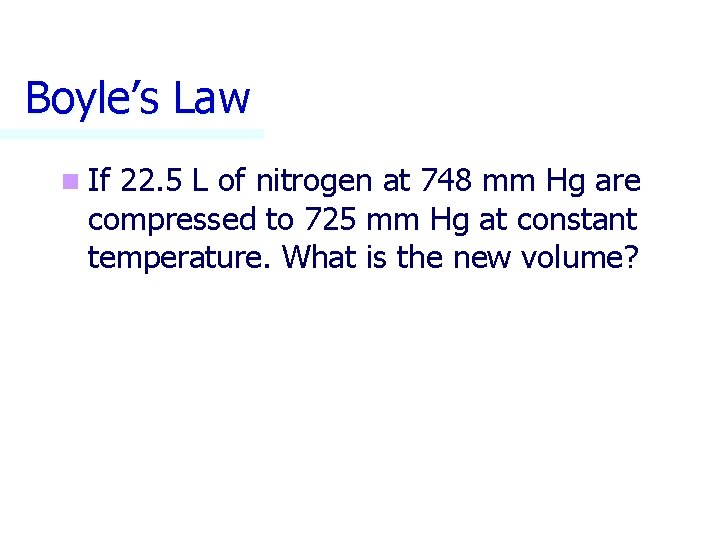
Boyle’s Law n If 22. 5 L of nitrogen at 748 mm Hg are compressed to 725 mm Hg at constant temperature. What is the new volume?
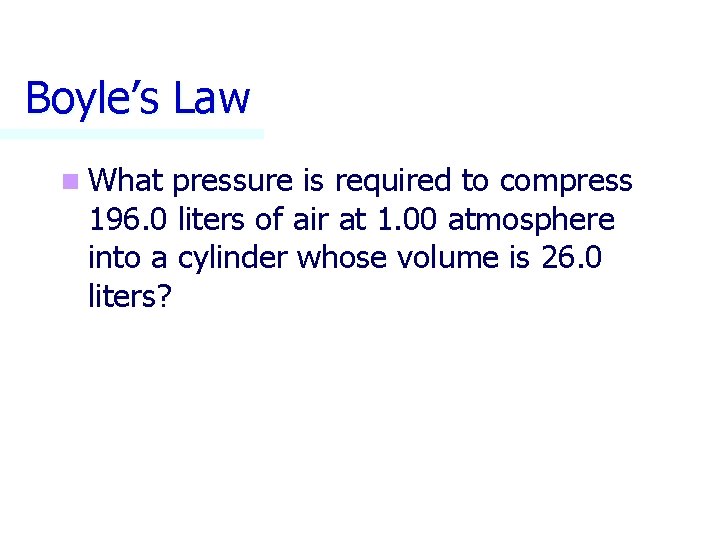
Boyle’s Law n What pressure is required to compress 196. 0 liters of air at 1. 00 atmosphere into a cylinder whose volume is 26. 0 liters?
While you wait… ……make sure that you are in your assigned Seat ………. . get out a calculator and a pen or pencil

AP Chemistry Big Idea 2 Chemical and physical properties of materials can be explained by the structure and the arrangement of atoms, ions, or molecules and the forces between them.
AP Chemistry Standards n 2. A. 1: The different properties of solids and liquids can be explained by differences in their structures, both at the particulate level and in their supramolecular structures. 2. A. 2: The gaseous state can be effectively modeled with a mathematical equation relating various macroscopic properties. A gas has neither a definite volume nor a definite shape; because the effects of attractive forces are minimal, we usually assume that the particles move independently.
WARM UP…………. A balloon has a volume of 2. 0 liters at a pressure of 98 k. Pa and a temperature of 25 o. C. What is the volume under standard conditions? 1. Convert 25 o. C to Kelvins 25 + 273 = 298 K 2. Standard pressure is 101. 32 k. Pa 3. Standard temperature is 273 K 4. Insert into formula
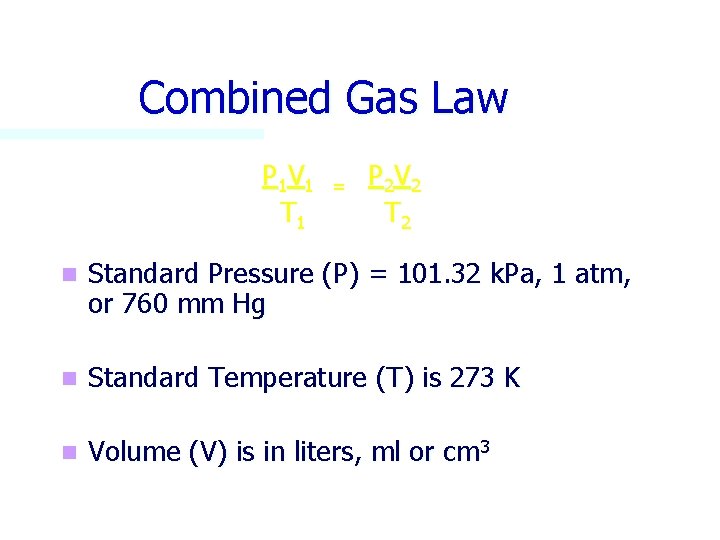
Combined Gas Law P 1 V 1 T 1 = P 2 V 2 T 2 n Standard Pressure (P) = 101. 32 k. Pa, 1 atm, or 760 mm Hg n Standard Temperature (T) is 273 K n Volume (V) is in liters, ml or cm 3
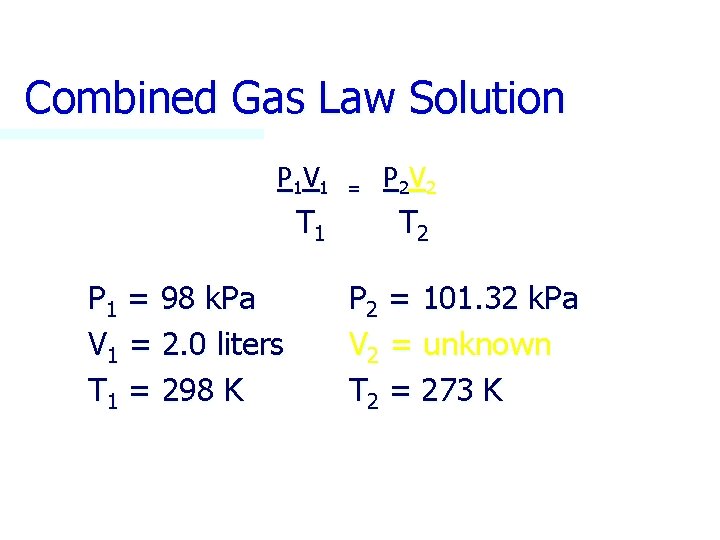
Combined Gas Law Solution P 1 V 1 T 1 P 1 = 98 k. Pa V 1 = 2. 0 liters T 1 = 298 K = P 2 V 2 T 2 P 2 = 101. 32 k. Pa V 2 = unknown T 2 = 273 K
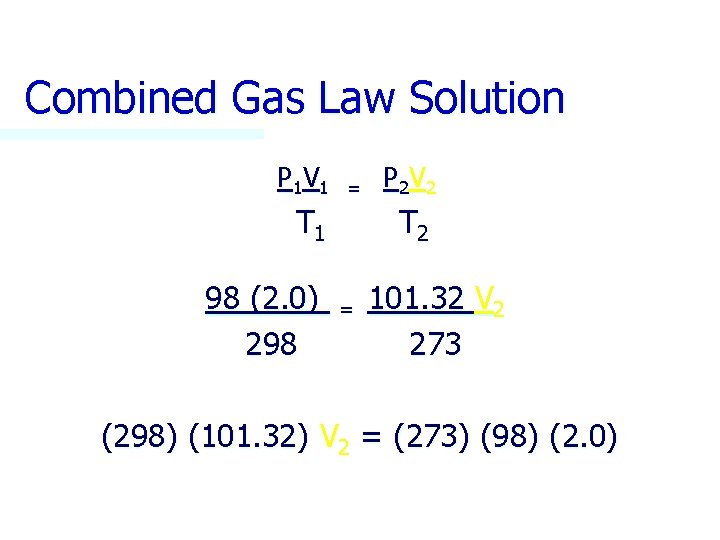
Combined Gas Law Solution P 1 V 1 = T 1 98 (2. 0) 298 P 2 V 2 T 2 = 101. 32 V 2 273 (298) (101. 32) V 2 = (273) (98) (2. 0)
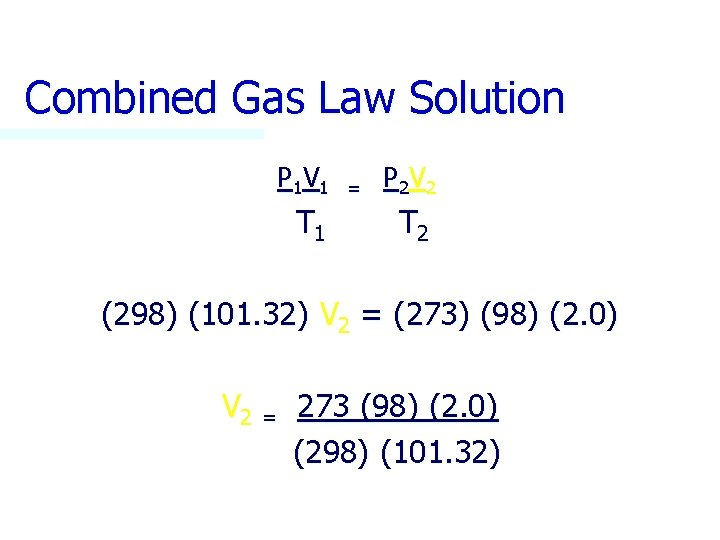
Combined Gas Law Solution P 1 V 1 T 1 = P 2 V 2 T 2 (298) (101. 32) V 2 = (273) (98) (2. 0) V 2 = 273 (98) (2. 0) (298) (101. 32)
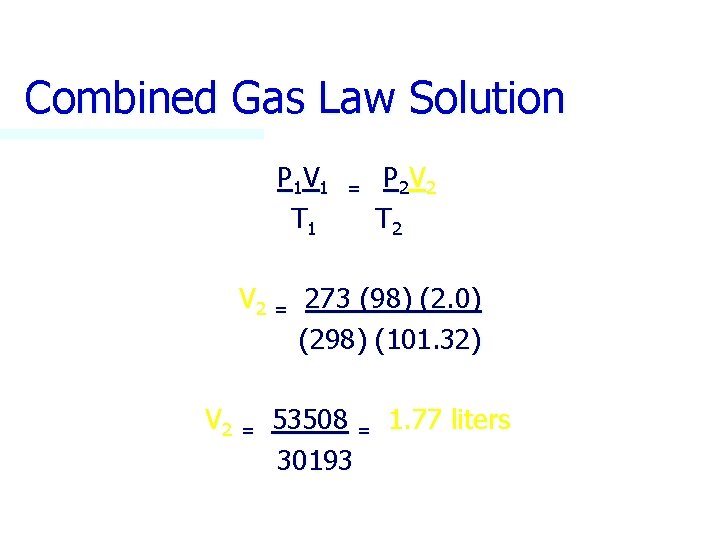
Combined Gas Law Solution P 1 V 1 T 1 = P 2 V 2 T 2 V 2 = 273 (98) (2. 0) (298) (101. 32) V 2 = 53508 = 1. 77 liters 30193
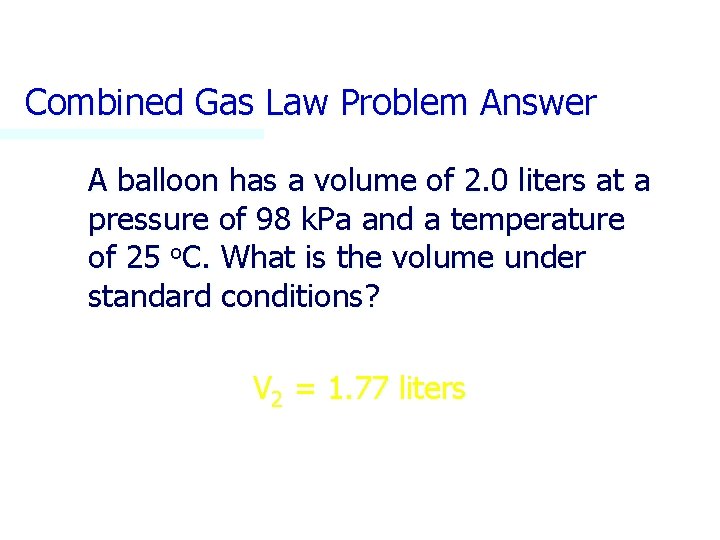
Combined Gas Law Problem Answer A balloon has a volume of 2. 0 liters at a pressure of 98 k. Pa and a temperature of 25 o. C. What is the volume under standard conditions? V 2 = 1. 77 liters
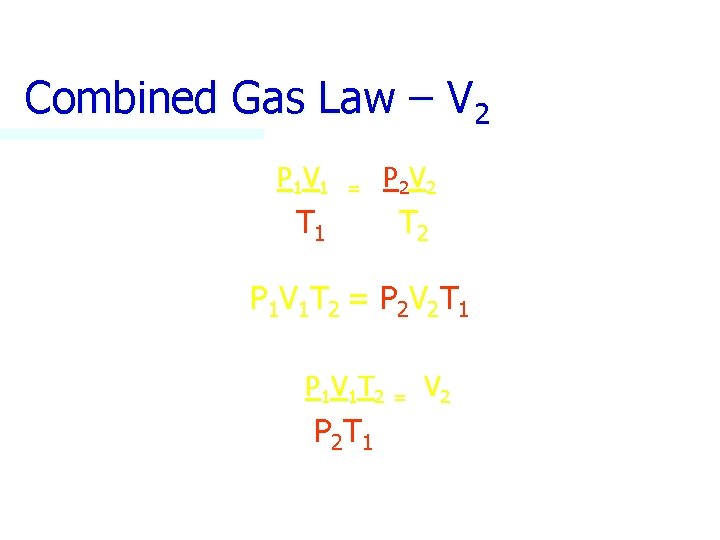
Combined Gas Law – V 2 P 1 V 1 = T 1 P 2 V 2 T 2 P 1 V 1 T 2 = P 2 V 2 T 1 P 1 V 1 T 2 = V 2 P 2 T 1
The Ideal Gas Law Chemistry Mr. Morrow
Research Project n Choose something of interest to you (food, beverages, cellphones, skateboards, chemistry of the brain etc) n Learn about the product, elements used, chemical processes and manufacturing n Choose one of the formats to present your findings……. . due next Thursday

Research Continued n Include mini experiments n Develop n Get models creative and make it fun

Today’s activities… ……with your phone or laptop log into kahoot. it And use pin # 239952 ……. . Unit 5 review …. . tower structure challenge ……. design, draw and build
Today’s Learning Target n. I can distinguish between an acid, base and neutral using the p. H scale
Warm up…. . . . 10 minutes n What is the range for the p. H scale n Name one strong acid and one strong base from the lab n What is the p. H of a neutral solution? n Which is more commonly used in soaps and shampoos?
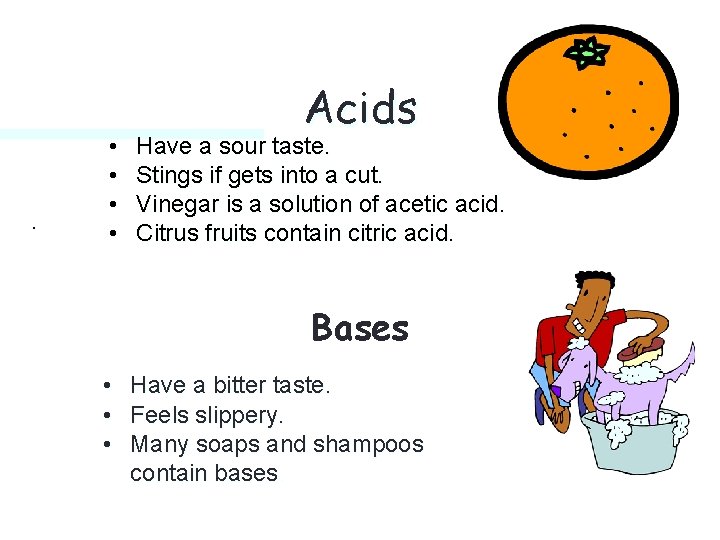
. • • Acids Have a sour taste. Stings if gets into a cut. Vinegar is a solution of acetic acid. Citrus fruits contain citric acid. Bases • • • Have a bitter taste. Feels slippery. Many soaps and shampoos contain bases.
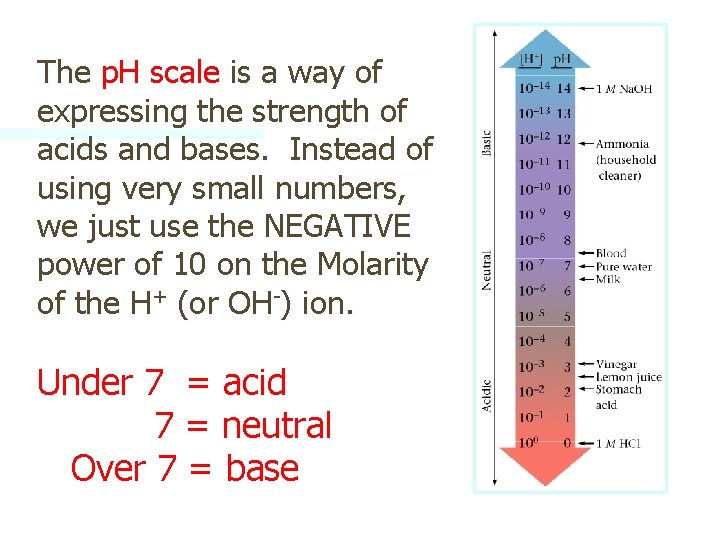
The p. H scale is a way of expressing the strength of acids and bases. Instead of using very small numbers, we just use the NEGATIVE power of 10 on the Molarity of the H+ (or OH-) ion. Under 7 = acid 7 = neutral Over 7 = base
Warm Up……. 10 minutes 1. Describe the following: n Unsaturated n Super Saturated 2. List the factors that affect solubility Turn in when complete

Test Day You will need n a calculator n pen or pencil Please keep cellphones put away until all Students are done with testing
Warm up……. . 10 minutes n If 25 liters of CO 2 are collected at 1200 degrees Celsius what will the volume of the gas be after it cools to 25 degrees Celsius? n I have a car with an internal volume of 12, 000 L. If I drove my car into the river and it implodes, what will be the volume of the gas when the pressure goes from 1. 0 atm to 1. 4 atm?
While you wait……. . n Pick n You up a copy of the ideal gas law lab will need a pen, pencil and calculator
Ideal Gases n hypothetical gas whose molecules occupy negligible space and have no interactions, and that consequently obeys the gas laws exactly.

Ideal Gas Law PV = n. RT P = pressure in kilopascals (k. Pa) or atmospheres (atm) V = volume in liters n = moles T = temperature in Kelvins R = universal gas constant
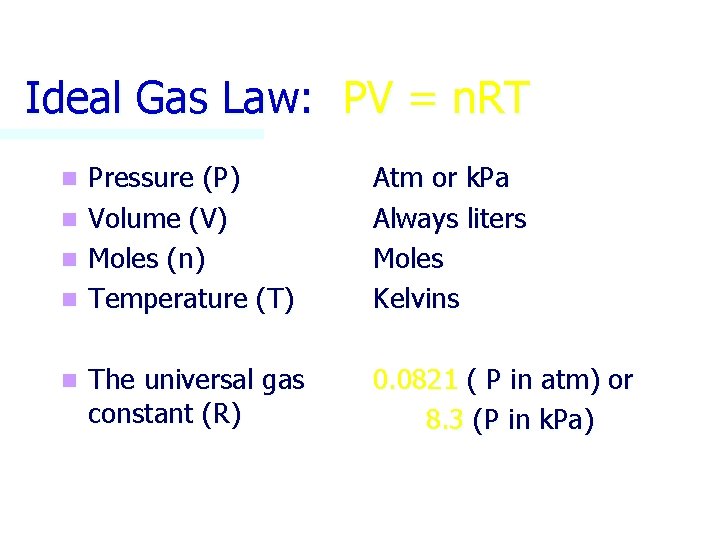
Ideal Gas Law: PV = n. RT n n n Pressure (P) Volume (V) Moles (n) Temperature (T) Atm or k. Pa Always liters Moles Kelvins The universal gas constant (R) 0. 0821 ( P in atm) or 8. 3 (P in k. Pa)
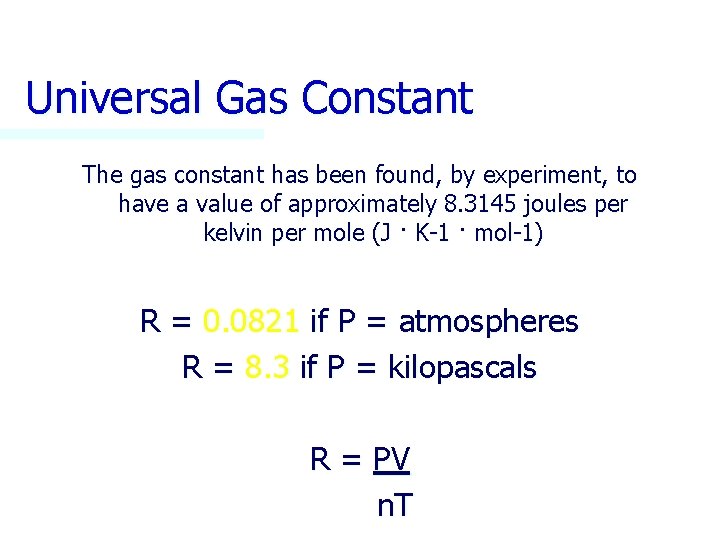
Universal Gas Constant The gas constant has been found, by experiment, to have a value of approximately 8. 3145 joules per kelvin per mole (J · K-1 · mol-1) R = 0. 0821 if P = atmospheres R = 8. 3 if P = kilopascals R = PV n. T
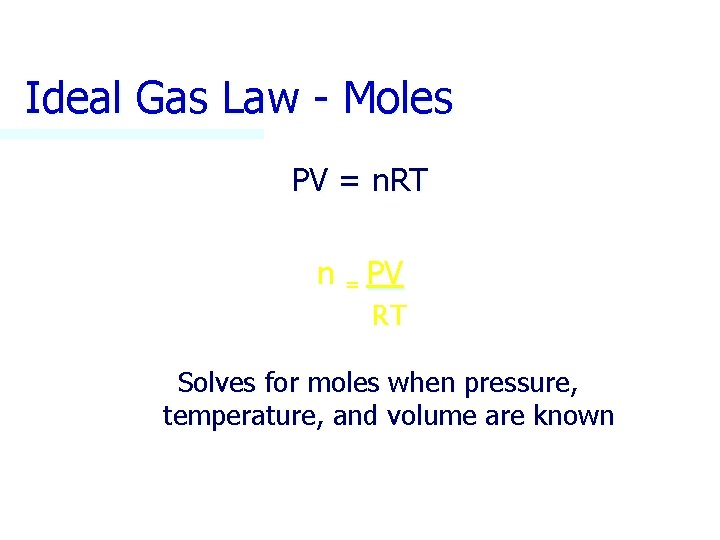
Ideal Gas Law - Moles PV = n. RT n = PV RT Solves for moles when pressure, temperature, and volume are known
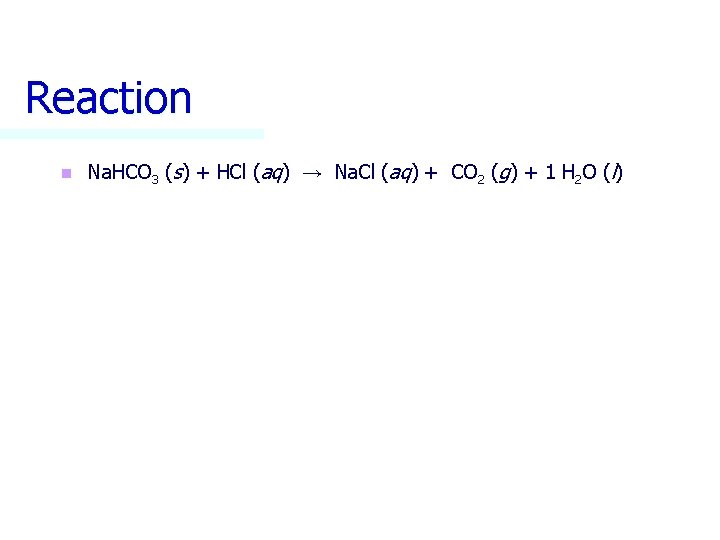
Reaction n Na. HCO 3 (s) + HCl (aq) → Na. Cl (aq) + CO 2 (g) + 1 H 2 O (l)
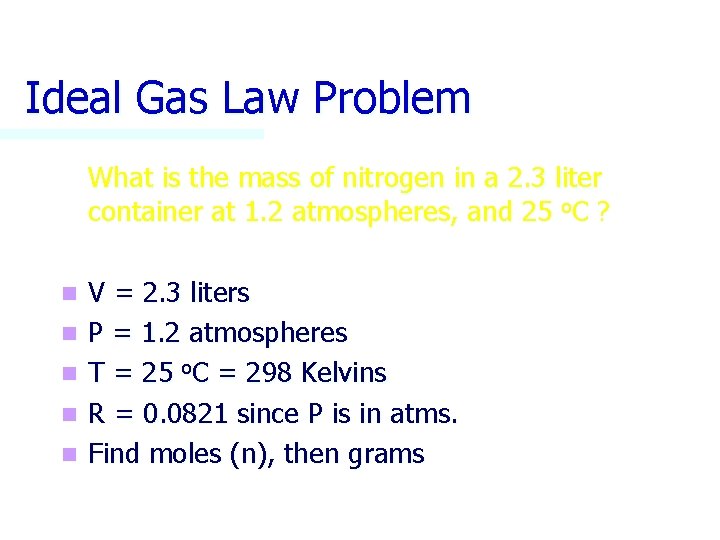
Ideal Gas Law Problem What is the mass of nitrogen in a 2. 3 liter container at 1. 2 atmospheres, and 25 o. C ? n n n V = 2. 3 liters P = 1. 2 atmospheres T = 25 o. C = 298 Kelvins R = 0. 0821 since P is in atms. Find moles (n), then grams
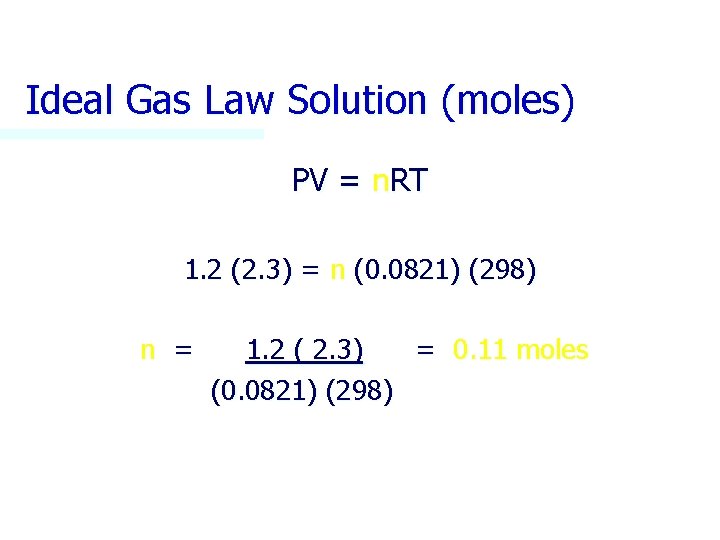
Ideal Gas Law Solution (moles) PV = n. RT 1. 2 (2. 3) = n (0. 0821) (298) n = 1. 2 ( 2. 3) = 0. 11 moles (0. 0821) (298)
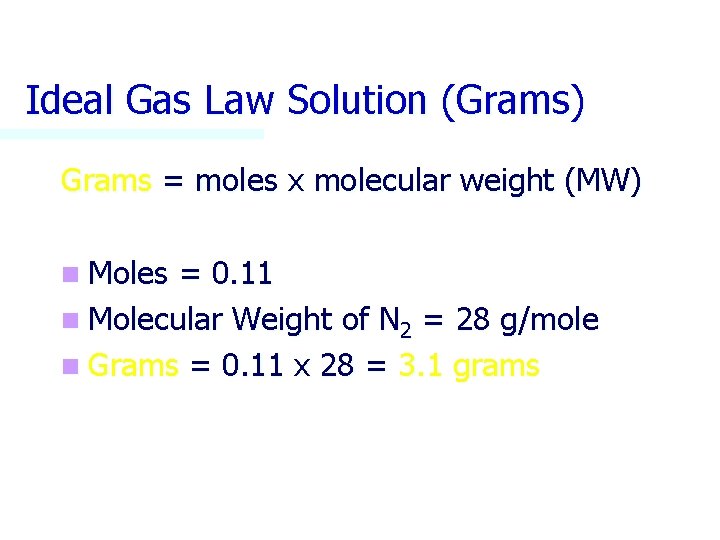
Ideal Gas Law Solution (Grams) Grams = moles x molecular weight (MW) n Moles = 0. 11 n Molecular Weight of N 2 = 28 g/mole n Grams = 0. 11 x 28 = 3. 1 grams
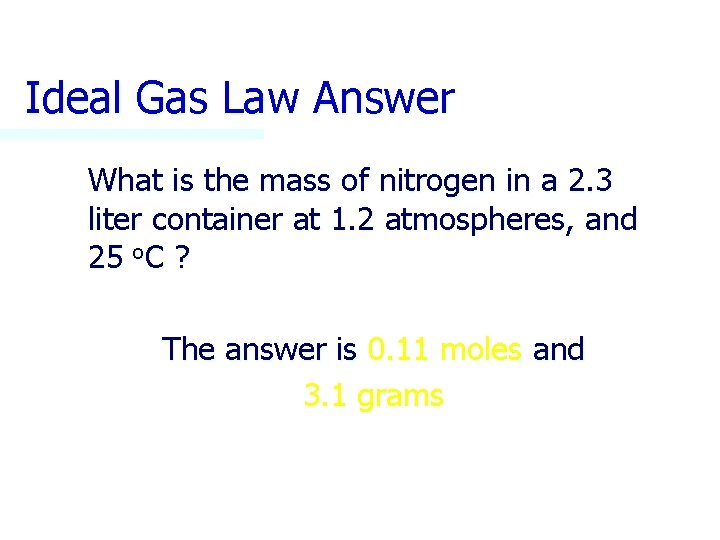
Ideal Gas Law Answer What is the mass of nitrogen in a 2. 3 liter container at 1. 2 atmospheres, and 25 o. C ? The answer is 0. 11 moles and 3. 1 grams
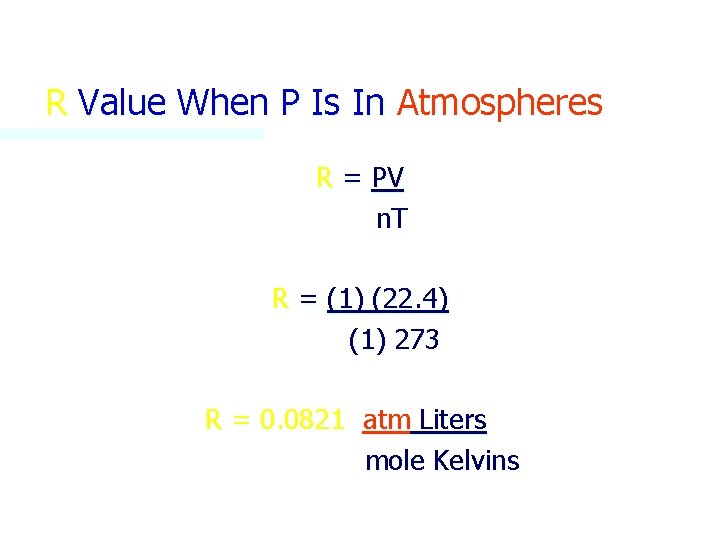
R Value When P Is In Atmospheres R = PV n. T R = (1) (22. 4) (1) 273 R = 0. 0821 atm Liters mole Kelvins
Molar Volume
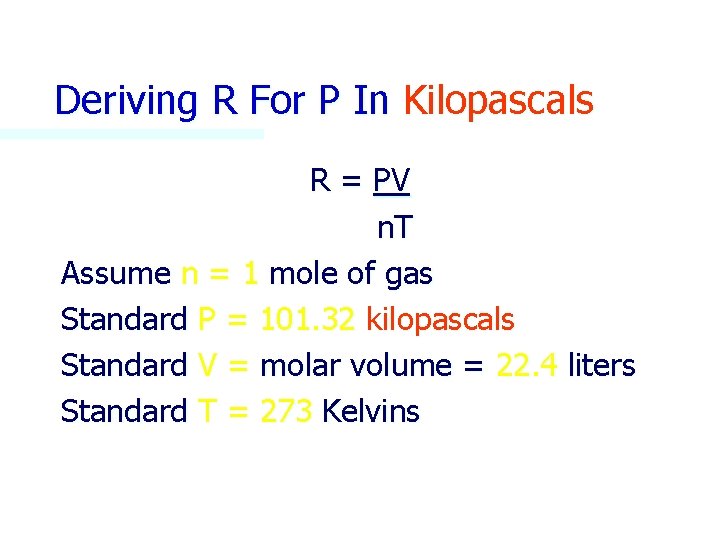
Deriving R For P In Kilopascals R = PV n. T Assume n = 1 mole of gas Standard P = 101. 32 kilopascals Standard V = molar volume = 22. 4 liters Standard T = 273 Kelvins

Deriving R for P in Atmospheres R = PV n. T Assume n = 1 mole of gas Standard P = 1 atmosphere Standard V = molar volume = 22. 4 liters Standard T = 273 Kelvins
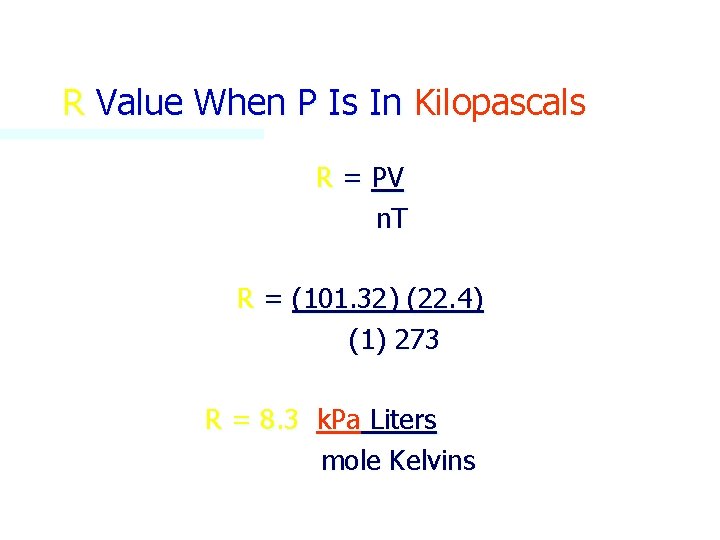
R Value When P Is In Kilopascals R = PV n. T R = (101. 32) (22. 4) (1) 273 R = 8. 3 k. Pa Liters mole Kelvins
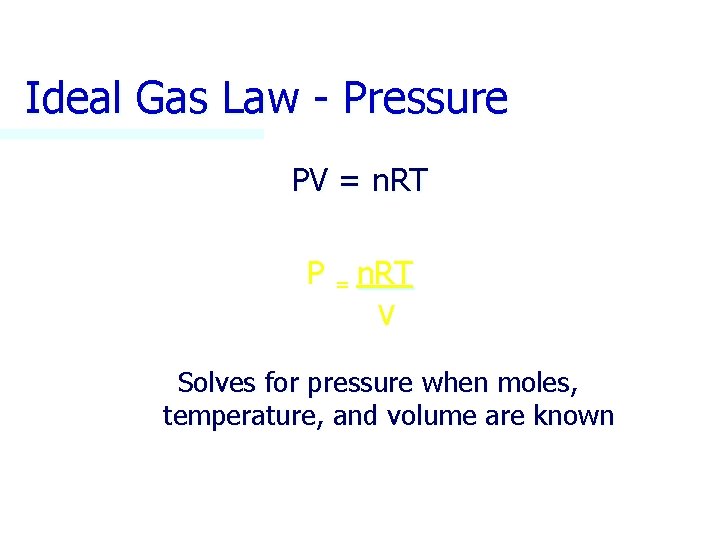
Ideal Gas Law - Pressure PV = n. RT P = n. RT V Solves for pressure when moles, temperature, and volume are known
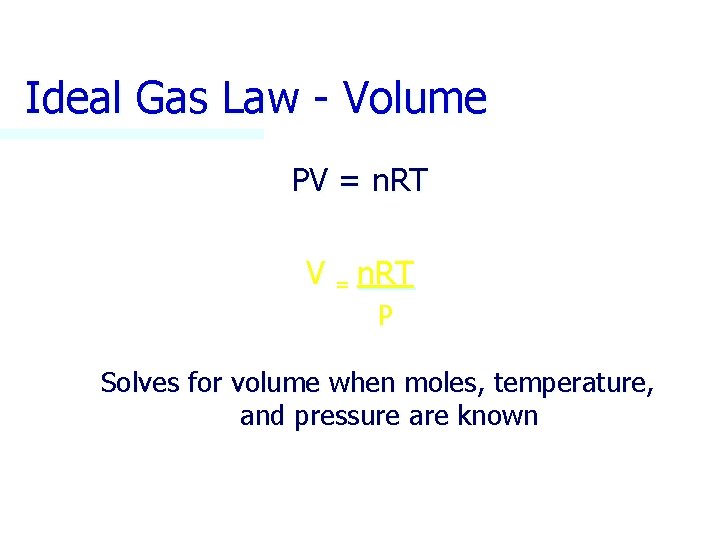
Ideal Gas Law - Volume PV = n. RT P Solves for volume when moles, temperature, and pressure are known

Ideal Gas Law - Temperature PV = n. RT T = PV n. R Solves for temperature when moles, pressure, and volume are known
- Slides: 79