
AVOGADROS HYPOTHESIS Science Original Article Link to the



- Slides: 11
AVOGADRO'S HYPOTHESIS Science
Original Article �Link to the original article: �http: //pubs. acs. org/doi/abs/10. 1021/ed 048 p 365
Amedeo Avogadro first published his hypothesis stating the directly proportional relationship between volume of gas and quantities of gas molecules in 1811. But, many other scientists disagreed over whether it was true or not for 50 years, and that argument wasn’t settled until after Avogadro’s death.
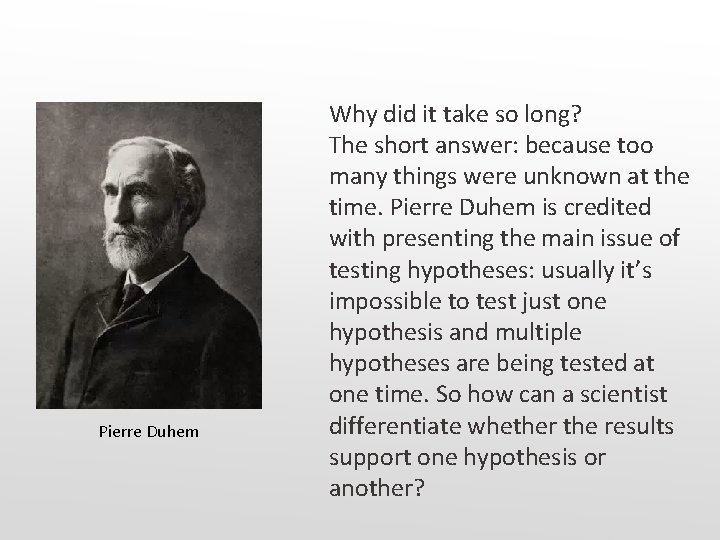
Pierre Duhem Why did it take so long? The short answer: because too many things were unknown at the time. Pierre Duhem is credited with presenting the main issue of testing hypotheses: usually it’s impossible to test just one hypothesis and multiple hypotheses are being tested at one time. So how can a scientist differentiate whether the results support one hypothesis or another?
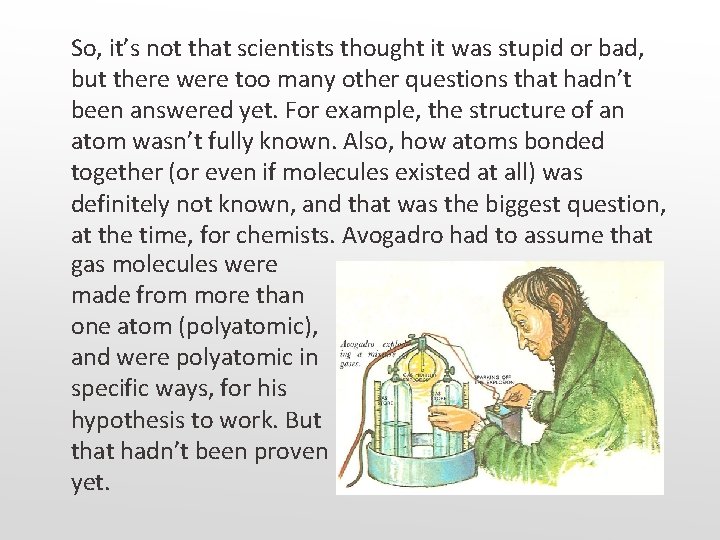
So, it’s not that scientists thought it was stupid or bad, but there were too many other questions that hadn’t been answered yet. For example, the structure of an atom wasn’t fully known. Also, how atoms bonded together (or even if molecules existed at all) was definitely not known, and that was the biggest question, at the time, for chemists. Avogadro had to assume that gas molecules were made from more than one atom (polyatomic), and were polyatomic in specific ways, for his hypothesis to work. But that hadn’t been proven yet.
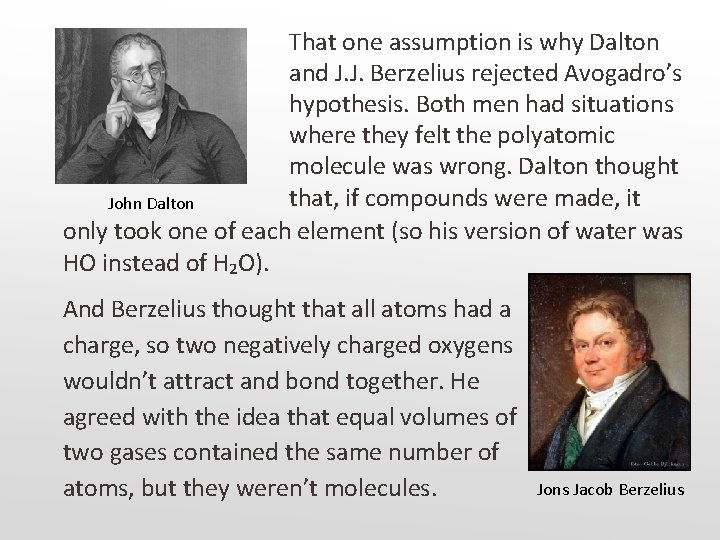
That one assumption is why Dalton and J. J. Berzelius rejected Avogadro’s hypothesis. Both men had situations where they felt the polyatomic molecule was wrong. Dalton thought that, if compounds were made, it John Dalton only took one of each element (so his version of water was HO instead of H₂O). And Berzelius thought that all atoms had a charge, so two negatively charged oxygens wouldn’t attract and bond together. He agreed with the idea that equal volumes of two gases contained the same number of atoms, but they weren’t molecules. Jons Jacob Berzelius
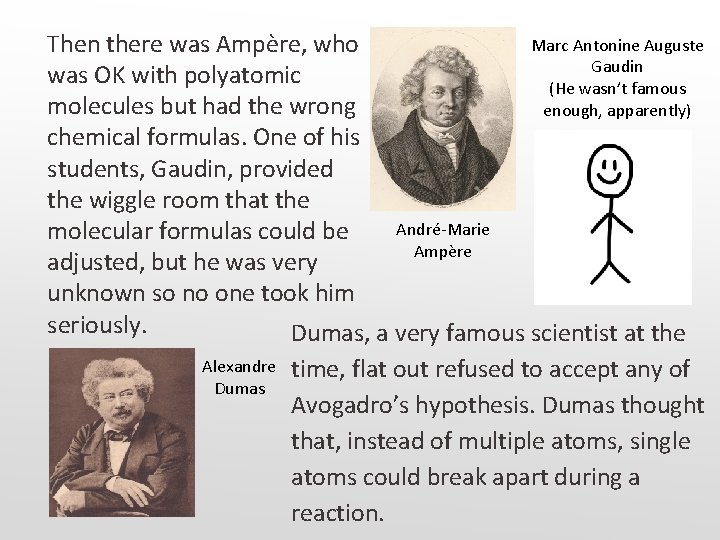
Marc Antonine Auguste Then there was Ampère, who Gaudin was OK with polyatomic (He wasn’t famous molecules but had the wrong enough, apparently) chemical formulas. One of his students, Gaudin, provided the wiggle room that the André-Marie molecular formulas could be Ampère adjusted, but he was very unknown so no one took him seriously. Dumas, a very famous scientist at the Alexandre Dumas time, flat out refused to accept any of Avogadro’s hypothesis. Dumas thought that, instead of multiple atoms, single atoms could break apart during a reaction.
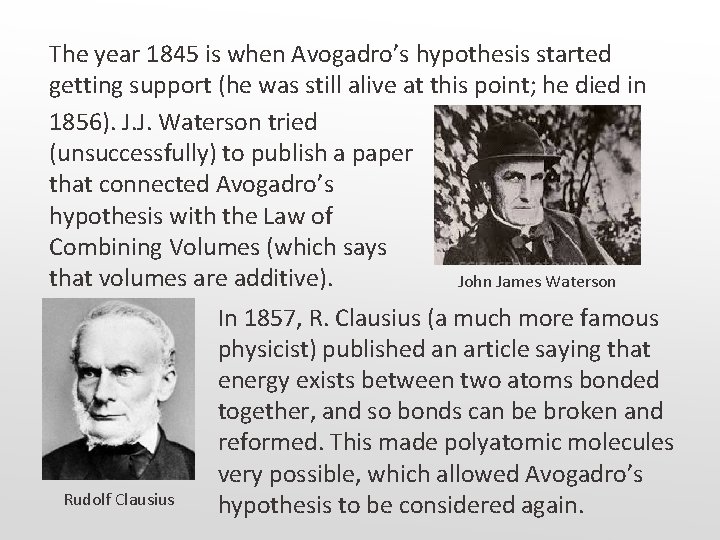
The year 1845 is when Avogadro’s hypothesis started getting support (he was still alive at this point; he died in 1856). J. J. Waterson tried (unsuccessfully) to publish a paper that connected Avogadro’s hypothesis with the Law of Combining Volumes (which says that volumes are additive). John James Waterson Rudolf Clausius In 1857, R. Clausius (a much more famous physicist) published an article saying that energy exists between two atoms bonded together, and so bonds can be broken and reformed. This made polyatomic molecules very possible, which allowed Avogadro’s hypothesis to be considered again.
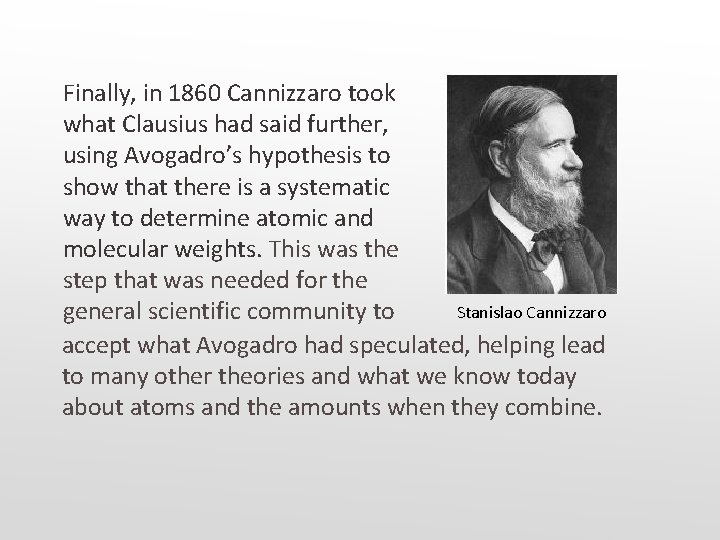
Finally, in 1860 Cannizzaro took what Clausius had said further, using Avogadro’s hypothesis to show that there is a systematic way to determine atomic and molecular weights. This was the step that was needed for the Stanislao Cannizzaro general scientific community to accept what Avogadro had speculated, helping lead to many other theories and what we know today about atoms and the amounts when they combine.