
AVLTREE AdelsonVelsky and Landis OR SELFBALANCING BINARY SEARCH
AVLTREE (Adelson-Velsky and Landis) OR SELF-BALANCING BINARY SEARCH TREE OR HEIGHT BALANCED TREE
AVL Trees • AVL tree is a self-balancing binary search tree in which the heights of the two sub-trees of a node may differ by at most one. • Because of this property, AVL tree is also known as a heightbalanced tree. • The key advantage of using an AVL tree is that it takes O(logn) time to perform search, insertion and deletion operations in average case as well as worst case (because the height of the tree is limited to O(logn)). • The structure of an AVL tree is same as that of a binary search tree but with a little difference. In its structure, it stores an additional variable called the Balance. Factor.
AVL Trees • The balance factor of a node is calculated by subtracting the height of its right sub-tree from the height of its left sub-tree. Balance factor = Height (left sub-tree) – Height (right sub-tree) • A binary search tree in which every node has a balance factor of -1, 0 or 1 is said to be height balanced. A node with any other balance factor is considered to be unbalanced and requires rebalancing. • If the balance factor of a node is 1, then it means that the left subtree of the tree is one level higher than that of the right sub-tree. Such a tree is called Left-heavy tree. • If the balance factor of a node is 0, then it means that the height of the left sub-tree is equal to the height of its right sub-tree. • If the balance factor of a node is -1, then it means that the left subtree of the tree is one level lower than that of the right sub-tree. Such a tree is called Right-heavy tree.
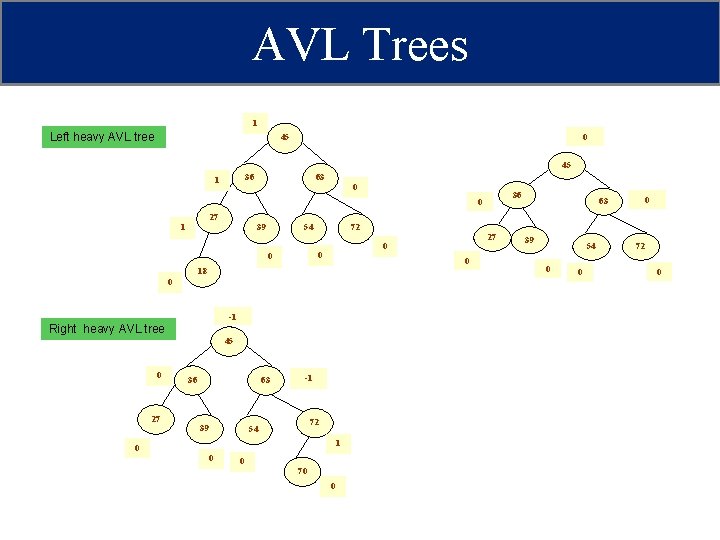
AVL Trees 1 Left heavy AVL tree 45 0 45 36 1 63 0 36 0 39 54 72 0 18 0 -1 Right heavy AVL tree 45 36 63 39 -1 72 54 1 0 0 0 27 1 0 63 70 0 39 54 0 0 72 0

AVL Tree Various operation can be performed on AVL Tree • Search • Insertion • Deletion
Searching for AVL a Node Treein an AVL Tree • Searching in an AVL tree is performed exactly the same way as it is performed in a binary search tree. • Because of the height-balancing of the tree, the search operation takes O(log n) time to complete. • Since the operation does not modify the structure of the tree, no special provisions need to be taken.
Inserting a Node in an AVL Tree • Since an AVL tree is also a variant of binary search tree, insertion is also done in the same way as it is done in case of a binary search tree. • Like in binary search tree, the new node is always inserted as the leaf node. But the step of insertion is usually followed by an additional step of rotation. • Rotation is done to restore the balance of the tree. However, if insertion of the new node does not disturb the balance factor, that is, if the balance factor of every node is still -1, 0 or 1, then rotations are not needed.
Inserting a Node in an AVL Tree • During insertion, the new node is inserted as the leaf node, so it will always have balance factor equal to zero. • The nodes whose balance factors will change are those which lie on the path between the root of the tree and the newly inserted node. • The possible changes which may take place in any node on the path are as follows: Ø Initially the node was either left or right heavy and after insertion has become balanced. Ø Initially the node was balanced and after insertion has become either left or right heavy. Ø Initially the node was heavy (either left or right) and the new node has been inserted in the heavy sub-tree thereby creating an unbalanced sub -tree. Such a node is said to be a critical node.
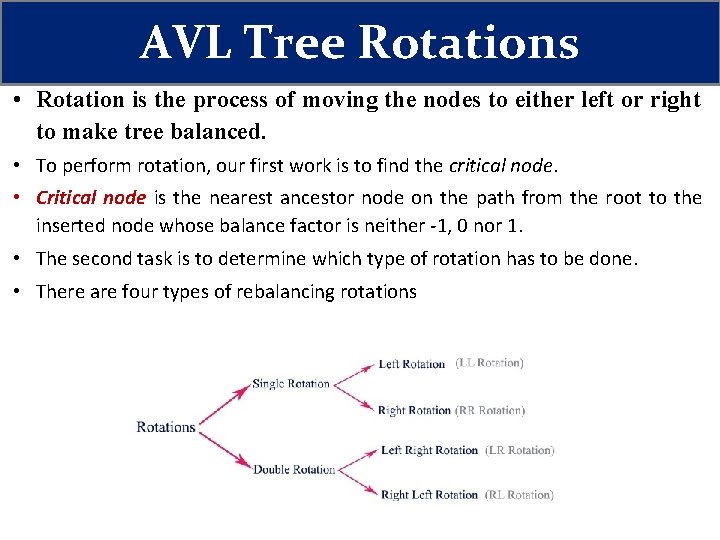
AVL Tree Rotations • Rotation is the process of moving the nodes to either left or right to make tree balanced. • To perform rotation, our first work is to find the critical node. • Critical node is the nearest ancestor node on the path from the root to the inserted node whose balance factor is neither -1, 0 nor 1. • The second task is to determine which type of rotation has to be done. • There are four types of rebalancing rotations
AVL Tree Rotations ØLL rotation: the new node is inserted in the left sub-tree of the left child of the critical node ØRR rotation: the new node is inserted in the right sub-tree of the right child of the critical node ØLR rotation: the new node is inserted in the right sub-tree of the left child of the critical node ØRL rotation: the new node is inserted in the left sub-tree of the right child of the critical node
Deleting a Node from an AVL Tree • Deletion of a node in an AVL tree is similar to that of binary search trees. • But deletion may disturb the AVLness of the tree, so to re-balance the AVL tree we need to perform rotations. • There are two classes of rotation that can be performed on an AVL tree after deleting a given node: R rotation and L rotation. • If the node to be deleted is present in the left sub-tree of the critical node, then L rotation is applied else if node is in the right sub-tree, R rotation is performed. • Furthere are three categories of L and R rotations. The variations of L rotation are: L-1, L 0 and L 1 rotation. Correspondingly for R rotation, there are R 0, R-1 and R 1 rotations.
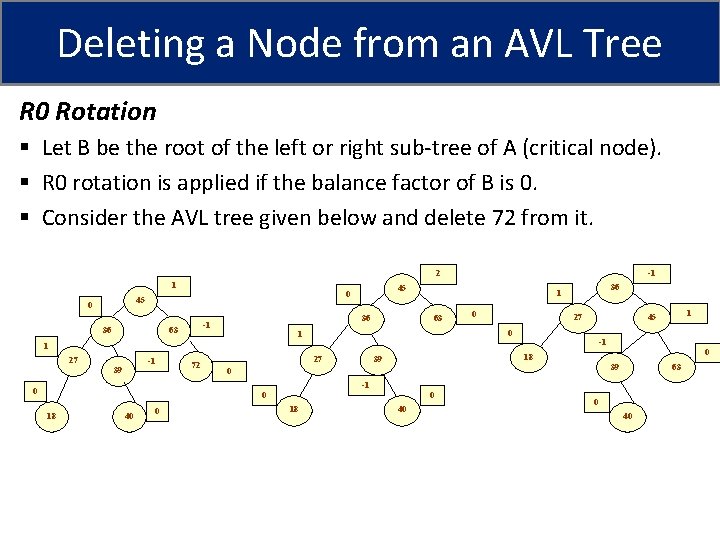
Deleting a Node from an AVL Tree R 0 Rotation § Let B be the root of the left or right sub-tree of A (critical node). § R 0 rotation is applied if the balance factor of B is 0. § Consider the AVL tree given below and delete 72 from it. 2 1 0 45 0 36 36 -1 63 -1 45 36 1 63 0 27 0 1 -1 1 27 -1 39 72 27 18 39 0 63 -1 0 0 18 40 1 45 0 40
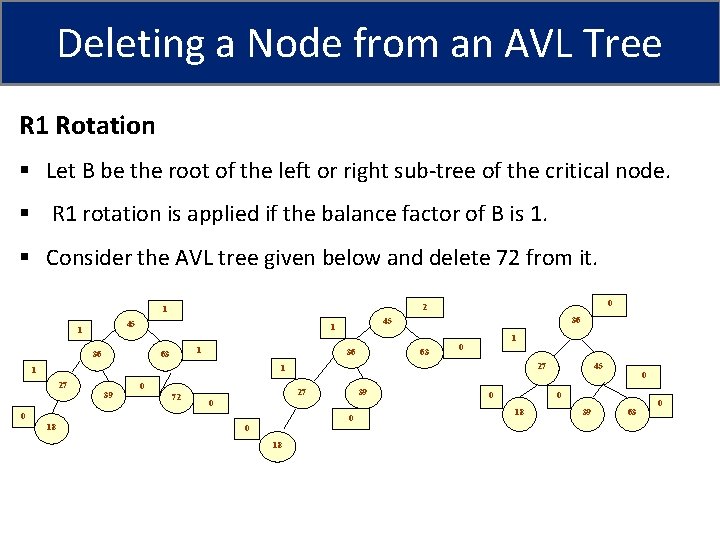
Deleting a Node from an AVL Tree R 1 Rotation § Let B be the root of the left or right sub-tree of the critical node. § R 1 rotation is applied if the balance factor of B is 1. § Consider the AVL tree given below and delete 72 from it. 45 1 1 63 36 45 1 36 0 2 1 36 63 1 0 27 1 1 27 39 0 72 27 0 18 39 0 0 0 18 0 45 0 0 18 39 63 0
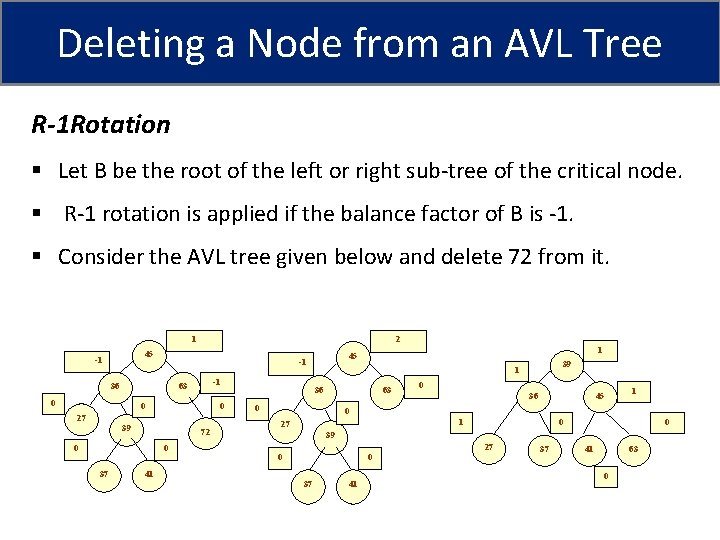
Deleting a Node from an AVL Tree R-1 Rotation § Let B be the root of the left or right sub-tree of the critical node. § R-1 rotation is applied if the balance factor of B is -1. § Consider the AVL tree given below and delete 72 from it. 1 2 45 -1 36 -1 63 0 0 0 27 39 72 0 0 37 1 45 -1 39 1 36 63 0 0 36 45 1 0 1 27 0 0 39 0 0 41 37 41 27 37 41 63 0
- Slides: 15