
AVL Trees Data Structures Fall 2007 Evan Korth
![Left(left) imbalance (1) [and right(right) imbalance, by symmetry] • B and C have the](https://slidetodoc.com/presentation_image/1e90647b4427ec85d414f479fff8edf6/image-7.jpg "Left(left) imbalance (1) [and right(right) imbalance, by symmetry] • B and C have the")
![Left(left) imbalance (2) [and right(right) imbalance, by symmetry] • B and C have the](https://slidetodoc.com/presentation_image/1e90647b4427ec85d414f479fff8edf6/image-8.jpg "Left(left) imbalance (2) [and right(right) imbalance, by symmetry] • B and C have the")
![Left(right) imbalance (1) [and right(left) imbalance by symmetry] • Can’t use the left-left balance](https://slidetodoc.com/presentation_image/1e90647b4427ec85d414f479fff8edf6/image-10.jpg "Left(right) imbalance (1) [and right(left) imbalance by symmetry] • Can’t use the left-left balance")
![Left(right) imbalance (2) [and right(left) imbalance by symmetry] • B will have two subtrees](https://slidetodoc.com/presentation_image/1e90647b4427ec85d414f479fff8edf6/image-11.jpg "Left(right) imbalance (2) [and right(left) imbalance by symmetry] • B will have two subtrees")
![Left(right) imbalance (3) [and right(left) imbalance by symmetry] • Neither 1 nor 3 worked](https://slidetodoc.com/presentation_image/1e90647b4427ec85d414f479fff8edf6/image-12.jpg "Left(right) imbalance (3) [and right(left) imbalance by symmetry] • Neither 1 nor 3 worked")
- Slides: 18
AVL Trees Data Structures Fall 2007 Evan Korth Adopted from a presentation by Simon Garrett and the Mark Allen Weiss book
AVL (Adelson-Velskii and Landis) tree • A balanced binary search tree where the height of the two subtrees (children) of a node differs by at most one. Look-up, insertion, and deletion are O( log n), where n is the number of nodes in the tree. • http: //www. cs. jhu. edu/~goodrich/dsa/trees/a vltree. html Source: nist. gov
Definition of height (reminder) • Height: the length of the longest path from a node to a leaf. – All leaves have a height of 0 – An empty tree has a height of – 1
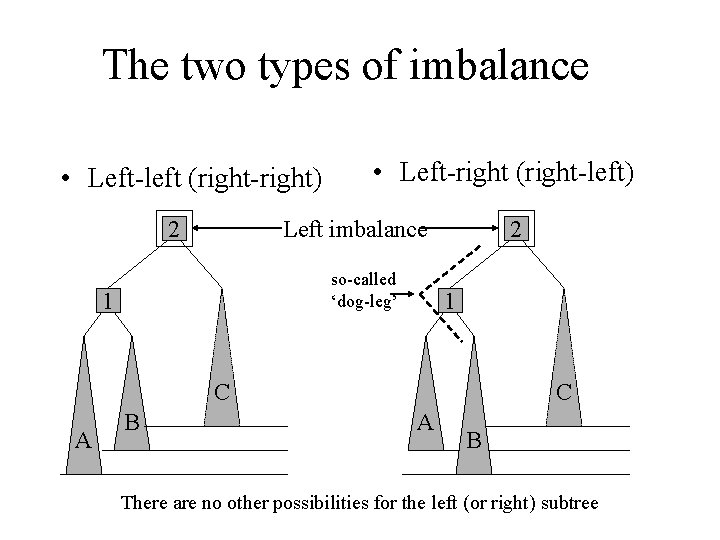
The insertion problem • Unless keys appear in just the right order, imbalance will occur • It can be shown that there are only two possible types of imbalance (see next slide): – Left-left (or right-right) imbalance – Left-right (or right-left) imbalance – The right-hand imbalances are the same, by symmetry
The two types of imbalance • Left-left (right-right) • Left-right (right-left) Left imbalance 2 so-called ‘dog-leg’ 1 2 1 C A B There are no other possibilities for the left (or right) subtree
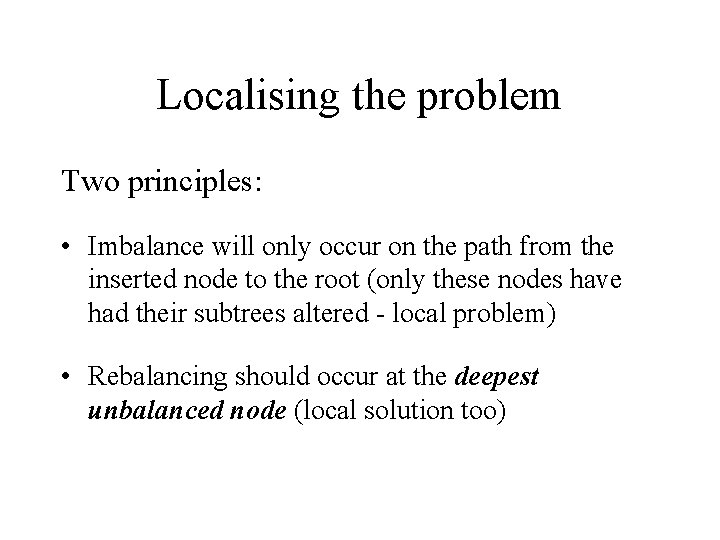
Localising the problem Two principles: • Imbalance will only occur on the path from the inserted node to the root (only these nodes have had their subtrees altered - local problem) • Rebalancing should occur at the deepest unbalanced node (local solution too)
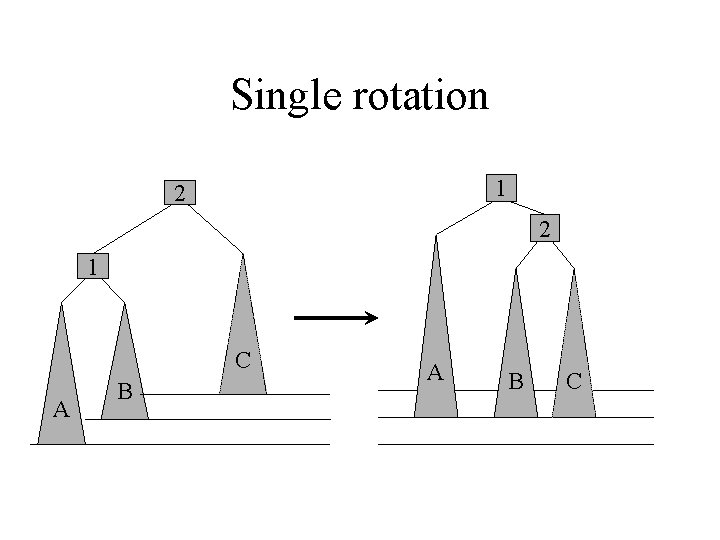
Left(left) imbalance (1) [and right(right) imbalance, by symmetry] • B and C have the same • Note the levels 2 height • A is one level higher 1 • Therefore make 1 the new root, 2 its right child and B and C the C subtrees of 2 A B
Left(left) imbalance (2) [and right(right) imbalance, by symmetry] • B and C have the same height • A is one level higher • Therefore make 1 the new root, 2 its right child and B and C the subtrees of 2 • Result: a more balanced and legal AVL tree • Note the levels 1 2 A B C
Single rotation 1 2 2 1 C A B C
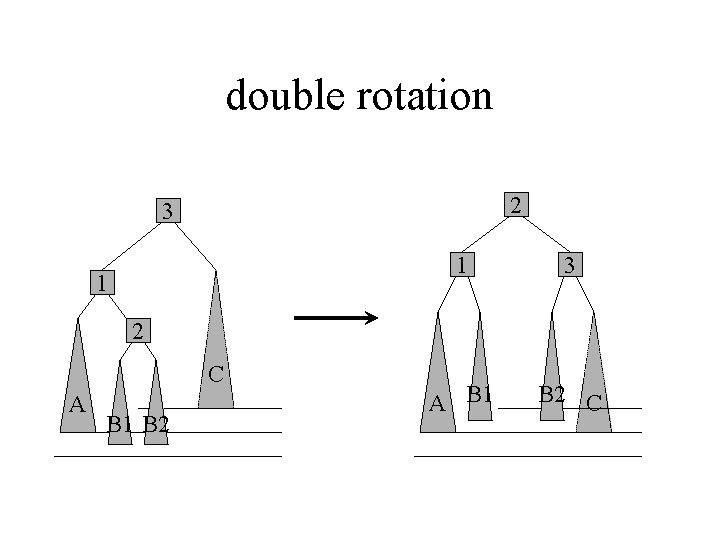
Left(right) imbalance (1) [and right(left) imbalance by symmetry] • Can’t use the left-left balance trick - because now it’s the middle subtree, i. e. B, that’s too deep. • Instead consider what’s inside B. . . 3 1 C A B
Left(right) imbalance (2) [and right(left) imbalance by symmetry] • B will have two subtrees containing at least one item (just added • We do not know which is too deep - set them both to 0. 5 levels below subtree A 3 1 2 C A B 1 B 2
Left(right) imbalance (3) [and right(left) imbalance by symmetry] • Neither 1 nor 3 worked as root node so make 2 the root • Rearrange the subtrees in the correct order • No matter how deep B 1 or B 2 (+/- 0. 5 levels) we get a legal AVL tree again 2 1 3 A B 1 B 2 C
double rotation 2 3 1 1 3 A B 1 B 2 C A B 1 B 2
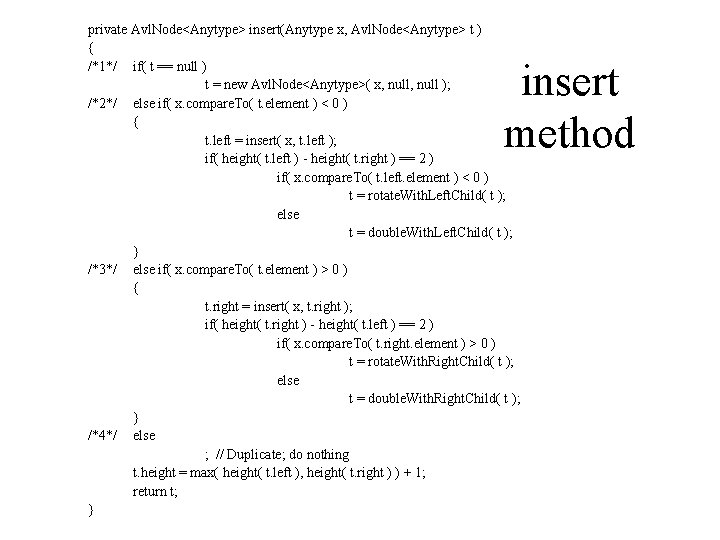
private Avl. Node<Anytype> insert(Anytype x, Avl. Node<Anytype> t ) { /*1*/ if( t == null ) t = new Avl. Node<Anytype>( x, null ); /*2*/ else if( x. compare. To( t. element ) < 0 ) { t. left = insert( x, t. left ); if( height( t. left ) - height( t. right ) == 2 ) if( x. compare. To( t. left. element ) < 0 ) t = rotate. With. Left. Child( t ); else t = double. With. Left. Child( t ); } /*3*/ else if( x. compare. To( t. element ) > 0 ) { t. right = insert( x, t. right ); if( height( t. right ) - height( t. left ) == 2 ) if( x. compare. To( t. right. element ) > 0 ) t = rotate. With. Right. Child( t ); else t = double. With. Right. Child( t ); } /*4*/ else ; // Duplicate; do nothing t. height = max( height( t. left ), height( t. right ) ) + 1; return t; } insert method
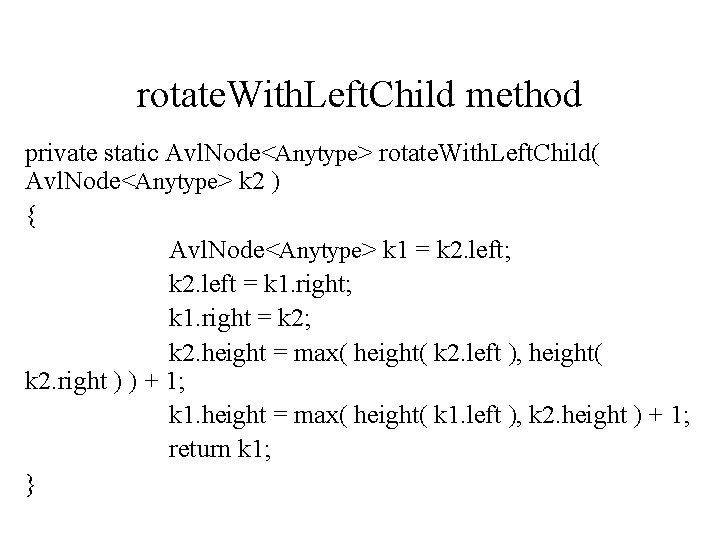
rotate. With. Left. Child method private static Avl. Node<Anytype> rotate. With. Left. Child( Avl. Node<Anytype> k 2 ) { Avl. Node<Anytype> k 1 = k 2. left; k 2. left = k 1. right; k 1. right = k 2; k 2. height = max( height( k 2. left ), height( k 2. right ) ) + 1; k 1. height = max( height( k 1. left ), k 2. height ) + 1; return k 1; }
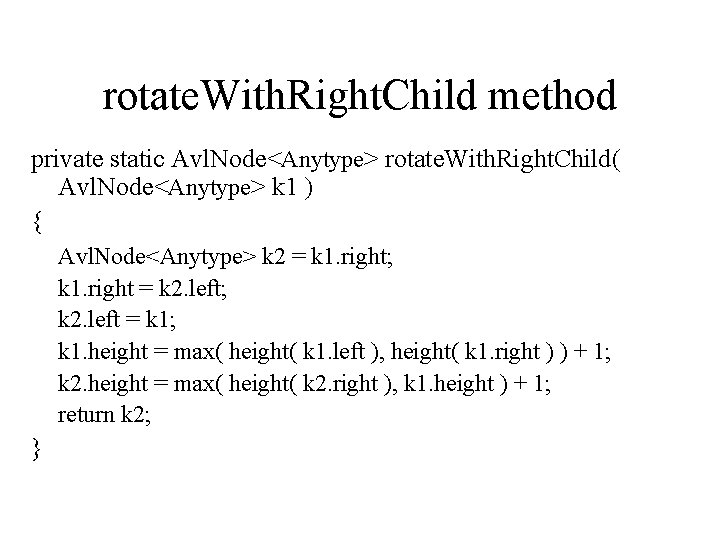
rotate. With. Right. Child method private static Avl. Node<Anytype> rotate. With. Right. Child( Avl. Node<Anytype> k 1 ) { Avl. Node<Anytype> k 2 = k 1. right; k 1. right = k 2. left; k 2. left = k 1; k 1. height = max( height( k 1. left ), height( k 1. right ) ) + 1; k 2. height = max( height( k 2. right ), k 1. height ) + 1; return k 2; }
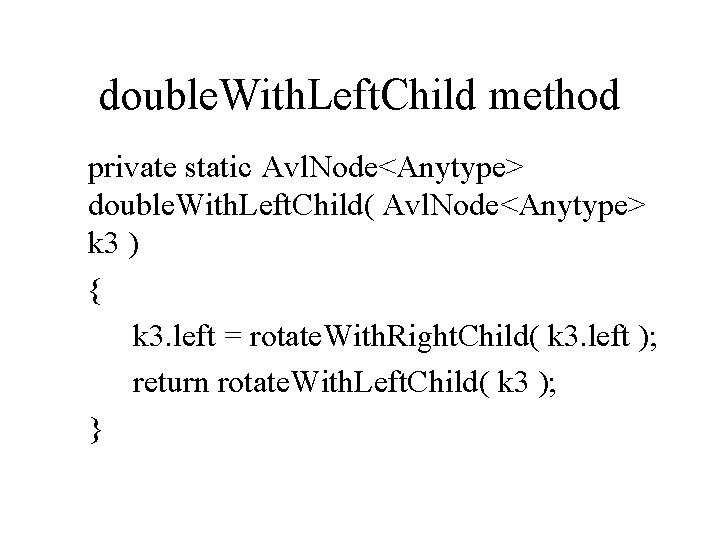
double. With. Left. Child method private static Avl. Node<Anytype> double. With. Left. Child( Avl. Node<Anytype> k 3 ) { k 3. left = rotate. With. Right. Child( k 3. left ); return rotate. With. Left. Child( k 3 ); }
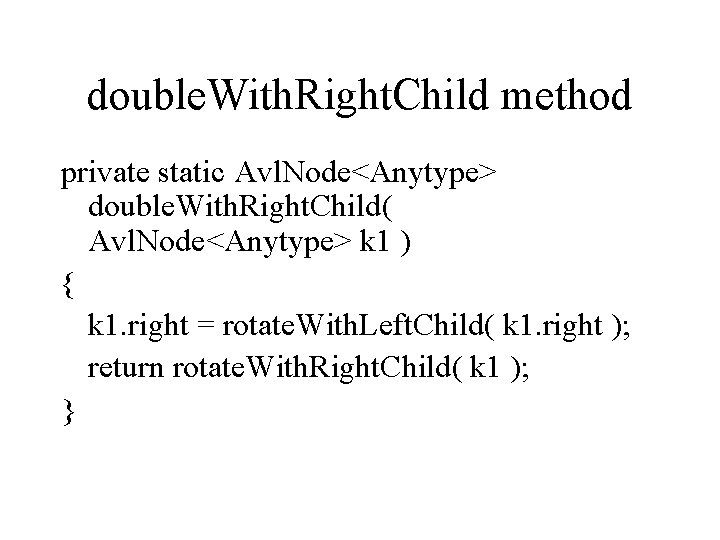
double. With. Right. Child method private static Avl. Node<Anytype> double. With. Right. Child( Avl. Node<Anytype> k 1 ) { k 1. right = rotate. With. Left. Child( k 1. right ); return rotate. With. Right. Child( k 1 ); }