
Aviation Safety Program Accident Mitigation NASA Research in
- Slides: 27
Aviation Safety Program Accident Mitigation NASA Research in Crashworthiness and Fire Prevention INTERNATIONAL AIRCRAFT FIRE AND CABIN SAFETY RESEARCH CONFERENCE November 16, 1998 Douglas A. Rohn Element Manager NASA Lewis Research Center dar 11/16/98 NASA/AM 1
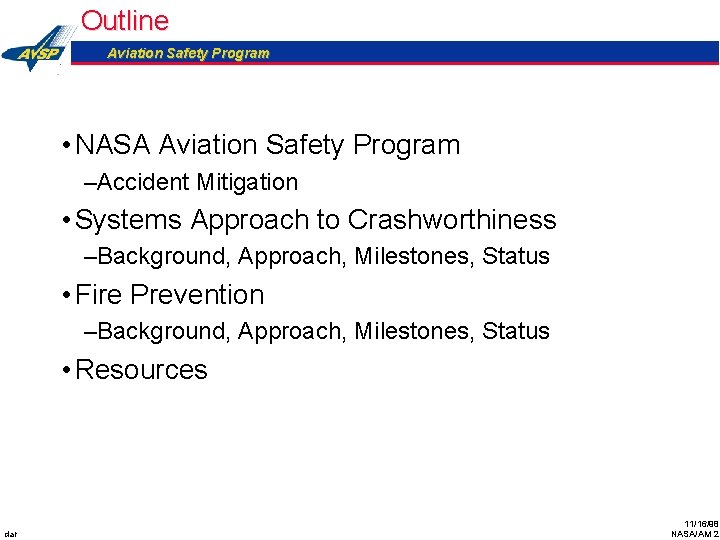
Outline Aviation Safety Program • NASA Aviation Safety Program –Accident Mitigation • Systems Approach to Crashworthiness –Background, Approach, Milestones, Status • Fire Prevention –Background, Approach, Milestones, Status • Resources dar 11/16/98 NASA/AM 2
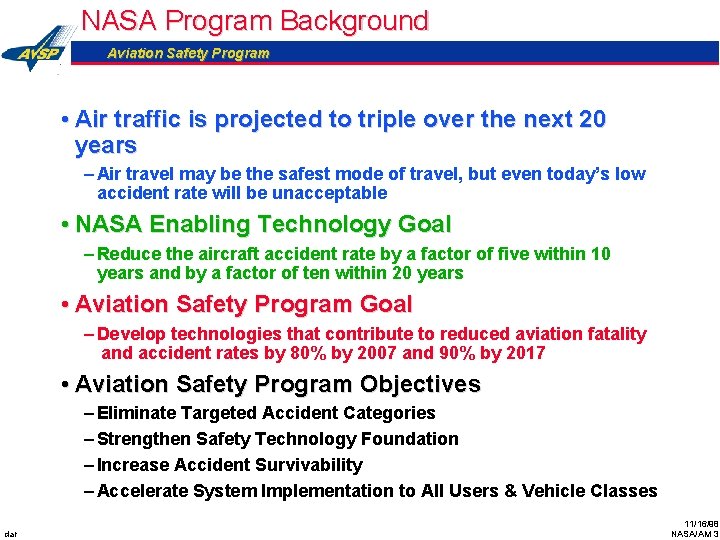
NASA Program Background Aviation Safety Program • Air traffic is projected to triple over the next 20 years – Air travel may be the safest mode of travel, but even today’s low accident rate will be unacceptable • NASA Enabling Technology Goal – Reduce the aircraft accident rate by a factor of five within 10 years and by a factor of ten within 20 years • Aviation Safety Program Goal – Develop technologies that contribute to reduced aviation fatality and accident rates by 80% by 2007 and 90% by 2017 • Aviation Safety Program Objectives – Eliminate Targeted Accident Categories – Strengthen Safety Technology Foundation – Increase Accident Survivability – Accelerate System Implementation to All Users & Vehicle Classes dar 11/16/98 NASA/AM 3
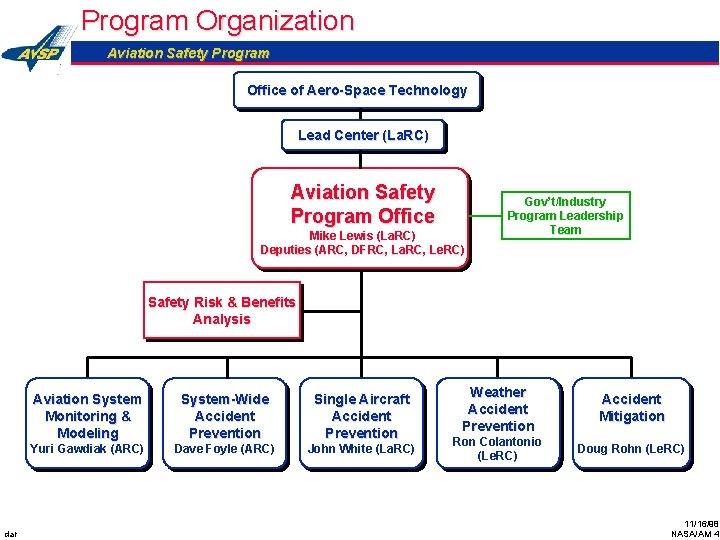
Program Organization Aviation Safety Program Office of Aero-Space Technology Lead Center (La. RC) Aviation Safety Program Office Mike Lewis (La. RC)) Deputies (ARC, DFRC, La. RC, Le. RC) Gov’t/Industry Program Leadership Team Safety Risk & Benefits Analysis dar Aviation System Monitoring & Modeling System-Wide Accident Prevention Single Aircraft Accident Prevention Yuri Gawdiak (ARC) Dave Foyle (ARC) John White (La. RC) Weather Accident Prevention Accident Mitigation Ron Colantonio (Le. RC) Doug Rohn (Le. RC) 11/16/98 NASA/AM 4
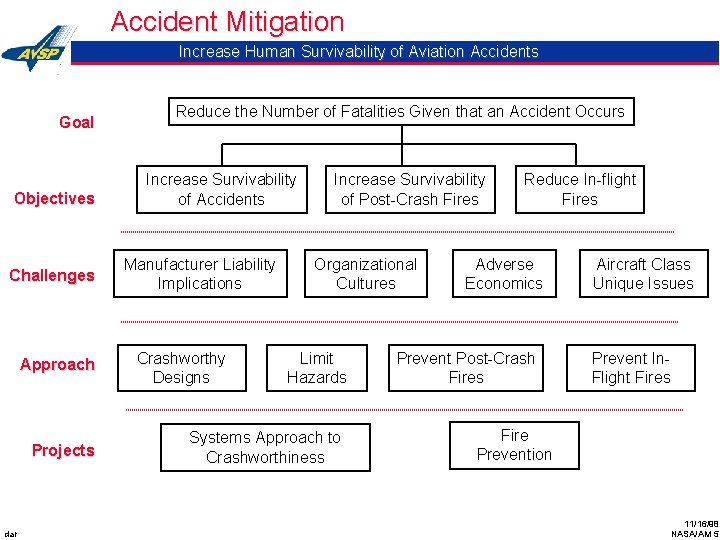
Accident Mitigation Increase Human Survivability of Aviation Accidents Aviation Safety Program Goal Objectives Challenges Approach Projects dar Reduce the Number of Fatalities Given that an Accident Occurs Increase Survivability of Accidents Manufacturer Liability Implications Crashworthy Designs Increase Survivability of Post-Crash Fires Organizational Cultures Limit Hazards Systems Approach to Crashworthiness Reduce In-flight Fires Adverse Economics Prevent Post-Crash Fires Aircraft Class Unique Issues Prevent In. Flight Fires Fire Prevention 11/16/98 NASA/AM 5
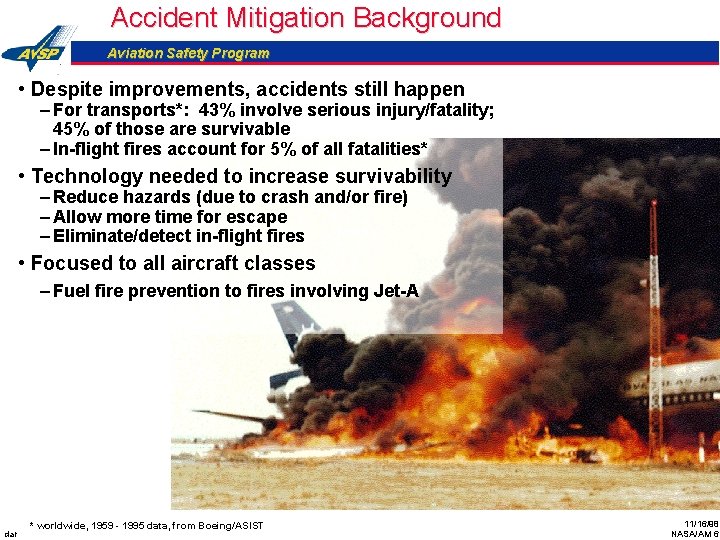
Accident Mitigation Background Aviation Safety Program • Despite improvements, accidents still happen – For transports*: 43% involve serious injury/fatality; 45% of those are survivable – In-flight fires account for 5% of all fatalities* • Technology needed to increase survivability – Reduce hazards (due to crash and/or fire) – Allow more time for escape – Eliminate/detect in-flight fires • Focused to all aircraft classes – Fuel fire prevention to fires involving Jet-A dar * worldwide, 1959 - 1995 data, from Boeing/ASIST 11/16/98 NASA/AM 6
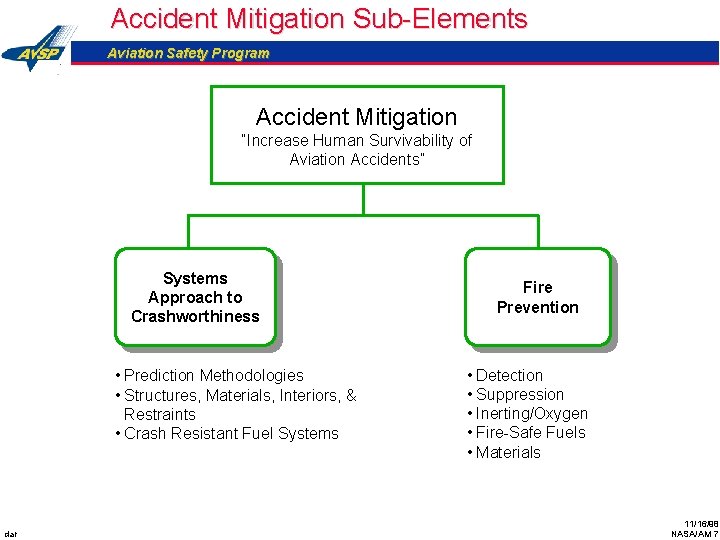
Accident Mitigation Sub-Elements Aviation Safety Program Accident Mitigation “Increase Human Survivability of Aviation Accidents” Systems Approach to Crashworthiness • Prediction Methodologies • Structures, Materials, Interiors, & Restraints • Crash Resistant Fuel Systems dar Fire Prevention • Detection • Suppression • Inerting/Oxygen • Fire-Safe Fuels • Materials 11/16/98 NASA/AM 7
Aviation Safety Program • NASA Aviation Safety Program • Accident Mitigation • Systems Approach to Crashworthiness –Background, Approach, Milestones, Status • Fire Prevention –Background, Approach, Milestones, Status • Resources dar 11/16/98 NASA/AM 8
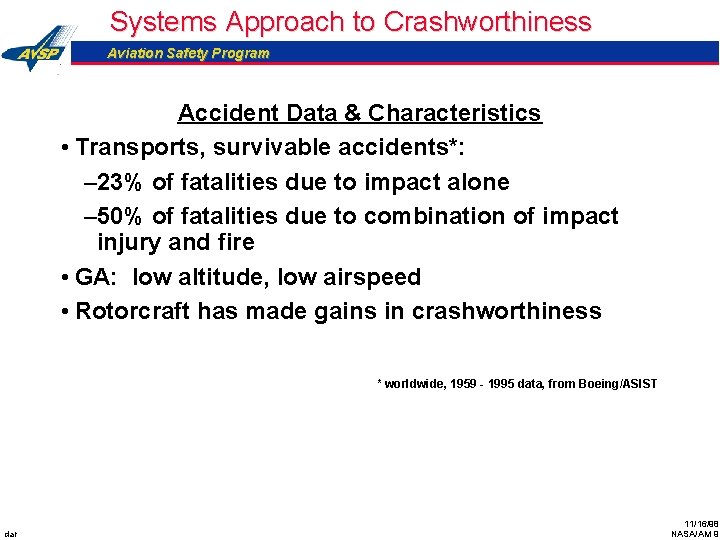
Systems Approach to Crashworthiness Aviation Safety Program Accident Data & Characteristics • Transports, survivable accidents*: – 23% of fatalities due to impact alone – 50% of fatalities due to combination of impact injury and fire • GA: low altitude, low airspeed • Rotorcraft has made gains in crashworthiness * worldwide, 1959 - 1995 data, from Boeing/ASIST dar 11/16/98 NASA/AM 9
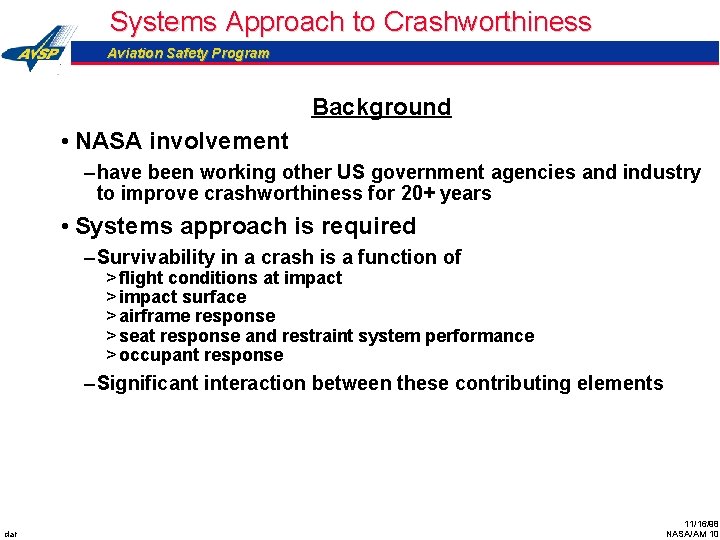
Systems Approach to Crashworthiness Aviation Safety Program Background • NASA involvement – have been working other US government agencies and industry to improve crashworthiness for 20+ years • Systems approach is required – Survivability in a crash is a function of > flight conditions at impact > impact surface > airframe response > seat response and restraint system performance > occupant response – Significant interaction between these contributing elements dar 11/16/98 NASA/AM 10
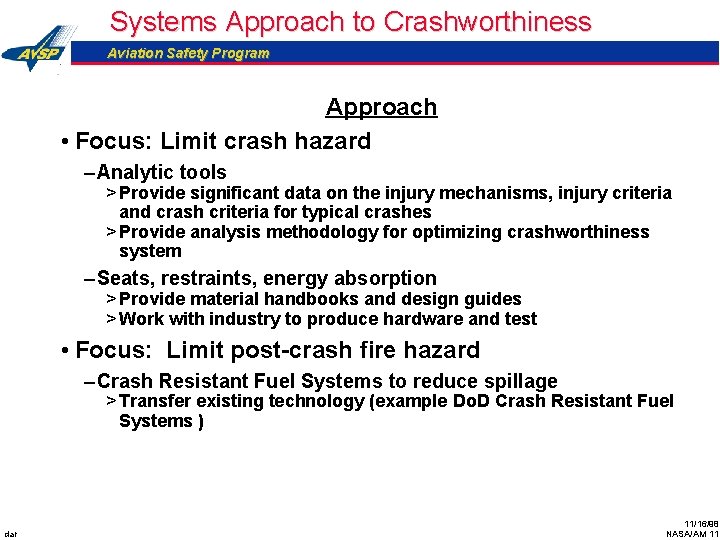
Systems Approach to Crashworthiness Aviation Safety Program Approach • Focus: Limit crash hazard – Analytic tools > Provide significant data on the injury mechanisms, injury criteria and crash criteria for typical crashes > Provide analysis methodology for optimizing crashworthiness system – Seats, restraints, energy absorption > Provide material handbooks and design guides > Work with industry to produce hardware and test • Focus: Limit post-crash fire hazard – Crash Resistant Fuel Systems to reduce spillage > Transfer existing technology (example Do. D Crash Resistant Fuel Systems ) dar 11/16/98 NASA/AM 11
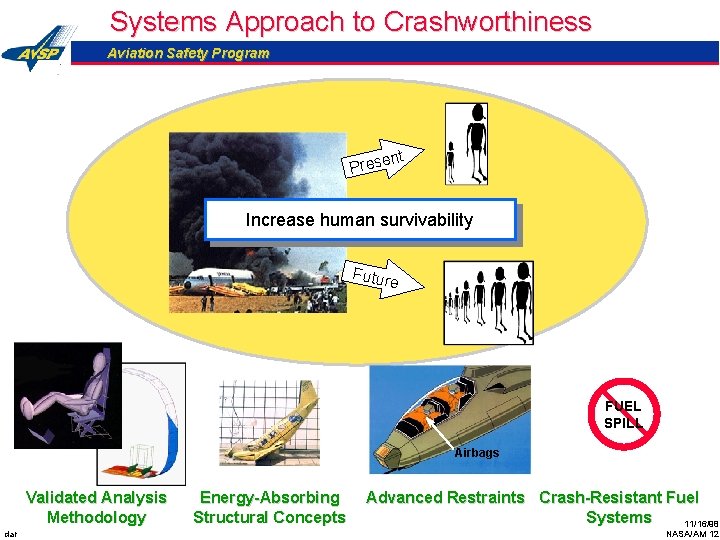
Systems Approach to Crashworthiness Aviation Safety Program nt Prese Increase human survivability Future FUEL SPILL Airbags Validated Analysis Methodology dar Energy-Absorbing Structural Concepts Advanced Restraints Crash-Resistant Fuel Systems 11/16/98 NASA/AM 12
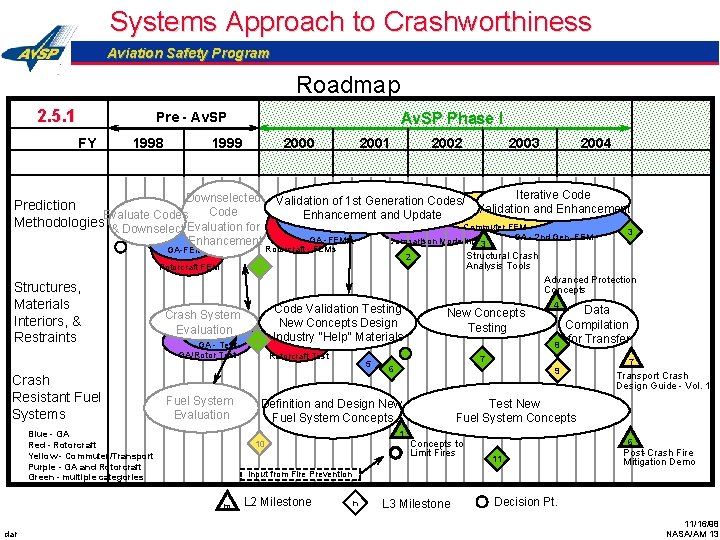
Systems Approach to Crashworthiness Aviation Safety Program Roadmap 2. 5. 1 Av. SP Phase I Pre - Av. SP FY 1998 1999 2000 Downselected Prediction Code Evaluate Codes Methodologies & Downselect Evaluation for Enhancement GA-FEM Crash Resistant Fuel Systems 2003 2004 Iterative Code Validation of 1 st Generation Codes/ Validation and Enhancement and Update Commuter FEM GA - 2 nd Gen. FEM Comparison Modeling 3 Structural Crash 2 GA -FEMs Rotorcraft - FEMs 3 Analysis Tools Advanced Protection Concepts Crash System Evaluation GA - Test GA/Rotor Test Fuel System Evaluation Blue - GA Red - Rotorcraft Yellow - Commuter/Transport Purple - GA and Rotorcraft Green - multiple categories Code Validation Testing New Concepts Design Industry “Help” Materials 4 Rotorcraft Test 5 New Concepts Testing 4 8 Data Compilation for Transfer 7 6 9 Definition and Design New Fuel System Concepts 1 10 7 Transport Crash Design Guide - Vol. 1 Test New Fuel System Concepts to Limit Fires 6 11 Post-Crash Fire Mitigation Demo input from Fire Prevention m dar 2002 1 Rotorcraft FEM Structures, Materials Interiors, & Restraints 2001 L 2 Milestone n L 3 Milestone Decision Pt. 11/16/98 NASA/AM 13
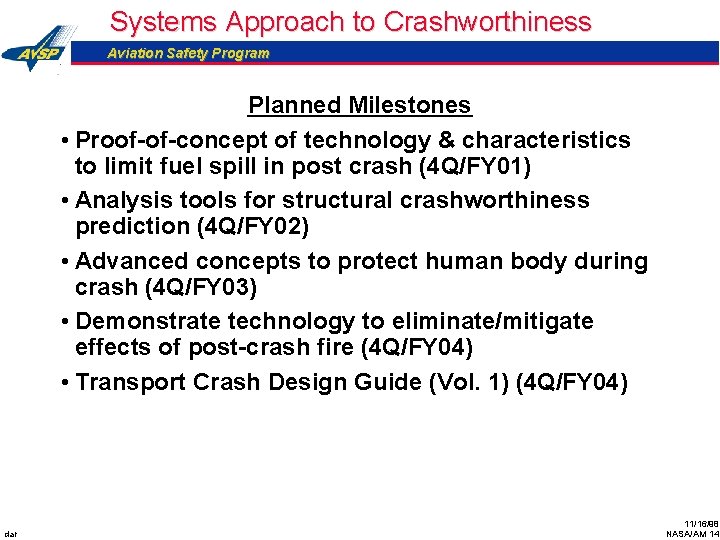
Systems Approach to Crashworthiness Aviation Safety Program Planned Milestones • Proof-of-concept of technology & characteristics to limit fuel spill in post crash (4 Q/FY 01) • Analysis tools for structural crashworthiness prediction (4 Q/FY 02) • Advanced concepts to protect human body during crash (4 Q/FY 03) • Demonstrate technology to eliminate/mitigate effects of post-crash fire (4 Q/FY 04) • Transport Crash Design Guide (Vol. 1) (4 Q/FY 04) dar 11/16/98 NASA/AM 14
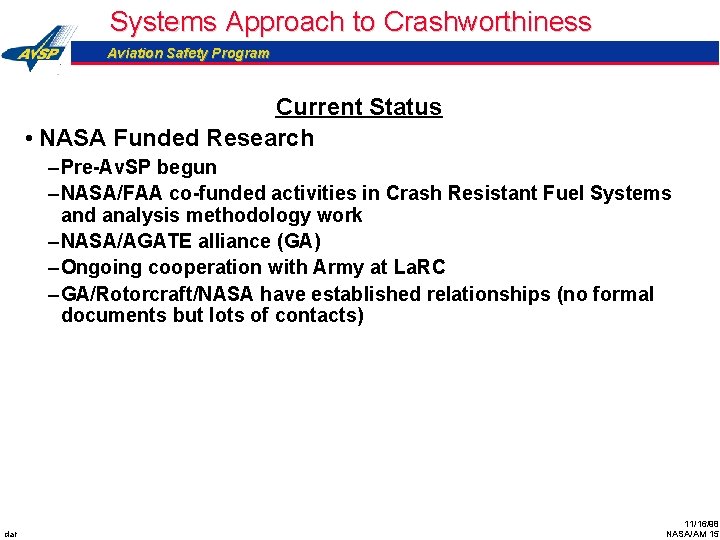
Systems Approach to Crashworthiness Aviation Safety Program Current Status • NASA Funded Research – Pre-Av. SP begun – NASA/FAA co-funded activities in Crash Resistant Fuel Systems and analysis methodology work – NASA/AGATE alliance (GA) – Ongoing cooperation with Army at La. RC – GA/Rotorcraft/NASA have established relationships (no formal documents but lots of contacts) dar 11/16/98 NASA/AM 15
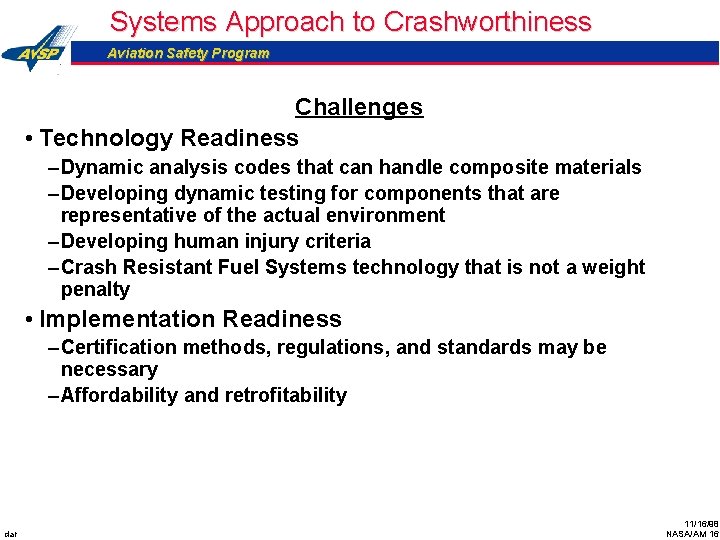
Systems Approach to Crashworthiness Aviation Safety Program Challenges • Technology Readiness – Dynamic analysis codes that can handle composite materials – Developing dynamic testing for components that are representative of the actual environment – Developing human injury criteria – Crash Resistant Fuel Systems technology that is not a weight penalty • Implementation Readiness – Certification methods, regulations, and standards may be necessary – Affordability and retrofitability dar 11/16/98 NASA/AM 16
Aviation Safety Program • NASA Aviation Safety Program • Accident Mitigation • Systems Approach to Crashworthiness –Background, Approach, Milestones, Status • Fire Prevention –Background, Approach, Milestones, Status • Resources dar 11/16/98 NASA/AM 17
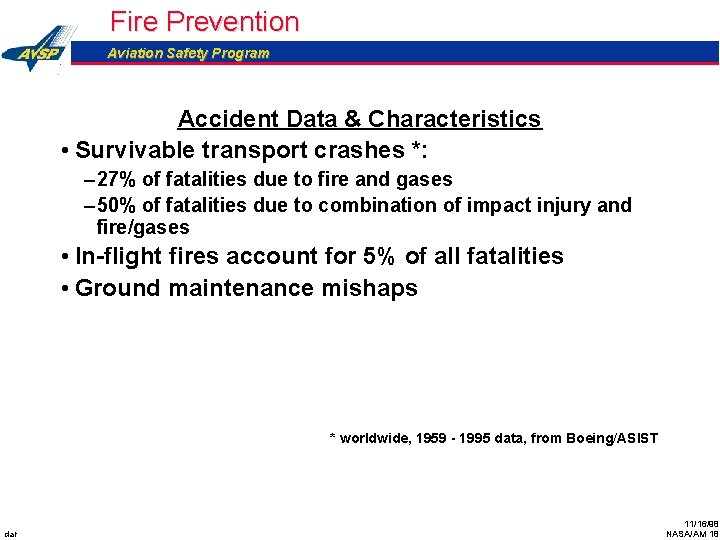
Fire Prevention Aviation Safety Program Accident Data & Characteristics • Survivable transport crashes *: – 27% of fatalities due to fire and gases – 50% of fatalities due to combination of impact injury and fire/gases • In-flight fires account for 5% of all fatalities • Ground maintenance mishaps * worldwide, 1959 - 1995 data, from Boeing/ASIST dar 11/16/98 NASA/AM 18
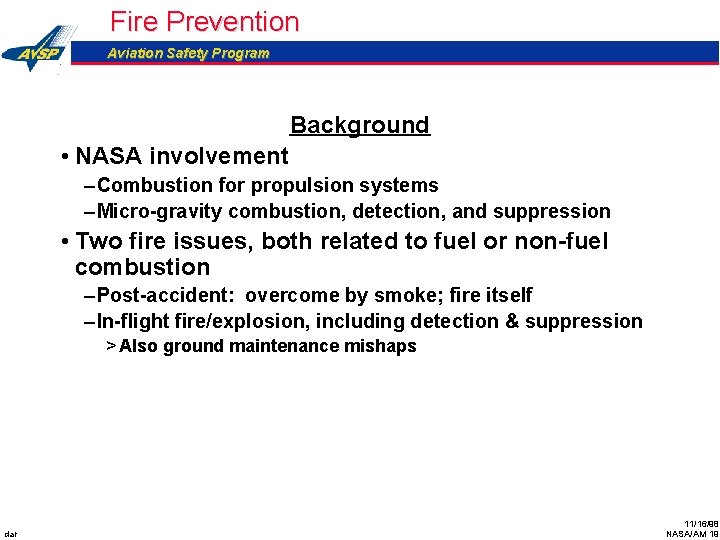
Fire Prevention Aviation Safety Program Background • NASA involvement – Combustion for propulsion systems – Micro-gravity combustion, detection, and suppression • Two fire issues, both related to fuel or non-fuel combustion – Post-accident: overcome by smoke; fire itself – In-flight fire/explosion, including detection & suppression > Also ground maintenance mishaps dar 11/16/98 NASA/AM 19
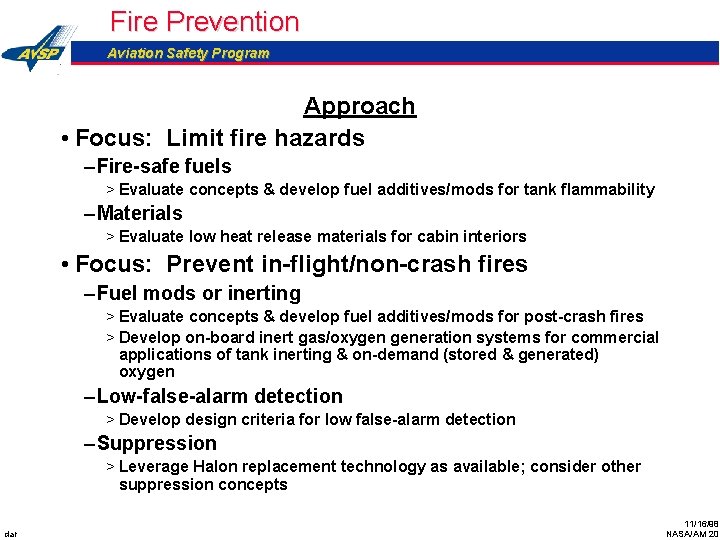
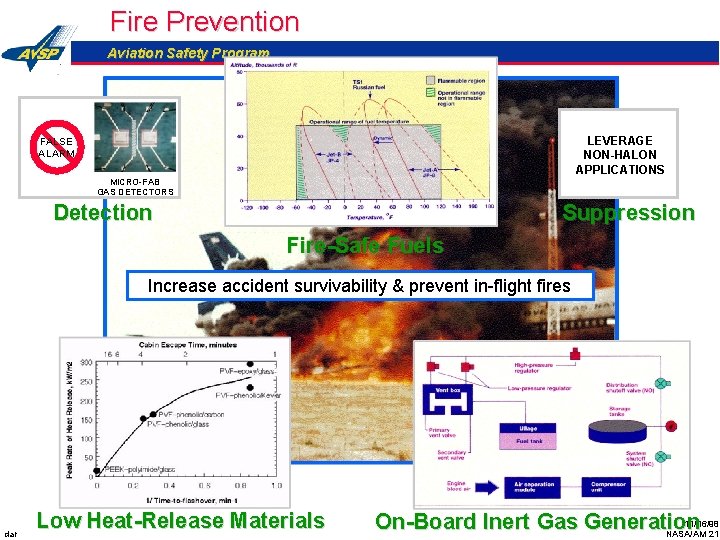
Fire Prevention Aviation Safety Program Approach • Focus: Limit fire hazards – Fire-safe fuels > Evaluate concepts & develop fuel additives/mods for tank flammability – Materials > Evaluate low heat release materials for cabin interiors • Focus: Prevent in-flight/non-crash fires – Fuel mods or inerting > Evaluate concepts & develop fuel additives/mods for post-crash fires > Develop on-board inert gas/oxygen generation systems for commercial applications of tank inerting & on-demand (stored & generated) oxygen – Low-false-alarm detection > Develop design criteria for low false-alarm detection – Suppression > Leverage Halon replacement technology as available; consider other suppression concepts dar 11/16/98 NASA/AM 20
Fire Prevention Aviation Safety Program LEVERAGE NON-HALON APPLICATIONS FALSE ALARM MICRO-FAB GAS DETECTORS Detection Suppression Fire-Safe Fuels Increase accident survivability & prevent in-flight fires dar Low Heat-Release Materials 11/16/98 On-Board Inert Gas Generation NASA/AM 21
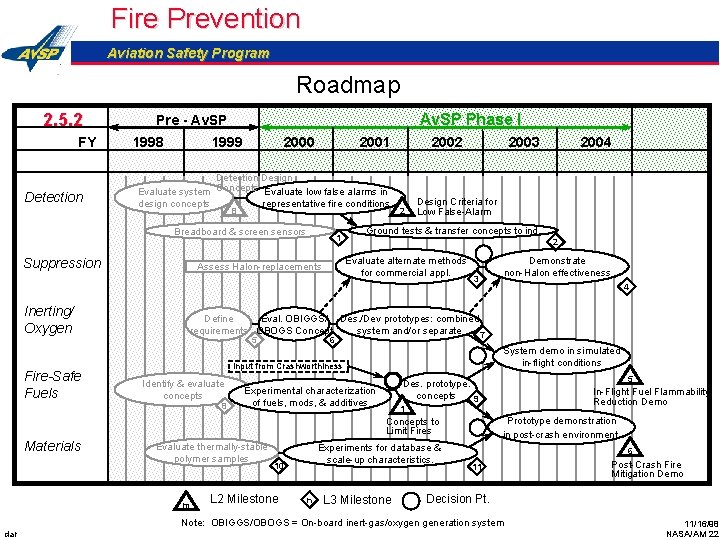
Fire Prevention Aviation Safety Program Roadmap 2. 5. 2 FY Detection Av. SP Phase I Pre - Av. SP 1998 1999 2000 2001 Detection Design Evaluate system Concepts Evaluate low false alarms in design concepts representative fire conditions B Breadboard & screen sensors Suppression Inerting/ Oxygen Fire-Safe Fuels 1 2002 2 Ground tests & transfer concepts to ind. 2 3 Demonstrate non-Halon effectiveness 4 Define Eval. OBIGGS/ Des. /Dev prototypes: combined system and/or separate requirements OBOGS Concept 7 5 6 System demo in simulated in-flight conditions input from Crashworthiness Identify & evaluate concepts 8 Evaluate thermally-stable polymer samples m L 2 Milestone n In-Flight Fuel Flammability Reduction Demo 1 Experiments for database & scale-up characteristics. 10 5 Des. prototype. concepts 9 Experimental characterization of fuels, mods, & additives Prototype demonstration in post-crash environment Concepts to Limit Fires Materials L 3 Milestone 6 11 Post-Crash Fire Mitigation Demo Decision Pt. Note: OBIGGS/OBOGS = On-board inert-gas/oxygen generation system dar 2004 Design Criteria for Low False-Alarm Evaluate alternate methods for commercial appl. Assess Halon-replacements 2003 11/16/98 NASA/AM 22
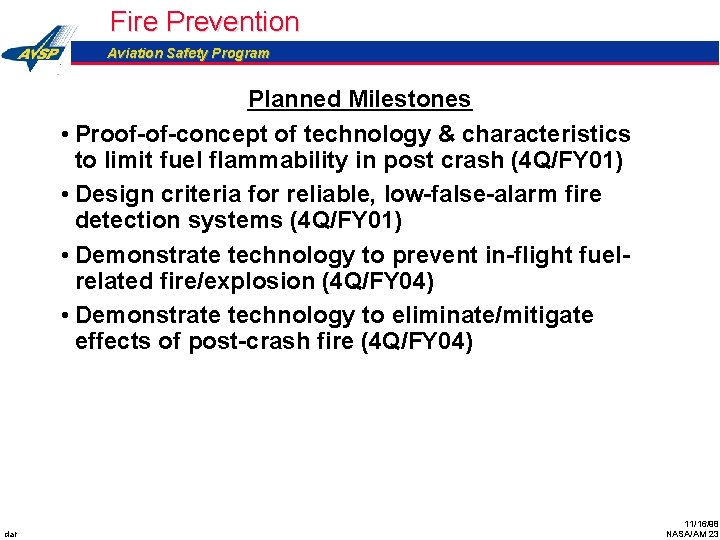
Fire Prevention Aviation Safety Program Planned Milestones • Proof-of-concept of technology & characteristics to limit fuel flammability in post crash (4 Q/FY 01) • Design criteria for reliable, low-false-alarm fire detection systems (4 Q/FY 01) • Demonstrate technology to prevent in-flight fuelrelated fire/explosion (4 Q/FY 04) • Demonstrate technology to eliminate/mitigate effects of post-crash fire (4 Q/FY 04) dar 11/16/98 NASA/AM 23
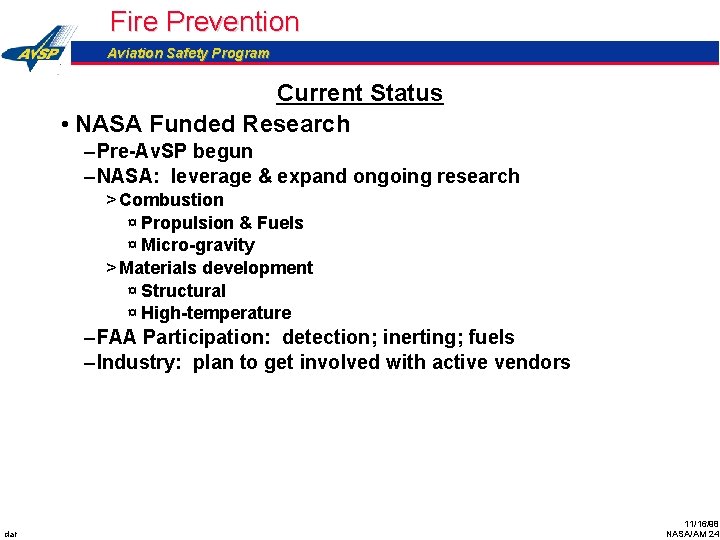
Fire Prevention Aviation Safety Program Current Status • NASA Funded Research – Pre-Av. SP begun – NASA: leverage & expand ongoing research > Combustion ¤ Propulsion & Fuels ¤ Micro-gravity > Materials development ¤ Structural ¤ High-temperature – FAA Participation: detection; inerting; fuels – Industry: plan to get involved with active vendors dar 11/16/98 NASA/AM 24
Fire Prevention Aviation Safety Program Challenges • Technology Readiness – Detection discrimination between fire and non-fire sources – Practical products to prevent fuel explosions/fires – Light-weight, high volume on-board inert gas/oxygen generation systems – Low heat-release materials in economic, large quantities – Effective, light-weight alternate suppression systems • Implementation Readiness – Economic barriers: cost, weight, infrastructure dar 11/16/98 NASA/AM 25
Resources Aviation Safety Program Planning & Rationale • NASA funds: $36. 8 M – Cost-share assumed for some activities > Industry: in-kind (hardware) for crash tests > FAA R&D: co-funded fuel system crash tests & in-kind fire prevention test support • Facilities – NASA-La. RC Impact Dynamics Research Facility – NASA-Le. RC Combustion Labs – FAA-Tech Center Crash & Fire Facilities • Partnerships – Strong participation of FAA Tech Center – AGATE cooperation for early products in GA Crashworthiness – Working on industry partners; leverage with Do. D – International ? dar 11/16/98 NASA/AM 26
Summary Aviation Safety Program • Systems Approach to Crashworthiness and Fire Prevention contribute to NASA safety goal • Technical content focused to reduce accident effects in order to enhance survivability; plus prevention – Crash dynamics, human protection, post-crash fire, inflight fire • Technical & implementation hurdles recognized • Preparing to execute – Finalizing plans; establishing cooperation dar 11/16/98 NASA/AM 27