
Aviation Safety Improvement How and Why the Industry
- Slides: 31
Aviation Safety Improvement How and Why the Industry is Progressing Kenneth Neubauer Futron Corporation
Aerospace Safety Ken Neubauer “Nubs” F-4 Phantom - Japan F-21 Kfir – Adversary, Oceana CO - VF-41 Black Aces USS Constellation – Ops Officer RAND Corporation Fellowship School of Aviation Safety Naval Safety Center Futron Corporation - 2007 kneubauer@futron. com (800) 807 -4927, x 7317
Overview • Where have we been and where are we now? Ø Safety performance and the driving metrics • What is making a difference? Ø The programs, the benefits and the barriers • What is next? Ø SMS, data sharing, advanced analytics. . . and then there are UAS • Conclusions Ø What could this mean for commercial space?
Overview • Where have we been and where are we now? Ø Safety performance and the driving metrics • What is making a difference? Ø The programs, the benefits and the barriers • What is next? Ø SMS, data sharing, advanced analytics. . . and then there are UAS • Conclusions Ø What could this mean for commercial space?
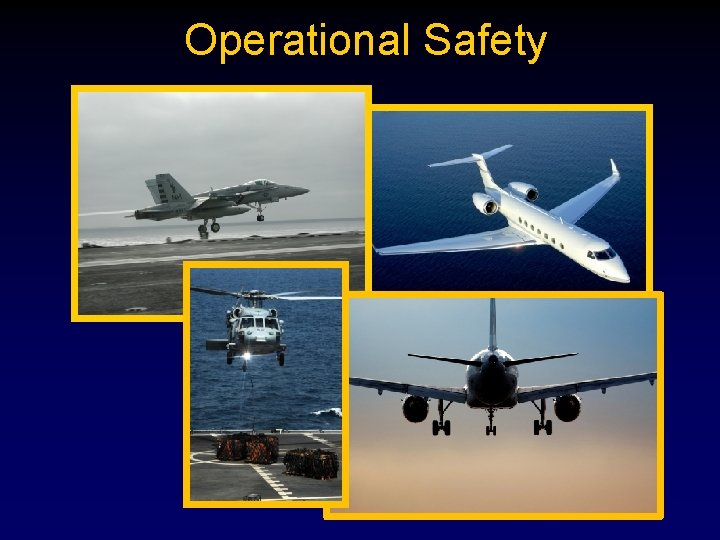
Operational Safety
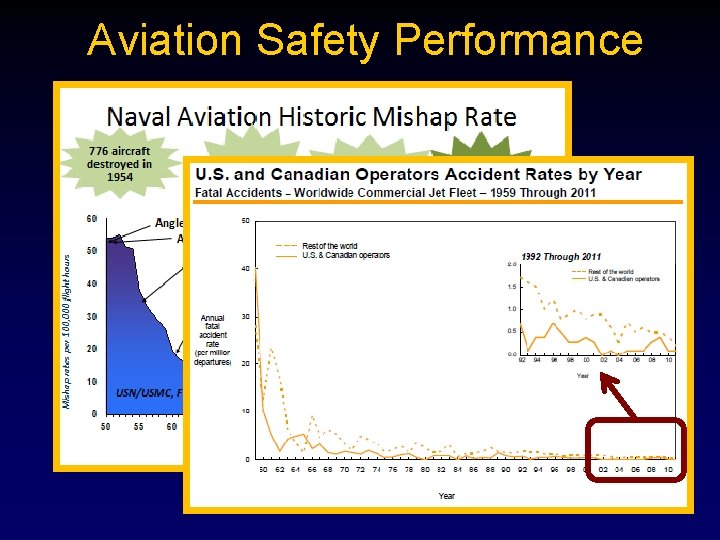
Aviation Safety Performance
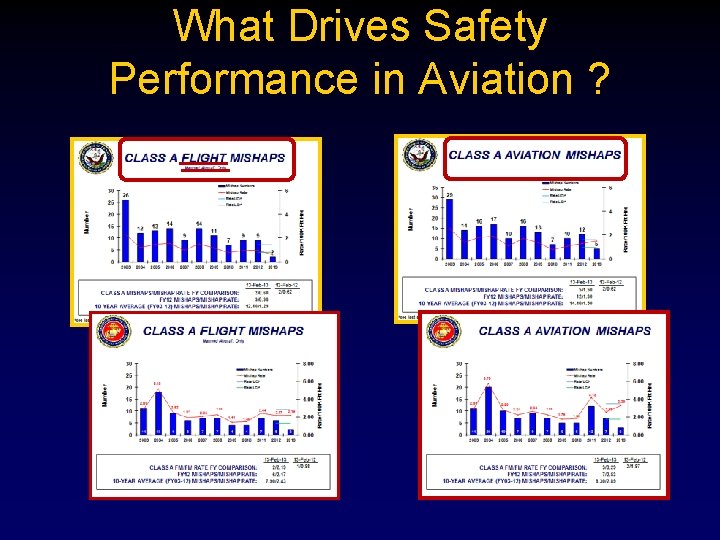
What Drives Safety Performance in Aviation ?
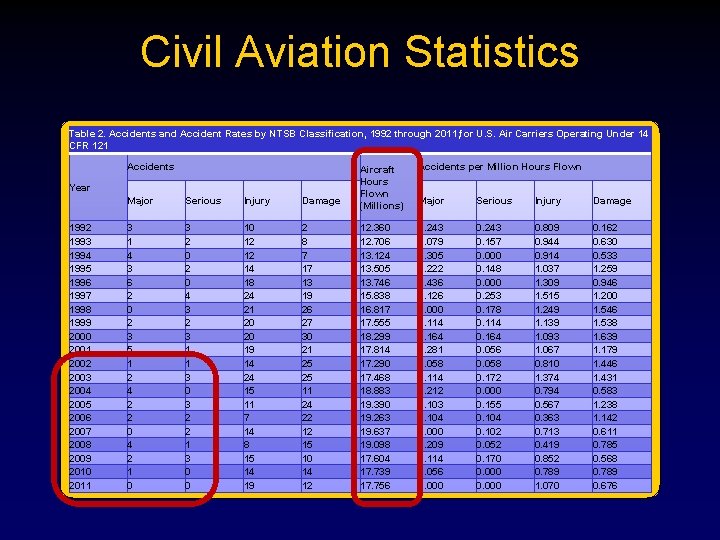
Civil Aviation Statistics Table 2. Accidents and Accident Rates by NTSB Classification, 1992 through 2011, for U. S. Air Carriers Operating Under 14 CFR 121 Accidents Major Serious Injury Damage Aircraft Hours Flown (Millions) 3 1 4 3 6 2 0 2 3 5 1 2 4 2 2 0 4 2 1 0 3 2 0 4 3 2 3 1 1 3 0 3 2 2 1 3 0 0 10 12 12 14 18 24 21 20 20 19 14 24 15 11 7 14 8 15 14 19 2 8 7 17 13 19 26 27 30 21 25 25 11 24 22 12 15 10 14 12 12. 360 12. 706 13. 124 13. 505 13. 746 15. 838 16. 817 17. 555 18. 299 17. 814 17. 290 17. 468 18. 883 19. 390 19. 263 19. 637 19. 098 17. 604 17. 739 17. 756 Year 1992 1993 1994 1995 1996 1997 1998 1999 2000 2001 2002 2003 2004 2005 2006 2007 2008 2009 2010 2011 Accidents per Million Hours Flown Major Serious Injury Damage 0. 243 0. 079 0. 305 0. 222 0. 436 0. 126 0. 000 0. 114 0. 164 0. 281 0. 058 0. 114 0. 212 0. 103 0. 104 0. 000 0. 209 0. 114 0. 056 0. 000 0. 243 0. 157 0. 000 0. 148 0. 000 0. 253 0. 178 0. 114 0. 164 0. 056 0. 058 0. 172 0. 000 0. 155 0. 104 0. 102 0. 052 0. 170 0. 000 0. 809 0. 944 0. 914 1. 037 1. 309 1. 515 1. 249 1. 139 1. 093 1. 067 0. 810 1. 374 0. 794 0. 567 0. 363 0. 713 0. 419 0. 852 0. 789 1. 070 0. 162 0. 630 0. 533 1. 259 0. 946 1. 200 1. 546 1. 538 1. 639 1. 179 1. 446 1. 431 0. 583 1. 238 1. 142 0. 611 0. 785 0. 568 0. 789 0. 676
Overview • Where have we been and where are we now? Ø Safety performance and the driving metrics • What is making a difference? Ø The programs, the benefits and the barriers • What is next? Ø SMS, data sharing, advanced analytics. . . and then there are UAS • Conclusions Ø What could this mean for commercial space?
Solutions Driving Improvement Civil Military
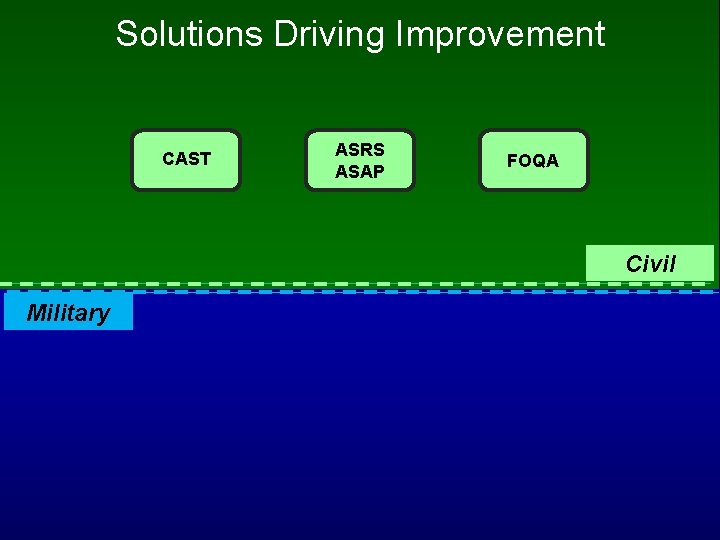
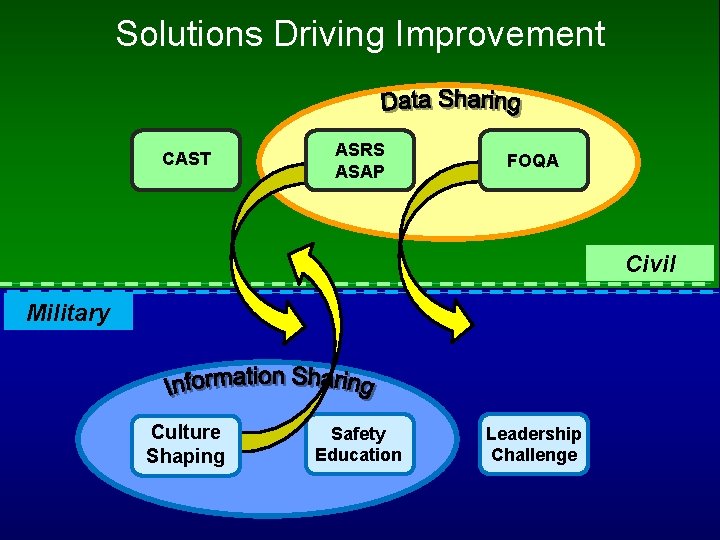
Solutions Driving Improvement CAST ASRS ASAP FOQA Civil Military
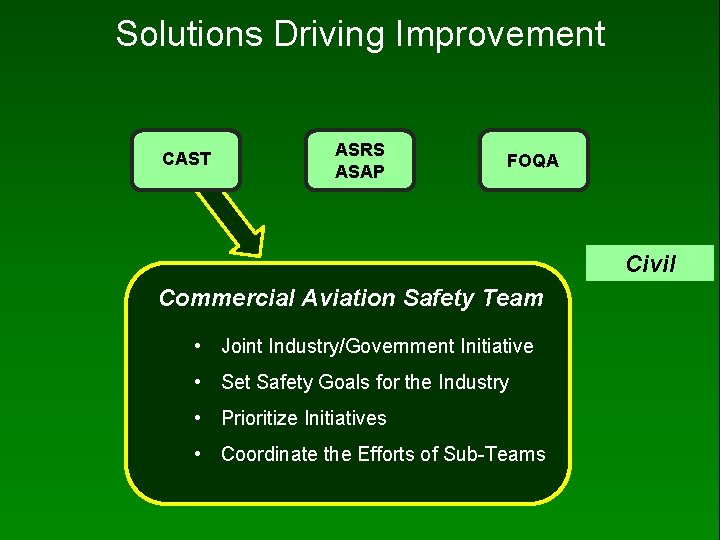
Solutions Driving Improvement CAST ASRS ASAP FOQA Civil Commercial Aviation Safety Team • Joint Industry/Government Initiative • Set Safety Goals for the Industry • Prioritize Initiatives • Coordinate the Efforts of Sub-Teams
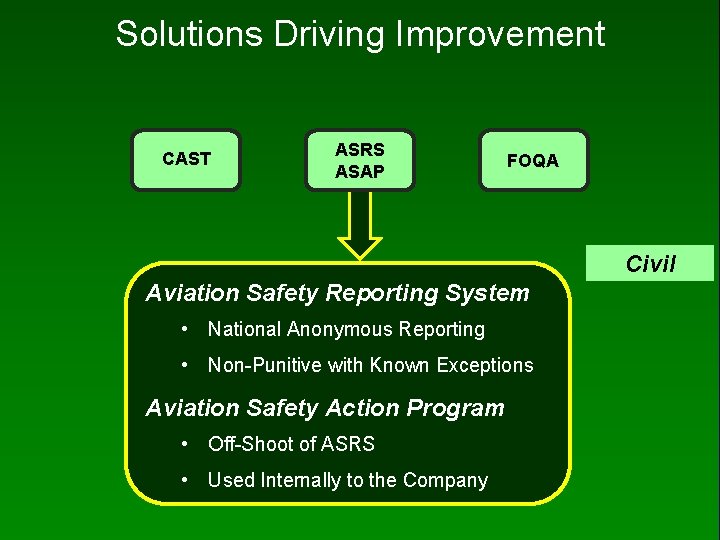
Solutions Driving Improvement CAST ASRS ASAP FOQA Civil Aviation Safety Reporting System • National Anonymous Reporting • Non-Punitive with Known Exceptions Aviation Safety Action Program • Off-Shoot of ASRS • Used Internally to the Company
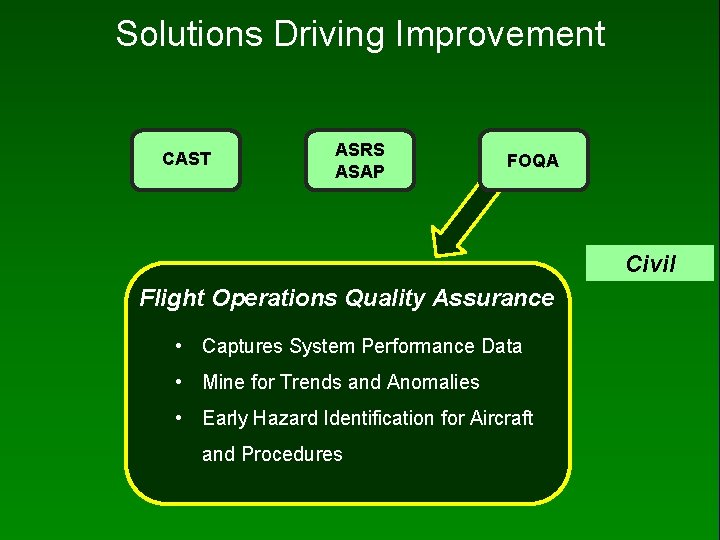
Solutions Driving Improvement CAST ASRS ASAP FOQA Civil Flight Operations Quality Assurance • Captures System Performance Data • Mine for Trends and Anomalies • Early Hazard Identification for Aircraft and Procedures
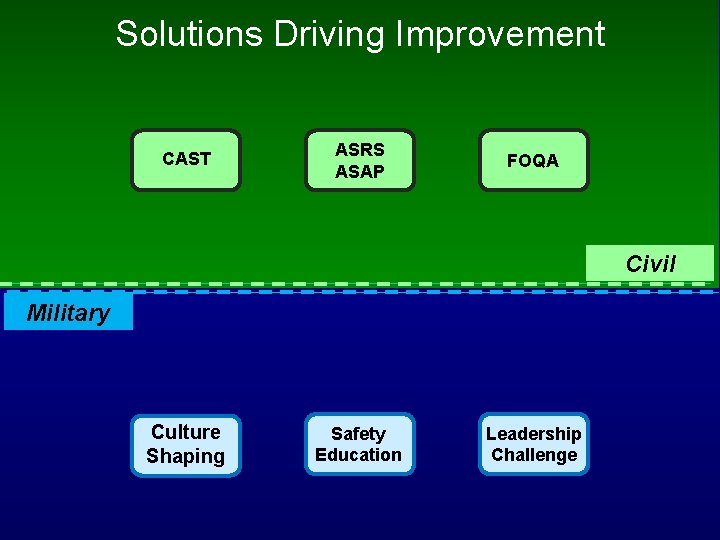
Solutions Driving Improvement CAST ASRS ASAP FOQA Civil Military Culture Shaping Safety Education Leadership Challenge
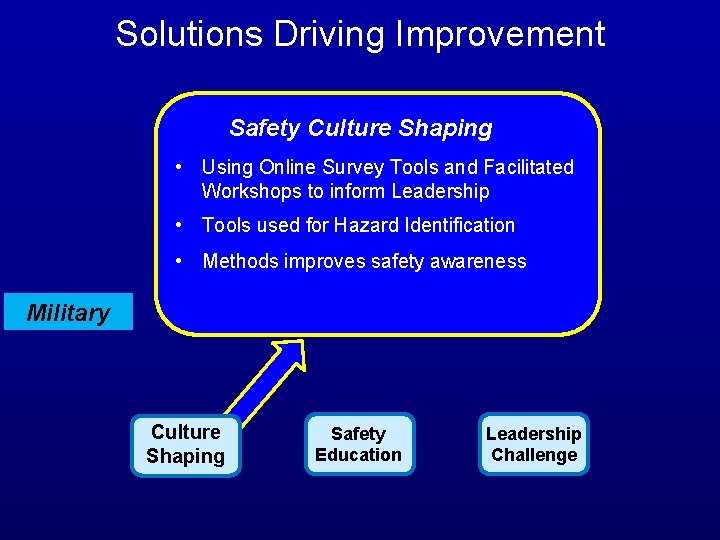
Solutions Driving Improvement Safety Culture Shaping • Using Online Survey Tools and Facilitated Workshops to inform Leadership • Tools used for Hazard Identification • Methods improves safety awareness Military Culture Shaping Safety Education Leadership Challenge
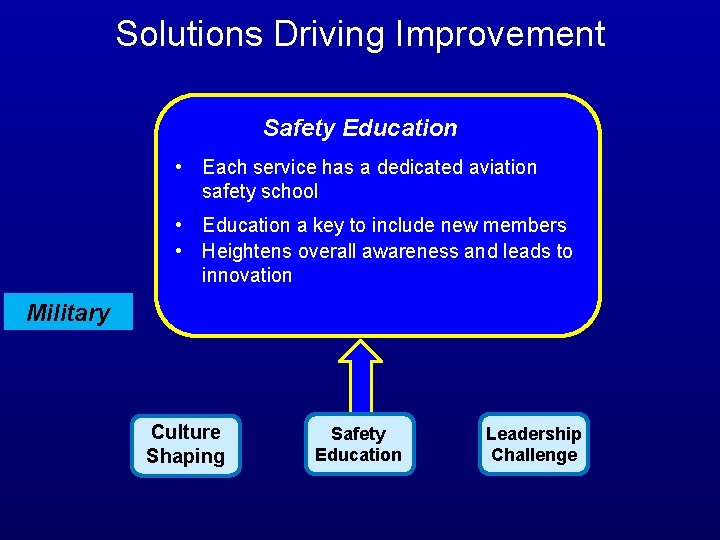
Solutions Driving Improvement Safety Education • Each service has a dedicated aviation safety school • Education a key to include new members • Heightens overall awareness and leads to innovation Military Culture Shaping Safety Education Leadership Challenge
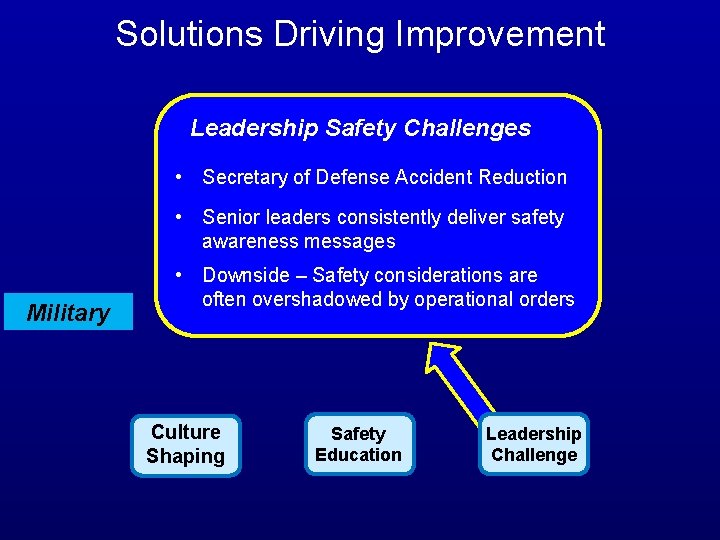
Solutions Driving Improvement Leadership Safety Challenges • Secretary of Defense Accident Reduction • Senior leaders consistently deliver safety awareness messages Military • Downside – Safety considerations are often overshadowed by operational orders Culture Shaping Safety Education Leadership Challenge
Solutions Driving Improvement CAST ASRS ASAP FOQA Civil Military Culture Shaping Safety Education Leadership Challenge
Overview • Where have we been and where are we now? Ø Safety performance and the driving metrics • What is making a difference? Ø The programs, the benefits and the barriers • What is next? Ø SMS, data sharing, advanced analytics. . . and then there are UAS • Conclusions Ø What could this mean for commercial space?
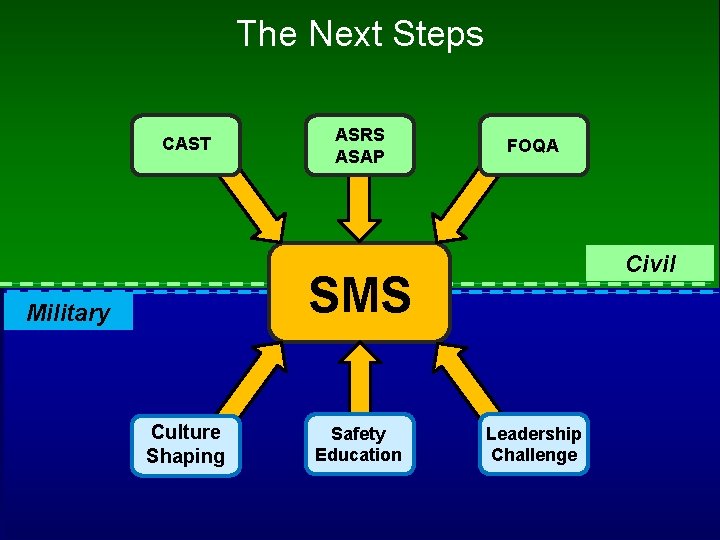
The Next Steps CAST ASRS ASAP FOQA Civil SMS Military Culture Shaping Safety Education Leadership Challenge
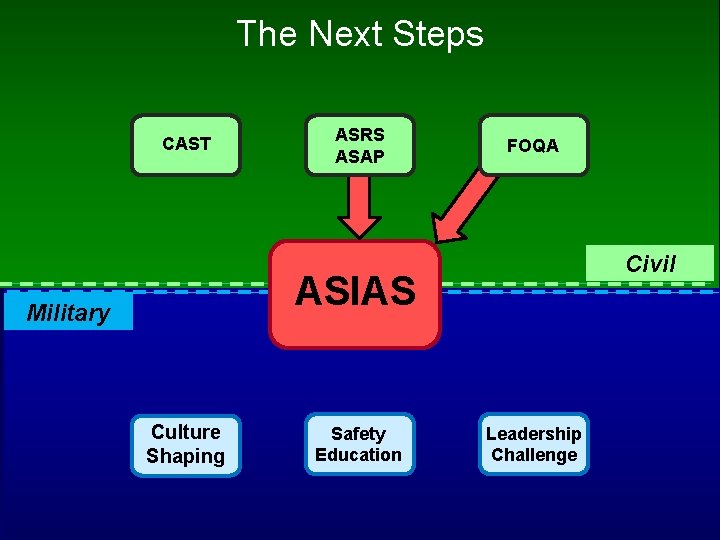
The Next Steps CAST ASRS ASAP FOQA Civil ASIAS Military Culture Shaping Safety Education Leadership Challenge
Overview • Where have we been and where are we now? Ø Safety performance and the driving metrics • What is making a difference? Ø The programs, the benefits and the barriers • What is next? Ø SMS, data sharing, advanced analytics. . . and then there are UAS • Conclusions Ø What could this mean for commercial space?
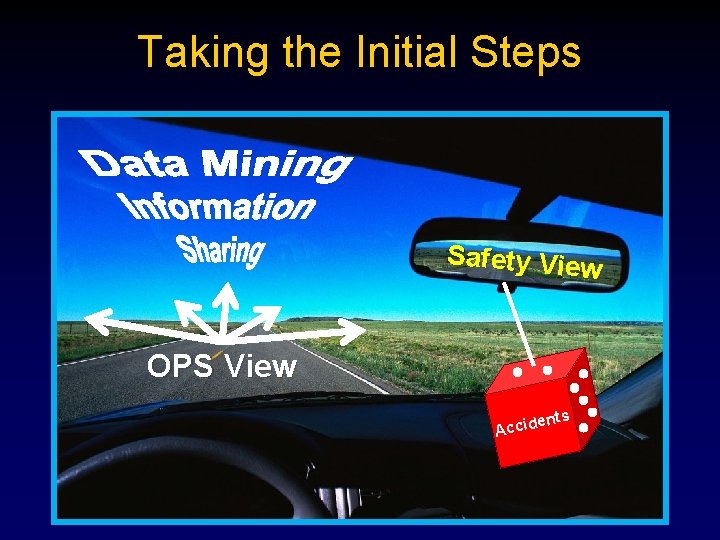
Taking the Initial Steps Safety View OPS View nts e Accid
Thank You for the Opportunity Kenneth Neubauer Futron Corporation, USA (800) 807 -4927, X 7317 kneubauer@futron. com
Proposed CSF Voluntary Data Sharing Agreement Jim Van Laak March 21, 2013
Advancing Safety for Commercial Space • Commercial space is healthy and growing • New players and vehicles mean more exposure to mishaps – Spaceflight has experienced consistently high mishap rates – New companies and systems suffer most • Public response to mishaps needs to be managed: – Poorly perceived operations could severely damage the industry – Careful operations may be acceptable as “the cost of progress” • Industry will benefit from a mature safety program as soon as possible Proposal: CSF voluntary information sharing initiative
Why Information Sharing • Aviation experience has demonstrated its safety value – Complex, high risk ops, numerous hazards, high failure rate early – Specifics differ but trends are common – Aviation has evolved a culture of professional excellence • Information sharing is core to progress – Learning comes through overcoming mistakes – Wise people learn from the mistakes of others – Goal: Industry learns from their collective experience base • Bonus - opportunity for ASRS-like protections – Limited immunity from enforcement for inadvertent violations – Objective evidence of an active safety culture
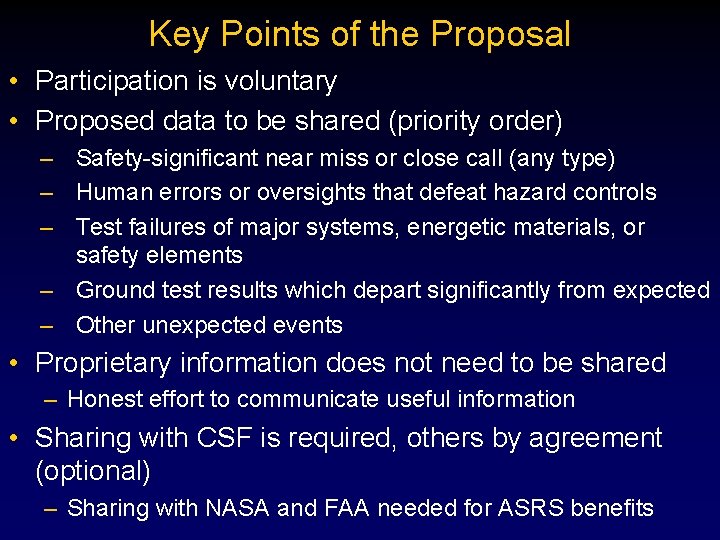
Key Points of the Proposal • Participation is voluntary • Proposed data to be shared (priority order) – Safety-significant near miss or close call (any type) – Human errors or oversights that defeat hazard controls – Test failures of major systems, energetic materials, or safety elements – Ground test results which depart significantly from expected – Other unexpected events • Proprietary information does not need to be shared – Honest effort to communicate useful information • Sharing with CSF is required, others by agreement (optional) – Sharing with NASA and FAA needed for ASRS benefits
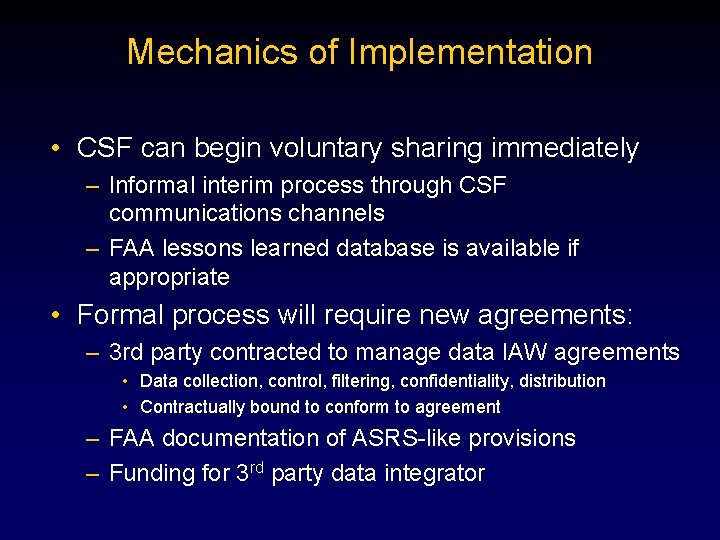
Mechanics of Implementation • CSF can begin voluntary sharing immediately – Informal interim process through CSF communications channels – FAA lessons learned database is available if appropriate • Formal process will require new agreements: – 3 rd party contracted to manage data IAW agreements • Data collection, control, filtering, confidentiality, distribution • Contractually bound to conform to agreement – FAA documentation of ASRS-like provisions – Funding for 3 rd party data integrator
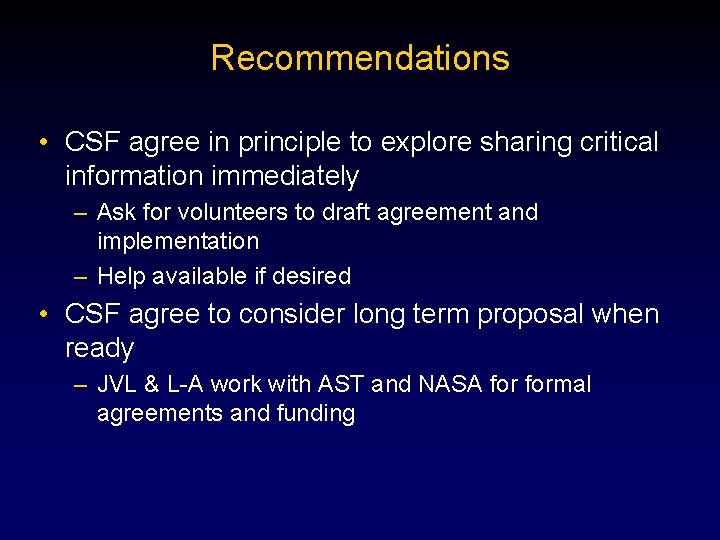
Recommendations • CSF agree in principle to explore sharing critical information immediately – Ask for volunteers to draft agreement and implementation – Help available if desired • CSF agree to consider long term proposal when ready – JVL & L-A work with AST and NASA formal agreements and funding