
AVIATION SAFETY CERTIFICATION OF NEW OPERATIONS AND SYSTEMS
- Slides: 28
AVIATION SAFETY & CERTIFICATION OF NEW OPERATIONS AND SYSTEMS WP 1 Certification Process Bernard PAULY (Thales Air Systems) ASCOS EASA Workshop, 19 April 2013, Cologne
AVIATION SAFETY AND CERTIFICATION OF NEW OPERATIONS AND SYSTEMS 05 JUNE 2021 2 Background → Need for improvement of existing certification processes already identified in FAA Commercial Airplane Certification Process Study → There is no reliable process to ensure that assumptions made in the design and certification safety assessment are valid for operation and maintenance activities → Human operators may not be aware of assumptions made in safety assessments, when developing their operations and maintenance procedures → Aircraft certification standards may not reflect the actual operating environment → Future ’emerging risks’ unknown today may need to be addressed → Current certification processes may take long or turn out infeasible
AVIATION SAFETY AND CERTIFICATION OF NEW OPERATIONS AND SYSTEMS 05 JUNE 2021 3 Total aviation system and the involved stakeholders
AVIATION SAFETY AND CERTIFICATION OF NEW OPERATIONS AND SYSTEMS 05 JUNE 2021 4 WP 1 Objectives/ Context/ Inputs → To analyse the existing European certification and rulemaking process and propose potential adaptations to ease certification of safety enhancement systems & operations → The scope is addressing the Total Aviation System with their stakeholders → The considered inputs are not only European (EASA, Eurocontrol…) but also worldwide (ICAO, FAA) → The on-going tasks of WP 1 are organised according to the following structure: → WP 1. 1 (deliverable D 1. 1) focused on analysis of the existing regulations and certification processes with identification of potential shortcomings and bottlenecks. → WP 1. 2 (deliverable D 1. 2) dedicated to proposal and assessment of options in terms of “certification” potentially applicable to the different domains (airworthiness, operations, ATM, …. ) → WP 1. 3 (deliverable D 1. 3) is focused on the selection and development of the most promising approach
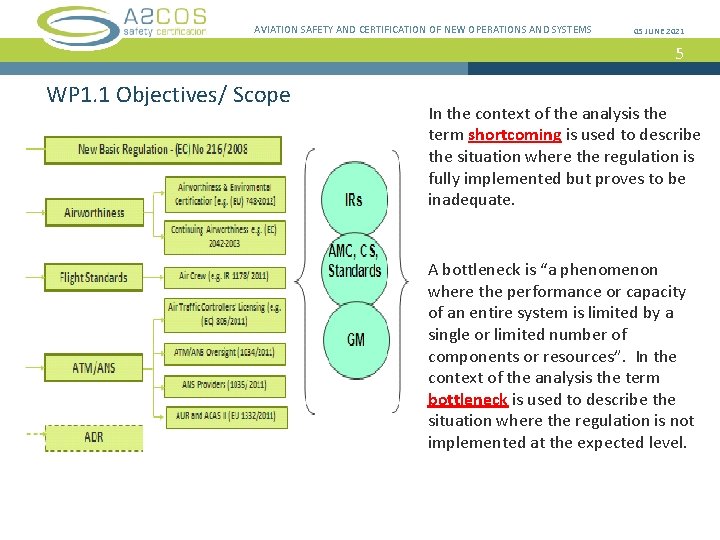
AVIATION SAFETY AND CERTIFICATION OF NEW OPERATIONS AND SYSTEMS 05 JUNE 2021 5 WP 1. 1 Objectives/ Scope In the context of the analysis the term shortcoming is used to describe the situation where the regulation is fully implemented but proves to be inadequate. A bottleneck is “a phenomenon where the performance or capacity of an entire system is limited by a single or limited number of components or resources”. In the context of the analysis the term bottleneck is used to describe the situation where the regulation is not implemented at the expected level.
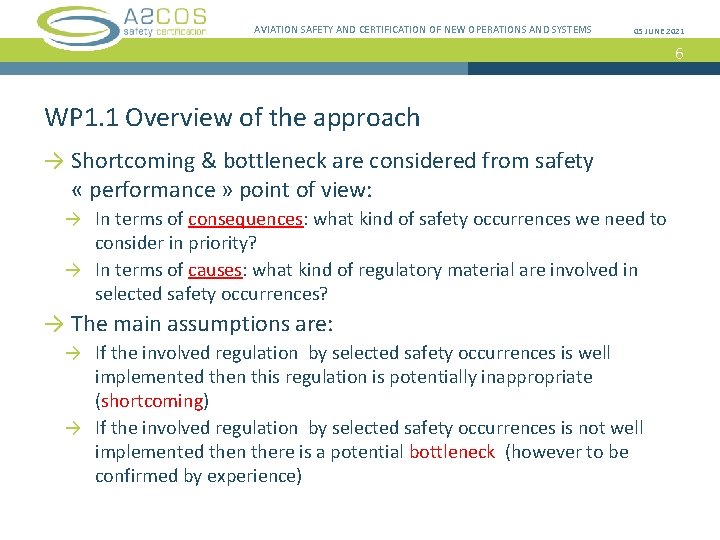
AVIATION SAFETY AND CERTIFICATION OF NEW OPERATIONS AND SYSTEMS 05 JUNE 2021 6 WP 1. 1 Overview of the approach → Shortcoming & bottleneck are considered from safety « performance » point of view: → In terms of consequences: what kind of safety occurrences we need to consider in priority? → In terms of causes: what kind of regulatory material are involved in selected safety occurrences? → The main assumptions are: → If the involved regulation by selected safety occurrences is well implemented then this regulation is potentially inappropriate (shortcoming) → If the involved regulation by selected safety occurrences is not well implemented then there is a potential bottleneck (however to be confirmed by experience)
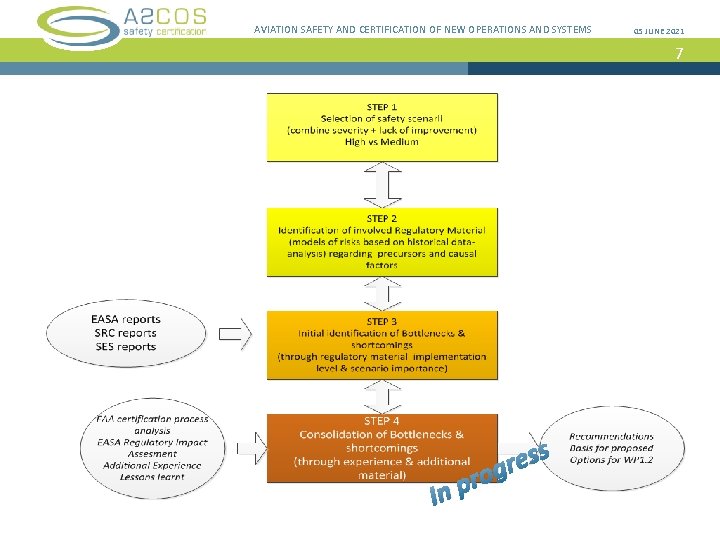
AVIATION SAFETY AND CERTIFICATION OF NEW OPERATIONS AND SYSTEMS 05 JUNE 2021 7 In s s e r g o pr
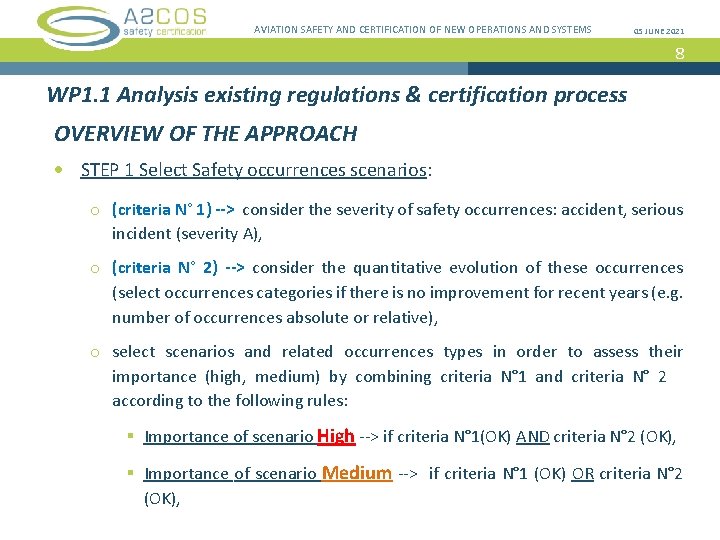
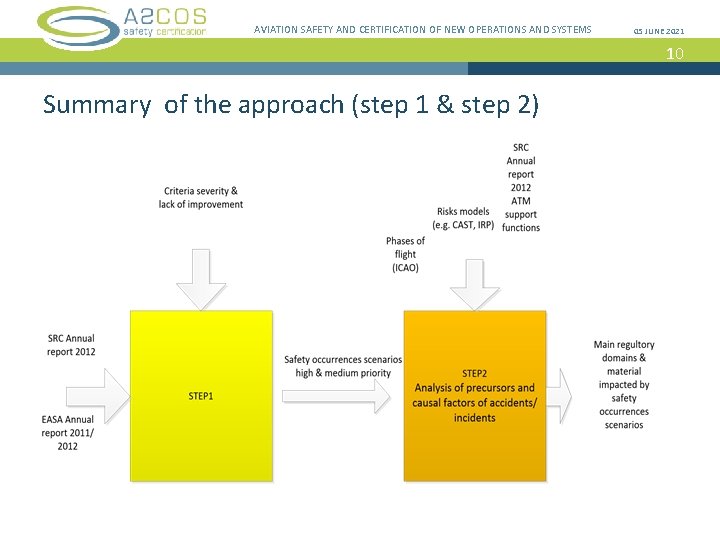
AVIATION SAFETY AND CERTIFICATION OF NEW OPERATIONS AND SYSTEMS 05 JUNE 2021 8 WP 1. 1 Analysis existing regulations & certification process OVERVIEW OF THE APPROACH STEP 1 Select Safety occurrences scenarios: o (criteria N° 1) --> consider the severity of safety occurrences: accident, serious incident (severity A), o (criteria N° 2) --> consider the quantitative evolution of these occurrences (select occurrences categories if there is no improvement for recent years (e. g. number of occurrences absolute or relative), o select scenarios and related occurrences types in order to assess their importance (high, medium) by combining criteria N° 1 and criteria N° 2 according to the following rules: Importance of scenario High --> if criteria N° 1(OK) AND criteria N° 2 (OK), Importance of scenario Medium --> if criteria N° 1 (OK) OR criteria N° 2 (OK),
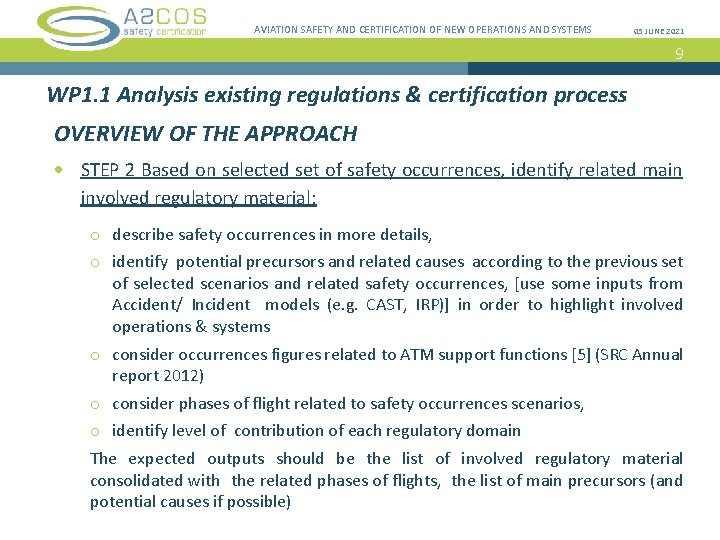
AVIATION SAFETY AND CERTIFICATION OF NEW OPERATIONS AND SYSTEMS 05 JUNE 2021 9 WP 1. 1 Analysis existing regulations & certification process OVERVIEW OF THE APPROACH STEP 2 Based on selected set of safety occurrences, identify related main involved regulatory material: o describe safety occurrences in more details, o identify potential precursors and related causes according to the previous set of selected scenarios and related safety occurrences, [use some inputs from Accident/ Incident models (e. g. CAST, IRP)] in order to highlight involved operations & systems o consider occurrences figures related to ATM support functions [5] (SRC Annual report 2012) o consider phases of flight related to safety occurrences scenarios, o identify level of contribution of each regulatory domain The expected outputs should be the list of involved regulatory material consolidated with the related phases of flights, the list of main precursors (and potential causes if possible)
AVIATION SAFETY AND CERTIFICATION OF NEW OPERATIONS AND SYSTEMS 05 JUNE 2021 10 Summary of the approach (step 1 & step 2)
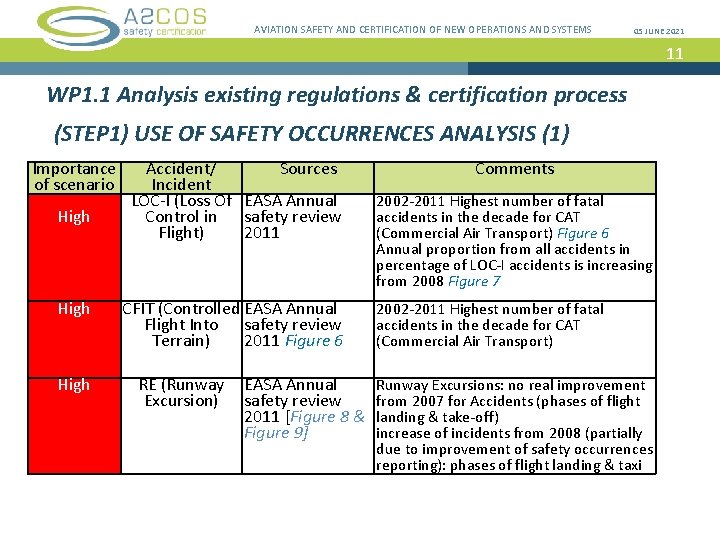
AVIATION SAFETY AND CERTIFICATION OF NEW OPERATIONS AND SYSTEMS 05 JUNE 2021 11 WP 1. 1 Analysis existing regulations & certification process (STEP 1) USE OF SAFETY OCCURRENCES ANALYSIS (1) Importance of scenario High Accident/ Sources Incident LOC-I (Loss Of EASA Annual Control in safety review Flight) 2011 CFIT (Controlled EASA Annual Flight Into safety review Terrain) 2011 Figure 6 RE (Runway Excursion) EASA Annual safety review 2011 [Figure 8 & Figure 9] Comments 2002 -2011 Highest number of fatal accidents in the decade for CAT (Commercial Air Transport) Figure 6 Annual proportion from all accidents in percentage of LOC-I accidents is increasing from 2008 Figure 7 2002 -2011 Highest number of fatal accidents in the decade for CAT (Commercial Air Transport) Runway Excursions: no real improvement from 2007 for Accidents (phases of flight landing & take-off) increase of incidents from 2008 (partially due to improvement of safety occurrences reporting): phases of flight landing & taxi
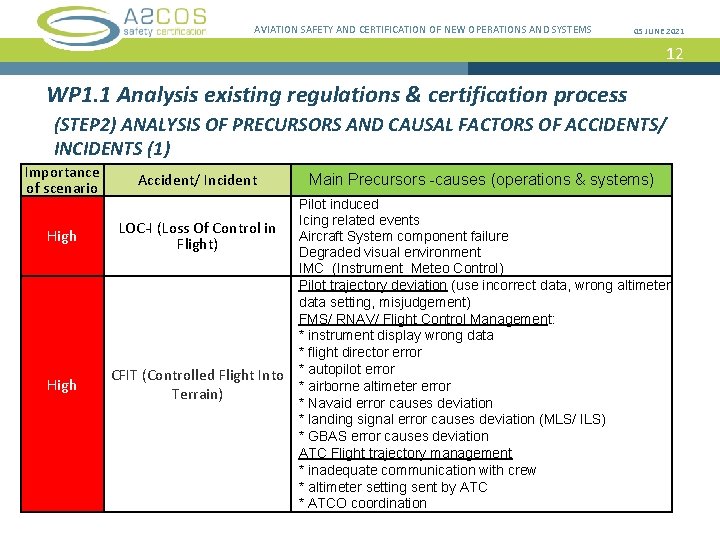
AVIATION SAFETY AND CERTIFICATION OF NEW OPERATIONS AND SYSTEMS 05 JUNE 2021 12 WP 1. 1 Analysis existing regulations & certification process (STEP 2) ANALYSIS OF PRECURSORS AND CAUSAL FACTORS OF ACCIDENTS/ INCIDENTS (1) Importance of scenario Accident/ Incident High LOC-I (Loss Of Control in Flight) High CFIT (Controlled Flight Into Terrain) Main Precursors -causes (operations & systems) Pilot induced Icing related events Aircraft System component failure Degraded visual environment IMC (Instrument Meteo Control) Pilot trajectory deviation (use incorrect data, wrong altimeter data setting, misjudgement) FMS/ RNAV/ Flight Control Management: * instrument display wrong data * flight director error * autopilot error * airborne altimeter error * Navaid error causes deviation * landing signal error causes deviation (MLS/ ILS) * GBAS error causes deviation ATC Flight trajectory management * inadequate communication with crew * altimeter setting sent by ATC * ATCO coordination
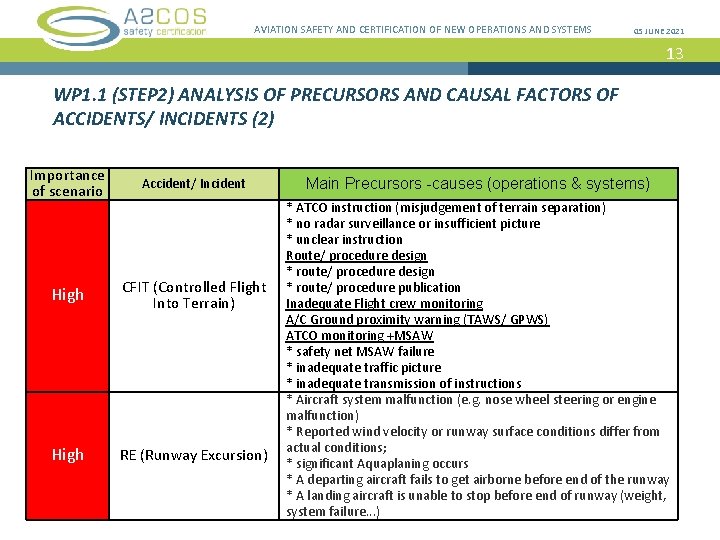
AVIATION SAFETY AND CERTIFICATION OF NEW OPERATIONS AND SYSTEMS 05 JUNE 2021 13 WP 1. 1 (STEP 2) ANALYSIS OF PRECURSORS AND CAUSAL FACTORS OF ACCIDENTS/ INCIDENTS (2) Importance of scenario Accident/ Incident High CFIT (Controlled Flight Into Terrain) High RE (Runway Excursion) Main Precursors -causes (operations & systems) * ATCO instruction (misjudgement of terrain separation) * no radar surveillance or insufficient picture * unclear instruction Route/ procedure design * route/ procedure publication Inadequate Flight crew monitoring A/C Ground proximity warning (TAWS/ GPWS) ATCO monitoring +MSAW * safety net MSAW failure * inadequate traffic picture * inadequate transmission of instructions * Aircraft system malfunction (e. g. nose wheel steering or engine malfunction) * Reported wind velocity or runway surface conditions differ from actual conditions; * significant Aquaplaning occurs * A departing aircraft fails to get airborne before end of the runway * A landing aircraft is unable to stop before end of runway (weight, system failure. . . )
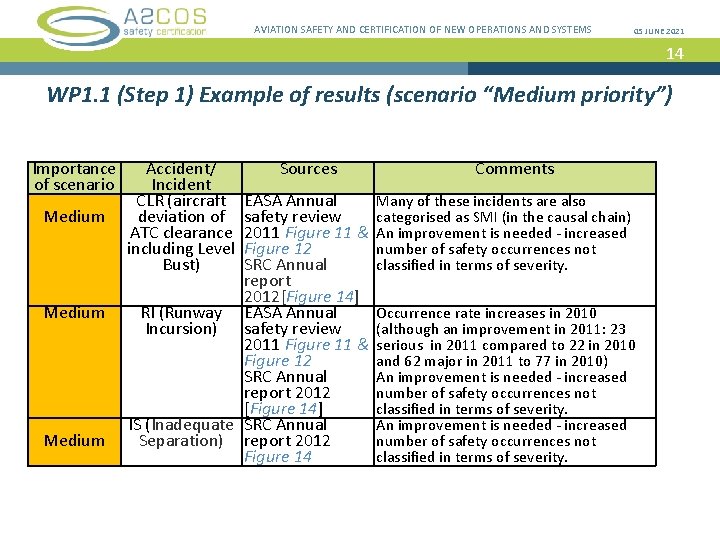
AVIATION SAFETY AND CERTIFICATION OF NEW OPERATIONS AND SYSTEMS 05 JUNE 2021 14 WP 1. 1 (Step 1) Example of results (scenario “Medium priority”) Importance of scenario Medium Accident/ Incident CLR (aircraft deviation of ATC clearance including Level Bust) Sources EASA Annual safety review 2011 Figure 11 & Figure 12 SRC Annual report 2012[Figure 14] RI (Runway EASA Annual Incursion) safety review 2011 Figure 11 & Figure 12 SRC Annual report 2012 [Figure 14] IS (Inadequate SRC Annual Separation) report 2012 Figure 14 Comments Many of these incidents are also categorised as SMI (in the causal chain) An improvement is needed - increased number of safety occurrences not classified in terms of severity. Occurrence rate increases in 2010 (although an improvement in 2011: 23 serious in 2011 compared to 22 in 2010 and 62 major in 2011 to 77 in 2010) An improvement is needed - increased number of safety occurrences not classified in terms of severity.
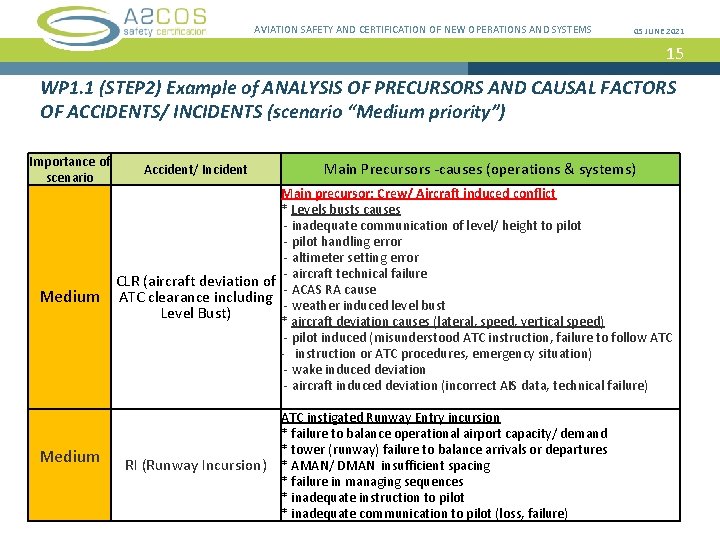
AVIATION SAFETY AND CERTIFICATION OF NEW OPERATIONS AND SYSTEMS 05 JUNE 2021 15 WP 1. 1 (STEP 2) Example of ANALYSIS OF PRECURSORS AND CAUSAL FACTORS OF ACCIDENTS/ INCIDENTS (scenario “Medium priority”) Importance of scenario Medium Accident/ Incident Main Precursors -causes (operations & systems) Main precursor: Crew/ Aircraft induced conflict * Levels busts causes - inadequate communication of level/ height to pilot - pilot handling error - altimeter setting error technical failure CLR (aircraft deviation of -- aircraft ATC clearance including ACAS RA cause - weather induced level bust Level Bust) * aircraft deviation causes (lateral, speed, vertical speed) - pilot induced (misunderstood ATC instruction, failure to follow ATC - instruction or ATC procedures, emergency situation) - wake induced deviation - aircraft induced deviation (incorrect AIS data, technical failure) RI (Runway Incursion) ATC instigated Runway Entry incursion * failure to balance operational airport capacity/ demand * tower (runway) failure to balance arrivals or departures * AMAN/ DMAN insufficient spacing * failure in managing sequences * inadequate instruction to pilot * inadequate communication to pilot (loss, failure)
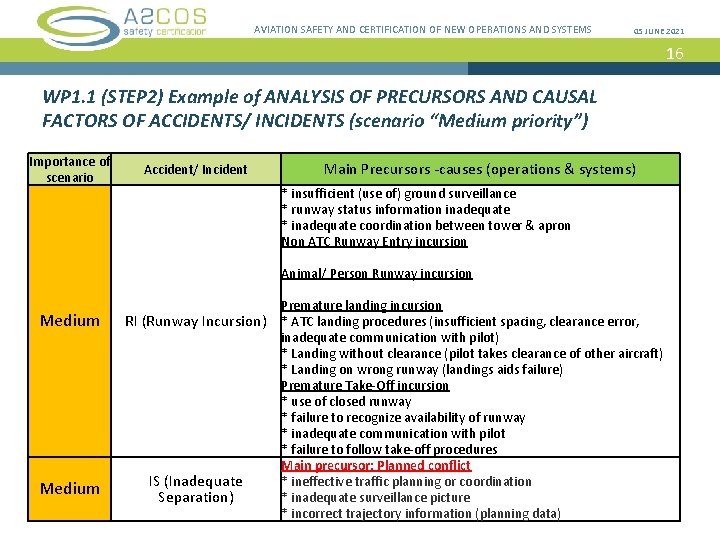
AVIATION SAFETY AND CERTIFICATION OF NEW OPERATIONS AND SYSTEMS 05 JUNE 2021 16 WP 1. 1 (STEP 2) Example of ANALYSIS OF PRECURSORS AND CAUSAL FACTORS OF ACCIDENTS/ INCIDENTS (scenario “Medium priority”) Importance of scenario Accident/ Incident Main Precursors -causes (operations & systems) * insufficient (use of) ground surveillance * runway status information inadequate * inadequate coordination between tower & apron Non ATC Runway Entry incursion Animal/ Person Runway incursion Medium RI (Runway Incursion) Medium IS (Inadequate Separation) Premature landing incursion * ATC landing procedures (insufficient spacing, clearance error, inadequate communication with pilot) * Landing without clearance (pilot takes clearance of other aircraft) * Landing on wrong runway (landings aids failure) Premature Take-Off incursion * use of closed runway * failure to recognize availability of runway * inadequate communication with pilot * failure to follow take-off procedures Main precursor: Planned conflict * ineffective traffic planning or coordination * inadequate surveillance picture * incorrect trajectory information (planning data)
AVIATION SAFETY AND CERTIFICATION OF NEW OPERATIONS AND SYSTEMS 05 JUNE 2021 17 WP 1. 1 Analysis existing regulations & certification process OVERVIEW OF THE APPROACH STEP 3 Use of the degree of implementation of regulatory material: consolidate the identification of shortcomings and bottlenecks by performing a cross analysis with the degree of implementation in Europe regarding the involved regulatory materials: o Very High Priority (shortcoming & bottleneck) if: The safety occurrences scenarios induced in the scope of the regulatory domain are high (accident/ incidents severity A), The interaction with the other regulatory domains is very important in the analysis of safety occurrences scenarios. The identified regulatory area is not implemented at the expected level (whatever the reason).
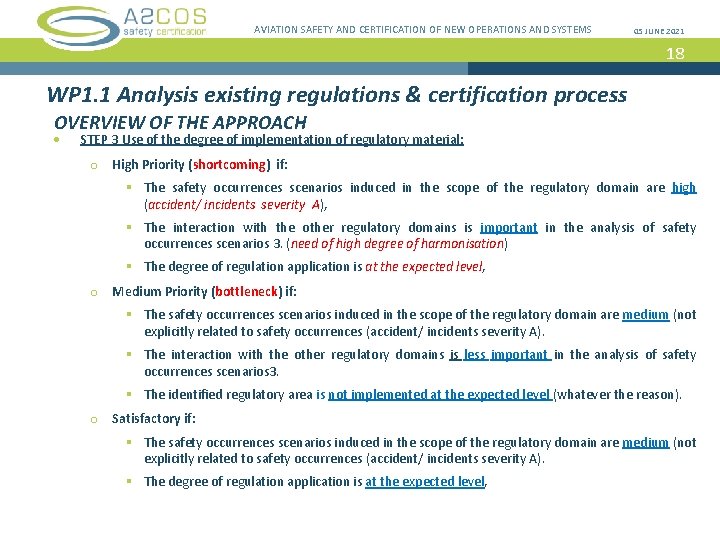
AVIATION SAFETY AND CERTIFICATION OF NEW OPERATIONS AND SYSTEMS 05 JUNE 2021 18 WP 1. 1 Analysis existing regulations & certification process OVERVIEW OF THE APPROACH STEP 3 Use of the degree of implementation of regulatory material: o High Priority (shortcoming) if: The safety occurrences scenarios induced in the scope of the regulatory domain are high (accident/ incidents severity A), The interaction with the other regulatory domains is important in the analysis of safety occurrences scenarios 3. (need of high degree of harmonisation) The degree of regulation application is at the expected level, o Medium Priority (bottleneck) if: The safety occurrences scenarios induced in the scope of the regulatory domain are medium (not explicitly related to safety occurrences (accident/ incidents severity A). The interaction with the other regulatory domains is less important in the analysis of safety occurrences scenarios 3. The identified regulatory area is not implemented at the expected level (whatever the reason). o Satisfactory if: The safety occurrences scenarios induced in the scope of the regulatory domain are medium (not explicitly related to safety occurrences (accident/ incidents severity A). The degree of regulation application is at the expected level,
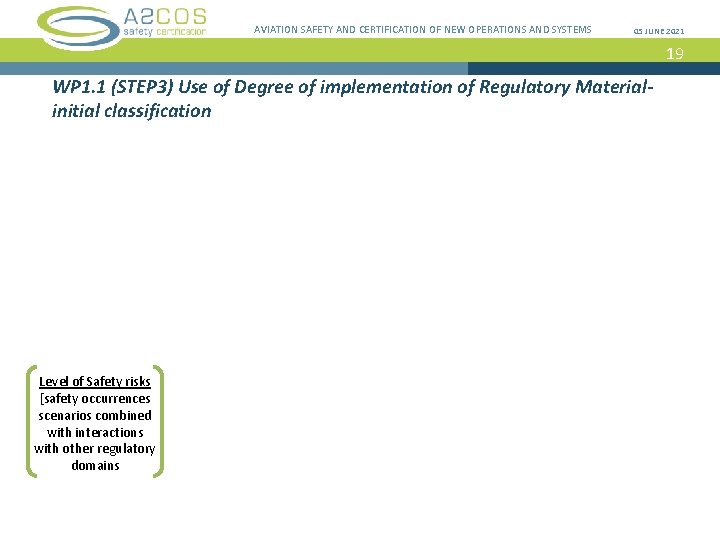
AVIATION SAFETY AND CERTIFICATION OF NEW OPERATIONS AND SYSTEMS 05 JUNE 2021 19 WP 1. 1 (STEP 3) Use of Degree of implementation of Regulatory Materialinitial classification Level of Safety risks [safety occurrences scenarios combined with interactions with other regulatory domains
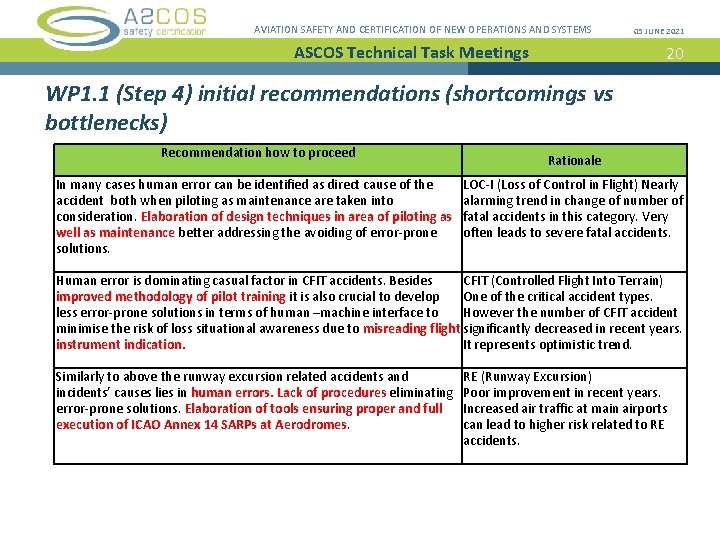
AVIATION SAFETY AND CERTIFICATION OF NEW OPERATIONS AND SYSTEMS ASCOS Technical Task Meetings 05 JUNE 2021 20 WP 1. 1 (Step 4) initial recommendations (shortcomings vs bottlenecks) Recommendation how to proceed In many cases human error can be identified as direct cause of the accident both when piloting as maintenance are taken into consideration. Elaboration of design techniques in area of piloting as well as maintenance better addressing the avoiding of error-prone solutions. Rationale LOC-I (Loss of Control in Flight) Nearly alarming trend in change of number of fatal accidents in this category. Very often leads to severe fatal accidents. Human error is dominating casual factor in CFIT accidents. Besides CFIT (Controlled Flight Into Terrain) improved methodology of pilot training it is also crucial to develop One of the critical accident types. less error-prone solutions in terms of human –machine interface to However the number of CFIT accident minimise the risk of loss situational awareness due to misreading flight significantly decreased in recent years. instrument indication. It represents optimistic trend. Similarly to above the runway excursion related accidents and incidents’ causes lies in human errors. Lack of procedures eliminating error-prone solutions. Elaboration of tools ensuring proper and full execution of ICAO Annex 14 SARPs at Aerodromes RE (Runway Excursion) Poor improvement in recent years. Increased air traffic at main airports can lead to higher risk related to RE accidents.
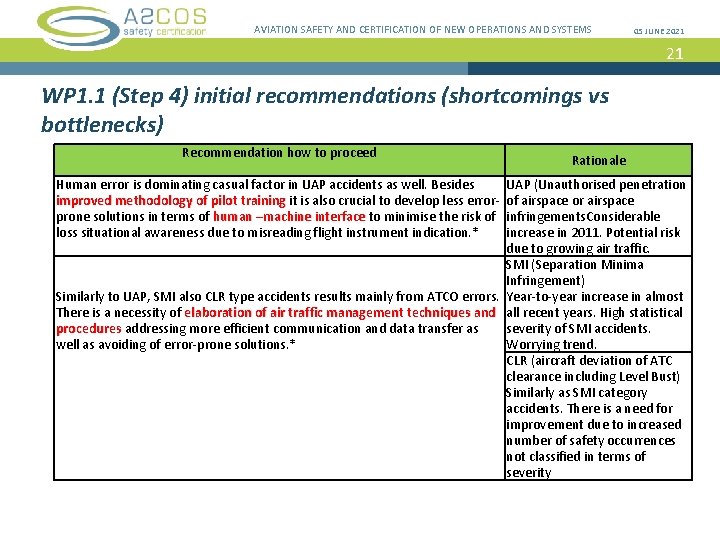
AVIATION SAFETY AND CERTIFICATION OF NEW OPERATIONS AND SYSTEMS 05 JUNE 2021 21 WP 1. 1 (Step 4) initial recommendations (shortcomings vs bottlenecks) Recommendation how to proceed Human error is dominating casual factor in UAP accidents as well. Besides improved methodology of pilot training it is also crucial to develop less errorprone solutions in terms of human –machine interface to minimise the risk of loss situational awareness due to misreading flight instrument indication. * Rationale UAP (Unauthorised penetration of airspace or airspace infringements. Considerable increase in 2011. Potential risk due to growing air traffic. SMI (Separation Minima Infringement) Similarly to UAP, SMI also CLR type accidents results mainly from ATCO errors. Year-to-year increase in almost There is a necessity of elaboration of air traffic management techniques and all recent years. High statistical procedures addressing more efficient communication and data transfer as severity of SMI accidents. well as avoiding of error-prone solutions. * Worrying trend. CLR (aircraft deviation of ATC clearance including Level Bust) Similarly as SMI category accidents. There is a need for improvement due to increased number of safety occurrences not classified in terms of severity
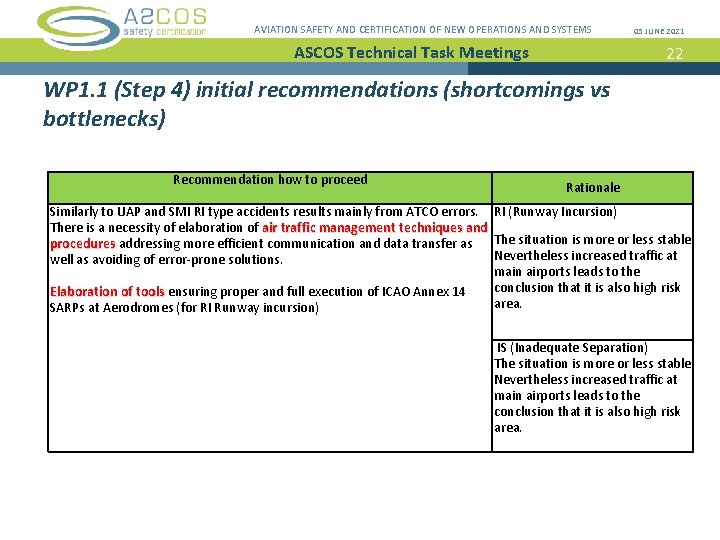
AVIATION SAFETY AND CERTIFICATION OF NEW OPERATIONS AND SYSTEMS ASCOS Technical Task Meetings 05 JUNE 2021 22 WP 1. 1 (Step 4) initial recommendations (shortcomings vs bottlenecks) Recommendation how to proceed Rationale Similarly to UAP and SMI RI type accidents results mainly from ATCO errors. RI (Runway Incursion) There is a necessity of elaboration of air traffic management techniques and The situation is more or less stable. procedures addressing more efficient communication and data transfer as Nevertheless increased traffic at well as avoiding of error-prone solutions. main airports leads to the conclusion that it is also high risk Elaboration of tools ensuring proper and full execution of ICAO Annex 14 area. SARPs at Aerodromes (for RI Runway incursion) IS (Inadequate Separation) The situation is more or less stable. Nevertheless increased traffic at main airports leads to the conclusion that it is also high risk area.
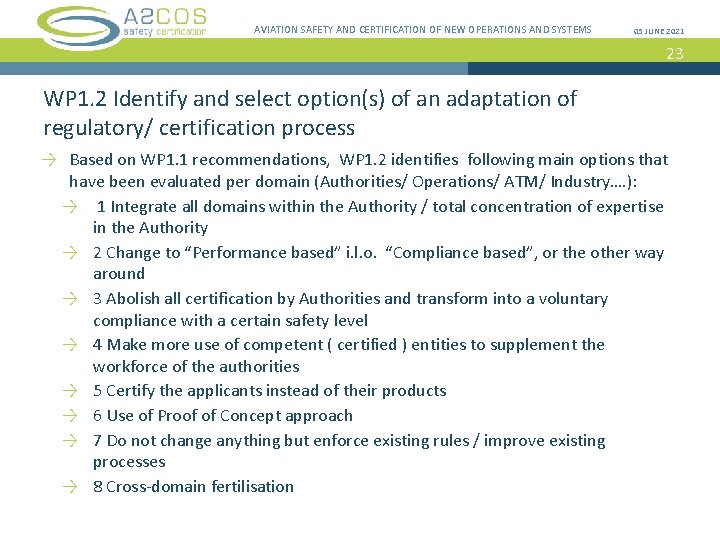
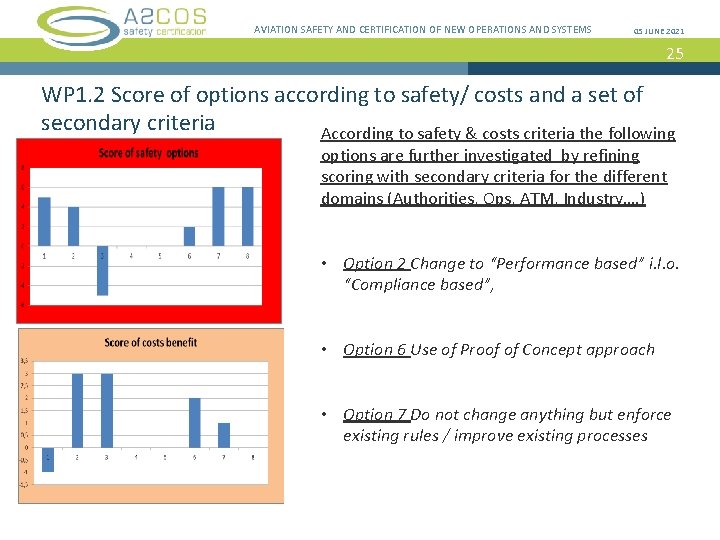
AVIATION SAFETY AND CERTIFICATION OF NEW OPERATIONS AND SYSTEMS 05 JUNE 2021 23 WP 1. 2 Identify and select option(s) of an adaptation of regulatory/ certification process → Based on WP 1. 1 recommendations, WP 1. 2 identifies following main options that have been evaluated per domain (Authorities/ Operations/ ATM/ Industry…. ): → 1 Integrate all domains within the Authority / total concentration of expertise in the Authority → 2 Change to “Performance based” i. l. o. “Compliance based”, or the other way around → 3 Abolish all certification by Authorities and transform into a voluntary compliance with a certain safety level → 4 Make more use of competent ( certified ) entities to supplement the workforce of the authorities → 5 Certify the applicants instead of their products → 6 Use of Proof of Concept approach → 7 Do not change anything but enforce existing rules / improve existing processes → 8 Cross-domain fertilisation
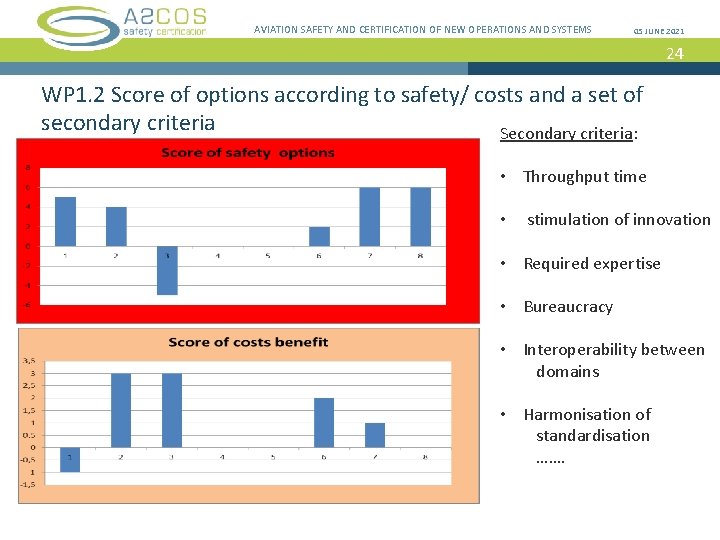
AVIATION SAFETY AND CERTIFICATION OF NEW OPERATIONS AND SYSTEMS 05 JUNE 2021 24 WP 1. 2 Score of options according to safety/ costs and a set of secondary criteria Secondary criteria: • Throughput time • stimulation of innovation • Required expertise • Bureaucracy • Interoperability between domains • Harmonisation of standardisation …….
AVIATION SAFETY AND CERTIFICATION OF NEW OPERATIONS AND SYSTEMS 05 JUNE 2021 25 WP 1. 2 Score of options according to safety/ costs and a set of secondary criteria According to safety & costs criteria the following options are further investigated by refining scoring with secondary criteria for the different domains (Authorities, Ops, ATM, Industry…. ) • Option 2 Change to “Performance based” i. l. o. “Compliance based”, • Option 6 Use of Proof of Concept approach • Option 7 Do not change anything but enforce existing rules / improve existing processes
AVIATION SAFETY AND CERTIFICATION OF NEW OPERATIONS AND SYSTEMS 05 JUNE 2021 26 Conclusion: recommendations of WP 1. 1 & WP 1. 2 for WP 1. 3 (development of the selected approach) → minimise unnecessary change, change recognising the good approaches already in place → provide a generic certification framework encompassing the total aviation system (TAS) → use a common language across all domains based on safety argument concepts (e. g. argument-based as described by OPENCOSS), but allowing flexibility to accommodate a variety of approaches across domains → provide rigorous management of interfaces, interfaces both between domains and between the TAS and its environment – key aim is to ensure that safety issues (e. g. assumptions, restrictions) are properly addressed and not lost at interfaces → allow, within each domain, certification approach to evolve from the current approach → keeping the existing approach where no change is required → learning lessons from other domains where this gives improvement → ensure that bottlenecks and shortcomings (as identified by WP 1. 1 and WP 1. 2) are addressed by the proposed approach
AVIATION SAFETY AND CERTIFICATION OF NEW OPERATIONS AND SYSTEMS 05 JUNE 2021 27 Conclusion: recommendations of WP 1. 1 & WP 1. 2 for WP 1. 3 (development of the selected approach) → promote flexibility within each domain to allow introduction of new technologies or procedures → harmonise approaches between domains where this is advantageous or necessary → simplify certification process where there are: → demonstrable benefits and → no loss of confidence in the assurance of safety → champion / reinforce existing techniques where they are appropriate but not consistently applied → provide a mechanism for identification and resolution of further bottlenecks and shortcomings
28 Thanks for your attention Aviation Safety and Certification of new Operations and Systems